8 Repetition Loops of Covert Narcissism: Why the Same Pattern Returns Disguised as a New Event
A structural reading of recurring cycles, where repetition is not chaos but a control system.
8 Repetition Loops of Covert Narcissism: Why the Same Pattern Returns Disguised as a New Event
A structural reading of recurring cycles, where repetition is not chaos but a control system.

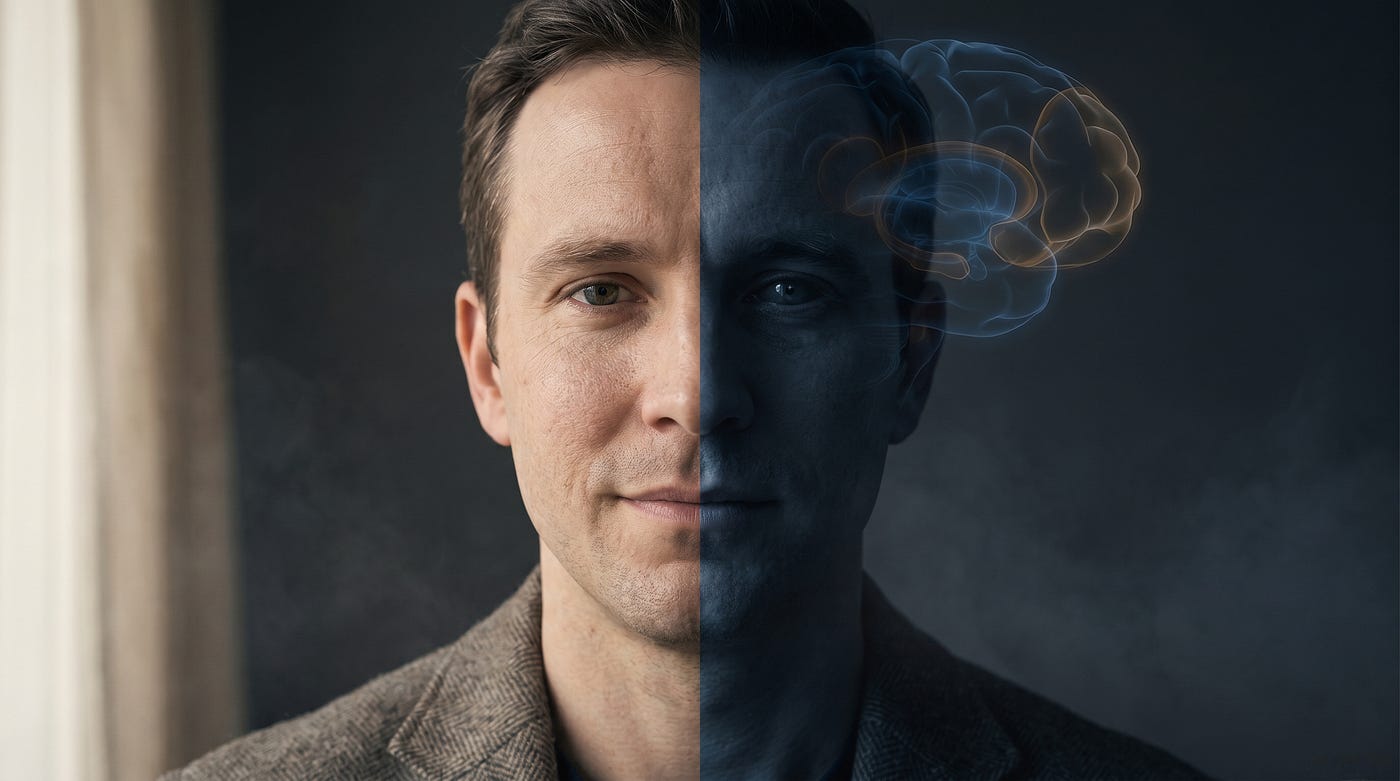
Image is generated via Chat Gpt 2.0 Model.
There is a strange kind of exhaustion that lives in relationships with covert narcissists. It’s not the exhaustion of conflict that has an arc and a resolution. It is the weariness of repetition, the faint dissonant knowledge that what has just happened happened before, in a slightly different guise, with a slightly different excuse, and that it is going to happen again.
The experience is often described by people inside these dynamics as chaos. But therapists studying pathological narcissism describe something almost the opposite: a remarkably stable architecture of interpersonal relations. Qualitative and daily-life studies of pathological narcissism often report an inner world that may wildly swing between grandiosity and vulnerability, but an external behavioural script that is patterned, cyclical, and predictable. Vulnerable narcissism in particular is strongly related to attachment insecurity and excessive, intense reactions to perceived rejection, which is why the same emotional script keeps returning at almost ritualistic intervals.
What seems chaotic is choreographed. What appears to be a new event is an old event in new clothes. To understand the covert narcissist, you have to stop looking at the content and start looking at the form. The message is the camouflage. The loop is the form.
Next are eight repetition loops, the structural mechanisms through which the same pattern repeats, again and again, while convincing everyone in the room that something brand-new just happened.
1. The Myth of Spontaneity — Why the Behavior Feels Unrepeatable Each Time
The first and most powerful defence the covert narcissist uses isn’t even a behaviour. That’s a frame. Each incident is portrayed (and very often privately felt to be) a one-off incident. Rough day. A peculiar misunderstanding. A pretty stressful week. It was, of course, some special provocation that would have made anyone behave like that.
This is the myth of spontaneity and the precondition for all other loops.
In the myth of spontaneity the covert narcissist is never a pattern person. Somebody who was pushed beyond their limit, just this once. The fight you had Tuesday has nothing to do with the silent treatment from March, which has nothing to do with the public humiliation last year, which has nothing to do with the cold birthday three Octobers ago. Each event is locked in its little glass jar, apart from the others by the simple insistence that this was something else.
For the observer — the partner, the child, the friend, the colleague — the framing is intoxicatingly seductive, for it keeps hope alive. If every event is singular, then every event is potentially the last one. The next morning can really be a fresh start. It is not broken, it is just getting unrelated bad weather over and over again.
But pathological narcissism is not the climate. Empirical work on grandiose and vulnerable narcissistic states across time shows the fluctuation is of the personality, not an interruption of it. The “spontaneous” episode is the inevitable downstroke of a recurrent wave. The narcissist’s secret gift is that each downstroke feels like the first, and it is a gift, carefully cultivated.
Then the first loop is the loop that hides all the rest. Until the assumption of randomness is taken apart, a specific cycle is not visible. The behaviour of a covert narcissist is not random. It looks random only when each instance is presented in isolation, stripped of its lineage.
2. Pattern Memory — The Cycle as Return, Not Surprise
The first loop is the lie of spontaneity. The second loop is the contradictory truth of spontaneity: pattern memory.
It’s pattern memory, what happens in the body of the person on the receiving end of covert narcissism long before it happens in the mind. It is that funny clench in the chest when the partner uses a certain tone that they have used before. The involuntary wince of a familiar phrase. It’s how a calendar event, a holiday, an anniversary, a family visit, a moment of your success begins to feel pre-loaded with dread because some version of what is about to happen has happened in this same context many times.
The mind, anxious to be fair, dismisses pattern memory as paranoia or oversensitivity. The covert narcissist will work to have you dismiss yourself. “You always expect the worst of me.” “You’re raking up old things.” “You’re stuck in the past.” These are not throwaway lines. These are systematic attacks on pattern memory, as pattern memory is the biggest threat to the loop. The cycle can only exist if it is experienced as a series of unrelated events.
What the literature on vulnerable narcissism shows is that pattern memory is not paranoia. It is accurate pattern recognition. Vulnerable narcissists have a stable architecture of attachment insecurity, shame proneness, and rejection sensitivity. When the underlying structures are stable, the behaviours generated by the underlying structures are stable. The script need not be consciously practiced. It’s produced, almost automatically, by the same internal triggers reacting to the same external prompts.
So the second loop is recognition, noticing that the new event is not new. Knowing that the sentence has a twin in your mind. You notice the silence has a shape you’ve felt before. Pattern memory turns a series of “incidents” into a single, continuous thing. That is when the loop becomes obvious — and the time the covert narcissist will work hardest to make you doubt yourself.
3. Trigger — What Activates the Script
There’s a starting gate for every loop. The trigger with the covert narcissist is rarely what they name. And almost always, it is something quieter and smaller and more telling.
The named trigger — the thing they will later say “caused” the episode — is nearly always your behaviour. You said something. You left something out . You’ve been with someone else. You made it. You put a cap on. The alibi is the named trigger.
The real trigger is something completely different . It’s usually one of a few common types . A threat to their self-image, no matter how small. A withdrawal of the admiration or attention they had become accustomed to. One of your successes that doesn’t revolve around them. A moment of independence in you — a friendship of your own, a private happiness, an interest unshared. A stressor in the environment that bruised their fragile sense of competence. A conscious or unconscious reminder of an old shame.
These are not exotic triggers. Same little fistful, over and over again. Once you see them you can almost set a clock by them. A promotion at your job. A weekend with your family of origin. A new piece of clothing that got compliments from strangers. A boundary politely maintained. A piece of news where, for a moment, the chat wasn’t about them. The script is activated within hours, days, sometimes minutes.
What is important to see here is that the trigger doesn’t justify the script, it just initiates it . To the covert narcissist, the actual event is wildly over-the-top, but proportional to the internal injury. Research on rejection sensitivity in pathological vulnerability demonstrates that perceived slights produce far more intense negative reactions than the slight could ever justify. That is why partners so often describe being caught off guard by the size of the response. The reaction is not to the visible event, it is to the invisible echo the event set off inside the narcissist.
So the trigger loop isn’t about what you did wrong. It is a matter of what you reminded them of. Until you know the difference, every conversation will be about your behaviour and every conversation will miss the real mechanism.
4. Reversal — How Blame, Sympathy, or Confusion Gets Rearranged
If the trigger is what sets the script in motion, the reversal is what makes the script unanswerable.
In an open fight, at least, the architecture of blame is visible: someone accuses, someone defends. The structure of blame is rearranged in mid-sentence, in the loop of a covert narcissist. The one who has hurt becomes the one seeking comfort. The injured party is asked to give that comfort, and to apologise for needing any of their own.
Clinicians and trauma researchers have a name for this formal version of the manoeuvre: DARVO — Deny, Attack, Reverse Victim and Offender. In the covert form it is rarely so dramatic. No one is openly admitting to any wrongdoing. Instead, there’s a quiet, sad re-centering. I know I shouldn’t have said that but I’ve been so overwhelmed. “I am sorry you took it that way. I just feel like whatever I do it’s not good enough for you. I think I’m a horrible person.
Each of these sentences does the same structural move. It echoes the surface of the accusation but re-imposes the emotional load of the situation on the wounded party. Within minutes you are not talking about what you were in. You are telling them they are not a horrible human being. You are explaining that you do appreciate all they do. You are taking care of their upset about having upset you.
This is the reversal loop and it does a lot of things all at once. It swallows your accusation without ever really digesting it. It re-stages the talk about their suffering, which makes them the most-felt person in the room again. It tyres you out, because reassuring them about your own injury is a kind of emotional labour that doesn’t let your own feelings land. Most important for the cycle, it leaves the actual damage untouched so that it is available to recur.
The covert narcissist doesn’t have to win the argument. They must ensure the argument never comes to a real conclusion. The reversal does this gently, even tenderly, and keeps intact every condition needed for the next iteration of the loop.
5. Reset — How the Cycle Is Made to Feel “Resolved” Without Resolution
After reversal, the reset is one of the most disorienting moves in the whole architecture.
A reset is not the answer. Repair means telling the truth about what happened, admitting that harm was done, no matter what, changing the underlying behaviour, and being open to being observed over time. None of those conditions apply in a reset. What is encountered instead is the semblance of return to normal.
The reset can be many things. A sudden rush of warmth and attention — sometimes called hoovering when it follows a discard. A considerate gesture, tailored to the partner’s known preferences. A heart-to-heart at two in the morning that doesn’t make promises, but does make emotional connections. A wide apology that, on closer inspection, never admits any real fault. A redefinition of the whole incident as a collective turning point: we have been through something together.
Resets work because human nervous systems are wired to seek the return of safety and any approximation of safety after threat produces a powerful relief. And even if the covert narcissist does not consciously intend it, the relief is for sale. Weekend away. A soft morning, unexpectedly. A phrase perfectly chosen. Cost is minimal. The take — the closing of the wound enough to keep the relationship alive — is huge.
But see what has not appeared. The behaviour has not been given a name so it can be tracked. There’s no accountability system in place. We have not seen the narcissist do the difficult work of being different under the same conditions that produced the harm. The wound has been dressed, not cured.
This is the reason why partners of covert narcissists so often report a frustrating feeling: everything is fine again and yet nothing has changed. No misunderstanding there. That is a correct reading of the reset. Structural change is required for resolution. The reset provides emotional warmth, not structural change. Because the warmth is real, it is mistaken for the change.
The most elegant move of the loop is the reset, because it is the move that resets the conditions for the next loop. The slate is wiped clean, not because the harm has been incorporated, but because the harm has been buried under a quickly poured-on layer of affection. The trigger will be enabled again. The script will run again. And since the previous incident was “resolved” the next one will again be presented as something unprecedented.
6. Disguise Mechanics — Same Pattern, Different Language
Most attempts to “prove” the pattern are defeated by the sixth loop. And even as the partners begin to suspect they are in a repeating system, the system itself adapts. The architecture is the same. The vocabulary changes .
This is the camouflage mechanism, and it is what makes covert narcissism so resistant to detection compared to overt forms. The overt narcissist tends to repeat the same lines, the same tactics, the same theatrical gestures. The repetition is loud and thus eventually visible. The covert narcissist, on the other hand, changes surfaces.
Last month’s complaint was about money. This month we’re talking about your tone of voice. Next month’s is about how you treat their family. The real structure — you’ve done something that — by amazing coincidence — necessitates me to be hurt and you to apologise — is the same in all three cases. But since the topic has turned, each instance seems like a separate dispute, taking place in a separate domain of life, with separate negotiations and separate concessions.
At the language level, the same rotation takes place. Sometimes the narcissist will use mental health lingo: “I’m having a hard time, my anxiety is bad this week, my depression is back. Sometimes the language of spirituality: I’m doing the work, trying to be a better person, the universe is teaching me something. And sometimes the language of victimhood: no one understands me, everyone leaves me, I am always misunderstood. Sometimes with newer generations, the language of therapy itself: you’re triggering me, that’s not how I receive love, you’re not holding space
The trick is that each vocabulary is borrowed from a domain that the partner respects. You would have to be the sort of person who makes light of mental health, or who is impatient with spiritual growth, or who is unkind to victims, or who doesn’t believe in therapy, to object to the behaviour. The disguise is not merely a rhetorical flourish, it is a structural shield. Each disguise shifts the price of pattern recognition to the viewer.
To see through the disguise, one must do something unintuitive: ignore the topic altogether and watch only the form. Any trigger before it? Inside the conversation is there a reversal? Is this a reset offered in lieu of accountability? If so — whether the language is psychiatric, spiritual, political, or therapeutic — the loop is on. The vocabulary is a mask. The architecture is the animal beneath.
7. The Observer’s Mistake — Treating Variation as Novelty
The seventh loop is not in the narcissist but in the beholder. Mistaking variation for novelty is the cognitive error that drives the whole system.
Human cognition is hardwired to detect differences. We are exquisitely sensitive to small changes, a new word, a different tone, an unfamiliar context. Usually this is a good thing. That becomes a weakness when you’re around a covert narcissist. Each little change — a new excuse, a new vocabulary, a new triggering event, a new mode of reset — registers as genuinely new, and therefore as something that has not yet been classified.
The observer makes the error of continuing to classify. This time it’s her mum. This time it’s work stress though. It’s about my friendship with X this time. This time it’s because we hadn’t been sleeping well. Each incident has its own folder, its own caveats, its own pending verdicts. The folders increase. The verdicts never come. And because each folder is open and unresolved, the observer never gets the meta-question: What do all these folders have in common?
Pathological narcissism is structurally a condition of stable interpersonal and affective dysfunction. The episodes are different on the surface — the engine producing them is not. When the observer ceases to catalogue the episodes separately, and begins to see them as the outputs of the same engine, a strange feeling comes: not surprise, but recognition. Not the pain of a new betrayal but a quieter, harder pain for one that’s lasted.
The mistake is not that one is stupid. It is loyalty, hope, fairness and love squandered on a system that doesn’t give them back. Most covert narcissists have partners who are unusually empathic, conscientious, and willing to give the benefit of the doubt — precisely why they were chosen. It is their very capacity for generosity that the loop uses to stay invisible. The observer does not need to become harsh to break the seventh loop, they need to become structural. They need to be able to ask, in a calm voice, Have I seen this shape before? And to believe in their own answer.
8. Pattern Recognition — How Clarity Breaks the Loop
The eighth loop is the only one that ends the others. It’s not a ‘behavior’. It is a perception.
Pattern recognition is when the partner, child, friend, colleague stops treating each event as a separate occurrence and starts seeing the system. It is the moment the question changes from “Why did this particular thing happen?” to “What sort of structure keeps producing things like this?” It is the moment in which a series of disconnected wounds assumes the silhouette of one, recurring mechanism.
Clinically, this is consistent with what longitudinal and qualitative studies of pathological narcissism continue to find: that the dysfunction is patterned, not random; that the oscillations between grandiosity and vulnerability follow recognisable rhythms; that the affective and interpersonal disturbances are stable traits rather than situational accidents. So, the literature has been describing a loop all along. The change for the person inside the relationship is that they finally believe what the literature has been saying.
Narcissists do not change their pattern recognition. Nothing within the relationship can. The relation of the observer to the loop changes. Once you can see the loop you can look at the trigger before the script starts. The reversal can be identified while it is happening, not after. The reset can be received without mistake as repair. The mask can be peeled off and the architecture underneath can be understood. The cycle doesn’t end on the side of the narcissist, it ends on the side of the observer.
Here too, the difference between covert narcissism and other forms of difficulty becomes most important. A difficult partner who is really struggling can hear, ‘I’ve noticed a pattern’ — and respond with curiosity, even if defensively at first. A covert narcissist can’t. Pattern recognition is the one thing the loop can’t survive, and the loop knows it. That is why all prior mechanism — the myth of spontaneity, the reversal, the reset, the disguise — is. They are all defences against the eighth loop. All are designed to keep the observer cataloguing single events, rather than mapping the architecture.
When the architecture actually appears, the observer does not depend for knowing what is happening on the acknowledgement of the narcissist. The inner record is consistent. One gets that unexplained fatigue that has no reason. The normal fear before predictable events stops being superstition and turns into accurate forecasting. Whatever happens next in the relationship — attempts to repair, distance, limited contact, separation, no contact — is finally being navigated from inside reality and not inside the loop.
The Architecture, Not the Episode
The deepest and most disorienting insight in the research on pathological narcissism is that there is no event to fix. There are only system outputs. It’s like mopping the banks of a river, trying to dry it up. Trying to deal with the outputs one at a time — this argument, this silent treatment, this birthday, this betrayal. The source keeps flowing, so the water keeps coming. This is not mere malice. A stable structure of interpersonal and affective nature that produces certain behaviours in certain conditions and that will continue producing them while the conditions exist.
This is why framing of “incidents” — so loved by covert narcissists and so often employed by their partners — is a trap. You are in the first loop when you are arguing about events. The entire setup is intended to hold you there.
The way out is not to fight harder in the loop. it is to step back far enough to see the outline of the loop. to name the trigger before the script is invoked. To see the reversal as it starts. To get the reset not to mistake it for repair. To take the mask off it. To trust pattern memory rather than the myth of spontaneity. To replace the cataloguing of the observer with the clarity of the observer.
The covert narcissist’s greatest weapon is the assumption that what just happened is unprecedented. Their entire system of behaviour is based on that one belief about the people around them. When that belief is lost, all other mechanisms in the loop lose their grip. The reversal no longer functions. Landing stops reset. The mask is no longer convincing. The script keeps running, but it runs in plain sight, and a script that runs in plain sight has lost most of its power.
Pattern recognition, there is grief. And there is also freedom. What you took for an affair with fickle weather, rare storms, moments of inexplicable beauty, is in fact a structure with a blueprint. The events shift. The architecture does not. Once you’ve walked the architecture from the outside, you no longer need the events to tell you what is happening inside it.
You will see the next “new” event coming long before the narcissist, of course. You will see their face before the trigger. You will hear the first sentence of the reversal and you will hear the second one. You’ll see the reset coming, but don’t mistake it for redemption. You’ll hear the new words and not be fooled by it.
That recognition is not cynical: It is the end of being in the loop.
The event changes, but the architecture remains.
메타데이터
- post_id
- fb7920cc3eba
- slug
- 8-repetition-loops-of-covert-narcissism-why-the-same-pattern-returns-disguised-as-a-new-event-fb7920cc3eba
- url
- https://medium.com/psyche-pedia/8-repetition-loops-of-covert-narcissism-why-the-same-pattern-returns-disguised-as-a-new-event-fb7920cc3eba
- canonical_url
- https://medium.com/psyche-pedia/8-repetition-loops-of-covert-narcissism-why-the-same-pattern-returns-disguised-as-a-new-event-fb7920cc3eba
- author_url
- https://medium.com/@waheedahmedofficial
- status
- ok
- fetched_at
- 2026-06-11 21:11:36