How to Get More Instagram Story Views in 2026: 17 Practical Strategies for Small Accounts
Instagram Stories can help creators and businesses remain visible between regular posts.
How to Get More Instagram Story Views in 2026: 17 Practical Strategies for Small Accounts
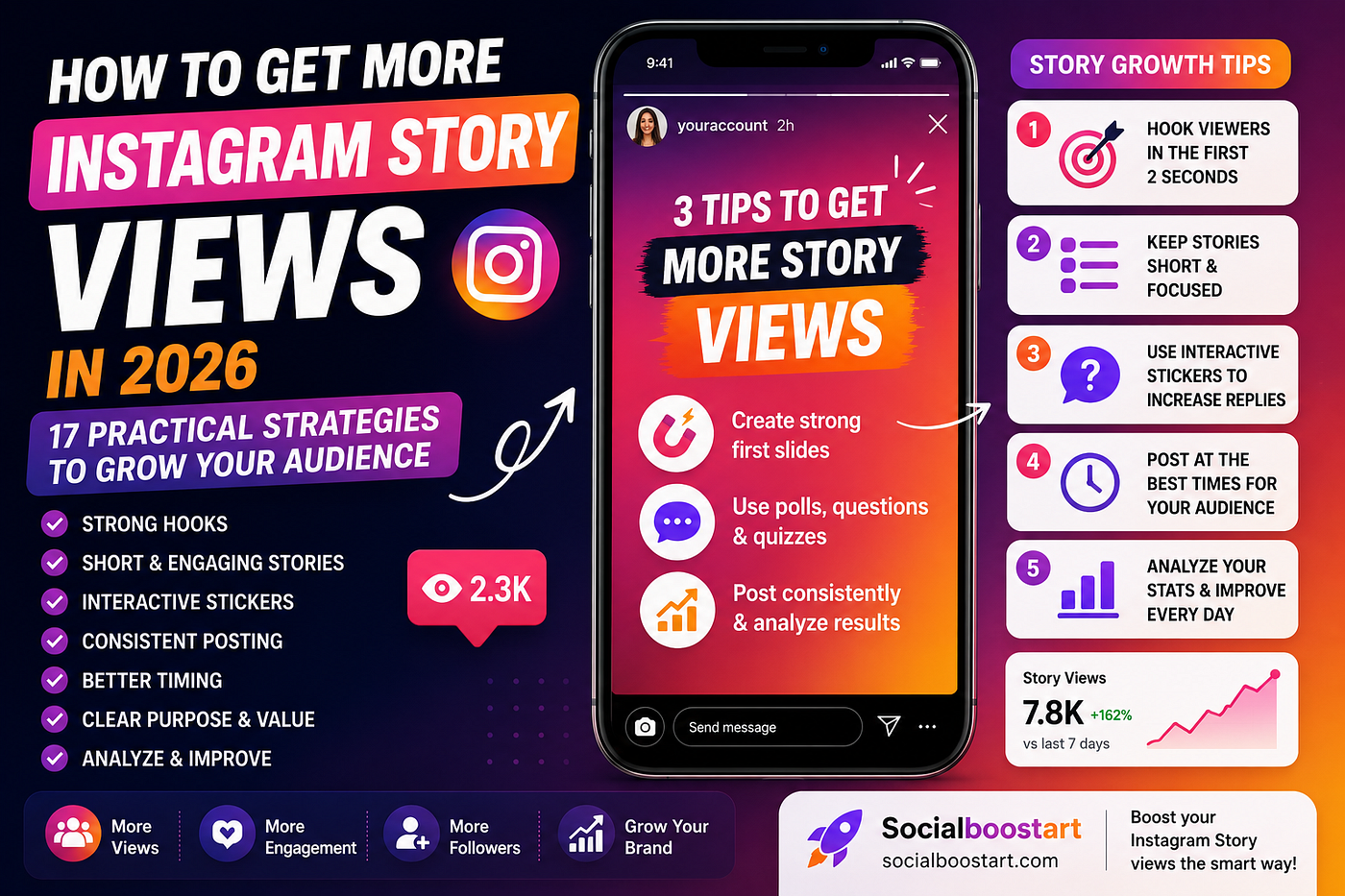
Instagram Stories can help creators and businesses remain visible between regular posts.
They provide a space for quick updates, behind-the-scenes content, audience questions, product demonstrations and direct conversations. However, many accounts publish Stories consistently without seeing meaningful growth in views or interactions.
A Story may receive attention during the first hour and then stop reaching additional viewers. Another Story may be viewed by only a small percentage of the account’s followers. Some viewers may watch the first slide but leave before reaching the rest of the sequence.
Low Instagram Story views do not always mean that the account needs more followers.
The problem may be connected to:
- Weak opening slides
- Excessive posting
- Repetitive content
- Poor timing
- Limited interaction
- Confusing Story sequences
- A lack of useful or entertaining information
- An audience that has learned to skip the account’s Stories
This guide explains how to get more Instagram Story views in 2026 by improving content structure, interaction, consistency and profile positioning.
Editorial disclosure: This article includes promotional links to Socialboostart. Third-party visibility services should be evaluated carefully and should support — not replace — valuable content and genuine audience relationships.
1. Give Every Story Sequence a Clear Purpose
Do not publish Stories simply because you feel that the account should remain active.
Before posting, decide what the Story sequence is supposed to accomplish.
Possible objectives include:
- Introducing a new post
- Teaching one useful lesson
- Answering a common question
- Showing a product in use
- Generating replies
- Collecting audience opinions
- Promoting an event
- Sharing a limited-time announcement
- Building familiarity with the creator
- Directing viewers to a website
A Story without a clear purpose often becomes a collection of unrelated images, reposts and updates.
This makes it difficult for viewers to understand why they should continue watching.
A more focused sequence might be:
- Introduce a common problem
- Explain why it happens
- Show a practical solution
- Provide an example
- Ask the viewer a relevant question
Each slide supports the same central idea.
When viewers understand the direction of the sequence, they have a stronger reason to watch the next slide.
2. Treat the First Story as a Hook
The first slide is one of the most important parts of an Instagram Story sequence.
It determines whether viewers continue or leave.
Weak opening slides often include:
- A repost with no explanation
- A long paragraph
- An unclear photograph
- A generic morning greeting
- A promotional graphic with too much text
- An image that requires background knowledge
- A video that takes several seconds to begin
The opening should communicate the subject quickly.
For example:
Three reasons people are leaving your website before purchasing
I tested two different Reel openings. Here is what happened.
This small design mistake made the entire room feel crowded.
Which package design would you trust more?
I almost cancelled this project because of one unexpected problem.
These openings introduce a problem, result, decision or unresolved question.
The viewer immediately understands why the following slides may be interesting.
3. Use Short Story Sequences
Posting more slides does not automatically create more Story views.
Long sequences can create fatigue, especially when every slide contains similar information.
A useful Story sequence may contain three to seven slides:
- Hook
- Context
- Main point
- Supporting example
- Audience interaction
- Conclusion
- Next step
The correct length depends on the topic.
A simple announcement may need only two slides. A tutorial may require six. A behind-the-scenes story may be longer when each slide introduces something new.
Review every slide before publishing and ask:
Does this slide provide information that the viewer needs?
If the answer is no, remove it.
A shorter sequence with a clear progression can perform better than 20 disconnected slides.
4. Avoid Posting Every Update at Once
Uploading a large group of Stories within a few minutes can overwhelm viewers.
When someone sees a long row of slides from one account, they may assume that watching will require too much time.
Consider separating your Stories across the day.
For example:
Morning
- A useful tip
- A question or poll
Afternoon
- A behind-the-scenes update
- A response to the poll
Evening
- A summary
- A recommendation or call to action
This approach creates multiple opportunities to reconnect with the audience.
However, do not separate one simple idea into unnecessary fragments merely to post more frequently. Every update should still provide value.
5. Create Stories That Invite an Easy Response
Interaction should not require significant effort.
Broad questions such as:
What do you think?
may receive few replies because the viewer does not know what type of response is expected.
Use specific prompts instead:
- Which design is clearer: A or B?
- Would you watch a full tutorial about this?
- What is your biggest challenge with Instagram?
- Have you made this mistake before?
- Which topic should I cover tomorrow?
- Do you prefer short or detailed tutorials?
- Would you use this feature?
Give the viewer a simple decision.
Polls, question boxes, sliders and quizzes can help make participation easier, but the sticker should be connected to the content.
Do not add an unrelated poll simply to create activity.
The question should help you understand the audience or continue the conversation.
6. Share the Result of Audience Polls
Many creators publish polls but never explain what happened afterward.
Sharing the result creates continuity.
For example:
Yesterday, 68% of you said writing captions is harder than choosing hashtags. Here are three caption structures you can test today.
This shows viewers that their participation influenced future content.
It also encourages them to interact again because they understand that responses are noticed.
Audience feedback can be converted into:
- Tutorials
- Frequently asked questions
- Product improvements
- New content series
- Detailed posts
- Videos
- Live sessions
- Downloadable resources
The audience becomes part of the content development process.
7. Mix Personal and Educational Content
Stories allow creators to show more personality than a polished feed may allow.
However, exclusively personal updates may feel irrelevant to new viewers. Exclusively educational content may make the account feel distant.
A balanced Story strategy can include:
- Quick lessons
- Work in progress
- Personal observations
- Audience questions
- Client or customer results
- Mistakes and lessons
- Product demonstrations
- Daily routines connected to the niche
- Recommendations
- Opinions about relevant developments
The personal content should still support the account’s identity.
A fitness coach can share meal preparation or training challenges.
A designer can show the decisions behind a project.
A business owner can show packaging, customer questions or operational improvements.
The objective is not to reveal every part of your life. It is to create familiarity and trust around the subject of the account.
8. Make Text Easy to Read
Instagram Stories are usually viewed on mobile devices.
Long paragraphs, small fonts and weak contrast make content difficult to understand.
Use:
- Short sentences
- Large text
- Clear spacing
- Strong contrast
- One main idea per slide
- Visual hierarchy
- Highlighted keywords
Instead of writing one paragraph containing six tips, divide the information across multiple slides.
For example:
Slide 1
Why are people leaving your Stories?
Slide 2
Reason 1: The first slide does not explain the topic.
Slide 3
Reason 2: Every slide looks identical.
Slide 4
Reason 3: The sequence takes too long to reach the result.
This structure is easier to follow than a wall of text.
Keep important elements away from areas that may be covered by the Instagram interface.
9. Use Video Without Delaying the Message
Face-to-camera Stories can help viewers become familiar with the creator.
However, spoken Stories often begin too slowly.
Avoid spending the first few seconds adjusting the camera, greeting the audience or explaining unrelated background information.
Begin with the main point:
I tested a different posting schedule this week, and one change increased the number of replies.
Then provide the context.
Add captions or short text summaries because some people may watch without sound.
Keep each video segment focused on one idea.
When an explanation becomes too long, divide it into multiple slides and use clear transitions:
- First, here is the problem.
- Now let me show you the example.
- This is what I changed.
- Here is the result.
- This is what I would do differently.
The viewer should always understand where the explanation is going.
10. Create Recurring Story Formats
Recurring formats help audiences know what to expect.
Examples include:
- Monday marketing lesson
- Weekly account review
- Question of the day
- Behind-the-scenes Friday
- One useful tool every morning
- Customer question of the week
- Monthly progress report
- Before-and-after breakdown
- This-or-that design poll
A recurring format reduces the need to invent a completely new concept every day.
It can also create a habit among viewers.
The format should remain recognizable through:
- A consistent title
- Similar visual design
- A regular schedule
- A clear subject
- A repeated interaction method
Do not make every sequence identical. Keep the structure familiar while changing the information.
11. Connect Stories With Feed Posts and Reels
Stories should support the rest of the account rather than operate separately.
When sharing a new post, do not simply repost the thumbnail and write:
New post.
Give viewers a reason to open it.
For example:
Most creators measure the wrong engagement metric. I compared three formulas in today’s post.
Or:
This transformation required only two changes. The full before-and-after breakdown is in the new Reel.
You can also introduce the topic before sharing the post:
- Ask the audience a question
- Share the result
- Explain one important point
- Direct viewers to the complete post
This creates context and curiosity.
The feed post should provide additional value rather than repeat everything already shown in the Story.
12. Use Story Highlights Strategically
Stories disappear from the main Story area, but useful content can be organized into Highlights.
Create Highlight categories based on what new profile visitors need to understand:
- Start Here
- Services
- Results
- Reviews
- Tutorials
- Frequently Asked Questions
- About
- Pricing
- Portfolio
- Products
Avoid creating too many categories.
A profile containing 15 outdated Highlights may feel difficult to navigate.
Review them regularly and remove:
- Expired offers
- Old pricing
- Broken links
- Outdated services
- Repetitive information
- Content that no longer represents the brand
The first several Highlights should answer the most important questions a potential follower or customer may have.
13. Study Where Viewers Leave
Do not evaluate a Story sequence using only the total number of viewers.
Compare the first and final slides.
Suppose:
- Slide 1 receives 1,000 views
- Slide 2 receives 910
- Slide 3 receives 880
- Slide 4 receives 620
- Slide 5 receives 590
The sharp decline between slides three and four suggests that something changed.
Possible causes include:
- Too much text
- An unrelated topic
- Repetition
- A weak transition
- A promotional message
- A video that takes too long
- A lack of visual clarity
Review the content at the point where viewers left.
Do not assume the entire sequence failed.
One slide may be responsible for most of the decline.
Tracking this over several weeks can reveal patterns in what the audience prefers.
14. Measure Replies, Taps and Profile Actions
Story views provide useful information, but they do not represent every meaningful result.
Also consider:
- Replies
- Poll participation
- Question-box responses
- Link clicks
- Profile visits
- Sticker taps
- Shares
- Product page visits
- Direct messages
- Purchases or bookings
A Story with fewer total views may be more valuable when it generates five qualified customer conversations.
Define the objective before publishing.
For an educational sequence, success may mean replies or shares.
For a product demonstration, success may mean link clicks.
For a personal Story, success may mean relationship building.
For a question, success may mean collecting useful audience research.
A larger view count is helpful only when it supports the intended outcome.
15. Avoid Constant Selling
Followers may stop watching Stories when every sequence ends with a sales message.
Promotional content is necessary for many businesses, but it should be supported by useful information and context.
A simple content balance might include:
- Education
- Entertainment
- Behind-the-scenes content
- Audience interaction
- Social proof
- Promotion
Instead of posting:
Buy now. Limited offer.
provide context:
- Explain the problem
- Show the solution
- Demonstrate the product
- Answer a common objection
- Present the offer
Viewers are more likely to respond when they understand why the offer is relevant.
Do not create fake urgency, exaggerated claims or countdowns for offers that never actually end.
Trust is more valuable than a temporary increase in clicks.
16. Promote Your Strongest Story Content
A useful Story concept can be reused in other formats.
A successful question-and-answer sequence may become:
- A carousel
- A Reel
- A blog article
- An email
- A frequently asked questions page
- A longer video
- A downloadable guide
A Story should not always be treated as temporary content.
Use it as a testing environment.
You can publish a short idea, measure audience interest and then develop the strongest topics into larger pieces of content.
Creators researching broader tools for social media growth and content visibility can explore Socialboostart.
External promotion is most effective when it supports a clear profile, useful content and a measurable objective.
17. Evaluate Optional Story View Services Carefully
Some creators and businesses consider paid visibility when publishing Stories connected to:
- Product launches
- Events
- Music releases
- Limited campaigns
- Important announcements
- Portfolio projects
- New account launches
- Brand collaborations
Before using any external service, review:
- Whether a password is required
- Which account information must be provided
- How delivery is paced
- Whether order tracking is available
- What the refill policy covers
- Whether pricing is displayed clearly
- Whether the provider promises unrealistic results
- Whether the service fits your objectives
- Current platform policies
Creators considering this approach can examine Socialboostart’s Instagram Story views packages.
Purchased visibility should not be treated as a guarantee of:
- Organic reach
- Sales
- Replies
- New followers
- Higher Story retention
- Website conversions
- Long-term audience loyalty
A public view number cannot replace useful content or genuine interaction.
Use any paid option only as one part of a wider strategy, and measure whether it supports a meaningful business or content objective.
Why Instagram Story Views May Suddenly Drop
Story views can change for many reasons:
- The account publishes too many slides
- The first slide is unclear
- The content has become repetitive
- Followers are less active
- Posting times have changed
- Recent Stories contain excessive promotion
- Viewers leave early in the sequence
- The account’s topic has changed
- The content no longer matches audience expectations
Do not react by immediately doubling your posting frequency.
First, review recent sequences.
Compare:
- Story topics
- Opening slides
- Sequence length
- Posting times
- Replies
- Poll participation
- Exits
- Link clicks
Try changing one major element at a time.
For example:
- Test shorter sequences for one week.
- Test stronger opening slides the next week.
- Add one interactive Story per day.
- Compare morning and evening posting.
- Reduce promotional slides.
Changing everything at once makes it difficult to understand what improved performance.
A Seven-Day Instagram Story Plan
Day 1: Audience research
Ask a specific question about the audience’s biggest challenge.
Share the results later in the day.
Day 2: Short tutorial
Explain one useful process in three to five slides.
End with a question.
Day 3: Behind the scenes
Show how you create a product, service or piece of content.
Explain one decision viewers may not normally see.
Day 4: Common mistake
Introduce one mistake, explain its effect and show the correction.
Day 5: Audience choice
Present two options and use a poll.
Explain which option you prefer and why.
Day 6: Social proof
Share a genuine result, review, project or customer experience with appropriate permission.
Explain what created the result.
Day 7: Summary and next step
Summarize the week’s most useful lesson.
Direct viewers to a relevant post, resource, product or upcoming Story series.
This schedule is only a starting point.
Adjust it according to the account’s subject, audience and objectives.
A Simple Story Quality Checklist
Before publishing, check the following:
- Does the first slide explain the topic?
- Is there one clear purpose?
- Is the text readable?
- Is the sequence unnecessarily long?
- Does each slide introduce something new?
- Is there a useful result or conclusion?
- Does the interaction sticker match the content?
- Is the call to action specific?
- Is the content valuable without the promotion?
- Can the strongest part be reused elsewhere?
After publishing, record:
- First-slide views
- Final-slide views
- Replies
- Poll responses
- Link clicks
- Profile visits
- Exits
- Business results
Use the results to improve the next sequence.
Final Thoughts
Getting more Instagram Story views requires more than posting throughout the day.
A strong Story strategy combines:
- Clear objectives
- Immediate hooks
- Short sequences
- Readable design
- Useful information
- Audience interaction
- Personal familiarity
- Consistent formats
- Careful analysis
- Relevant promotion
Do not treat Stories as disposable content.
They can be used to test ideas, understand the audience, build relationships, answer objections and guide viewers toward more detailed content.
Focus first on creating Stories that people want to continue watching.
Make the opening clear. Remove unnecessary slides. Invite specific responses. Study where viewers leave. Repeat the formats that generate meaningful actions.
More Story views become valuable when those views represent real attention.
메타데이터
- post_id
- fb89aa57e1e0
- slug
- how-to-get-more-instagram-story-views-in-2026-17-practical-strategies-for-small-accounts-fb89aa57e1e0
- url
- https://medium.com/@socialboostart/how-to-get-more-instagram-story-views-in-2026-17-practical-strategies-for-small-accounts-fb89aa57e1e0
- canonical_url
- https://medium.com/@socialboostart/how-to-get-more-instagram-story-views-in-2026-17-practical-strategies-for-small-accounts-fb89aa57e1e0
- author_url
- https://medium.com/@socialboostart
- status
- ok
- fetched_at
- 2026-08-03 23:10:18