UK History Books Recalled
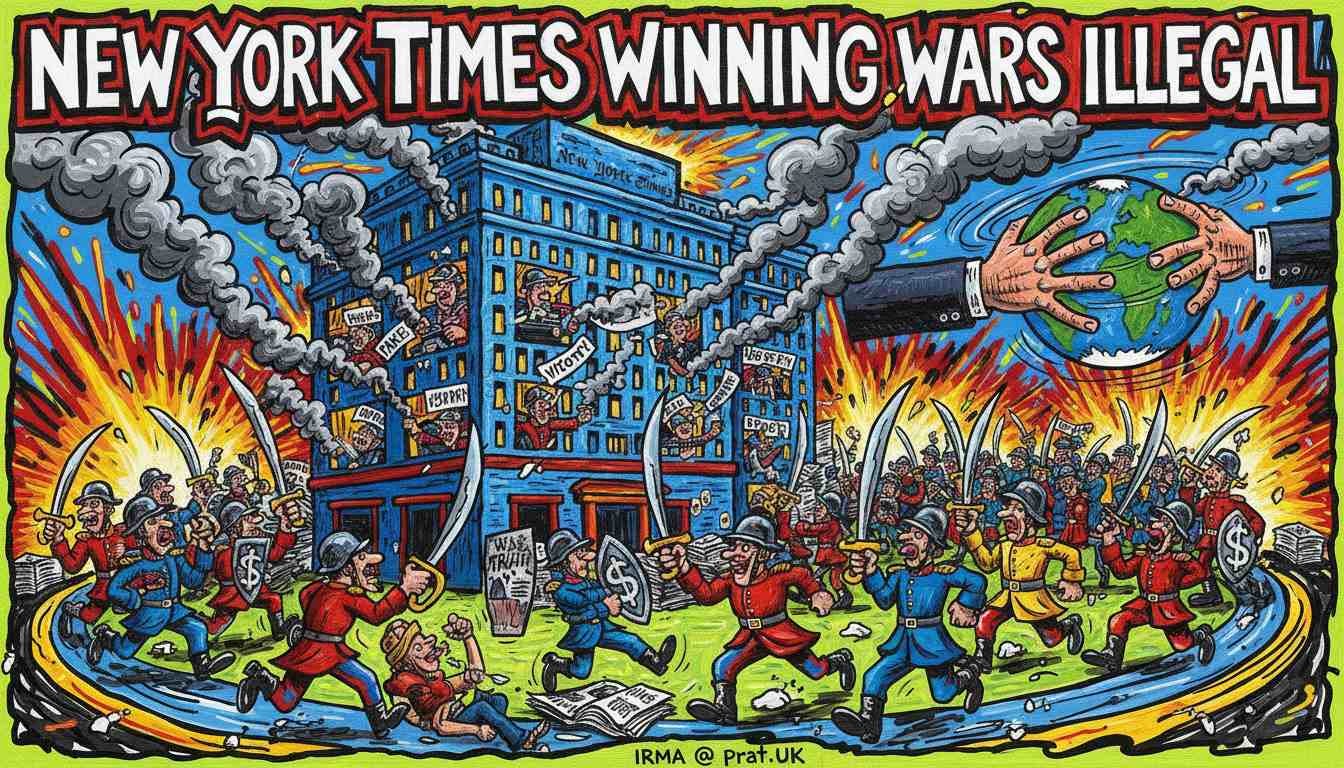
History Books Recalled After Trump’s Comments Accidentally Turn Winning Wars Into Crimes
UK History Books Recalled
History Books Recalled After Trump’s Comments Accidentally Turn Winning Wars Into Crimes
Five Early Observations from the Department of Retroactive Outrage
- Historians confirm winning a war is now considered “aggressive success” — Churchill, Eisenhower, and Wellington have been referred to the relevant tribunal, pending availability of a sufficiently outraged prosecutor.
- Students nationwide relieved to learn failing history tests may now be considered “morally consistent.”
- Museums quietly replacing “victory” exhibits with “deeply problematic participation events.”
- One professor admitted: “We spent forty years teaching the causes of war, and now we’re teaching apologies for the outcomes.”
- Civil War reenactors now required to pause halfway through and hold a court-martial of Lincoln, Grant, and Sherman for war crimes, facilitated by a Yale Law graduate on a six-figure government grant.
The Great Rewrite Begins Somewhere Between Genghis Khan and a Strongly Worded Op-Ed
Wellington, Nelson, Churchill — ALL Guilty of War Crimes
WASHINGTON, D.C. — Iran closed the Strait of Hormuz — the bottleneck through which roughly a fifth of the world’s oil passes — shot down American pilots, and backed militias across the Middle East for four decades. Donald Trump threatened to bomb their bridges.
Naturally, the bridges are the problem.
Following Trump’s entirely predictable promise to respond with force, historians across the Western world have begun what insiders are calling “the largest rewrite of human history since someone first said, ‘Actually, that’s not what happened.’”
The shift is breathtaking in its stupidity: winning wars is now a crime. Losing them, apparently, is fine.
According to a leaked memo from the American Historical Association titled “Victory: Let’s Not Rush to Judgement,” past leaders including Genghis Khan, Peter the Great, Wellington, Nelson, Churchill, George Washington, Abraham Lincoln, Woodrow Wilson, Harry S. Truman, and Lyndon B. Johnson have been “reclassified as historically complicated individuals who were, in light of Donald Trump, clearly guilty of war crimes.”
From Wellington, who had the breathtaking audacity to defeat Napoleon at Waterloo without first consulting a French feelings committee, to Nelson, who won Trafalgar whilst inconveniently dying in the process — a martyrdom that Yale Law notes does not confer immunity — to Churchill, who won the entire Second World War and had the sheer nerve to write six volumes boasting about it, to the Black Prince, who devastated France in the fourteenth century without so much as an environmental impact assessment, to Francis Drake, who circumnavigated the globe and defeated the Spanish Armada in what historians now classify as “an act of disproportionate nautical confidence,” to the Duke of Marlborough, who won four major battles in a row at Blenheim, Ramillies, Oudenarde, and Malplaquet and clearly should have stopped at two — all of them, every last sword-swinging, empire-building, battle-winning one of them, now stand posthumously guilty of the gravest crime the modern academy has yet identified: winning, and not feeling sufficiently terrible about it afterward.
One assumes the memo was peer-reviewed, DEI-compliant, and written by people who have never once been shot at.
Dr Elinor Braithwaite, a senior historian at Yale who now identifies as “temporarily confused,” explained the new framework:
“We’re not saying they were wrong. We’re saying they were… decisively problematic in a way that achieved results.”
She then paused, stared into the middle distance, and added: “Honestly, we’re workshopping the language.”
The language workshop meets Tuesdays, achieves nothing, and closes with a standing ovation for everyone who attended. Truman, who dropped two atomic bombs and ended the Pacific War in a fortnight, is currently listed as its most wanted.
The New York Times Introduces Its “War, But Make It Reflective” Section
The New York Times — the paper that spent three years assuring readers the Afghan withdrawal was “largely peaceful” while people fell off aeroplanes — has now turned its considerable talents to informing Trump that bombing the infrastructure of a theocratic regime holding American shipping hostage is, legally speaking, rather bad form. The mullahs, one assumes, are grateful for the coverage.
Revised Times headlines reportedly now read:
- “Allied Forces Achieve Victory, Raise Serious Questions About Tone”
- “Normandy Landings Successful, But At What Cost To Vibes? Eisenhower Referred to ICC”
- “End of World War II Met With Mixed Reviews From Axis Powers; Truman Indicted Posthumously”
- “Wellington Wins at Waterloo: Was It Proportionate? Experts Divided”
- “Iran Closes Global Shipping Lane; Experts Urge Caution About Strongly Worded Response”
An anonymous editor — described as “visibly tired but morally energised” — told reporters:
“We’re just asking questions. For example, if you win a war… isn’t that exactly what someone trying to win a war would do?”
The room reportedly fell silent after that. Three interns spontaneously applied to the International Court of Justice, which has been reliably available to rule against Western democracies since 1945 and has never once stopped a war.
Yale Law School Rushes to Defend Nation That Chants “Death to America”
In what legal observers are calling “a bold allocation of expertise,” professors from Yale, NYU, and Stanford Law Schools rapidly assembled to explain, at considerable length, why the United States may not bomb the country that shot down its pilots, funds proxy militias across four continents, and is constitutionally committed to the elimination of Israel.
The professors cited the Geneva Conventions, the principle of proportionality, and something called “customary international humanitarian law,” which is apparently the thing that applies to America and not to the regime currently mining international shipping lanes.
None of the professors mentioned the United Nations Charter article guaranteeing freedom of navigation, possibly because it was inconvenient, or possibly because they had a faculty meeting.
Trump said he was “not at all” worried. This is the correct response when a country that has chanted “Death to America” since 1979 complains about American aggression. Polling suggests most people with functioning petrol tanks — and a memory longer than a news cycle — agreed with him entirely.
Democrats Pivot From Policy to Time Travel Indictments
In what insiders are calling “a bold reallocation of outrage resources,” several lawmakers have shifted focus from current policy debates to the far more manageable business of retroactively indicting historical figures who cannot answer back.
A draft resolution titled “The Past Has Some Explaining To Do” reportedly includes language condemning:
- “Overperformance in wartime scenarios” — see: Patton, MacArthur, Nelson, Cromwell
- “Unilateral victory declarations” — see: Washington, 1781; Churchill, 1945; any Roman general ever
- “Failure to consult future ethical standards before invading” — see: literally everyone in all of recorded history
- “Winning without completing the requisite war crimes impact assessment” — see: Alexander the Great, posthumous indictment pending Greek government approval
One unnamed staffer described the strategy with admirable candour:
“Why argue about modern hypocrisy when you can go back and find better examples? The past is absolutely teeming with people who didn’t even have Twitter to defend themselves. It’s really rather convenient.”
Polling data from the Institute for Selective Outrage (margin of error: emotionally flexible) found:
- 63% of respondents believe historical figures should have known better
- 22% asked, “Known better than what?”
- 15% said, “Hang on — are we supposed to be losing on purpose now?”
The State Department declined to comment, as it was busy drafting a communiqué urging “maximum restraint” — the diplomatic equivalent of telling a man whose house is on fire to consider the feelings of the arsonist.
Eyewitnesses Report History Teachers Entering “Freestyle Mode”
High school classrooms have become ground zero for the new doctrine, and it is not going well for anyone involved.
One history teacher in Ohio described the precise moment the curriculum collapsed beneath him:
“I was halfway through explaining the Revolutionary War when a student raised his hand and asked, ‘So was George Washington a war criminal for winning?’ And I thought… you know what, I genuinely do not get paid enough to answer that. Particularly since last Tuesday’s memo suggests the correct answer is yes.”
He has since applied for early retirement and a position somewhere quiet, where questions of geopolitics are somebody else’s problem.
Another teacher abandoned textbooks entirely, replacing them with open-ended discussions titled “What Even Is Victory?” — a seminar that has now run six consecutive weeks without producing a conclusion, which the teacher describes as “very much the point” and Ofsted would describe as “requires improvement.”
Students, meanwhile, are adapting with the cheerful pragmatism of people who didn’t do the reading anyway. Sophomore Jake Reynolds summarised the new doctrine with alarming clarity:
“Basically, if you lose, you’re a victim. If you win, you’re suspicious. So the goal is to tie. I think that’s what they mean by diplomacy.”
He received an A-minus. The marking rubric now includes a category for “moral ambiguity demonstrated.”
Other Unexpected Consequences of Peak Liberal Outrage
The ripple effects have spread well beyond history departments and into areas that would have been unimaginable to anyone who had not spent the last decade watching Western institutions slowly lose their minds.
Military academies are reportedly trialling a new doctrine called “Strategic Almost-Winning,” in which battlefield success is carefully calibrated to avoid appearing too effective. One senior officer described it as “what we used to call a British result, but now it’s Pentagon policy.”
Sports leagues are also adapting. The NFL briefly considered awarding both teams a loss “to promote ethical ambiguity,” though fans objected, citing a preference for “at least one clear emotion per Sunday.” The Premier League noted this was simply called a nil-nil draw and that England had been pioneering the concept since 1966.
Hollywood has begun developing historical films in which battles conclude with mutual apologies and a group embrace. Current titles in development include: Saving Private Feelings; The Longest Day — But Was It Legal?; Patton: A War Crimes Retrospective; and a prestige miniseries about Wellington at Waterloo told entirely from Napoleon’s perspective, in which the Duke is the villain for winning too decisively. Early test screenings indicate audiences are “confused but supportive,” which is apparently sufficient for a greenlight and a BAFTA nomination.
Even language itself is quietly evolving under the pressure. The word “victory” is under formal review, with proposed replacements including:
- “Outcome with implications”
- “Resolution event”
- “Forceful conclusion, subject to tribunal review”
- “A ceasefire, but louder”
What the Funny People Are Saying
“The left has decided that winning is a war crime. Which explains quite a lot about their election results.” — Frankie Boyle
“I don’t mind rewriting history. I just want to know — do I still get credit for passing it?” — **David Mitchell**
“We’ve reached the point where even the past needs a publicist. And frankly, the past’s publicist is doing a terrible job.” — Armando Iannucci
The Final Twist Nobody Saw Coming
In a development that surprises no one who has met an academic, historians have begun reviewing their own work and may soon classify themselves as “contributors to narrative imbalance” — which carries no legal weight but produces enormous quantities of grant applications.
One leaked draft suggests future textbooks could include the following disclaimer:
“This account reflects the values of people who already knew how things turned out, which in itself may be unfair to those who did not.”
As one exhausted archivist put it:
“We used to study history. Now we’re negotiating with it.”
And somewhere, deep in a library basement, a dusty copy of The Second World War by Winston Churchill whispered: “I was fine the way I was.”
It has since been reported to the relevant faculty committee for “unacceptable confidence in its own conclusions” and Churchill himself has been posthumously added to the war crimes referral list — just below Truman, just above Caesar, and directly above whoever invented the trebuchet.
Auf Wiedersehen, amigo!
This article satirises the media and academic left’s response to Donald Trump’s April 2026 ultimatum to Iran, in which he threatened to destroy Iranian infrastructure if Tehran did not reopen the Strait of Hormuz — the passage through which roughly 20% of global oil flows. Iran had closed the strait following the outbreak of the US-Israel conflict with Iran. Yale, NYU, and Stanford law professors rushed to publish open letters warning of war crimes; the New York Times ran extensive coverage framing Trump’s threats as legally dubious. Trump called the war crimes concerns irrelevant. A two-week ceasefire was announced on 8 April 2026, conditional on Iran reopening the strait. The historians, meanwhile, are still workshopping the language.

Originally published at https://prat.uk on April 8, 2026.
메타데이터
- post_id
- fba913062837
- slug
- uk-history-books-recalled-fba913062837
- url
- https://medium.com/@londons.prat/uk-history-books-recalled-fba913062837
- canonical_url
- https://medium.com/@londons.prat/uk-history-books-recalled-fba913062837
- author_url
- https://medium.com/@londons.prat
- status
- ok
- fetched_at
- 2026-07-13 06:23:13