Miran’s Essay in 6 Slides: “A User’s Guide to Restructuring the Global Trading System”
With Stephen Miran recently nominated to the Fed’s Board of Governors, it’s a timely moment to revisit his essay published last November…
Miran’s Essay in 6 Slides: “A User’s Guide to Restructuring the Global Trading System”
With Stephen Miran recently nominated to the Fed’s Board of Governors, it’s a timely moment to revisit his essay published last November. What might a future “Mar-a-Lago Accord” — or a modern-day “Plaza Accord 2.0” — look like?
I’ve distilled the key insights from his lengthy essay into six concise slides.
The Roots of Economic Discontent Lie in the Dollar
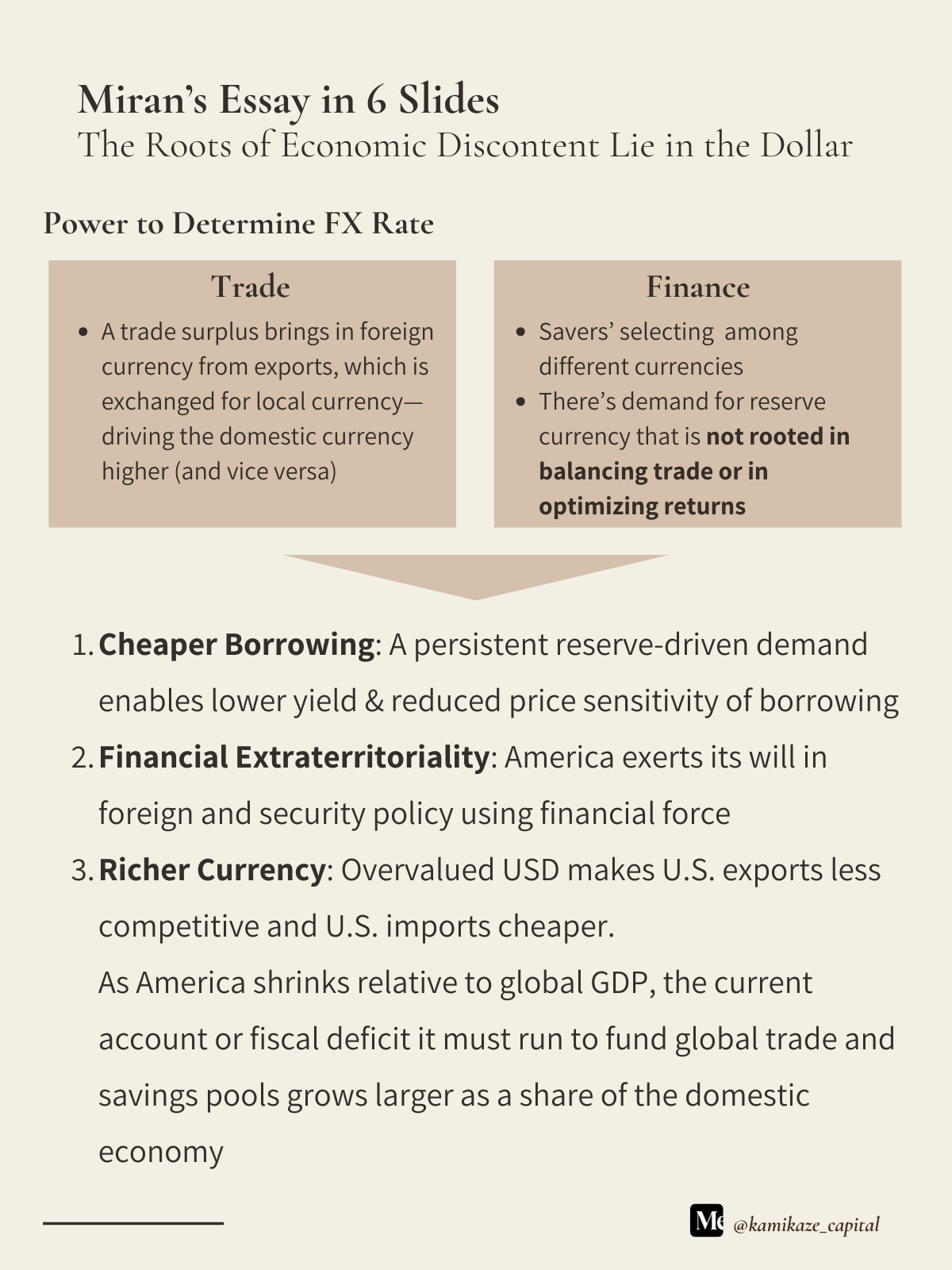
- Global demand for the dollar as the world’s reserve currency has kept it persistently strong. While this benefits consumers through cheaper imports, it undermines the competitiveness of U.S. manufacturing and makes it harder to improve the trade balance
- At the same time, demand for dollars has lowered yields and dampened price sensitivity for U.S. Treasury bonds. The dollar-based financial system — reinforced by U.S. sanctions — has further strengthened America’s ability to project both economic and security power
- Yet being the issuer of the reserve currency comes with costs. To sustain global growth, the United States must continually supply dollars through current account and budget deficits — effectively exporting Treasury bonds in exchange for imported goods
- As the U.S. share of the global economy has declined, the burden of supporting both world growth and global security has grown heavier
- Now, with China and Russia emerging as economic and military challengers, reducing reliance on China and revitalizing domestic manufacturing has become not just an economic goal, but a national security imperative
- Trump is aiming to move away from the “strong dollar” policy. This doesn’t mean giving up the dollar’s role as the world’s reserve currency. Instead, the goal is to push other countries to share more of the economic and security burden, redistribute global demand for the dollar, and boost U.S. tax revenues
- Tariffs and Currencies policy are central to advancing this agenda
Tariffs

- Import Price = Export Price × Exchange Rate × (1 + Tariff Rate)
- Tariffs influence dollar appreciation by reducing the competitiveness of imported goods. Ideally, any increase in import prices from tariffs would be offset by a stronger dollar, keeping inflation in check. This dynamic was evident during the first Trump administration’s tariff policy toward China. In effect, it was as if China had devalued its currency — becoming poorer — and indirectly absorbed the cost of U.S. tariffs. Under these conditions, the U.S. government boosted tax revenue without sparking inflation
- If, however, the dollar is not appreciated, American consumers faces higher prices. Yet this scenario makes U.S. manufacturing more competitive, contributing to an improved trade balance

- Trump has publicly stated that he would seek a 60% tariff on China
- Given the potential disruptions to supply chains, however, such tariffs would likely be phased in gradually, much like during his first administration. For example, rates could rise by 2% per month
- This steady escalation would put pressure on China to open its markets and negotiate trade agreements, with the possibility of tariffs occasionally exceeding the 60% target
- For countries outside China, Trump has floated a baseline tariff of 10% or more. Nations would be grouped according to factors such as exchange rate policies, trade agreements, and security ties, with tailored tariff levels for each
- As with China, these tariffs would begin at low rates and gradually rise toward 10%, and in some cases climb well beyond that threshold if circumstances warranted
- But what might the ultimate average tariff level be? Drawing on the research of Costinot and Rodriguez-Clare, Miran’s paper points to 20% as the optimal figure — one that maximizes economic benefits. Some analysts believe Trump could push tariffs close to, but just under, this level
- A mix of tax measures could also be deployed to revive U.S. manufacturing. Possible combinations include import tariffs paired with export subsidies, or higher consumption taxes offset by lower income taxes
- The main risk of such a strategy lies in retaliatory tariffs. Yet by embedding tariff policy within a broader package of trade and security agreements, Trump could reduce the incentive for partners to retaliate, thereby limiting potential blowback
Currencies
Attempts to pursuing a fairly valued dollar could reduce the dollar’s appeal to foreign investors and pose the risk of rising long-term yields.
Miran broadly divides approaches into two categories: 1) Unilateral Currency Approaches and 2) Multilateral Currency Approaches.

Unilateral Currency Approaches
- One proposal for a unilateral currencies approach is to utilize the International Emergency Economic Powers Act (IEEPA) to impose fees on interest earned from U.S. Treasury securities held by foreign officials, thereby reducing the incentive to hold dollars. These fees could be adjusted by country
- Because domestic Treasury holders have no bearing on exchange rates, U.S. investors would not be subject to such fees
- (Author’s view) In effect, this policy would function as a forced interest rate cut. Given Trump’s desire to reduce federal interest payments, he may be willing to pursue such a drastic measure
- The United States could also intervene directly by selling dollars and purchasing foreign currencies to strengthen the currencies of its trading partners. Such operations could be carried out through the Treasury’s Exchange Stabilization Fund (ESF) or the Federal Reserve’s System Open Market Account (SOMA)
- This approach, however, would expose the U.S. to the risks of foreign currency investments. If the Federal Reserve were to use newly issued dollars for these purchases, it could also fuel inflationary pressure
- Although unilateral currency measures are relatively straightforward to implement, they carry the potential to disrupt markets — driving volatility, raising long-term interest rates, and creating broader financial instability
Multilateral Currency Approaches

- In pursuing a fairly valued dollar exchange rate, Miran highlights EUR and RMB as key target currencies, with JPY also playing an important role. Yet Europe and China are unlikely to accept an agreement that revalues their currencies and shifts manufacturing back to the United States. More likely, Washington would first apply pressure through punitive tariffs, then use tariff relief as leverage to secure a currency deal
- Japan, UK, Canada, and Mexico may prove more cooperative — but on their own, they are not enough to fulfill U.S. objectives
- For a country’s currency to appreciate, it must sell dollars. To avoid negative side effects such as rising long-term yields, countries create demand for long-term bonds by “terming-out” (refinancing into longer-term debt) their U.S. Treasury holdings . The result is fewer dollar reserves overall, but with longer duration. This helps their currencies strengthen while keeping yields suppressed
- On this point, Miran cites Zoltan Poszar’s proposal: countries under the U.S. security umbrella should support U.S. financing not by holding short-term bills, but by shifting into low-interest Century Bonds, with tariffs imposed on those that refuse to comply. Beyond Poszar’s idea, Miran also raises the possibility of Perpetual Bonds
- (Author’s view) If such a term-out into Century or Perpetual Bonds were ever implemented, it could effectively be seen as a form of U.S. default

- Such a restructuring would allow countries to share the burden of global security, reallocate demand for dollars, and transfer the interest costs currently borne by U.S. taxpayers onto foreign taxpayers — all while devaluing the dollar without driving up long-term yields
- Unlike during the era of the Plaza Accord, today most dollar reserves available for sale are concentrated in the Middle East and East Asia — regions where not all governments are willing partners of the United States
- To secure their cooperation, tariffs and security commitments would be bundled together, while dollar liquidity could be supplied through swap lines and similar mechanisms to offset the risks associated with the term-out. Exempting tariffs once an accord is signed would also provide a strong incentive for agreement


- Today, the majority of U.S. Treasury bonds are held by private investors — mostly U.S. domestic. If these investors were to sell off a significant portion of their holdings, the goals of the currency accord could be undermined
- From reading Miran’s essay, it appears that foreign officials would step in to absorb such private-sector sales. In other words, countries would not only term-out their existing U.S. Treasury holdings but also take on market sales, converting them into ultra-long-term bonds. While the potential volume could be substantial, Miran does not provide detailed specifics about how this scheme would be implemented
Market and Volatility Considerations

- Currency policies tend to have a greater impact on markets than tariff policies, but their implementation requires addressing inflation and trade deficits first. The likely sequence begins with tariff measures, which strengthen the dollar and serve as negotiating leverage, combined with deregulation and energy price reduction policies. Once certain targets are achieved, the focus will shift to currency policies designed to weaken the dollar
- Tariff relief could be offered to countries that make substantial investments in the United States. Trump has publicly welcomed China building automobile factories in the U.S., but given China’s limited commitment, placing Chinese-held U.S. Treasury securities in escrow could help ensure that these investments are made
- If these tariff and currency policies are enacted, countries remaining under the U.S. security umbrella will share a larger financial burden, while those that distance themselves may face significant market instability. Foreign exchange volatility is likely to increase, accelerating the shift away from the dollar and benefiting alternatives such as gold and crypto assets
Author’s View
- Based on Miran’s essay, his aim appears to be reducing the U.S. government’s interest burden, but he does not seem particularly concerned with domestic interest payments that recirculate within the U.S. economy. His primary focus is on cutting interest payments abroad
- He also seems to favor minimal intervention in the private sector, instead targeting the demand for dollars held by foreign officials. Since these dollars were often acquired by selling their own currencies through forex interventions, “terming out” these dollar reserves could act as a penalty for devaluation policies. If implemented, foreign officials would be forced to lock in ultra-long-term U.S. Treasury bonds for extended periods. This would shift the U.S. Treasury market toward greater private-sector participation, centered on U.S. domestic consumption
- In terms of foreign exchange, governments may encourage financial institutions and the private sector to purchase dollars from officials, effectively transferring dollar liquidity from the public to the private sector
- The dollars acquired in this way would likely be recycled into U.S. investments, including bonds, stocks, real estate, and foreign direct investment, potentially sparking a major U.S. investment boom
- One caveat is that countries pegged to the dollar or with illiquid currencies might respond by selling dollars and buying euros or yen instead, placing upward pressure on those currencies
메타데이터
- post_id
- fbb0a0cf73be
- slug
- mirans-essay-in-6-slides-a-user-s-guide-to-restructuring-the-global-trading-system-fbb0a0cf73be
- url
- https://medium.com/@kamikaze_capital/mirans-essay-in-6-slides-a-user-s-guide-to-restructuring-the-global-trading-system-fbb0a0cf73be
- canonical_url
- https://medium.com/@kamikaze_capital/mirans-essay-in-6-slides-a-user-s-guide-to-restructuring-the-global-trading-system-fbb0a0cf73be
- author_url
- https://medium.com/@kamikaze_capital
- status
- ok
- fetched_at
- 2026-08-19 06:12:39