Synthetic Data Provenance & Watermarking: How Enterprises Can Prove Origin, Signal Identity, and…
Build audit-ready, compliant AI pipelines with provenance, watermarking, and licensing — prove origin, signal identity, and encode rights…
Synthetic Data Provenance & Watermarking: How Enterprises Can Prove Origin, Signal Identity, and Encode Rights for Trusted AI
Build audit-ready, compliant AI pipelines with provenance, watermarking, and licensing — prove origin, signal identity, and encode rights globally
⚡ TL;DR
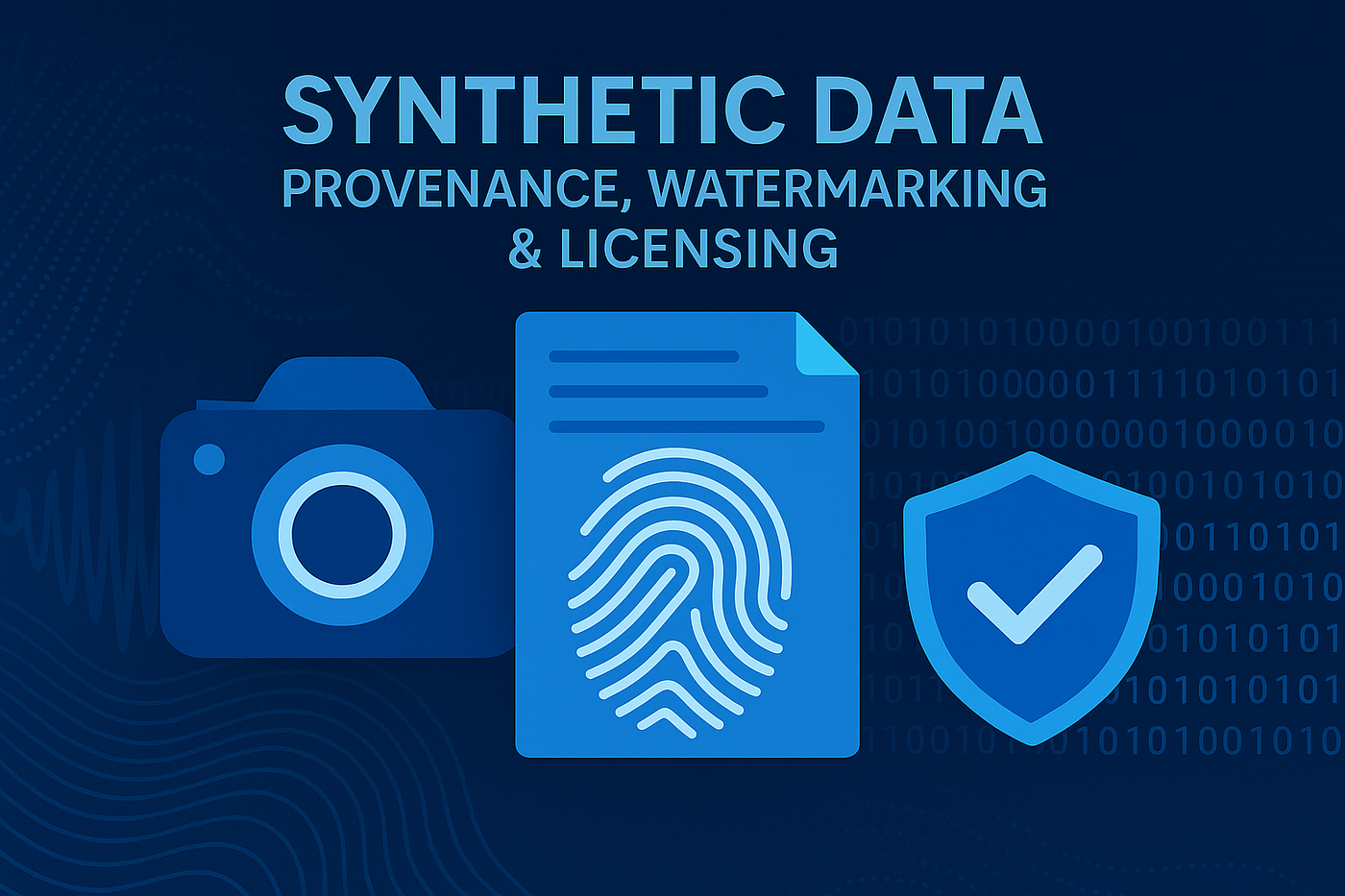
Synthetic data fuels modern enterprises — but trust demands proof. This guide explains how to prove where your AI-generated content came from (provenance), signal that it’s synthetic (watermarking), and encode rights that travel with it (licensing).
Together, these create a governance blueprint every enterprise needs to deploy AI at scale — confidently, globally, and defensibly.
Synthetic data isn’t a risk if you can prove origin, signal identity, and encode rights.

Why this matters now

Synthetic content is no longer a lab curiosity. Your brand images, product docs, support transcripts, internal training sets, voice-over dubs, and code snippets are increasingly touched by AI. That creates three hard questions every leader must answer:
- Where did this come from — and how did it change? (provenance)
- Can we identify it as AI-generated — reliably and at scale? (watermarking)
- What are the rights and restrictions on use and redistribution? (licensing)
Boards, regulators, platforms, and customers are converging on the same expectation: proof, not promises. This article offers a pragmatic way to get there.
Plain-English foundations
Synthetic data. Content created or significantly modified by AI — text, images, audio, video, code, tabular data, even 3D scenes.
Provenance. A tamper-evident record of who/what/when/how across the asset’s life. Think “flight recorder” for content. Modern ecosystems attach this record as a signed manifest that can travel with the file.
Watermarking. An imperceptible signal embedded inside media so participating tools (or public detectors) can recognize AI-generated assets — even after common edits.
Licensing. The rules that govern use: commercialization, redistribution, attribution, re-training, and jurisdictional limits. With synthetic data, you must consider inputs (sources), tools/models, and outputs.

Provenance vs. watermarking (and why you need both)
Provenance establishes lineage. It links source materials, prompts, model versions, parameters, edits, approvals, and publication. If the manifest remains intact, any verifier can check integrity and authorship.
Watermarking provides identity signals. It helps your ecosystem recognize AI-generated assets quickly (including reposts and mild edits), which is vital for brand protection and consumer transparency.
Rule of thumb: Provenance for auditability; watermarking for fast recognition. Use both for defence-in-depth.

The risk story leaders actually care about
Brand trust. Without clear signals and records, synthetic campaigns can look deceptive — even when you’re following policy.
Legal & regulatory exposure. If you can’t prove origin, edits, and disclosure, you can’t prove compliance.
Data debt. Training or re-training on unknown synthetic inputs creates compounding lineage problems that surface months later.
Operational drag. Missing manifests and ad-hoc exceptions slow launches, complicate takedowns, and increase the cost of incident response.
Real-world scenarios
Marketing images for a global launch

- Attach a signed content manifest to each final image with model/version, major edits, and approver.
- Enable watermarking at generation for rapid internal recognition and platform-level “AI-generated” badges.
- Label public assets where required; link to credentials so journalists and partners can verify origin in one click.
Synthetic support transcripts for training

- Register each dataset version with prompts, policies, and model build info in the manifest.
- Mark synthetic subsets so downstream teams can filter or weight them during evaluation.
- Keep license proofs for seeds and contracts; avoid accidental re-training on restricted outputs.
Multilingual audio dubs
- Add source references and TTS model details to the manifest; embed an audio watermark for brand protection.
- Publish a clear disclosure (“This audio is AI-dubbed”) in the player page and metadata.
What to track in the synthetic content supply chain

- Source & rights: Original materials, contracts, and proof you can synthesize from them.
- Policies & prompts: Guardrails and instructions that shaped generation.
- Models & versions: Family, commit/version, safety adapters, fine-tunes.
- Generation parameters: Sampler, temperature, seed, resolution, locale.
- Post-processing: Tools used, transforms, recompressions, crops, translations.
- Approvals: Reviewers, automated checks passed/failed, change tickets.
- Licensing footprint: Input licenses, tool/model terms, output license you apply.
- Identifiers: Manifest IDs, asset IDs in your DAM/registry, watermark presence.
Pro tip: Treat datasets as first-class assets. Record collection-level hashes/IDs so you can prove integrity at dataset scale — not just per file.
Watermarking: strengths, limits, and how to use it well

Strengths
- Excellent for your ecosystem: if you watermark everything you generate, your detectors can still recognize assets after typical edits.
- Consumer transparency: platforms can show “AI-generated” badges based on signals.
- Brand protection: faster triage of impersonations and leaks.
Limits
- Not universal: A detector for your scheme won’t identify outputs from tools that don’t watermark (or watermark differently).
- Adversarial pressure: Strong transformations can degrade or spoof signals. That’s why provenance and policy still matter.
Best practices
- Turn on watermarking across all first-party generation routes.
- Red-team quarterly: crop, compress, re-encode, translate; track durability metrics.
- Always pair watermarks with signed manifests.
Licensing: think in three layers

- Inputs. What rights did you have to the seeds/context? (Attribution? Commercial? No derivatives?)
- Tools & models. What do their terms allow for outputs? (Commercialization, redistribution, re-training, attribution, region limits?)
- Outputs. What license will you apply to synthetic assets for partners or public use?
Policies to codify

- Attribution: When and how to credit sources — even for synthetic derivatives.
- No-use zones: PII, vendor-restricted, export-controlled, or sensitive data that may never be used as seeds.
- Downstream restrictions: Whether others may re-train on your synthetic outputs (many enterprises disallow by default).
- Jurisdiction overlays: Disclosure rules differ across markets; automate labeling for EU-facing and platform-specific channels.
Reference architecture

Ingestion & policy gates
- Classify sources by rights, sensitivity, geography; block prohibited inputs.
- Create a provenance starter record the moment an asset enters the system.
Generation layer
- Use models/routes with watermarking enabled where feasible.
- Capture prompts, parameters, model hashes, and safety adapters automatically.
- Emit a signed manifest at generation time; store alongside the asset.
Post-generation
- Use editing tools that preserve manifests; enrich with reviewer attestations (“policy checks passed”).
- Prevent accidental metadata stripping on export/publish.
Registry & DAM
- Keep assets and manifests together; index by IDs/hashes.
- Offer a drag-and-drop verifier for business teams and a watermark detector for your content.
Publish & disclose
- Auto-label AI-generated/edited assets in required channels and regions.
- Expose a “Content Credentials” panel so anyone can inspect origin and edits.
Monitor & respond
- Crawl high-risk platforms; use watermark and provenance to triage incidents and accelerate takedowns.
- Keep an incident log mapped to your risk framework.
Operating model: who owns what

- Product/Content teams: Declare use cases; own prompts, quality, disclosure.
- ML/Platform: Implement watermarking, signing, model/version capture, and verifiers.
- Security: Key management for signing, registry integrity, and detector access control.
- Legal/Compliance: Input/tool/output licenses, disclosure requirements, approval matrices.
- Brand/Comms: Public messaging, consumer labeling, crisis playbooks.
- Data/AI Governance: Policies, audits, red-team drills, board reporting.
KPIs your board will understand
- Provenance coverage: % of public synthetic assets with valid, verifiable manifests.
- Watermark durability: % of watermarked assets detectable after common edits.
- Policy conformance: % of assets correctly labeled in regulated channels.
- Incident MTTR: Time to detect and take down impersonations using signals.
Dataset lineage completeness: % of training/inference datasets with signed, queryable manifests.
30-day rollout (lightweight but real)
Week 1 — Turn it on
- Enable watermarking in first-party generation paths.
- Stand up a signer & verifier; wire manifest capture into your pipeline.
Week 2 — Make it visible
- Add a “Show credentials” button in your CMS/DAM.
- Update the publishing checklist with disclosure rules per region/platform.
Week 3 — Register and test
- Register datasets and assets; record model/version/prompt basics.
- Pilot watermark detection; document baseline detection rates.
Week 4 — Challenge and codify
- Run a small red-team exercise (crop, compress, translate); track resilience.
- Finalize a synthetic-data licensing policy: attribution, no-use zones, downstream restrictions.

Common pitfalls (and how to avoid them)
- Watermarks only. Great for your content, weak for the open web. Always pair with provenance and disclosure.
- Accidental manifest loss. Many export workflows strip metadata. Fix the pipeline — don’t rely on people to remember.
- Tool/model license blind spots. Some providers restrict commercialization or re-training; capture and enforce centrally.
- Labeling gaps. If a channel requires disclosure, automate it.
- Dataset sprawl. Without collection-level lineage, you can’t measure risk or improve quality.
Executive FAQ
Is watermarking enough for compliance? No. It helps identify your outputs; regulators and auditors will still expect provenance records and clear disclosure.
Will manifests survive editing and publishing? Yes — if tools are configured to preserve them. Treat manifest preservation as a non-negotiable pipeline requirement.
Should we watermark text? Text watermarking exists and works best on longer, minimally edited content. Treat it as a useful signal — not ground truth — paired with provenance.
How does this fit our risk framework? Provenance + watermarking + disclosure operationalize core controls (governance, measurement, incident response) in modern AI risk programs.

The take-home
If you can prove what you made, signal that it’s AI-generated, and encode the rights that travel with it, you can use synthetic data at enterprise scale — confidently, globally, and defensibly.
Do this once, automate it, and it becomes a competitive advantage.
Glossary
Content Credentials (C2PA). An open approach to attach cryptographically signed provenance to media so anyone can verify origin and edits. Dataset lineage. A traceable history showing where data came from and how it changed. Disclosure/Labelling. Telling users that content is AI-generated or AI-edited (often required by policy or law). Manifest. The signed record that stores provenance details and travels with the asset. Watermark. An embedded, often invisible signal for recognizing AI-generated content. No-use zones. Data categories that are blocked from synthesis due to policy, ethics, or regulation.
A message from our Founder
Hey, Sunil here. I wanted to take a moment to thank you for reading until the end and for being a part of this community.
Did you know that our team run these publications as a volunteer effort to over 3.5m monthly readers? We don’t receive any funding, we do this to support the community. ❤️
If you want to show some love, please take a moment to follow me on LinkedIn, TikTok, **Instagram. You can also subscribe to our [weekly newsletter](https://newsletter.plainenglish.io/)**.
And before you go, don’t forget to clap and follow the writer️!
메타데이터
- post_id
- fbb6164bc045
- slug
- synthetic-data-provenance-watermarking-how-enterprises-can-prove-origin-signal-identity-and-fbb6164bc045
- url
- https://blog.stackademic.com/synthetic-data-provenance-watermarking-how-enterprises-can-prove-origin-signal-identity-and-fbb6164bc045
- canonical_url
- https://blog.stackademic.com/synthetic-data-provenance-watermarking-how-enterprises-can-prove-origin-signal-identity-and-fbb6164bc045
- author_url
- https://medium.com/@raktims2210
- status
- ok
- fetched_at
- 2026-07-18 12:52:00