The Long View: What the News Doesn’t Tell You About the Strait of Hormuz
“Those who fail to remember the past are doomed to repeat it — and those who do remember the past are doomed to watch everyone else repeat…
The Long View: What the News Doesn’t Tell You About the Strait of Hormuz
“Those who fail to remember the past are doomed to repeat it — and those who do remember the past are doomed to watch everyone else repeat it.”
There is a particular kind of confidence that settles over a well-informed person watching a crisis unfold in real time. You know the players. You understand the stakes. You’ve read the background briefings. You follow analysts on three continents. You are, by any reasonable standard, paying attention.
The Strait of Hormuz is in the news again. Drones. Tanker disruptions. GPS jamming. The familiar arithmetic of oil prices and naval deployments, of Iranian leverage and American counterpressure, of regional actors calculating their exposure and their opportunity. The coverage is competent. The analysts are serious. The information is largely accurate.
What’s missing isn’t more information. It’s depth of field.
The Ocean Beneath the Foam
The French historian Fernand Braudel, writing in the middle of the twentieth century, described historical time as moving at three different speeds. At the surface — what he called the level of events — things happen fast. Battles, elections, assassinations, crises. This is the level the news covers, and it covers it well. Beneath that, moving more slowly, are the medium-term structures: economic cycles, demographic shifts, the rise and fall of trade networks over decades and generations. And beneath that, moving so slowly it can feel like geology rather than history, is what Braudel called the longue durée — the long duration. Geography. Climate. The deeply embedded cultural habits and physical structures that shape what human beings in a given place can and cannot do, across centuries and sometimes millennia.
Braudel’s image for the event level was “surface agitation” — the crests of foam on the ocean. The foam is real. It matters. But it doesn’t tell you what the ocean is doing. And if you want to understand the ocean — if you want to understand why the foam keeps forming in the same places, in the same patterns, with the same results — you have to learn to look through the surface to what’s moving beneath it.
The Strait of Hormuz is, in this sense, one of the most instructive places on earth to practice looking.
A 33-Kilometer Fact
The strait is 33 kilometers wide at its narrowest point. That is not a political fact. It is not a cultural fact. It is a geographical fact, produced by plate tectonics and erosion over millions of years, and it has determined the political and economic history of the region as surely as any treaty or revolution.
Whoever controls that 33-kilometer passage controls the flow of trade between the Indian Ocean and the Persian Gulf. For most of recorded history, that meant spices, silk, and pearls. Today it means roughly 20 percent of the world’s oil supply. The commodity changes. The logic does not.
This is where the long view begins — not with a particular nation or religion or political system, but with a geographical chokepoint that has been generating the same strategic imperative for a thousand years: control the strait, control the leverage.
The Pattern Across Five Centuries
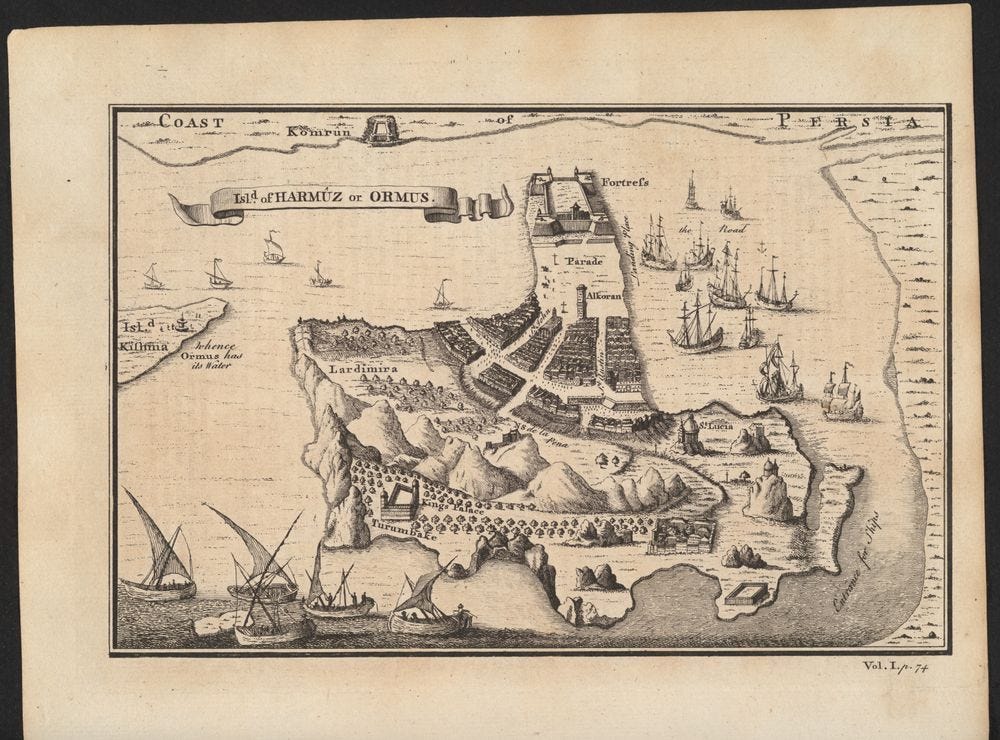
In the medieval centuries, from roughly the tenth to the fifteenth, Hormuz was a thriving trading hub where the ancient world’s routes converged — Chinese silk, Indian spices, Arabian incense, East African gold, and the merchants, pilgrims, and travelers who moved among them. Marco Polo passed through twice and wrote about its fierce climate and flourishing commerce. Ibn Battuta, the fourteenth-century Moroccan traveler, described it as a great and beautiful city with crowded markets. The Kingdom of Hormuz — a local dynasty ruling the islands and coasts — managed this network with considerable sophistication, playing larger powers against each other with the confidence of those who understand they occupy indispensable ground.
Then, in 1507, a Portuguese fleet commanded by Afonso de Albuquerque arrived.
Albuquerque didn’t come to Hormuz by accident or adventure. He came because the Portuguese Crown had grasped, with unusual strategic clarity, that control of the Indian Ocean trade routes meant control of the most lucrative commerce in the world, and that control of those routes meant controlling their chokepoints. He attacked the local fleet, killed much of the island’s population, imposed annual tribute, and began building a fortress. Portuguese rule, consolidated after his return in 1515, lasted for more than a century.
The specific actors here are historically particular. The underlying logic is not. Albuquerque was executing a strategy that could have been derived from first principles by anyone who looked at a map and asked: where does everything have to pass through? The answer led to Hormuz in the sixteenth century. It leads there today.
The Portuguese were dislodged in 1622, in an episode that deserves more attention than it typically gets. Shah Abbas I of the Safavid Empire — the Persian dynasty that ruled what is now Iran — had spent years watching Portuguese power consolidate itself at what he understood to be the southern gateway of his domain. He had soldiers but no navy. The strait that gave him leverage also gave his adversary a permanent maritime advantage.
His solution was to find a partner who had ships and who had its own reasons to challenge Portuguese dominance. That partner was the English East India Company.
The arrangement was not altruism on either side. The English were hesitant to attack a European Christian power on behalf of a Muslim state — the diplomatic complications in Europe were real. What resolved their hesitation was commercial incentive and strategic calculation: the Portuguese were a competitor, and weakening them at Hormuz would open trade opportunities the English wanted for themselves. Abbas sweetened the arrangement with customs exemptions. In February 1622, Iranian ground forces and English warships moved against the Portuguese position on Qeshm Island, cutting off their fresh water supply. By April, after a ten-week siege, the Portuguese presence in the region was over. One of England’s most celebrated navigators, William Baffin, died in the fighting.
The fortress the Portuguese built still stands on Hormuz Island, partially in ruins, partially cannibalized into the foundations of other buildings. The stone endures. The empire that built it is gone.
Now notice what this sequence looks like from altitude. A dominant outside power controls the chokepoint. A regional power that lacks the capability to dislodge it unilaterally finds a rising competitor with aligned interests and forms a strategic alliance. Together they eject the dominant power. The new partner expects and receives preferential trade arrangements.
This is not a story about the Portuguese, or the Safavids, or the English East India Company. It is a structural pattern — one that has repeated at Hormuz, in variations, across four more centuries, with different technologies and different actors playing functionally identical roles.
The Dutch followed the English. The British Empire succeeded the East India Company. The United States deployed its navy to protect tanker traffic during the Iran-Iraq War of the 1980s, when both sides targeted oil shipping in the Gulf — the same logic of strait control, now dressed in Cold War geopolitics and petroleum economics. And here we are again, with Iranian drones and GPS disruption and the familiar geometry of leverage and counterpressure playing out in the same 33 kilometers.
What the Long View Explains That the News Cannot
Here is the question the current coverage does not ask, because it cannot be answered at the event level: why does Iran keep doing this?
The surface answer involves the current government’s ideology, the nuclear negotiations, the sanctions regime, the regional ambitions of the Islamic Republic. These are real factors. But they are also temporary factors — every government is temporary, every sanctions regime is eventually renegotiated, every ideological posture eventually shifts.
The long view offers a different answer. Iran — under whatever name, whatever dynasty, whatever political system — has been the dominant land power in this region for most of the past two thousand years. It has also, for most of that time, been relatively weak at sea. The Safavids had no navy. The Qajars who followed them had no navy. The Islamic Republic has spent decades developing asymmetric maritime capabilities — drones, mines, fast attack boats — precisely because the geography of the Persian Gulf gives a sea power decisive advantages that a land power needs to neutralize.
The threat to close Hormuz is not an Iranian invention. It is the logical strategic response of the regional land power to the maritime advantage of outside powers. Shah Abbas understood this in 1622. The current government understands it today. The specific language, the specific weapons, the specific political demands have all changed. The structural logic has not moved at all.
This is what the long view gives you that five weeks of competent news coverage cannot: not more facts, but a different frame. You stop asking “what is Iran doing?” and start asking “what does the dominant land power in this region always do when a maritime power contests control of its outlet to the sea?” That question has a very long and consistent answer. And it tells you considerably more about what is likely to happen next than anything in the current diplomatic cable traffic.
The Library Problem
There is a reason most people don’t think this way, and it isn’t laziness or intellectual failure. It’s structural.
You can read a serious history of the Vietnam War — one that covers the American involvement in full, with the full complement of political context, military strategy, and human cost — in a single volume of four or five hundred pages. That is a manageable intellectual undertaking. The book has a shape. It has a beginning, a middle, and an end. It has named people making consequential decisions. It satisfies the narrative appetite that humans bring to the past.
The long view of Vietnam doesn’t fit in a book. It requires a library. Not metaphorically. Actually. The Mekong Delta as an agricultural system across two thousand years. Vietnamese resistance to Chinese imperial pressure as a recurring dynamic across a millennium. French colonialism as an administrative template that determined what American policymakers misread and why. You read the geographers alongside the political historians alongside the economic historians alongside the environmental historians, and slowly, across many books and many years, a picture emerges that no single author could have produced.
The same is true of Hormuz. The geological history. The trade networks of the medieval Indian Ocean world. The Portuguese maritime empire. The Safavid state and its relationship with European commercial powers. The British imperial system that replaced them. The twentieth-century oil economy and the Cold War framework that was built on top of it. No single book holds all of that. The unit of analysis isn’t a volume. It’s a library.
This is not a complaint about the limits of popular history. It is a description of why long-term historical thinking is genuinely hard to acquire and genuinely easy to avoid — and why the consequences of avoiding it are not merely academic.
What You Were Never Told About Iraq
In 2003, the United States invaded Iraq to liberate the Iraqi people from a dictator. That was the story. It was told with conviction by people who believed it, and it was believed by a public that had no particular reason to question the premise.
The premise was false — not because Saddam Hussein wasn’t a dictator, he was, but because there was no “Iraqi people” in the sense the story required. There was no Iraqi nation with a shared identity and a shared history that had been suppressed by one man’s tyranny and was waiting to be freed. What there was, instead, was a set of borders drawn by European powers after World War I with considerable creativity and minimal regard for the people living inside them.
The story of those borders is not complicated, but it requires going back further than 2003. The territory that became Iraq had been, for four centuries, three distinct provinces of the Ottoman Empire — one centered on Mosul in the north, predominantly Kurdish; one centered on Baghdad in the center, predominantly Sunni Arab; one centered on Basra in the south, predominantly Shia Arab. These were not administrative conveniences. They reflected genuine historical, cultural, and religious differences that had been forming for centuries.
When the Ottoman Empire collapsed after World War I, Britain and France divided its Arab territories between themselves in arrangements that were primarily about their own strategic and economic interests. Britain wanted a land route to India and access to the oil fields being discovered in the region. The solution was to take those three very different Ottoman provinces and draw a single border around them, call the result Iraq, install a king imported from elsewhere in the Arab world, and declare a nation into existence.
The people inside that border were not consulted. The Kurds, who had been promised a homeland by the Treaty of Sèvres in 1920, watched that promise evaporate by 1923 when the Treaty of Lausanne redrew the map to British and Turkish advantage. The Shia majority in the south found themselves governed by a Sunni-dominated administrative structure built to serve British imperial interests. The tensions that would define Iraqi politics for the rest of the twentieth century — the Kurdish question, the Sunni-Shia divide, the chronic instability of a state whose people did not share a national identity — were baked in at the moment of creation.
Saddam Hussein didn’t create those tensions. He exploited them and suppressed them with extraordinary brutality, which is what every ruler of the artifical state of Iraq had been forced to do in some measure since 1920. When the Americans removed him, they didn’t liberate a nation. They removed the cork from a bottle that had been under pressure for eighty years.
Iraq was not an exception to a general pattern. It was an example of one. From the Berlin Conference of 1884, where European powers divided Africa among themselves with a straightedge and no meaningful reference to the people living there, to the post-war settlements that conjured Yugoslavia and Czechoslovakia into existence from the wreckage of the Austro-Hungarian Empire, the European imperial project drew borders to serve its own administrative and economic interests. The consequences followed the same logic every time. Rwanda’s Hutu-Tutsi divide — sharpened and institutionalized by Belgian colonial administration into something far more rigid and lethal than what existed before — produced a genocide in 1994. Yugoslavia held together under Tito’s authoritarian hand for decades and came apart in ethnic cleansing the moment that hand was removed. Czechoslovakia managed a peaceful divorce only because it happened to contain two reasonably coherent constituent nations that the borders accidentally enclosed. The pattern is so consistent and so well documented across so many continents that ignorance of it in 2003 was not a gap. It was a failure of due diligence so complete it amounts to the same thing.
A public with even a modest grasp of this history would have heard “liberating the Iraqi nation” and known immediately that something was wrong with the premise. Not that the invasion was necessarily unjustifiable on other grounds — that’s a separate argument. But the specific justification offered — freeing a coherent people with a coherent national identity from a single bad actor — was a story that required historical ignorance to believe. It assumed a nation that European imperialism had never intended to form.
This is the point where the long view stops being an intellectual enhancement and becomes something closer to a civic necessity. The liberation of Iraq was not sold as a geopolitical calculation about oil and regional influence, though that is largely what it was. It was sold as a moral story about freedom and oppression — a story whose emotional power depended entirely on the audience not knowing the history that made it false. The ignorance was not incidental. It was the mechanism.
The Thing That Never Happened Before
The Hormuz pattern and the Iraqi borders are both examples of the long view applied to distant places and large geopolitical forces. But the same dynamic operates closer to home, in contexts where the historical ignorance is harder to excuse.
In 2006, Felipe Calderón won the Mexican presidential election by a narrow margin. His opponent, Andrés Manuel López Obrador — known universally as AMLO — declared the election fraudulent, refused to accept the result, and staged a ceremony in Mexico City’s central plaza, the Zócalo, in which he had himself symbolically installed as the legitimate president of Mexico. He held the title for a time, maintained a parallel political operation, and used the position as leverage in the ongoing contest over power and legitimacy.
The American press coverage of these events was, in a word, baffled. Reporters and commentators described what they were watching as extraordinary, alarming, without precedent — a dangerous rupture in Mexican democratic norms that threatened the stability of the country and the region.
It was none of those things. It was a pronunciamiento.
The pronunciamiento is a specific political form with deep roots in Mexican history — not a tantrum or an anomaly but a recognized procedure with its own logic and its own rules. When a faction loses an election or a political contest it believes was stolen, it declares the result illegitimate, installs a symbolic counter-executive, and uses that installation as a platform for negotiation, mobilization, and the application of political pressure. More often than not it ended in blood. Who held the presidency was frequently decided not by the ballot but by who won the battle that followed. Mexican politics ran on this mechanism for most of the nineteenth century. Santa Anna deployed it. Iturbide faced it. It was as Mexican as the Zócalo itself — which is precisely why AMLO chose the Zócalo.
The reason no living American journalist had seen it before was not that it had never happened. It was that the Institutional Revolutionary Party — the PRI — had held the Mexican presidency for seventy-one consecutive years, from 1929 to 2000. Under one-party dominance, the pronunciamiento is unnecessary. There is no contested election to reject, no rival faction with a plausible claim to parallel legitimacy. The form went dormant not because it had been abolished or because Mexican political culture had transcended it, but because the conditions that made it useful had been suspended. When competitive elections returned and produced a genuinely close result, the form reasserted itself immediately, exactly as anyone familiar with nineteenth-century Mexican political history would have predicted.
This is what the gap in living memory costs. Seventy-one years is long enough to erase a pattern from the awareness of everyone currently working in a newsroom. When the pattern returned, the press had no frame for it — and so they invented one. They called it unprecedented. They treated it as a crisis of Mexican democracy rather than as a feature of Mexican political culture older than the democracy itself. The analysis that followed was built on that false foundation, and it was wrong in ways that mattered.
AMLO, it is worth noting, went on to win the presidency in 2018 by a landslide. Whether you regard his eventual presidency as a vindication or a calamity, the pronunciamiento of 2006 was not a breakdown. It was the invocation of a very old form — one that, for once, did not end in the streets.
There is a journalistic tradition that understood exactly what this essay is arguing. The inverted pyramid — the structure that puts the essential facts first and the analytical depth after — was designed precisely to serve two kinds of readers at once: the person who needs the headline and the person who wants to understand what the headline means. At its best, long-form journalism did the work the longue durée demands. 60 Minutes, in its serious years, sent correspondents into the field for weeks to produce twenty minutes of television that actually explained something. Foreign bureaus staffed by reporters who spent careers in a single region accumulated exactly the kind of deep contextual knowledge that turns an event into a pattern. PBS still does some of this. The New Yorker still does some of this. The tradition is not dead.
But it is diminished, and the diminishment is not accidental. The economic model that sustained serious long-form journalism — the advertising revenue that made it profitable to maintain a Cairo bureau or spend three months on a single investigation — collapsed with the internet, and what replaced it optimizes for speed, volume, and engagement. The result is a news environment that is extraordinarily well-informed at the surface level and increasingly impoverished beneath it. The drone strike gets covered. The thousand years of strategic logic that explains why it happened does not, because that story doesn’t have a dateline and can’t be written in an afternoon.
But here is what you can do. You can learn to hear the missing history in the stories you’re being told. You can develop the habit of asking, when a crisis is presented as unprecedented, whether you actually know enough history to judge that. You can notice when a political justification for military action requires a particular historical ignorance to be persuasive — and treat that requirement as a warning sign rather than an accident.
This is not a call to become a historian. It is a call to become a harder target for the people who depend on your not knowing the history.
Part of what makes that ignorance so reliable is biological. Collective memory runs on a roughly two-generation clock. The first generation lives through an event and carries it in their bodies. The second generation grows up inside it — the veteran at the dinner table, the survivor whose silence communicates everything words can’t. By the third generation it has become a packaged story, and packaged stories, drained of the emotional truth that gave them weight, can be filled with almost any meaning — including meanings that would have been unthinkable to anyone who was there.
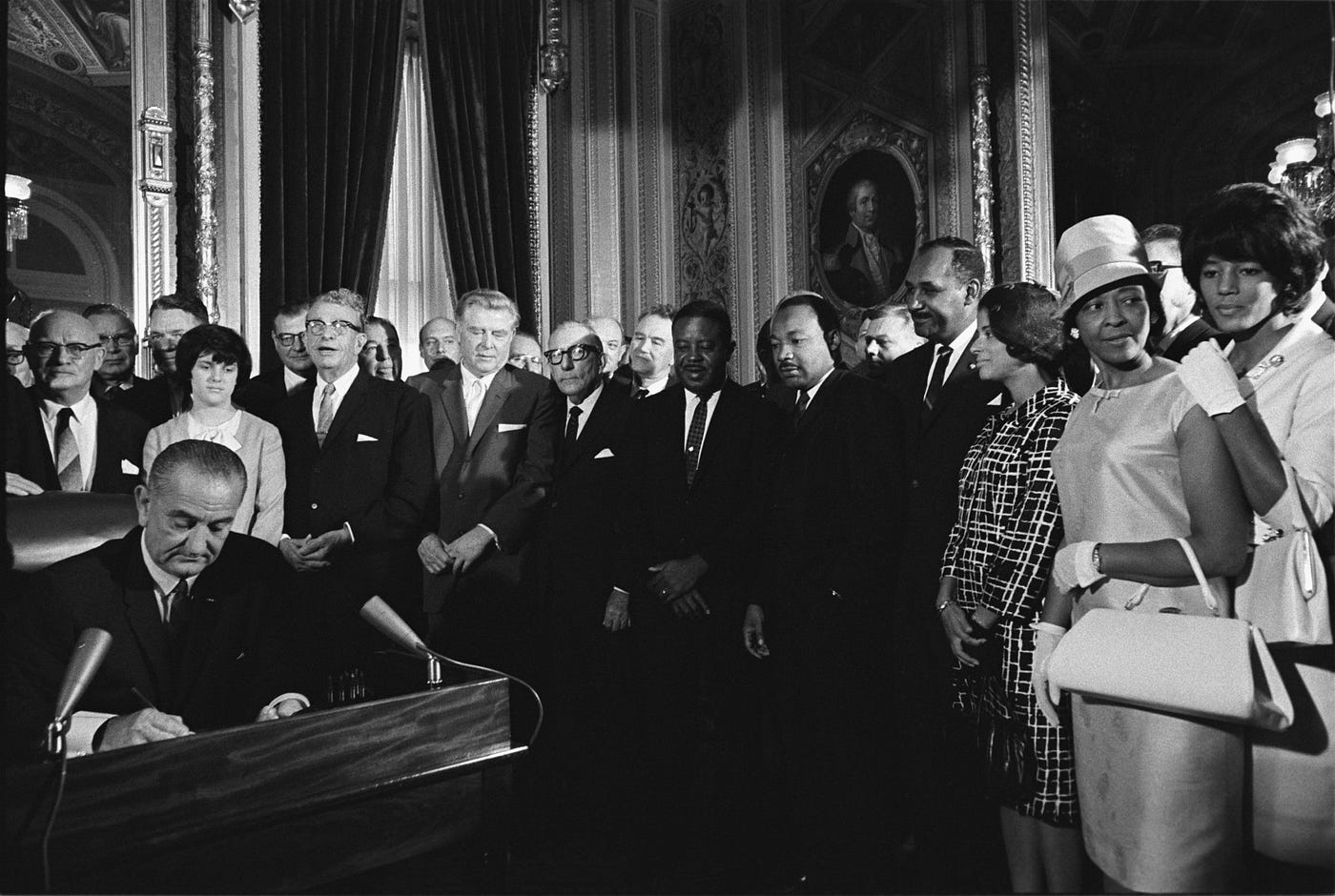
This is why any American who celebrated Nazi aesthetics in 1950 would have been denounced on the spot. The people who had confronted what those aesthetics produced were still alive, still present, still capable of making the abstraction concrete. By 2020, with that generation passing from the scene, the symbols had become available for reinterpretation by people for whom they carried no lived weight. The contrast with Germany is instructive and it has nothing to do with national character. Germany lost the war on its own soil, was occupied, and was forced by circumstance and external pressure to scaffold the memory into its institutions — mandatory education, memorials that are not optional, legal structures that make certain forms of forgetting difficult. The memory was anchored. In the United States it was left to voluntary culture, and voluntary culture, when the living witnesses are gone, drifts toward whatever is emotionally available to people who weren’t there.
The pronunciamiento vanished from American awareness in seventy-one years. The logic of European imperial borders became invisible in three generations. The lesson of what unchecked nationalism produces is fading on the same schedule. None of this is mysterious. It is the predictable result of leaving historical memory to chance.
The Vietnam War planners were not stupid men. They were brilliant, credentialed, supremely confident in their ability to analyze the situation in front of them. What they lacked was depth of field. They measured and quantified and briefed the surface with extraordinary precision while the deeper structure — a Vietnamese national identity forged by a thousand years of resisting outside domination, which was going to treat American soldiers exactly as it had treated Chinese imperial armies, French colonial administrators, and Japanese occupiers — continued to do its work below the level they were capable of seeing. Fifty-eight thousand Americans and millions of Vietnamese died in a war whose outcome was largely determined before it started, by history the people who started it hadn’t bothered to learn.
The Hormuz crisis will not be resolved by any particular negotiation or military posture, because it is not primarily a political problem. It is a geographical problem that recurs in political form. The strait will remain where it is. The structural incentive to control it will remain. The specific terms of whatever arrangement emerges from the current moment will be written at the surface level. The deeper logic will continue to operate at a speed that no news cycle can track.
Understanding that doesn’t tell you what to think about the current crisis. It tells you that anyone who claims to understand it without understanding the long history is offering you foam and calling it ocean. And you are now in a position to know the difference.
History is not a record of the past. It is a discipline for understanding the present by learning to see through it — to perceive the structures that produce what we call current events, the long currents that shape what seems, from the surface, like the unpredictable turbulence of human affairs.
The Strait of Hormuz is 33 kilometers wide and has been generating the same strategic imperative for a thousand years. That is not a detail about the Middle East. It is a lesson about time — about the difference between the speed at which events happen and the speed at which the structures producing them change.
The foam moves fast. The ocean does not. If you only watch the foam, you will be surprised, again and again, by the ocean. And the people who most need you to be surprised are counting on it.
메타데이터
- post_id
- fbc51b368166
- slug
- the-long-view-what-the-news-doesnt-tell-you-about-the-strait-of-hormuz-fbc51b368166
- url
- https://medium.com/dispatches-from-exile/the-long-view-what-the-news-doesnt-tell-you-about-the-strait-of-hormuz-fbc51b368166
- canonical_url
- https://medium.com/dispatches-from-exile/the-long-view-what-the-news-doesnt-tell-you-about-the-strait-of-hormuz-fbc51b368166
- author_url
- https://medium.com/@cosmicgilligan
- status
- ok
- fetched_at
- 2026-06-21 15:33:18