Superstring Theory 101
In the latest season of the TV series “Young Sheldon,” there are quite a few references to superstring theory. And the climax is when…
Superstring Theory 101

In the latest season of the TV series “Young Sheldon,” there are quite a few references to superstring theory. And the climax is when Sheldon, along with his fellow teenager colleagues, publishes their theory on alternative geometries for compactifying extra dimensions, besides using Calabi-Yau complex geometry.
They publish their theory in one of the best physics journals in the world, namely Physical Review Letters, which has an impact factor of 8.6 and an Eigen score of 0.36516. In the last four decades, 65% of Nobel Prize winners in physics have published their papers in this journal, so it is indeed deserving of a Tier 1 ranking.
As a result of Sheldon and his colleagues’ publication in the PRL journal, Sheldon receives many offers for graduate-level physics programs from various top universities such as MIT, Harvard, Princeton, and Caltech.
So, what is this superstring theory anyway?
So far, the superstring theory is the best candidate for the Theory of Everything (ToE), which is a single theory that can explain the entire universe or multiverse entirely. Sheldon says the superstring theory is the Next Big Thing in science. This theory emerged in the 1960s, with fluctuating popularity. It was abandoned by many physicists at some point, but lately, it seems to be gaining traction again.
The theory suggests that at the most fundamental scale, the Planck scale (1.616×10^−35 meters), electrons, quarks and all elementary particles are composed of one-dimensional strings that vibrate continuously.
Interestingly, the strings that compose quarks are identical to those that compose electrons, neutrinos, or muons or any other elementary particle type (could be graviton as well). There’s no difference here. The only difference lies in how these strings vibrate and whether they form open loops or closed loops. This concept has the potential to unify two fundamental laws of physics that govern the universe, namely General Relativity and Quantum Mechanics.
Different vibration modes can be analogized to different musical notes when you pluck a guitar string. Certain plucks will produce a G note, and others will produce a C note, even though it’s the same guitar string, but it can produce different notes depending on how you pluck it. That’s the concept of the superstring theory. Different vibration modes or frequencies of the same string will produce elementary particles with different physical properties, such as electrons, quarks, muons, or neutrinos. The universe seems a gigantic musical orchestra at the very fundamental level.
However, for this theory to unify all types of particles and the laws of physics, it requires additional dimensions besides the 3 spatial dimensions and 1 time dimension. How many additional spatial dimensions are needed? At least, the universe must have 3 large spatial dimensions + 1 time dimension and additional 6 spatial small rolled-up at the Planck scale.
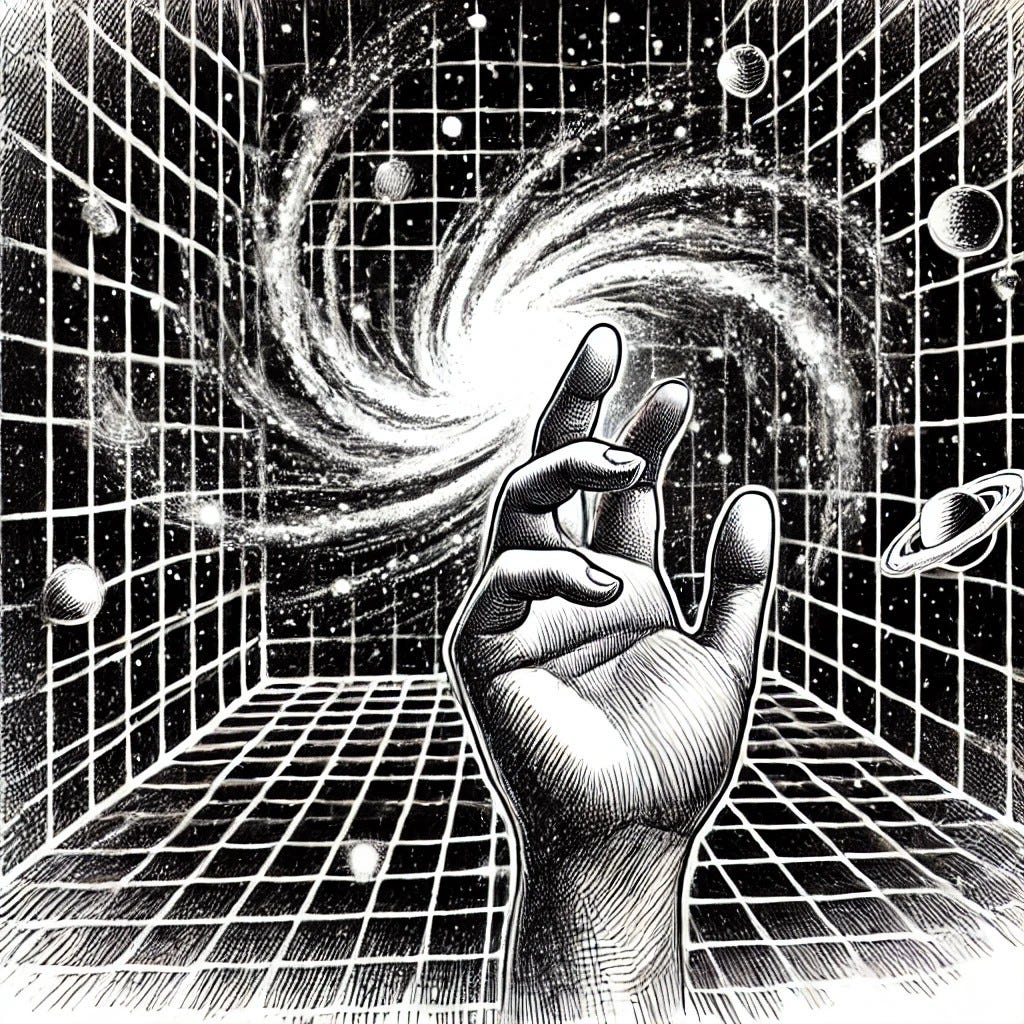
Why should these extra dimensions be rolled up so small at the Planck scale? It’s because based on observations, only 3 spatial dimensions expand to the macro level, and we haven’t found evidence of the existence of extra dimensions on a large scale. This concept is called dimensional compactification. With the addition of these 6 extra dimensions, the one-dimensional strings have more degrees of freedom to produce various vibration patterns.
The problem starts to arise with the addition of these 6 dimensions. How can these 6 dimensions be rolled up so small at the Planck scale or a scale much smaller than the size of a quark? This certainly requires complex geometry that has many dimensions at a small scale, but remains flat and smooth at a large scale. Like a sheet of A4 paper that looks flat and smooth from afar, but when you zoom in, it will appear not smooth, here and there. One form of geometry that has these properties and is quite promising is the 6-dimensional Calabi-Yau complex geometry.
Is the superstring theory finished then? Far from it… Why? It turns out that by using Calabi-Yau geometry, there are at least 10⁵⁰⁰ or possibly 10²⁷²⁰⁰⁰ ways in which this geometry can compactify these additional 6 dimensions. The implications of these various compactifications are enormous, meaning that there will be so many types of universes that can be generated from this method. Each type of compactification will result in a universe with its own set of physical laws. The superstring theory is not a single universe theory, but rather a framework for a multiverse or multiple universes theory.
With so many choices of compactifications, it’s very difficult or even impossible to find a unique compactification that produces a universe like the one we inhabit. Trying to calculate each one individually would clearly take billions of years, maybe even with supercomputers. Perhaps there’s also no standardized algorithmic method to encode calculations of complex n-dimensional geometry into an array-based or tensor flow-based computations. So, it’s uncertain when we can find this version of compactification.
Because of this complexity, physicists are looking for geometrical formalisms other than Calabi-Yau. So, indeed, Sheldon’s paper can be considered quite up-to-date with the development of superstring theory. So far, there are several alternative geometries that could replace Calabi-Yau but still need rigorous testing, namely:
- G2 and Spin (7) manifold
- F Theory compactifications
- Non-Geometric Compactifications
- Orbifolds and Singular Spaces
- Non-Compact Geometries
At some point, I’ll discuss the above exotic concepts.
메타데이터
- post_id
- fbcbd7b87e8c
- slug
- superstring-theory-101-fbcbd7b87e8c
- url
- https://medium.com/@kosmologi.indonesia/superstring-theory-101-fbcbd7b87e8c
- canonical_url
- https://medium.com/@kosmologi.indonesia/superstring-theory-101-fbcbd7b87e8c
- author_url
- https://medium.com/@kosmologi.indonesia
- status
- ok
- fetched_at
- 2026-06-09 15:37:30