RPTFM #1 | Rust: Introduction
Read and Prompt The Fucking Manual: Rust — Introduction
RPTFM #1 | Rust: Introduction
Read and Prompt The Fucking Manual: Rust — Introduction
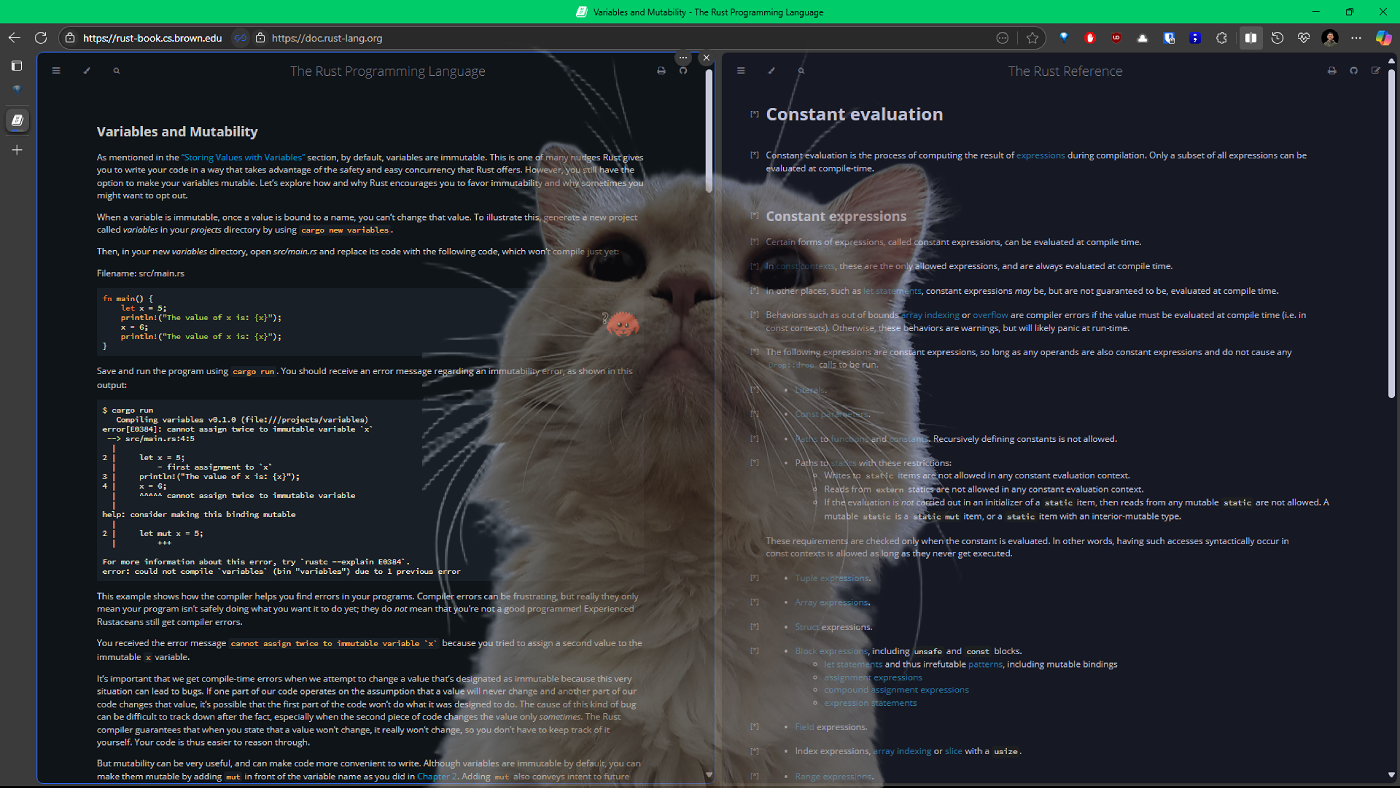
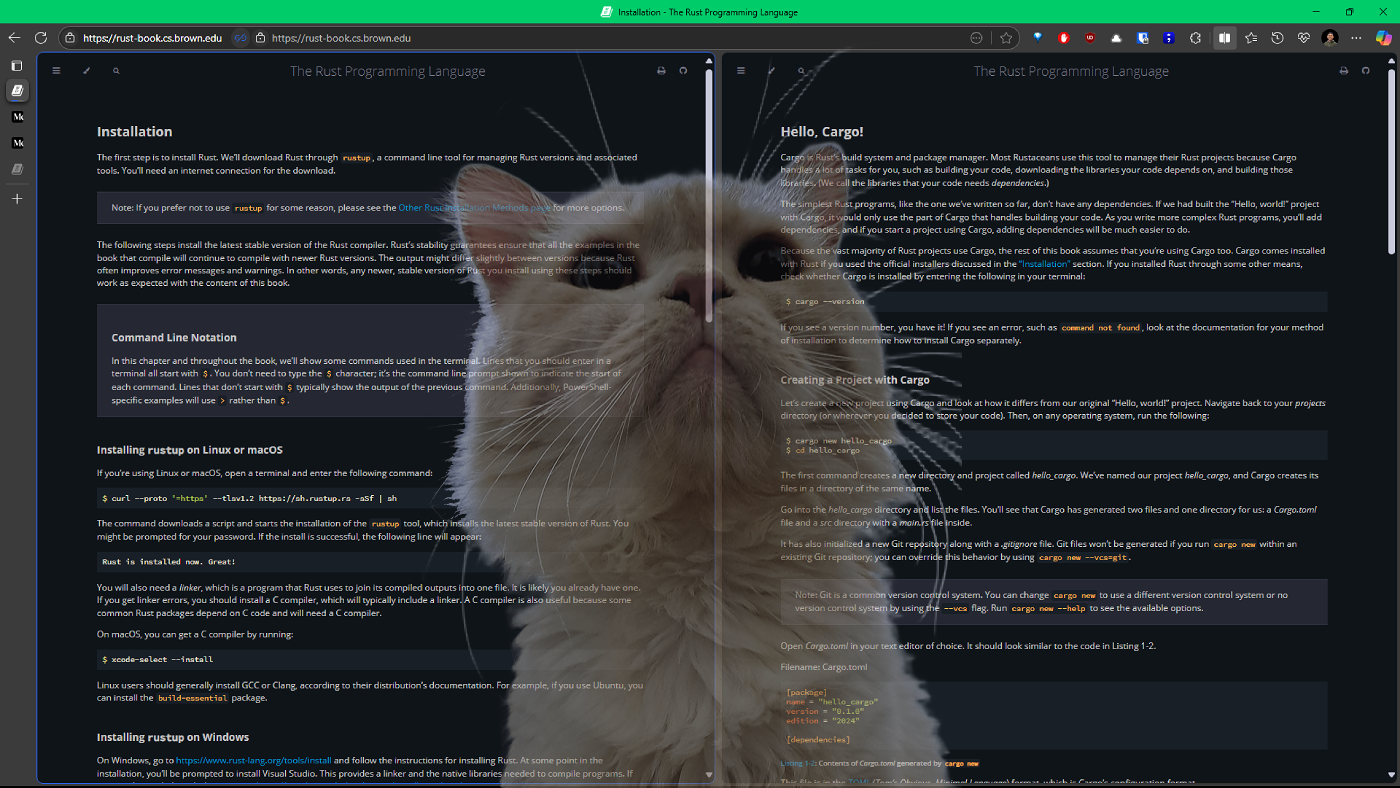
A photoshoped RPTFM Rust illustration of author’s cat reading Rust documentation and prompting via Microsoft Copilot.
If you're new to Rust, don’t worry, since I’m the same. In this story, I share my log, or rather, my notes on learning Rust as a programming language. I learned Rust this way, with prior knowledge of Python as a programming language, by thoroughly reading the Rust documentation and prompting with Copilot Bing. I’m using the Cognitive Engineering Lab fork of The Rust Programming Language, as it offers a more interactive aspect of learning programming languages, including quizzes and highlighting. Let’s deep dive into the Introduction page.

Interactive aspect of Cognitive Engineering Lab fork of The Rust Programming Language.
Just a heads up, when everyone isn’t familiar with my writing story format. I use this one below
To highlight that this is the source or quote from Rust documentation I focus or prompt later on
Then this one here is my train of thought, how I prompt the previous statement, or how I choose to act upon it. What comes after this is usually the response.
Like this is the response. I know this format might not be for everyone, but I just feel right with this (I’m a lil bit autistic).
Introduction
Rust claims it helps us write faster, more reliable software. I quote,
Low-level code is prone to various subtle bugs, which in most other languages can be caught only through extensive testing and careful code review by experienced developers. In Rust, the compiler plays a gatekeeper role by refusing to compile code with these elusive bugs, including concurrency bugs. By working alongside the compiler, the team can spend their time focusing on the program’s logic rather than chasing down bugs.
I prompt Copilot: 'Explain the following text primarily based on the surrounding page content'. Its response:
🌟 This text highlights a fundamental strength of Rust, particularly in the context of your current environment — a contact form for Brown University’s Rust Experiment. The researchers there are investigating ways to make Rust easier to learn and use, so this passage gives a solid rationale for why Rust is worth the effort.
Here’s a breakdown framed by the surrounding context:
🔧 Low-Level Code Challenges
- Subtle bugs are common in systems-level programming — think memory corruption, data races, and thread safety issues.
- In most languages, catching these requires manual testing and experienced developers combing through code line-by-line.
🦀 Rust’s Compiler as a Gatekeeper
- Rust flips the script: its compiler acts like a safety inspector, refusing to compile code that could introduce bugs.
- This includes concurrency bugs — the notoriously difficult kind that emerge in multi-threaded environments.
🧠 Cognitive Load Shift
- Developers no longer spend all their time fighting fires or debugging obscure issues.
- Instead, they can focus on program logic and architecture, trusting the compiler to catch mistakes early.
This kind of reliability is especially compelling for Rust learners or participants in experiments like the one on this page — you’re not just learning syntax, you’re learning how to rely on tooling that builds robust software from day one.
I follow up with the next question by asking, “What does it mean?
Low-level code is prone to various subtle bugs. Does low-level code refer to a certain programming language or not in this context? I immediately thought about C or C++ since it is kinda low-level programming language. CMIIW”. This is its response:
You’re spot on, Rangga — your instinct to think of C or C++ is exactly in line with what “low-level code” refers to here. Let’s break it down a bit more clearly 👇
🔍 What “Low-Level Code” Means
- In this context, low-level code refers to programming languages or paradigms that give developers direct control over hardware and memory.
- Think languages like C, C++, or even assembly — they’re close to the metal, which gives you flexibility and performance, but also greater risk.
- These environments don’t have built-in safety nets; the programmer is responsible for managing memory, avoiding leaks, handling concurrency correctly, and preventing undefined behaviour.
🐛 Why It’s “Prone to Subtle Bugs”
- In such low-level environments, bugs like:
- Memory leaks
- Null pointer dereferences
- Data races in concurrent threads
- Buffer overflows
- Can sneak past compilers and only emerge during runtime — if you’re lucky.
These bugs are notoriously hard to detect and can require exhaustive testing and expert-level code reviews.
🦀 Rust’s Solution
- Rust gives you low-level control without sacrificing safety.
- Its compiler acts as a gatekeeper, enforcing rules around memory and concurrency so that many of these bugs are caught before the program even runs.
- It’s like having a brilliant co-developer who slaps your hand anytime you try to write unsafe code 😅
Then I found a quite unusual tech term for me, which is contemporary developer tools. So, I prompt Copilot: ‘Explain the following text primarily based on the surrounding page content’. Its response:
🚀 In the context of the Rust programming language, “contemporary developer tools” refers to a suite of modern, well-integrated tools that make the developer experience smoother, more efficient, and enjoyable — even while working in a systems programming language, which is traditionally more technical and bare-bones.
Here’s how the Rust ecosystem uses this phrase and what it means on the surrounding page:
🛠️ The Tools Mentioned
- Cargo: Rust’s built-in package manager and build tool. It handles compiling code, managing dependencies, running tests, and building documentation. It’s the Swiss Army knife of Rust development.
- Rustfmt: This ensures that all Rust code across a team follows the same formatting rules — so you spend less time arguing about spacing and more time writing meaningful logic.
- rust-analyzer: A powerful language server that gives you IDE features like auto-completion, error messages as you type, and seamless navigation through code.
📐 What “Contemporary” Implies
- These tools are modern, well-designed, and user-friendly, similar to the kind of tooling you’d expect in higher-level languages like Python, JavaScript, or Kotlin.
- They help bring a high-level ergonomic experience to a low-level control language, balancing power with productivity.
🧠 Why It Matters
In many traditional systems languages (like C or C++), you’d need to rely on external tools, manual configuration, and deep expertise to get even basic conveniences. Rust flips that by making best-in-class tooling part of the language’s DNA — making it easier for students, teams, and companies to adopt and scale.
In their documentation, Rust said that this is for people who value speed and stability, and I quote,
The Rust compiler’s checks ensure stability through feature additions and refactoring. This is in contrast to the brittle legacy code in languages without these checks, which developers are often afraid to modify. By striving for zero-cost abstractions — higher-level features that compile to lower-level code as fast as code written manually — Rust endeavors to make safe code be fast code as well.
I prompt Copilot: ‘Explain the following text primarily based on the surrounding page content’. Its response:
🦀 This excerpt from the Rust Book sits at the heart of Rust’s philosophy: how to blend speed, safety, and maintainability — three things that traditionally conflict in systems programming. Let’s unpack it in context:
🔐 Compiler Checks = Stability
- Rust’s compiler rigorously analyses code before it runs, enforcing rules around memory, borrowing, ownership, and concurrency.
- These checks prevent subtle bugs and allow developers to safely add features or refactor code without the fear of breaking things.
- In other languages (like older versions of C/C++), small changes in “brittle legacy code” can cause crashes or undefined behaviour, so devs often avoid touching it.
🚧 Legacy Code vs. Rust Code
- Legacy code = fragile, unpredictable, hard to modify.
- Rust code = robust and well-guarded by compile-time safety, which encourages experimentation and long-term health of the codebase.
⚡ Zero-Cost Abstractions
- These are high-level features (like generics, iterators, closures, smart pointers) that don’t introduce runtime overhead.
- When compiled, they perform as efficiently as manually written low-level code.
- Rust doesn’t ask you to choose between safe but slow or fast but risky — it wants you to have both.
🧠 Why It Matters
This balance lets developers build powerful, maintainable software without sacrificing performance. It also lowers the emotional cost of innovation: instead of fearing bugs and regressions, you can confidently evolve your project.
I still don’t understand the term zero-cost abstractions —higher-level features in
By striving for zero-cost abstractions — higher-level features that compile to lower-level code as fast as code written manually — Rust endeavors to make safe code be fast code as well.
So I do the same previous prompt for this specific prompt and this is its response
🔥 This sentence from the Rust Book speaks to one of Rust’s most powerful promises: you don’t have to trade safety for speed.
Let’s break it down using the page’s context, which describes Rust’s core goals of stability, performance, and developer confidence:
💡 What Are “Zero-Cost Abstractions”?
- These are high-level programming features — like iterators, generics, or closures — that don’t introduce runtime performance penalties.
- Instead of slowing your program down, they are compiled by Rust into low-level machine code that’s just as efficient as if you’d written it all by hand in C or assembly.
Think of it like using sleek LEGO building blocks that snap together beautifully, yet the final structure is just as aerodynamic and solid as if it were moulded from a single piece.
🦺 Safety Without Sacrificing Speed
- In many traditional languages, choosing safe constructs (e.g. memory checks, type safety) can mean slower code.
- Rust flips that: it wants your safe code to be blazing fast, too.
- Thanks to its compiler’s deep understanding of ownership and lifetimes, it can optimise aggressively without needing garbage collection or runtime checks.
💪 Why It Matters
- This approach means developers can confidently use expressive, modular code without worrying about hidden costs.
- It also supports long-term scalability — teams can refactor or extend their software without fearing performance bottlenecks.
In the big picture, Rust’s philosophy here aligns with your interest in architectural clarity and symbolic structure. It’s like coding with powerful metaphors that compile down to raw machine truth. Want to look at a real example of a zero-cost abstraction in action, like how Rust iterators compare to loops under the hood?
Then who this ebook is for, you and I might wonder, the documentation answers it
This book assumes that you’ve written code in another programming language but doesn’t make any assumptions about which one.
Since I have a slow-loading brain to understand what this line means so I prompt once again: ‘Explain the following text primarily based on the surrounding page content’. Its response:
📚 Based on the context from the Rust Book’s introduction, this sentence sets expectations for the reader’s background — it’s essentially the book saying:
“Hey, we assume you’ve dabbled in programming before, but we don’t care if it was Python, JavaScript, C++, or even Scratch.”
🔑 What This Means in Context
- The book isn’t for complete beginners who’ve never written any code.
- It is for people who’ve coded before, regardless of which language — it could be something low-level like C, high-level like Ruby, or domain-specific like R.
- It deliberately doesn’t tailor examples to any one background, making it accessible to folks from a wide range of programming ecosystems.
This gives it a broad and welcoming tone, aligning with the Rust community’s inclusive approach: come as you are, as long as you’ve typed if and {} before.
This ebook has two chapters: concept and project. The project chapters are Chapters 2, 12 and 21. Otherwise, fall into the concept chapter. For Chapter 18, and I quote
Chapter 18 looks at how Rust idioms compare to object-oriented programming principles you might be familiar with
Once again, I prompt with the same line by selecting that line and right-clicking in Microsoft Edge 👉🏼 Ask Copilot, so it instantly requests a prompt ‘Explain the following text primarily based on the surrounding page content’. The response:
🧠 In the context of the Rust Book, this line sets up a gentle bridge between two programming mindsets: Rust idioms and object-oriented programming (OOP) principles. The book assumes you may already be familiar with concepts like classes, inheritance, and polymorphism from languages like Java, Python, or C++, and it wants to show you how Rust achieves similar design patterns — but in its own way.
Here’s how that comparison plays out based on the surrounding content:
🦀 What Are Rust Idioms?
- Rust tends to favour composition over inheritance, using things like structs, enums, and traits to organise and abstract behaviour.
- Instead of “classes,” Rust uses structs to hold data and impl blocks to add methods.
- Traits are Rust’s way of enabling polymorphism — think interfaces in other languages, but more flexible and safer.
🧰 How They Mirror OOP Principles
- Encapsulation: You can manage visibility and control access to data using Rust’s privacy rules and modules.
- Polymorphism: Rust uses trait objects and generics to support behaviour across types, replacing the traditional inheritance tree.
- Abstraction: Traits and generics let you write code that’s decoupled from specific data types, much like abstract classes or interfaces.
🔄 Why This Comparison Is Made
- The book wants to show: “Hey, if you’ve used OOP before, Rust has tools that feel familiar, even if they work differently.”
- It’s meant to reduce friction for learners transitioning from other languages and ease the mental shift toward Rust’s ownership-driven, type-safe, and fearlessly concurrent ecosystem.
Later, Chapter 20 introduced me to an unknown term, which is
Chapter 20 contains a smorgasbord of advanced topics of interest, …
Therefore, the usual right-click prompt response is as follows
🔥 In the context of The Rust Programming Language book, the phrase “Chapter 20 contains a smorgasbord of advanced topics of interest” is meant to give readers a heads-up that they’re about to enter a buffet of powerful, flexible, and nuanced features that go beyond the basics.
Here’s what this means based on the surrounding content:
🧠 What “Smorgasbord” Signifies
- It implies variety and richness — a wide array of topics you can choose from depending on your curiosity or needs.
- The chapter doesn’t follow one single theme; instead, it offers mini deep-dives into multiple advanced Rust concepts.
🔍 What’s Inside Chapter 20
According to the page outline, it includes:

Table explaining the terms in Chapter 20.
🚀 Why This Chapter Matters
- It’s tailored for developers ready to push the limits of what Rust can do.
- Perfect for those building libraries, frameworks, or systems-level tools where performance and expressiveness are key.
- It’s like unlocking expert mode — you’ve mastered the foundations, now it’s time to bend the rules strategically.
Lastly, I come across these terms in the Meaning column that I assume are usual from other programming languages like Go, but not the case for Python programmers i.e. panic

Table explaining Ferris icon indicates something inside the code across this Rust ebook.
Therefore, the usual right-click prompt response is as follows
🔍 Within the Rust Book’s introduction, this text introduces Ferris, the friendly unofficial mascot of Rust 🦀, as a visual guide to help readers interpret code examples — especially ones that are intentionally broken or imperfect.
Here’s what it means in context:
🦀 Who Is Ferris?
- Ferris is a cute, crab-shaped icon that appears next to certain Rust code snippets in the book.
- It’s used to flag code examples that are expected to fail or behave in undesired ways — not mistakes, but teaching moments.
📚 What Each Label Means

Table explaining Ferris messages.
🤹 Why This Matters
- Rust’s compiler is strict, and learning how it reacts is part of the journey.
- By clearly marking these examples, the book teaches readers how to read and understand errors — which is central to mastering Rust.
- Ferris acts like a tour guide saying: “This path leads to a trap — let’s study it and learn how to avoid it.”
Up Next
The Series
[embed]RPTFM: Rust 🦀 Read & Prompt The Fucking Manual of Rustranggakd.medium.com
메타데이터
- post_id
- fbcedf126fe0
- slug
- rptfm-1-rust-introduction-fbcedf126fe0
- url
- https://medium.com/run-out-of-rust/rptfm-1-rust-introduction-fbcedf126fe0
- canonical_url
- https://medium.com/run-out-of-rust/rptfm-1-rust-introduction-fbcedf126fe0
- author_url
- https://medium.com/@ranggakd
- status
- ok
- fetched_at
- 2026-07-18 16:58:14