Beyond Excel: How OneStream Reinvents Finance with a Single, Intelligent CPM Platform
Finance teams today are expected to do far more than close the books. They must forecast faster, explain variances instantly, and support…
Beyond Excel: How OneStream Reinvents Finance with a Single, Intelligent CPM Platform
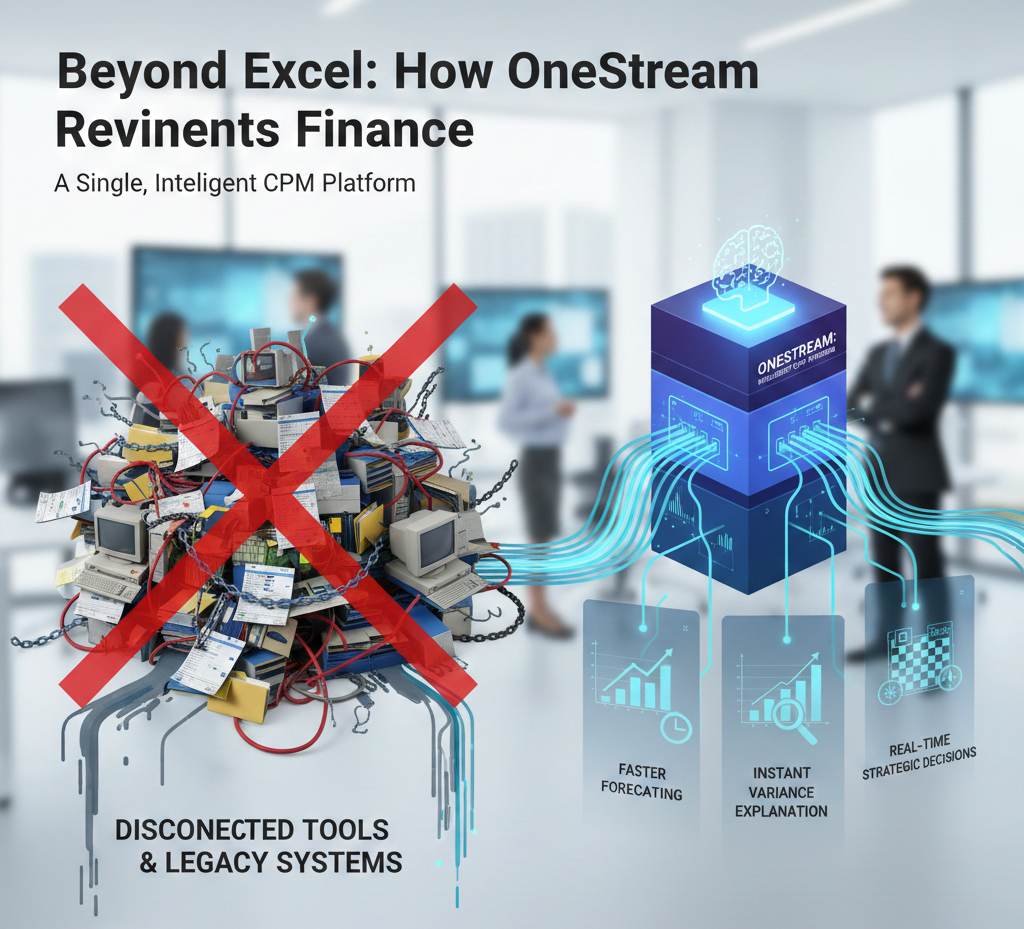
Finance teams today are expected to do far more than close the books. They must forecast faster, explain variances instantly, and support strategic decisions in real time. Yet many organizations still rely on disconnected tools, spreadsheets, and legacy CPM systems that were never designed for this pace.
This is exactly the gap OneStream was built to solve.
This article combines what OneStream is and how it works internally, giving you a clear mental model from day one.
Why OneStream Exists: The Problem with Traditional Finance Systems
Before OneStream, finance teams typically used:
- Excel for planning and analysis
- One tool for consolidation
- Another tool for budgeting & forecasting
- Manual reconciliations between systems
This led to familiar problems:
❌ Excel Dependency
- Version conflicts (“final_v7_updated.xlsx”)
- No audit trail
- Manual errors at scale
❌ Legacy CPM Tools
- Separate cubes for Consolidation and FP&A
- Data duplication
- Heavy IT dependency for simple changes
❌ Slow Decision-Making
- Forecast cycles take weeks
- Limited scenario modeling
- Finance reacts instead of leading
OneStream’s core idea was simple but powerful:
Unify finance processes, data, and ownership on a single platform.
One Platform for Consolidation and FP&A
Unlike traditional CPM tools, OneStream does not treat consolidation and FP&A as separate worlds.
What this means in practice:
- Same actuals feed both reporting and forecasting
- No reconciliation between systems
- Finance works from a single source of truth
Core processes supported:
- Financial Consolidation
- Budgeting & Forecasting
- Long-range planning
- Management reporting
- Scenario & what-if analysis
This unification is possible because of OneStream’s single-cube architecture.
OneStream Architecture — Explained Simply
Let’s break the architecture into concepts you can actually remember.
1. Application: The Finance Universe
A OneStream Application is the complete finance environment.
It contains:
- Dimensions (structure)
- Cubes (data storage)
- Business rules (logic)
- Workflows (process control)
- Security (governance)
- Dashboard, Cube View (Reports)
Think of the application as your entire finance operating system.
2. Dimensions: How Data Is Organized
Dimensions answer how data is classified.
Common dimensions include:
- Account — What (Revenue, Expense, Assets)
- Entity — Where (Legal entities, departments)
- Time — When (Month, Quarter, Year)
- Scenario — Why (Actual, Budget, Forecast)
- Flow — How (Movements, balances)
Plus User-Defined Dimensions (UDs) for business-specific needs like product, customer, or region.
Dimensions are metadata — they define structure, not values.
3. Cubes: Where Data Actually Lives
A Cube stores numeric financial data based on dimension intersections.
Example:
Entity = US
Account = Revenue
Time = Jan-2025
Scenario = Actual
OneStream’s key design choice:
Single Cube for Multiple Finance Processes
This allows:
- Consolidation and FP&A to share the same data
- No duplication
- No reconciliation layers
Metadata vs Data: A Critical Beginner Concept
Many new learners confuse these two.
Metadata
- Dimensions
- Hierarchies
- Members
- Cube structures
Metadata defines possibility.
Data
- Actual numbers
- Budget values
- Forecast figures
Data represents reality.
In OneStream, strong metadata design = clean data forever.
Why the Single Cube Matters (More Than You Think)
Traditional CPM tools use:
- One cube for consolidation
- Another cube for planning
This causes:
- Sync issues
- Different numbers in different reports
- Endless reconciliation meetings
OneStream’s single cube:
- Eliminates duplication
- Improves performance
- Enables real-time Actual vs Forecast analysis
- Simplifies maintenance
This is one of the biggest reasons enterprises move to OneStream.
How Finance and IT Collaborate in OneStream
OneStream is intentionally designed to balance ownership.
Finance owns:
- Cube Views
- Dashboards
- Forecast models
- Business logic understanding
IT supports:
- Infrastructure
- Security framework
- Integrations
- Performance tuning
The result?
Finance becomes self-sufficient, not dependent.
Real-World Use Cases
Here’s how organizations actually use OneStream:
- Month-end close with governed workflows
- Rolling forecasts using live actuals
- Management dashboards without Excel exports
- Scenario modeling (best case / worst case)
- Audit-ready reporting with full traceability
All inside one platform.
Final Thought
OneStream isn’t just another CPM tool.
It represents a shift:
- From fragmented finance → unified finance
- From Excel dependency → governed flexibility
- From reporting past → shaping the future
If you’re starting your OneStream journey, understanding this foundation will make everything else — cube views, business rules, dashboards — far easier to master.
메타데이터
- post_id
- fbd12447d8a6
- slug
- beyond-excel-how-onestream-reinvents-finance-with-a-single-intelligent-cpm-platform-fbd12447d8a6
- url
- https://medium.com/@darshakhp/beyond-excel-how-onestream-reinvents-finance-with-a-single-intelligent-cpm-platform-fbd12447d8a6
- canonical_url
- https://medium.com/@darshakhp/beyond-excel-how-onestream-reinvents-finance-with-a-single-intelligent-cpm-platform-fbd12447d8a6
- author_url
- https://medium.com/@darshakhp
- status
- ok
- fetched_at
- 2026-07-20 08:15:26