America’s National Game: 1974
Henry Aaron breaks home-run record of Babe Ruth
America’s National Game: 1974
Henry Aaron breaks home-run record of Babe Ruth
Happy Birthday, US (or us!)
On April 8, 1974, Henry Aaron broke Babe Ruth’s career record for home runs. What follows is a paean to Aaron but also a review of Ruth’s prior place atop all players in on-field performance. For “greatness,” however, some — myself included — have proposed Jackie Robinson as the epitome. Yet Aaron, despite the comparisons with Ruth, lived his life in the wake of Robinson.
Was Ruth greater than all who had preceded him? Yes. The question that arose in the 1970s: Was Aaron greater than Ruth?
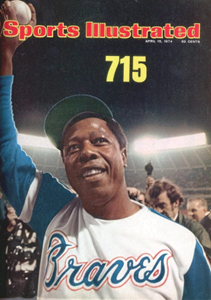
Sports Illustrated cover, April 15, 1974
In 1999, the 25th anniversary of Henry’s 715th homer, a “blue-ribbon panel” (on which I served) selected the 100 all-time greats from whom the fans, in a nationwide poll, would choose 25 to determine the All-Century Team. The outcome was fascinating, as much for who was out as who was in. Ruth, dead for half a century, pulled in the most votes, with 1,158,044, but Aaron trailed him by less than 1,300.
And yet, an asterisk attaches to Ruth. He hit against pitchers who threw complete games about half the time (today it is well under 1 percent), and thus faced the same delivery three, four, and five times a game. Ruth faced no relievers as they were used in Aaron’s day, let alone ours. Ruth never had to hit at night. African Americans never graced the same field as Ruth; had they done so, white players might have lost their places and the overall level of competition would have risen. Ruth may have been better than any baseball player ever was or will be; yet it defies reason to claim that his opposition was likewise better.
Who was Henry Aaron? Born in Mobile, Alabama in 1934, he signed with the Indianapolis Clowns of the Negro American League in 1952, to play shortstop for $200 a month. In the biography he wrote with Lonnie Wheeler, he recounted the day he left home, with sandwiches his mom made, and boarded the train:
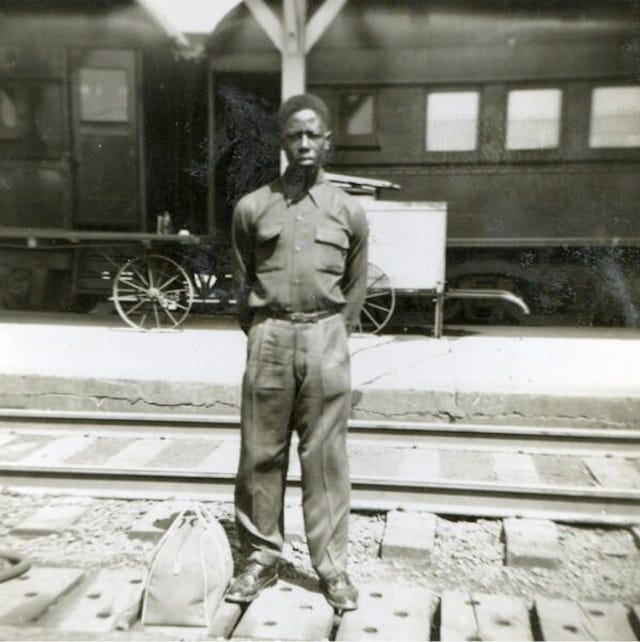
The day Aaron left Mobile to join the Indianapolis Clowns
It was the first time I had been around white people. After a while I got up the courage to walk up and down the aisle. I wanted to see what a dining car looked like, and I needed somebody to tell me where I wasn’t allowed to go. Then I sat back down, listened to those wheels carrying me farther away from home, and tried to talk myself out of getting off at the next stop and going back.
The truly competitive era of the Negro Leagues had ended with the integration of the majors and the demise of the Negro National League after 1948. The Clowns were a barnstorming outfit — the Harlem Globetrotters of baseball — never once during Aaron’s time with them playing in Indiana.
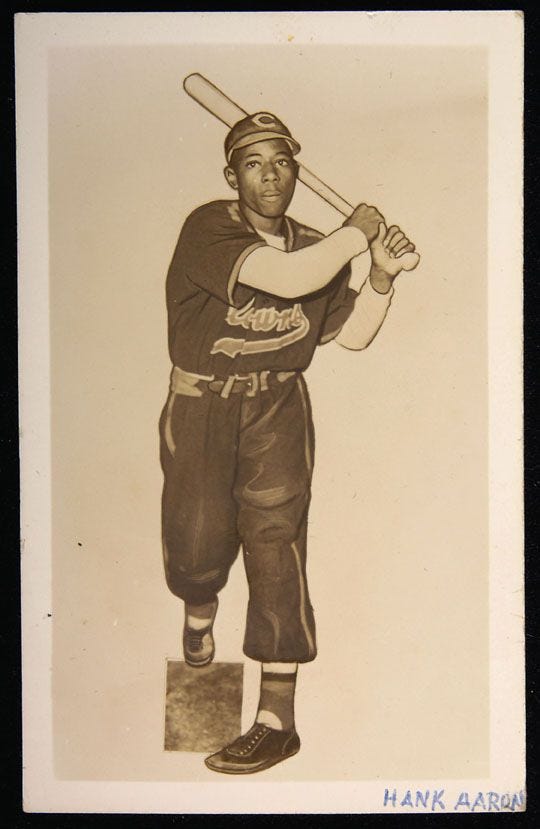
Aaron with the Clowns; he would be the last in MLB to have started in the Negro Leagues
With the Clowns, Aaron recalled a meal before a Sunday rainout in Washington, DC.
We had breakfast while we were waiting for the rain to stop, and I can still envision sitting with the Clowns in a restaurant behind Griffith Stadium and hearing them break all the plates in the kitchen after we were finished eating. What a horrible sound. Even as a kid, the irony of it hit me: here we were in the capital in the land of freedom and equality, and they had to destroy the plates that had touched the forks that had been in the mouths of black men. If dogs had eaten off those plates, they’d have washed them.
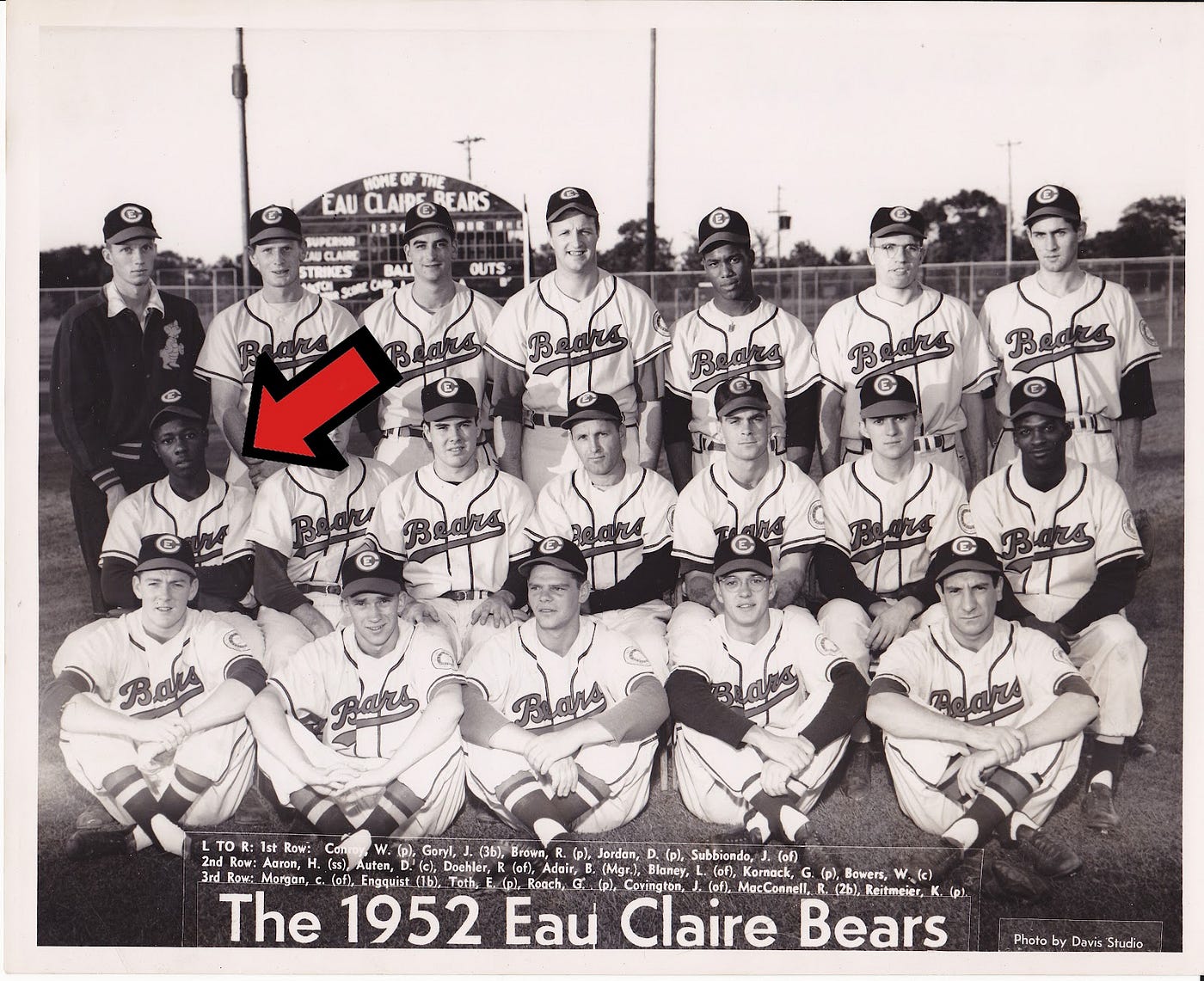
Eau Claire Bears: Aaron with Black players Wes Covington and Julie Bowers
In midseason the Clowns sold his contract to the Boston Braves, who sent him to the Class-C Northern League club in Eau Claire, Wisconsin. There he played 87 games, hitting .336 with nine home runs and 61 RBIs.
The following year Aaron was sent to Class-A Jacksonville to break the color line in the South Atlantic League. Moved from shortstop to second base, Aaron led that league in hitting, with a .362 average; in RBIs, 125; runs, 115; and hits, 208. He hit 22 home runs and struck out only 22 times.
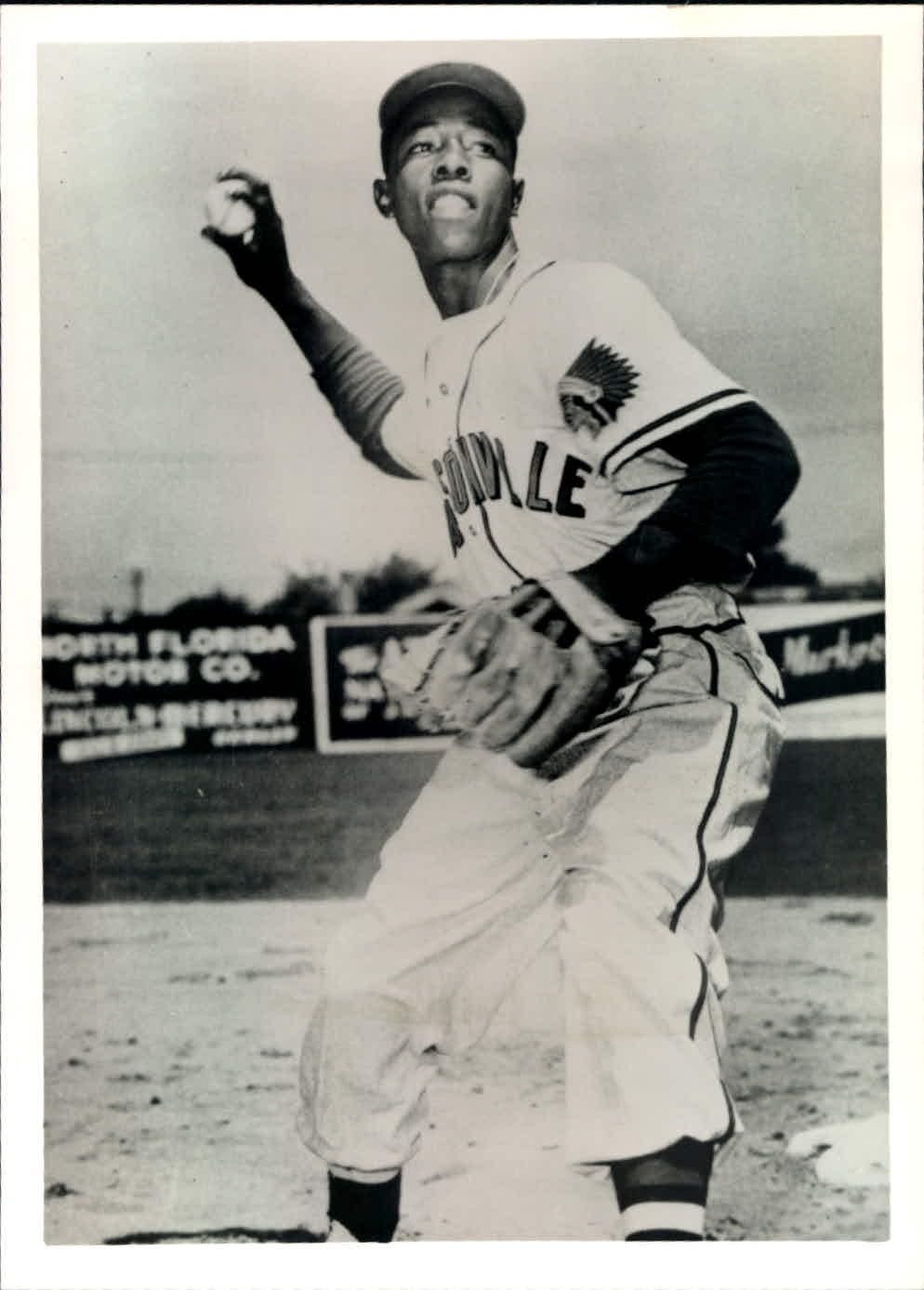
Henry Aaron, Jacksonville 1953
Expected to play the 1954 season at either Toledo or Atlanta — he was hoping not to integrate another Southern league — Aaron was a courtesy invite to the Braves’ spring training (they had left Boston for Milwaukee in 1953). On Saturday, March 13, Bobby Thomson broke a leg. The next day Aaron started for the Braves in Thomson’s place in left field, soon moving to right.
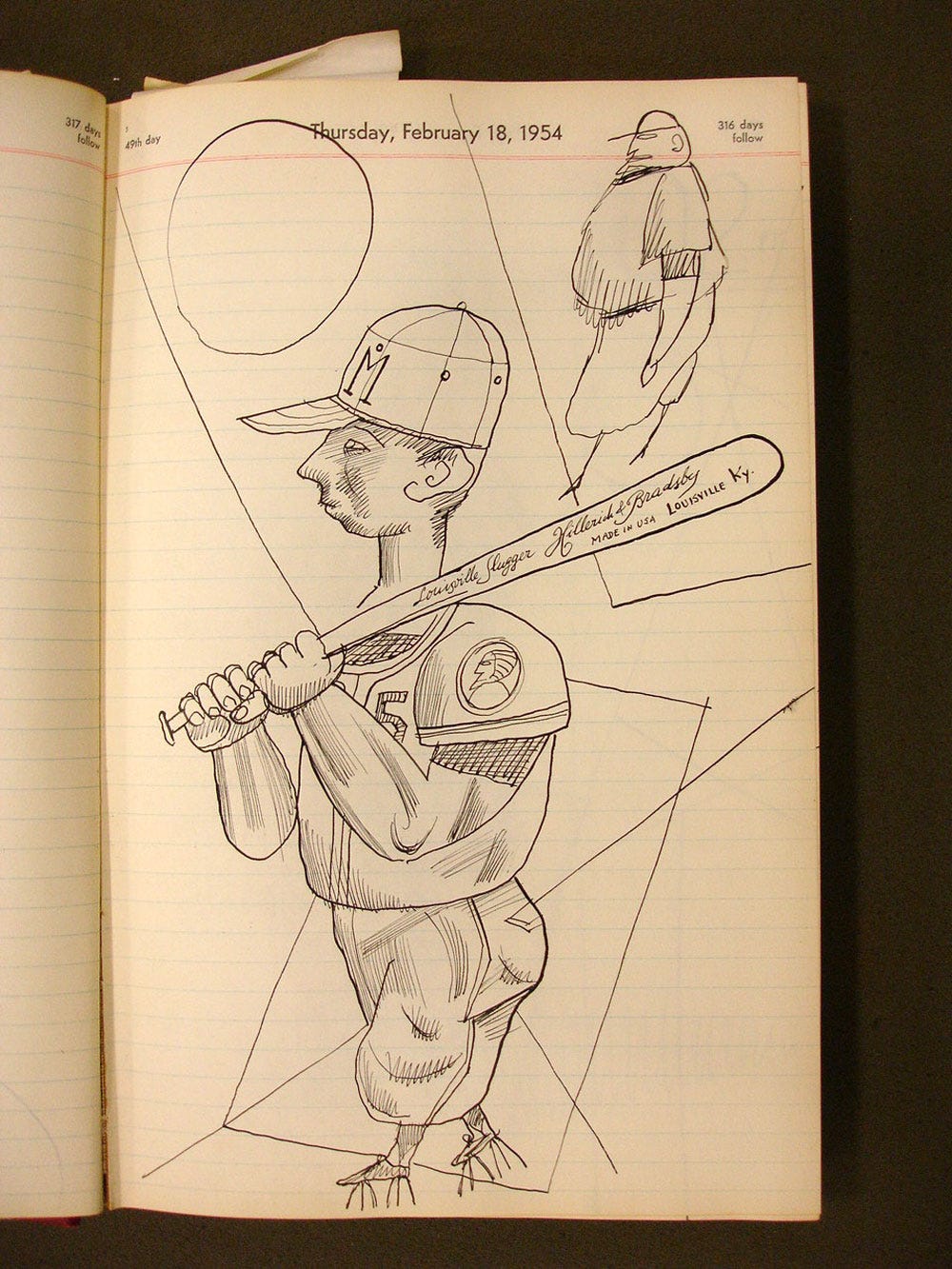
Saul Steinberg’s Henry Aaron in spring training, 1954; he wore #5 then
Aaron’s debut season in Milwaukee was marked by only 13 homers. But 1957 was his breakout year. In late September, Aaron hit an extra-inning homer that clinched the pennant. “I galloped around the bases, and when I touched home plate the whole team was there to pick me up and carry me off the field…. I had always dreamed about a moment like Bobby Thomson had in ’51, and this was it.” The city set an attendance record and Aaron, who hit 44 homers, was named Most Valuable Player. The Braves became world champions, defeating the Yankees in seven games.
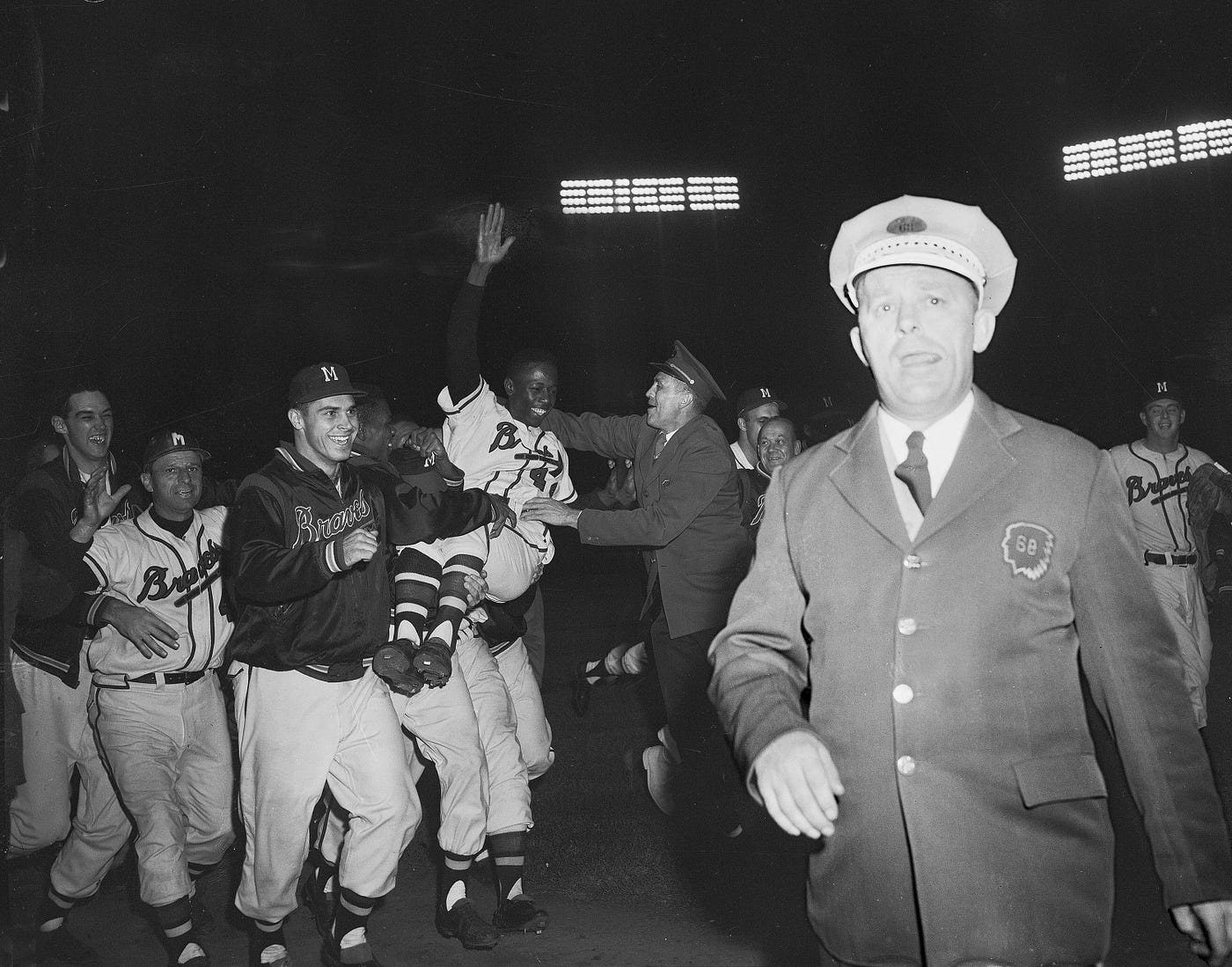
Aaron’s homer wins the 1957 pennant
Although Aaron maintained his prowess, Milwaukee’s attendance plummeted. The team relocated to Atlanta in 1966; on Opening Day there, the biggest cheer came after the scoreboard flashed a message that said “April 12, 1861: First Shots Fired on Fort Sumter … April 12, 1966: The South Rises Again.”
Things changed forever for Aaron as he changed his focus: “I would be on trial in Atlanta, and I needed a decisive way to win over the white people before they thought of a reason to hate me.” He slugged 44 and 39 homers, respectively, in his first two years there. He was 34 years old and had 481 lifetime home runs, and neither he nor anyone else was thinking about Babe Ruth’s mark.
By 1972, however, reporters began asking about Ruth. Meanwhile, the FBI investigated death threats and a plot to kidnap Aaron’s daughter from her college dorm; the hate mail accelerated. Aaron finished 1973 with 40 homers, leaving him at 713.
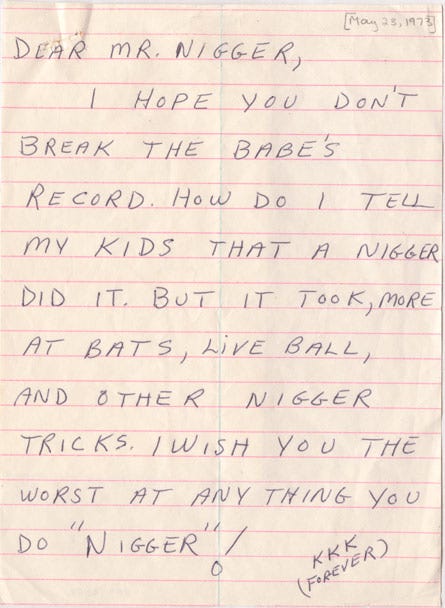
The Braves kept a handful of the letters Aaron received
The next year began with controversy. The Braves wanted to hold Aaron out of the lineup for their first three games in Cincinnati so he could tie or break Ruth’s record in Atlanta. After MLB’s Commissioner ordered them to play Aaron in at least two of the road games, Aaron hit homer 714 off Jack Billingham in his first at bat of the season. He sat out the second game, and in the third he struck out twice and grounded out once against Clay Kirby.
The Braves returned home and, on April 8, a crowd of 53,775 people showed up for the game — an Atlanta attendance record. In Aaron’s first at bat, the Dodgers’ Al Downing had walked him. The Braves were trailing, 3–1, in the fourth and Aaron was again at bat. With a man on first, Downing didn’t want to walk him again. Aaron deposited a low slider into the Braves’ bullpen in left field. As the fans cheered, Aaron’s mother embraced him at the plate. “I never knew my mother could hug so tight,” he said. She had feared someone might shoot him.
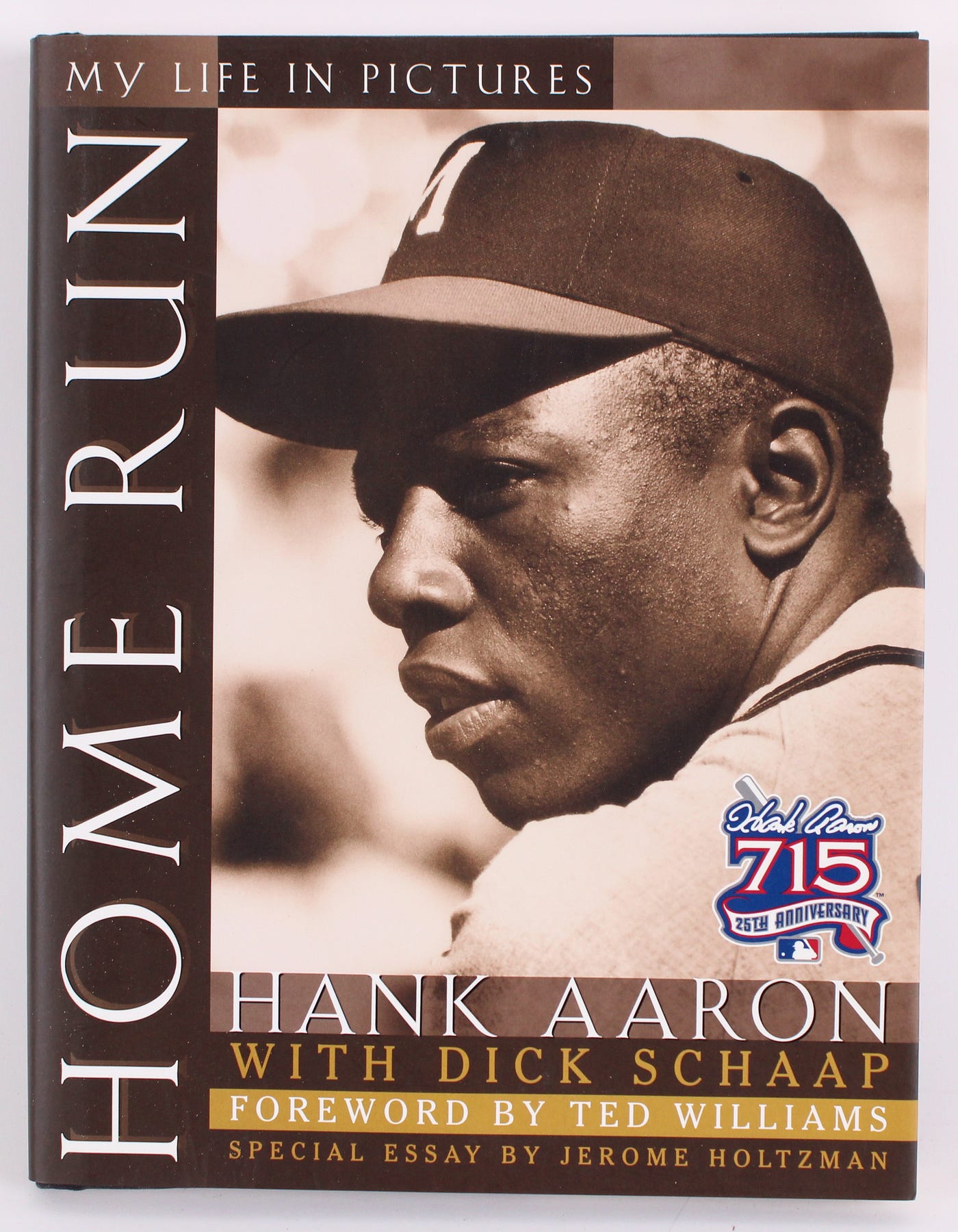
In 1999, I published Aaron’s “Life in Pictures,” a 25th anniversary book
Vin Scully addressed the racial tension in his call of the home run:
What a marvelous moment for baseball; what a marvelous moment for Atlanta and the state of Georgia; what a marvelous moment for the country and the world. A Black man is getting a standing ovation in the Deep South for breaking a record of an all-time baseball idol. And it is a great moment for all of us, and particularly for Henry Aaron…. And for the first time in a long time, that poker face in Aaron shows the tremendous strain and relief of what it must have been like to live with for the past several months.
Henry Aaron later said, “I believed, and I still do, that there was a reason why I was chosen to break the record. It’s my task to carry on where Jackie Robinson left off.”
메타데이터
- post_id
- fbddd70efa27
- slug
- americas-national-game-1974-fbddd70efa27
- url
- https://ourgame.mlblogs.com/americas-national-game-1974-fbddd70efa27
- canonical_url
- https://ourgame.mlblogs.com/americas-national-game-1974-fbddd70efa27
- author_url
- https://medium.com/@thorn_john_87223
- status
- ok
- fetched_at
- 2026-07-09 13:13:48