Portfólio Série: Implementing an ERP System: From Quotation to Go-Live
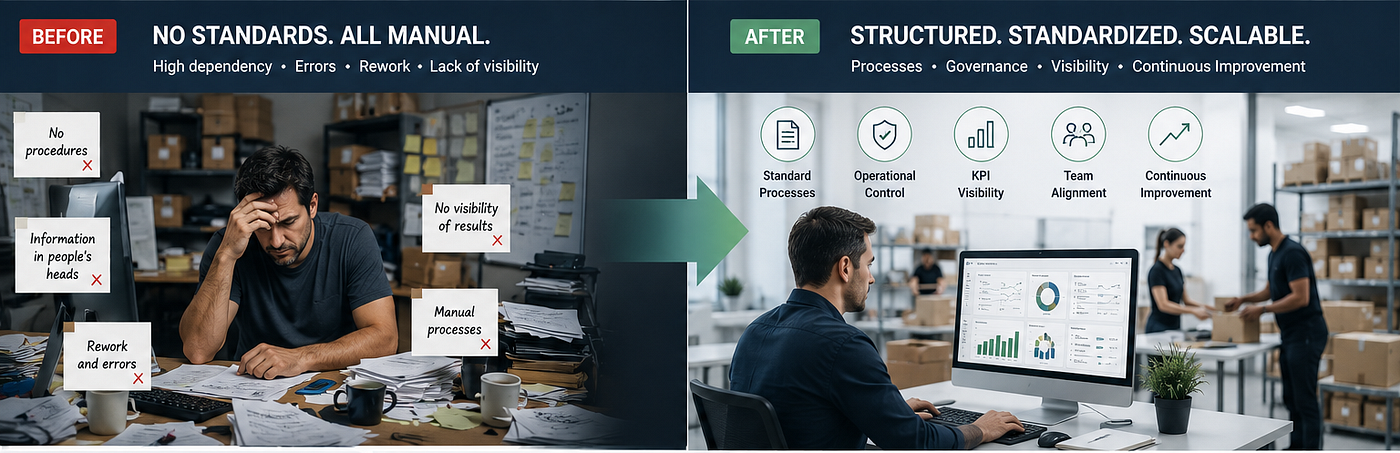
Implementing an ERP system is rarely just a technical project. It is primarily an operational alignment exercise. In our case, the process…
Portfólio Série: Implementing an ERP System: From Quotation to Go-Live

Implementing an ERP system is rarely just a technical project. It is primarily an operational alignment exercise. In our case, the process started after we had already mapped most operational workflows and documented franchise procedures, which provided a clear understanding of what needed to be digitalized.
Below is the structured journey from the initial ERP quotation phase to the final go-live.
1. Gathering Requirements
The first step was consolidating operational requirements.
By this stage, most of the key processes had already been mapped and documented, and I go over this processes on the case below:
The franchise operations were well understood, and the operational structure was clearly defined. This preparation allowed us to identify precisely which processes needed to be digitized within the ERP environment.
Having this clarity significantly reduced ambiguity during vendor discussions and helped ensure that all conversations focused on real operational needs rather than generic ERP capabilities.
2. Meetings with ERP Vendors
Once the requirements were defined, we began engaging ERP providers.
More than 15 ERP vendors were contacted during the evaluation phase. Each vendor participated in approximately three meetings, which typically included:
• Presentation of operational requirements • Product demonstrations • Discussions about technical capabilities • Initial commercial negotiations
These meetings allowed us to compare not only technical features but also the vendors’ understanding of operational realities.
3. Negotiation of Implementation and Support Costs
After the initial evaluation rounds, the vendor list was narrowed down to the top three candidates.
These finalists were invited for a deeper alignment phase, focusing on:
• Implementation methodology • Integration capabilities • Support structure • Long-term operational costs
The selected ERP provider offered the core modules we needed and, most importantly, supported centralized integration. This integration enabled a unified dashboard to monitor:
• Sales performance across stores • Inventory levels • Operational indicators across the franchise network
This centralized visibility was a critical decision factor.
4. Go-Live Preparation
Before the ERP could go live, a significant data preparation effort was required.
All master data was extracted from existing systems and spreadsheets. During this process, we discovered inconsistencies in SKU structures, as different stores had adopted slightly different procedures over time.
To address this, the team:
• Normalized SKU structures • Standardized product data • Consolidated the master dataset
Once the data was cleaned and standardized, it was imported into the ERP database, allowing the system to start with a consistent operational foundation.
The workflow organizaiton sheets below:
[embed]
Outcome
By combining process mapping, vendor evaluation, structured negotiation, and careful data preparation, the ERP implementation was able to launch with a clear operational structure and reliable data.
The result was not just a new system, but a centralized operational platform capable of supporting sales monitoring and inventory management across the entire franchise network.
메타데이터
- post_id
- fbe879bd48eb
- slug
- implementing-an-erp-system-from-quotation-to-go-live-fbe879bd48eb
- url
- https://medium.com/@lucashfk/implementing-an-erp-system-from-quotation-to-go-live-fbe879bd48eb
- canonical_url
- https://medium.com/@lucashfk/implementing-an-erp-system-from-quotation-to-go-live-fbe879bd48eb
- author_url
- https://medium.com/@lucashfk
- status
- ok
- fetched_at
- 2026-06-22 18:00:48