Recoil, Reaction, and Responsibility: The Physics and HSE Lessons Behind Mishandling a Gun
Introduction: When Curiosity Meets Catastrophe
Recoil, Reaction, and Responsibility: The Physics and HSE Lessons Behind Mishandling a Gun
Introduction: When Curiosity Meets Catastrophe
In a recent viral video, a young boy can be seen handling a firearm with careless enthusiasm. He laughs, points the gun around casually, and with a confident smirk, pulls the trigger. What happens next is a sudden and violent reminder that physics never negotiates. The gun recoils sharply, striking the boy in the face. The incident — though it may have ended with laughter or shock — captures something far more serious than a simple mistake. It reveals a dangerous gap in our collective understanding of energy, control, and safety.
This moment is not merely about a boy and a gun. It’s a case study of how human ignorance collides with physical laws. Whether it’s a firearm, a pressurized system, or a heavy machine, every source of energy obeys the same scientific principles. And when those principles are ignored, the outcome is always the same: loss, injury, or death.
This article explores the physics behind firearm recoil, how the human body interacts with kinetic forces, and the HSE (Health, Safety, and Environment) lessons that apply across industries — from gun ranges to oil rigs. The goal is simple: to prove that safety isn’t just about rules; it’s about understanding how the universe reacts when we act carelessly.
1. The Science of Recoil: Why the Gun Strikes Back
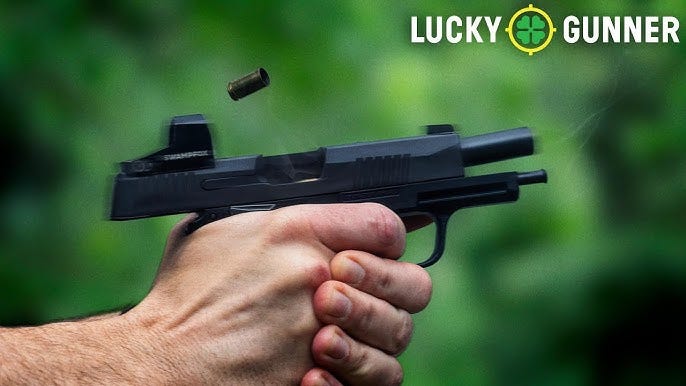
When a firearm discharges, an explosion occurs inside its chamber. Gunpowder burns rapidly, generating expanding gases that push the bullet forward through the barrel. According to Newton’s Third Law of Motion — for every action, there is an equal and opposite reaction — the forward motion of the bullet must be balanced by an equal backward motion on the gun itself. This backward motion is called recoil.
The Equation Behind the Kick
The recoil velocity (V₍r₎) can be expressed as:
V(r)=m(b)×V(b)m(g)V₍r₎ = \frac{m₍b₎ × V₍b₎}{m₍g₎}V(r)=m(g)m(b)×V(b)
Where:
- m₍b₎ = mass of the bullet
- V₍b₎ = velocity of the bullet
- m₍g₎ = mass of the gun
Let’s say a 9mm bullet (mass = 0.008 kg) exits the barrel at 350 m/s, and the gun weighs 1 kg. Then,
V(r)=0.008×3501=2.8m/sV₍r₎ = \frac{0.008 × 350}{1} = 2.8 m/sV(r)=10.008×350=2.8m/s
That means the gun moves backward at 2.8 meters per second — fast enough to cause visible injury if the shooter is unprepared or holding the weapon improperly. In larger firearms, such as shotguns or rifles, this force increases dramatically.
Physics doesn’t discriminate between professionals and amateurs. The laws of motion respond to energy, not experience.
2. The Human Factor: Biomechanics of Mishandling a Gun
The boy in the video didn’t understand that the gun in his hands was a controlled explosion waiting to release energy. When he fired, his stance, grip, and body alignment were completely wrong. To understand why this caused injury, we need to look at the biomechanics of recoil.
Improper Stance
The human body absorbs recoil through its skeletal alignment. A proper stance — knees bent, shoulders forward, elbows slightly flexed — distributes the energy through the arms and torso. The boy, standing upright and relaxed, provided no resistance. The force had nowhere to go except directly into his face.
Grip and Control
A weak or unbalanced grip fails to counteract the rotational torque of the firearm. When the gun recoiled, it pivoted upward, converting linear momentum into rotational motion — a phenomenon called muzzle rise. The boy’s poor grip allowed the gun to swing backward and hit him.
Reaction Time
The average human reaction time to unexpected force is around 200 milliseconds. Recoil happens in less than 10 milliseconds. In other words, by the time the boy even realized what was happening, physics had already completed its lesson.
3. Firearms as Energy Sources: The HSE Perspective
From an HSE standpoint, a firearm isn’t a weapon — it’s an energy source. Every safety professional knows that any system storing or releasing energy poses inherent risks. Whether that energy is mechanical, chemical, thermal, or electrical, it must be controlled, contained, and respected.
Hazard Identification
In HSE terms, the firearm is the hazard — a potential source of harm. The act of firing creates a hazardous event involving kinetic energy, combustion, noise, and pressure. The risk arises when an untrained or unaware individual interacts with that hazard.
Risk Assessment
The risk equation is simple:
Risk = Probability × Consequence
In the boy’s case, both were high:
- Probability: He lacked training, making mishandling almost certain.
- Consequence: Facial injury or even death.
That results in an intolerable level of risk, violating every basic safety principle.
Hierarchy of Controls
Applying the Hierarchy of Controls to this scenario:
- Elimination: Keep firearms away from minors or untrained individuals.
- Substitution: Use simulation guns or airsoft replicas for education.
- Engineering Controls: Trigger locks, safety mechanisms, and secured storage.
- Administrative Controls: Training, supervision, and procedural controls.
- PPE: Eye and ear protection, though not a substitute for proper control.
If even one of these levels had been applied, the incident would never have occurred.
4. The Physics of Workplace Safety: Recoil in Other Forms
What happened with the gun is not unique to firearms. The principle of recoil applies across industries — wherever energy is released without control.
Compressed Gas and Pressure Systems
In oil and gas, pressure systems store tremendous energy. A sudden valve release or pipe burst produces the same reactive force as a gunshot, launching debris at lethal speeds. This is called stored energy release, and it’s responsible for many fatal incidents each year.
Hydraulic Recoil
Hydraulic lines under pressure can “whip” violently when ruptured — mirroring the backward motion of firearm recoil. Workers caught in this reaction zone often suffer fractures or amputations. Again, energy plus human error equals tragedy.
Mechanical Recoil in Tools
Even handheld power tools demonstrate this principle. A grinder kickback or drill slip occurs for the same reason — a reactionary force when resistance changes. Understanding this makes workers appreciate how physics is the silent partner in every safety breach.
5. Human Error and Behavioral Safety
At the root of most safety incidents lies human behavior. The boy’s mistake wasn’t the trigger pull — it was his attitude. He didn’t perceive risk because he lacked experience and supervision.
Behavioral safety science tells us that people often underestimate low-frequency, high-impact events. The brain normalizes routine actions, and unless trained, we assume control even when we don’t have it.
Complacency and Risk Perception
The illusion of safety is the most dangerous form of risk. The boy thought the gun was manageable because it looked small and familiar. Workers in industry make similar assumptions daily — “I’ve done this a hundred times” is the most common prelude to an accident.
Training and Supervision
Every HSE framework — from NEBOSH to ISO 45001 — emphasizes competency. Competency isn’t just knowledge; it’s skill, judgment, and attitude combined. Training without supervision is half a measure; supervision without enforcement is useless.
The absence of either leads to preventable injuries — like this one.
6. Legal and Ethical Implications
In professional settings, this incident would qualify as a failure to control hazards. Under OSHA’s General Duty Clause, employers must provide a workplace “free from recognized hazards likely to cause death or serious harm.” Allowing untrained personnel to handle high-energy equipment violates this clause.
From an ethical standpoint, guardians and adults have a moral duty to restrict access to firearms. Safety doesn’t end with rules — it begins with responsibility. A child’s ignorance is forgivable; an adult’s negligence is not.
7. Lessons for HSE Professionals
This video offers powerful teaching material for HSE trainers. It demonstrates:
- The real-world impact of kinetic energy.
- The consequences of ignoring control barriers.
- The importance of behavioral conditioning and awareness.
Incorporating physics-based explanations in safety training helps workers understand why certain precautions exist. When people grasp the energy relationships behind hazards, compliance turns into conviction.
For instance:
- Demonstrating recoil can help welders respect the power of compressed cylinders.
- Showing video slow-motion of kickback can train mechanics to anticipate reaction forces.
- Using energy analogies can improve hazard communication across technical teams.
In short, when physics meets safety education, understanding replaces ignorance.
8. Preventing the Next Incident: The Safety Chain
Every accident occurs because of a broken safety chain — a sequence of failed barriers that should have stopped it. In the case of the boy and the gun, here’s the chain:
- Unsafe Condition: Loaded firearm accessible to a child.
- Unsafe Act: The child pointing and firing without knowledge.
- Lack of Control: No supervision or restriction.
- Event: Trigger pulled, recoil occurs.
- Outcome: Injury due to energy release.
Breaking even one link in this chain — locking the gun, educating the child, or simply supervising — would have prevented the outcome. That’s how proactive safety works.
9. Physics as a Safety Teacher
Physics is not just theory — it’s the operating manual of the universe. Every explosion, every recoil, every fall obeys its rules. When HSE professionals teach safety, they are essentially teaching applied physics.
The formula for momentum, force, or energy transfer is not abstract — it predicts exactly what happens when humans underestimate energy.
For example:
- Kinetic energy (E = ½mv²) explains why even small bullets cause large damage.
- Impulse (FΔt) shows how duration of contact affects impact severity.
- F = ma proves that the same mass under acceleration can exert tremendous force.
The more we integrate these lessons into HSE culture, the fewer incidents we’ll see — not just with guns, but with machines, vehicles, and tools.
Conclusion: Every Action Has a Reaction
The video of a boy struck by his own gun recoil is not just a moment of folly — it’s a microcosm of how safety fails everywhere. The physics is universal, and so is the lesson: energy must be respected.
Whether you’re firing a gun, tightening a valve, or starting a compressor, the laws of motion are always at play. They never forgive ignorance. The boy’s injury is a physical manifestation of Newton’s Third Law — an equal and opposite reaction to carelessness.
As HSE professionals, our mission is to turn such moments into learning opportunities. Every accident is a lesson in applied physics, and every lesson ignored is a risk multiplied.
So, the next time someone handles a tool, machine, or weapon with overconfidence, remember:
Physics doesn’t care who you are. It only cares about balance.
And in safety, as in physics, balance is everything.
메타데이터
- post_id
- fbec1259d86e
- slug
- recoil-reaction-and-responsibility-the-physics-and-hse-lessons-behind-mishandling-a-gun-fbec1259d86e
- url
- https://medium.com/@usmanzafar4321/recoil-reaction-and-responsibility-the-physics-and-hse-lessons-behind-mishandling-a-gun-fbec1259d86e
- canonical_url
- https://medium.com/@usmanzafar4321/recoil-reaction-and-responsibility-the-physics-and-hse-lessons-behind-mishandling-a-gun-fbec1259d86e
- author_url
- https://medium.com/@usmanzafar4321
- status
- ok
- fetched_at
- 2026-07-17 00:53:25