The Brain Doesn’t Play One Slow Wave During Deep Sleep — It Plays an Entire Orchestra
How the cortex, hippocampus, thalamus, and brainstem conduct a symphony of rhythms while you sleep
The Brain Doesn’t Play One Slow Wave During Deep Sleep — It Plays an Entire Orchestra
How the cortex, hippocampus, thalamus, and brainstem conduct a symphony of rhythms while you sleep
When people talk about slow-wave sleep, they usually imagine one thing: a single, slow, brain-wide wave rolling across the cortex like a tide. Neurons switch on and off in unison. The brain drifts into deep rest.
That picture is not wrong. But it’s missing most of the story.
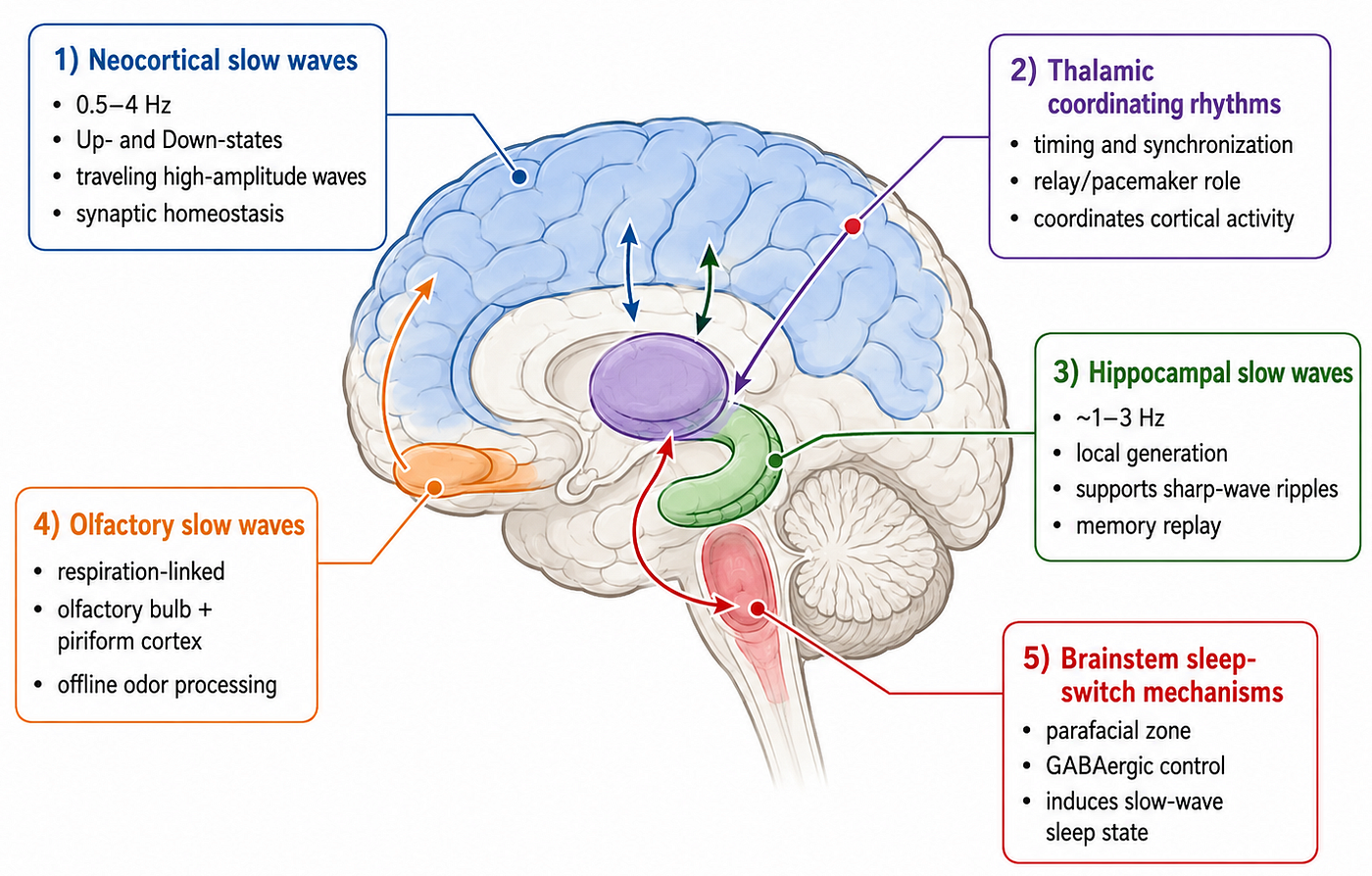
The sleeping brain doesn’t produce one slow wave. It produces five different kinds of slow oscillations — each in a different place, each with its own shape, frequency, and job. Some repair synapses. Some replay the day’s memories. Some reorganize smell memories. Some keep the timing tight. Some flip the switch that turns deep sleep on.
The brain isn’t humming one note during deep sleep. It’s running a coordinated network of slow rhythms at the same time.
1. Cortical Slow Waves: The Engine of Deep Sleep
The most famous slow waves are cortical slow waves. These are the high-amplitude, 0.5–4 Hz oscillations that define deep non-REM sleep on an EEG. They arise mainly in the neocortex, where neurons alternate between:
- an “up” state (firing actively)
- a “down” state (barely firing)
This gives cortical slow waves their signature look: large, synchronized waves that can travel across wide areas of the brain.
Their main job? Synaptic homeostasis. During the day, learning strengthens synapses. If this kept piling up, the brain would become overloaded, noisy, and metabolically expensive. Cortical slow waves help downscale synapses overnight, preserving what matters while trimming the excess.
They’re not just a marker of deep sleep. They’re part of the brain’s nightly maintenance crew.
And even these “global” waves aren’t perfectly global. They can start locally, travel across the cortex, and vary by region. Some parts of the brain can be in deep slow-wave sleep while others are still lighter.
2. Thalamic Rhythms: The Brain’s Timing Grid
The thalamus is often called a “relay station.” That’s true — but it undersells its real role in slow-wave sleep.
The thalamus is the timing system. It helps coordinate when and how slow oscillations line up across distant brain regions. For memory consolidation to work, different events must happen at the right phase of the slow wave.
The thalamus aligns:
- cortical slow waves
- sleep spindles
- hippocampal ripples
into a coordinated sequence. Think of it as the timing grid that keeps the whole system from falling into chaos. Without this coordination, memory replay would be random and inefficient.
3. Hippocampal Slow Waves: The Memory Replay Rhythm
The hippocampus adds a completely different kind of slow activity.
For a long time, scientists thought hippocampal slow activity was just a echo of cortical slow waves. That view is too simple. The hippocampus can generate its own slow oscillatory dynamics, and they are tightly tied to memory processing.
These rhythms help organize sharp-wave ripples — brief, high-frequency bursts that carry the actual memory content.
- Cortical slow waves create a broad sleep state.
- Hippocampal slow waves structure when memory information is replayed.
The slow rhythm provides the temporal window. The ripple carries the memory.
In simple terms: Cortical slow waves restore the system. Hippocampal slow waves replay the day.
4. Olfactory Slow Waves: Smell, Breath, and Sleep
The olfactory system shows why “slow wave” is not a single category.
The olfactory bulb and piriform cortex produce slow-wave-like activity during sleep that is tightly linked to breathing and odor processing. These rhythms are different from cortical and hippocampal slow waves in key ways:
- They are slower and more respiratory-coupled.
- They are sensory-linked, not globally synchronized.
- They are functionally tied to odor memory.
These olfactory slow waves are not mainly about global sleep depth or broad memory replay. They support the offline reorganization of smell memories, refining which odor associations are strengthened, weakened, or reorganized while you sleep.
This is a distinct kind of slow wave: sensory, breath-linked, and specialized for odor memory.
5. Brainstem Slow-Wave Control: The Sleep Switch
The brainstem does not generate slow waves like the cortex or hippocampus. But it controls whether the brain enters a slow-wave state at all.
Regions such as the parafacial zone in the medulla contain neurons that promote slow-wave sleep. When these neurons are active, they:
- push the brain toward deep non-REM sleep
- increase slow-wave activity across larger networks
The brainstem is a regulator, not a memory processor. Its job is to help initiate and stabilize the state in which synaptic downscaling, memory replay, and sensory reorganization can happen.
Without this regulatory system, the cortex, thalamus, hippocampus, and sensory systems would not coordinate properly. The brainstem is the switch that turns the whole slow-wave system on.
Different Slow Waves, Different Jobs
Once you look across systems, it becomes clear that “slow wave” hides a lot of biological diversity:
- Cortical slow waves are large, traveling, and strongly linked to synaptic regulation.
- Thalamic rhythms help coordinate timing between brain regions.
- Hippocampal slow waves are more local and closely tied to memory replay.
- Olfactory slow waves support sensory reorganization and odor memory.
- Brainstem circuits help trigger and stabilize the slow-wave state.
These are not separate in the sense that they operate in isolation. They are separate in the sense that they have different origins, properties, and functions.
The key point is that slow waves are both diverse and connected.
Why This Distinction Matters
Treating slow-wave activity as one single thing can be misleading. If you group all slow waves together, you miss their specialization. You miss the fact that a slow wave in the cortex is not doing exactly the same thing as a slow rhythm in the hippocampus or olfactory system.
You also miss the possibility that different sleep disorders, aging processes, or neurological diseases may affect different slow-wave systems in different ways:
- Aging may reduce cortical slow-wave strength.
- Memory disorders may disrupt hippocampal replay.
- Sensory or emotional disturbances may involve altered coordination between olfactory, limbic, and cortical systems.
- Sleep problems may arise not only because slow waves are weaker, but because the wrong slow-wave systems are failing to coordinate.
The better question is not “How much slow-wave sleep did someone get?” The better question is: “Which slow-wave systems were active, what were they doing, and how well were they connected?”
Slow Waves Are a Family, Not a Single Event
Slow-wave sleep is still one of the deepest and most restorative states of the brain. That remains true.
But the slow waves of sleep are not one uniform rhythm. They are a family of oscillations distributed across neural systems. The cortex, thalamus, hippocampus, olfactory system, and brainstem each contribute in different ways.

Some slow waves restore synaptic balance. Some coordinate memory replay. Some reorganize sensory information. Some regulate the transition into deep sleep. Their functions differ, but their timing is connected.
The real beauty of slow-wave sleep is not that the brain shuts down into one simple rhythm. It is that many rhythms, each with its own function, become coordinated into a larger biological conversation.
References
- Tononi G, Cirelli C. Sleep and synaptic homeostasis: a hypothesis. Brain Res Bull. 2003;62(2):143–150.
- Tononi G, Cirelli C. Sleep function and synaptic homeostasis. Sleep Med Rev. 2006;10(1):49–62.
- Steriade M, McCarley RW. Brain Control of Wakefulness and Sleep. 2nd ed. Springer; 2005.
- Massimini M, et al. The sleep slow oscillation as a traveling wave. J Neurosci. 2004;24(31):6862–6870.
- Diekelmann S, Born J. The memory function of sleep. Nat Rev Neurosci. 2010;11(2):114–126.
- Staresina BP, et al. Hierarchical nesting of slow oscillations, spindles and ripples in the human hippocampus during sleep. Nat Neurosci. 2015;18(11):1679–1686.
- Buzsáki G. Two-stage model of memory trace formation: a role for “noisy” brain states. Neuroscience. 1989;31(3):551–570.
- Postma A, et al. Slow-waves in the olfactory system. Trends Neurosci. 2006.
- Cirelli C, Tononi G. GABAergic parafacial zone is a medullary slow-wave-sleep-promoting center. Nat Neurosci. 2008.
- Zheng Y, et al. Breathing coordinates hippocampal brain waves to strengthen memory while we sleep. Northwestern Medicine. 2024.
메타데이터
- post_id
- fbeed6f537b6
- slug
- the-brain-doesnt-play-one-slow-wave-during-deep-sleep-it-plays-an-entire-orchestra-fbeed6f537b6
- url
- https://medium.com/@dgurve/the-brain-doesnt-play-one-slow-wave-during-deep-sleep-it-plays-an-entire-orchestra-fbeed6f537b6
- canonical_url
- https://medium.com/@dgurve/the-brain-doesnt-play-one-slow-wave-during-deep-sleep-it-plays-an-entire-orchestra-fbeed6f537b6
- author_url
- https://medium.com/@dgurve
- status
- ok
- fetched_at
- 2026-06-11 05:11:55