Pakistan Calls for International Action on the Plastic Crisis
But will global support work without political will at home? I report from the streets of Peshawar
Pakistan Calls for International Action on the Plastic Crisis
But will global support work without political will at home?
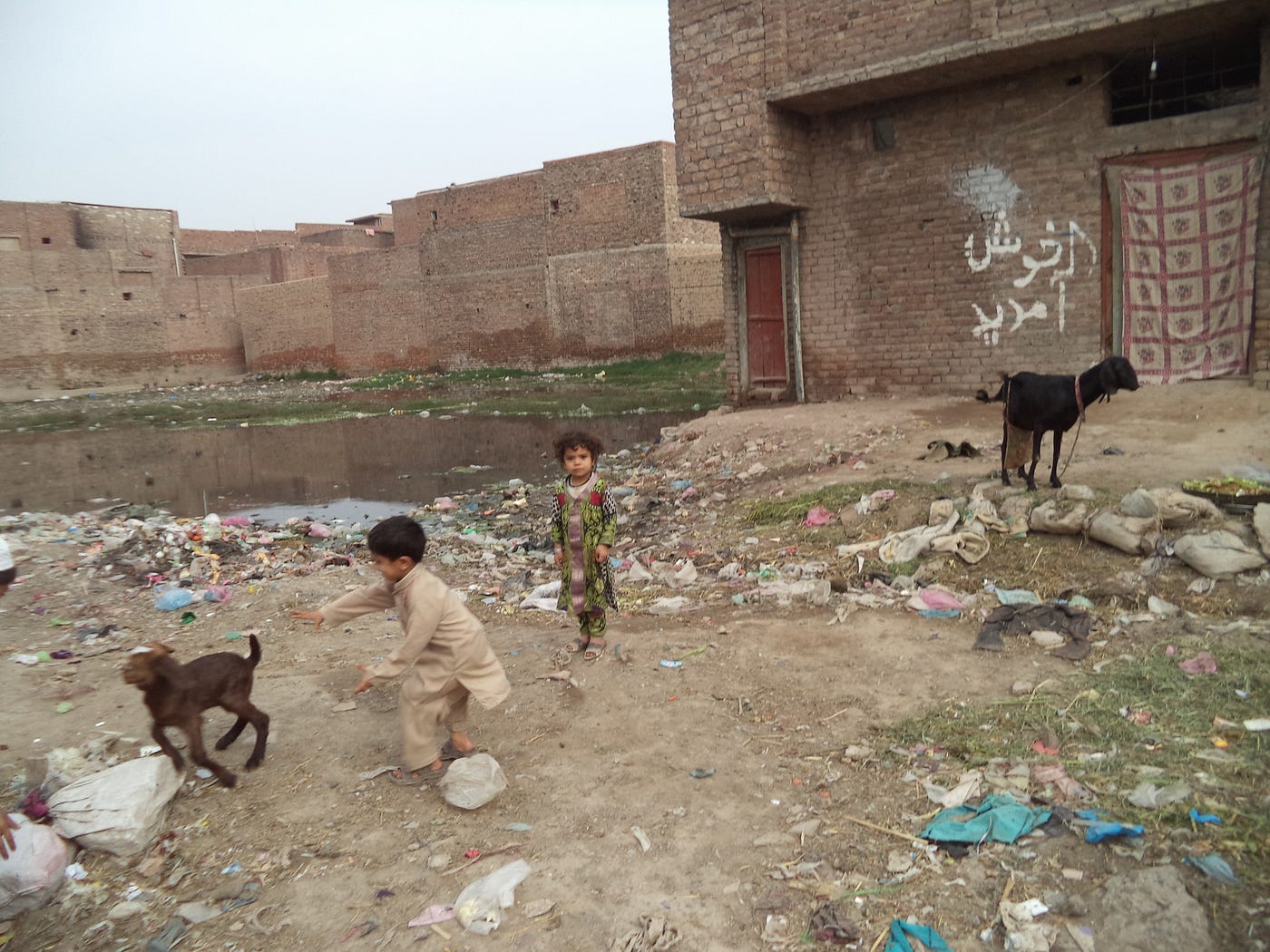
A child is playing with his goat beside garbage-strewn area and stagnant water in Peshawar, Pakistan. Photo by the author
An energetic child — unaware of the silent danger around him— is playing with his pet goat on a muddy ground outside his home. The front area and a plot next to his house are overwhelmed with unattended waste and dirty water, exposing residents, including children, to significant environmental and health risks.
This scene is not unique in a country that has one of the highest rates of mismanaged plastic in South Asia. In many vicinities across my country, plastic waste has become a persistent feature of daily life, clogging drains, contaminating the environment, and threatening public health.
In Pakistan, the ubiquity of plastic waste is reaching a tipping point, as the country ranked sixth globally and third in Asia among plastic waste generators.
According to Pakistan’s Ministry of Climate Change and Environment Coordination, Pakistan is estimated to generate 3.9 million tonnes of plastic waste annually, of which only 4–9 percent is recycled. The ministry stated that most plastic waste ends up in dumping sites, water channels, municipal landfills, and sewer drains, contributing to serious environmental pollution.
Yet Pakistan’s plastic burden is not limited to waste generated within its borders. The country becomes an international dumpsite for hazardous waste, raising questions about environmental justice and waste governance.
Pakistan’s Federal Minister for Climate Change and Environmental Coordination, Dr Musadik Malik, has said, “Plastic pollution is not just an environmental issue, it’s an issue of justice, fairness, and sovereignty.” Dr. Malik pointed out that wealthy nations consume plastics at rates up to 20 times higher than many developing countries, yet export low-value, contaminated, or non-recyclable waste to poorer nations such as Pakistan.
The combination of domestically generated and imported waste and its improper disposal has made it difficult for the government to tackle the crisis on its own. So it is now calling for global support.
Why global support matters?
In practical terms, no country can tackle plastic pollution alone, as it is a global threat and a transboundary problem that requires coordinated international action. Without international cooperation, the global plastic crisis cannot be tackled, no matter how fascinating the policies are, as only policies are not enough. World Trade Organization (WTO), Deputy Director-General Jean-Marie Paugam said
“Without international cooperation, the policies that countries introduce to tackle plastic pollution may cause problems and be ineffective.”
To curb plastic waste, a robust infrastructure, state-of-the-art technology, adequate recycling facilities, and improved landfill management are required. Pakistan lacks these facilities, which is why Islamabad is seeking international support to tackle plastic waste. Pakistan’s Prime Minister Shahbaz Sharif said:
“Plastic waste has reached alarming levels across the globe — and Pakistan is no exception. He emphasized that bold and collective international actions are inevitable to curb pollution and protect the environment.”
A crisis of policy and enforcement
In Pakistan, plastic waste is not merely an environmental issue; it is also a political problem marked by weak enforcement, poor governance, and corruption. This politico-environmental problem has become a daunting challenge, and various politicians, environmentalists, and activists raise concerns, urging the government to take pragmatic measures to tackle the growing crisis. Vice President of the Pakistan People’s Party, Senator Sherry Rehman, told The Express Tribune newspaper,
“Pakistan is grappling with severe plastic pollution, with an estimated annual consumption of 55 billion plastic bags, and is expected to rise by 15% each year…Despite multiple efforts to curb the use of plastic bags, success has been elusive due to a lack of alternatives, slow implementation, and insufficient public awareness.”
Although Pakistan has taken various measures to curb plastic waste — including introducing legislation to mitigate plastic waste, joining the World Economic Forum’s Global Plastic Action Partnership (GPAP), and signing the Basel Convention — the country continues to grapple with a growing plastic waste crisis.
Pakistan’s mounting plastic waste crisis highlights a lack of political will, weak governance, corruption, limited public awareness, and the gap between policy commitments and actions on the ground.
Without addressing these challenges, international cooperation may struggle to achieve its intended impact. It is feared that funds could be embezzled, resources mismanaged, and the gap between promises and implementation could widen further
Without transparency, accountability, and effective enforcement, Pakistan risks losing the confidence of international partners. Such failures would not only undermine global cooperation but also deepen the plastic waste crisis, allowing waste to continue accumulating in landfills, waterways, and communities across the country.
A threat disguised as a treasure
Millions of people are already at risk from plastic waste — especially those exposed to it directly — disproportionately vulnerable to waste-borne diseases. Sadly, many people, including children, perceive the threat of waste as a treasure.
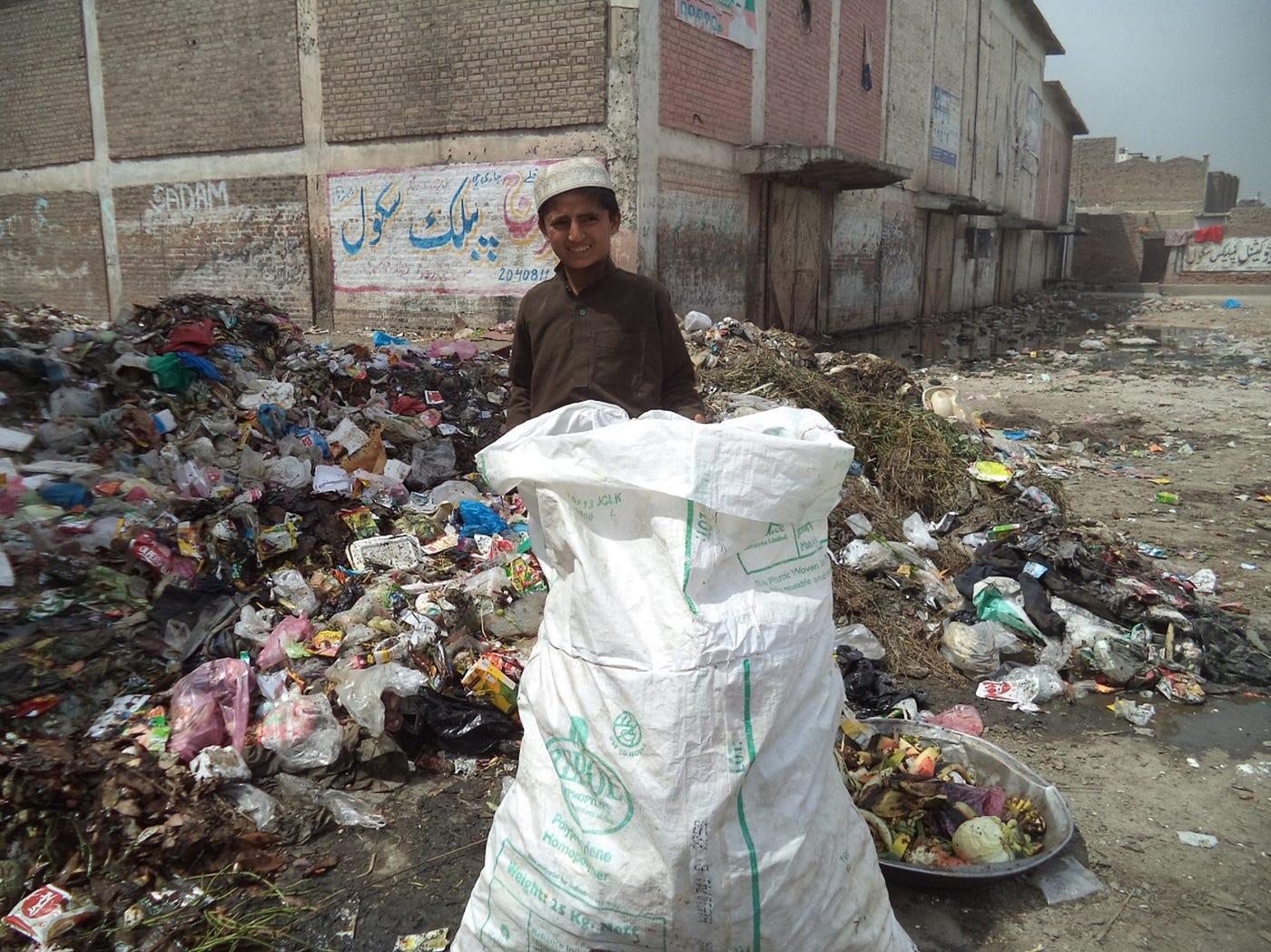
Nasir Khan , a waste-picker poses for a photo in Peshawar, Pakistan. Photo by the author
Nasir Khan, a waste-picker, wearing a dark brown dress and a white cap on his head, pointing a finger towards the waste, tells me:
“For me, this plastic waste is not trash, it’s a treasure.”
He elaborated,
“People don’t like to touch it, but I sort through it and collect things such as plastic bottles, and bottle caps to earn a living and put food on my family’s table.”
He collects waste with his bare hands and earns £2 a day.
“Yeah, my work is risky, as sometimes my hands get injured due to broken glass or blades in the trash, but life itself is a risk. Many people, such as firefighters and doctors, put their lives in danger for their families, and I’m doing the same,”
When I ask him about the risk associated with his livelihood, he replied,
“I’m aware of the health risks of my work, but if it (waste) feeds my family, then who cares about health?”
For many informal waste pickers, like Nasir, plastic waste is a source of livelihood. Some garbage collectors understand the dangers of plastic waste, while others are unaware of them. Those who know the hazards of plastic waste have no choice but to deal with it to survive.
In Pakistan, thousands of informal waste pickers — the backbone of the country’s recycling sector — earn amid severe health and environmental hazards. The waste they collect and sell may provide a livelihood, but it also exposes them to daily risks that threaten their health and, in some cases, their lives.

Waste collectors gather recyclable plastic from a open dumpsite along the roadside as a stray dog sits nearby poses threat in Peshawar, Pakistan. Photo by the author
A growing crisis
Plastic waste poses an existential threat to the people and environment, and its exponential growth is an alarming indicator of a deepening environmental crisis.
The residents of Peshawar told me, “Open dumping in the residential areas and overflowing garbage containers make lives miserable for them.” Inayatullah Hafeez, a resident of Gulbahar, Peshawar, said, “The unbearable stink of the garbage makes it difficult for us to breathe. He said, “The unattended waste attracts flies, rats, and dogs, posing locals vulnerable to dog bites and environmental diseases.”
Another resident, Hidayat Allah, said,
“The accumulated waste not only underscores poor waste management and unsatisfactory sanitation but also reveals a lack of political commitment to tackle the issue.”
Mismanaged plastic waste is detrimental to human health and the ecosystem. Scientists and researchers say that 99% of plastics are made from fossil feedstocks that release greenhouse gases and contribute to global warming. These gases warm the Earth by trapping heat in the air, posing a serious threat to people and the environment. A single standard plastic bag takes 1,000 years to degrade in a landfill.
As plastic breaks down in the environment, it can act as a carrier for pathogens and toxic substances that may enter the human body through water, food, or air. Once it enters the human body, it can lead to cardiovascular diseases, disability, diabetes, neurodegenerative diseases, stillbirths, birth defects, chronic inflammation, and other potentially life-threatening conditions.
In the environment, plastic pollution can also contribute to the spread of vector-borne and water-borne diseases, as well as respiratory illnesses such as asthma.
Pakistan — one of the most vulnerable countries to climate change — is experiencing accelerated warming, with growing plastic waste exacerbating the situation.
The UN expressed concern over the rising plastic pollution in Pakistan. The UN, in its report entitled “Rethinking Pakistan’s relationship with Plastic,” revealed that the volume of Pakistan’s plastic waste is equivalent to the height of two K2 Mountains, the world’s second-highest mountain.
Commitments Without Substantive Action
Understandably, then, Pakistan has joined calls for stronger global action to address plastic pollution.
However, meaningful progress at home will depend on more than international commitments. Pakistan’s plastic crisis is often framed as a waste management problem, but the issue runs deeper. and needs a serious approach. The country has no shortage of promising policies, pledges, or international commitments. The greater challenge lies in translating those commitments into effective action, supported by domestic implementation and coordinated global cooperation.
Global support can help Pakistan tackle its plastic crisis, but without true accountability, transparency, effective implementation, and enforcement at home, plastic waste will only accumulate — and waste pickers like Nasir will continue to ply a dangerous trade.
메타데이터
- post_id
- fbf08a992837
- slug
- pakistan-calls-for-international-action-on-the-plastic-crisis-fbf08a992837
- url
- https://medium.com/the-new-climate/pakistan-calls-for-international-action-on-the-plastic-crisis-fbf08a992837
- canonical_url
- https://medium.com/the-new-climate/pakistan-calls-for-international-action-on-the-plastic-crisis-fbf08a992837
- author_url
- https://medium.com/@mahwishqayyum7860
- status
- ok
- fetched_at
- 2026-06-11 21:11:36