From Bodensee to Bilbao: Why the Future of Global Collaboration is Not Multilateral, but…
Last week, I represented the Lake Constance (Bodensee) Region at the 2nd Catalytic RITA Gathering in Euskadi, kindly hosted by the Basque…
From Bodensee to Bilbao: Why the Future of Global Collaboration is Not Multilateral, but Plurilateral & Polycentric
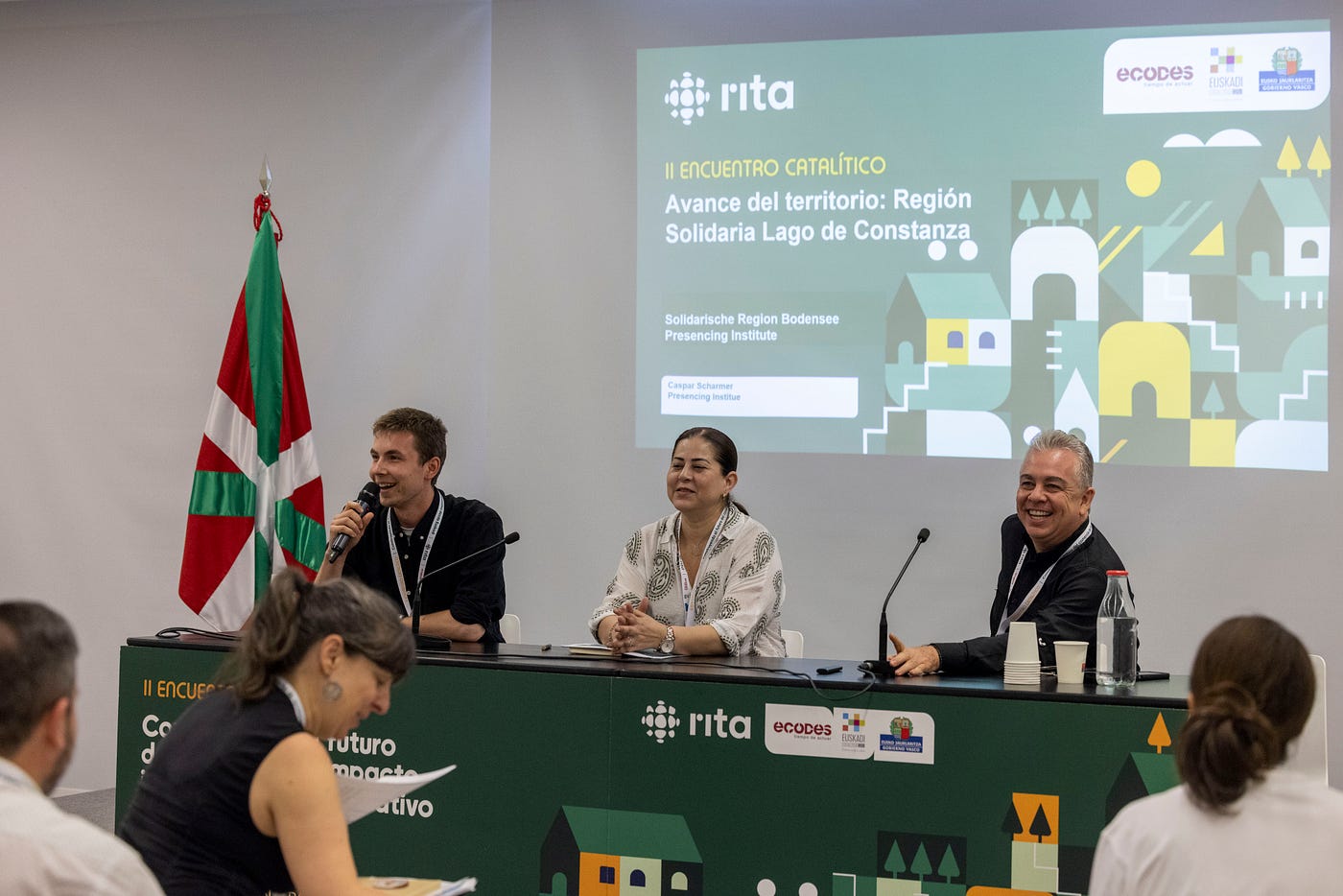
Presenting the Solidarity Region Bodensee at the RITA Gathering, Bilbao, May 2026
Last week, I represented the Lake Constance (Bodensee) Region at the 2nd Catalytic RITA Gathering in Euskadi, kindly hosted by the Basque Government and co-organized with ECODES. I also had the chance to present the Solidarity Region Bodensee, an initiative of the Presencing Institute working toward food sovereignty, regional resilience, and cross-border collaboration across the tri-national Lake Constance area, shared by Germany, Austria, and Switzerland.
RITA (the Regional Impact Trade Alliance) is a global alliance of regions that trade with purpose. Its aim is to bring together territories, local governments, businesses, investors, academia and civil society committed to building economies that regenerate rather than extract. The mission: to help regions connect locally rooted solutions with global opportunities based on trust, verifiability, and shared prosperity.
The gathering was attended by regions from across Europe and Latin America. The declaration was signed by participants from Córdoba, Mar del Plata, Mendoza, the Gran Chaco, and Mendiolaza in Argentina; Guatemala and the Cuenca del Motagua; Santiago de Chile, Valparaíso, Maule, Maipo, and Linares in Chile; Bilbao, Donostia-San Sebastián, Maó, Madrid, Aragón, and Navarra in Spain; the Recôncavo de Guanabara in Brazil; Canelones and Uruguay; Tapachula, Chiapas, Mar de Cortés, Tuxtla Gutiérrez, and Frontera Sur in Mexico; Arizona in the United States; Lille in France; Andros in Greece; Roma in Italy; and Bodensee, in Germany, Austria, and Switzerland.
The declaration titled commits the signing territories to making local solutions globally visible, driving positive-impact economies, building multi-actor alliances based on trust, developing a measurable system of interregional impact trade, and positioning regions as references of a new global economic identity.
“We are not waiting for the future to arrive. We are building it, region by region, alliance by alliance, agreement by agreement.” — Euskadi Declaration
What RITA is working toward is a Regional Impact of Origin (RIO): a verified identity built on collaboration between the public sector, private sector, civil society, and academia. Inspired by the Italian denominazione di origine, RIO applies the same logic not to a product, but to an entire region. This identity would allow regions to access markets, investment, and knowledge and to trade confidently, with others knowing where the impact comes from. Through forums, working groups, and a digital platform, regions exchange knowledge, find partners, and design collaborative deals.

Group photo, Donostia-San Sebastián, May 2026
What initiatives like RITA signal is a new emerging paradigm of international collaboration: not unilateral, not multilateral, but plurilateral and polycentric.
While this may feel new, it actually fits much closer to the historical norm than what we have grown used to.
The monopoly of nation-states over international trade and diplomacy is a surprisingly recent invention. Its foundations were laid in the French Revolution, and its institutions consolidated across the 19th and 20th centuries. For much of this period, the nation-state progressively absorbed or displaced the parallel structures that had existed alongside it like churches, guilds, city networks, and trading leagues. These were actors that, before this centralisation, had been more influential in shaping international trade and cross-border relationships than any central state authority.
Consequently, during the Middle Ages, power was distributed across many overlapping institutions: kingdoms, yes, but also the church, free cities, merchant guilds, and trade networks that operated across borders with their own rules, standards, and identities. Rather than disorder, this was a different kind of order: polycentric, layered, and in many ways more resilient than what replaced it.
One of the most striking examples is the Hanseatic League. From the 13th to the 17th century, a network of merchant cities: Lübeck, Hamburg, Bremen, Bruges, Riga, London, Danzig built a trading system stretching from the Baltic to the North Sea. No sovereign territory, no army, no head of state. What it had instead was shared standards, mutual trust, a common legal framework, and a collective identity built around a shared purpose.

One of the working groups, Bilbao, May 2026
The current breakdown of the post-Cold War unipolar order has not produced a stable multipolar world. What it has produced is something messier and more interesting: a proliferation of parallel structures, networks, alliances, and initiatives being built within and around existing institutions, not to replace them but to do what they cannot or will not do.
This is happening, in part, because the failures of current international diplomacy are impossible to ignore. Climate change, growing inequality, biodiversity loss, and the fraying of social contracts. These are challenges that the nation-state system, operating through its existing multilateral architecture, has proven unable to address at the speed and scale required. The frustration is real, and it is generative. More and more, actors who care about these issues are not waiting for permission. They are building.
RITA is not building outside the system. They are building alongside it. RITA works with governments at all levels, with foundations, with the private sector, with multilateral institutions, with universities and civil society organisations across four continents.
“The inspiration behind RITA was the Hanseatic League and the Italian denominazione di origine, a trading network built on trust, and a verification built on place.” — Pedro Tarak, co-founder of RITA
RITA’s own operating motto captures this perfectly: While System Building, Business Doing. The alliance does not wait for a complete governance framework before facilitating real exchanges between regions. It builds the system and proves it at the same time: through actual trades, actual collaborations, actual agreements between territories allowing them to learn from each one and feeding that learning back into the emerging architecture.

The Lake Constance (Bodensee) region, vineyards overlooking the lake where Germany, Austria, and Switzerland meet.
I arrived at the gathering as a representative of a young initiative still building its foundation. The Solidarity Region Bodensee has been running learning journeys, hosting dialogue spaces, piloting a consumer community initiative, slowly weaving relationships across three countries and dozens of actors.
What the week in Euskadi gave me was perspective. The Basque Country has spent decades building exactly the kind of multi-actor, multi-level ecosystem that RITA describes, and it shows. From the Mondragon cooperative network to its whole-of-society approach to the 2030 Agenda, it is a region that has turned vision into practice over generations.
Young initiatives like Bodensee have much to learn from the Basque Country, and from the regions across Latin America in the RITA alliance who are years ahead in translating this vision into reality. What the gathering showed me is that the potential of regional work is not abstract. It is concrete, proven, and already being built.
—
To learn more about the Solidarity Region Bodensee watch our most recent film here (captions available in ESP & ENG) or visit our website. Learn more about RITA at globalrita.com. Learn more about the Presencing Institute at presencing.org
메타데이터
- post_id
- fbf3584d9893
- slug
- from-bodensee-to-bilbao-why-the-future-of-global-collaboration-is-not-multilateral-but-fbf3584d9893
- url
- https://medium.com/presencing-institute-blog/from-bodensee-to-bilbao-why-the-future-of-global-collaboration-is-not-multilateral-but-fbf3584d9893
- canonical_url
- https://medium.com/presencing-institute-blog/from-bodensee-to-bilbao-why-the-future-of-global-collaboration-is-not-multilateral-but-fbf3584d9893
- author_url
- https://medium.com/@caspar.scharmer
- status
- ok
- fetched_at
- 2026-06-15 20:49:13