Proving the Pythagorean Theorem
Some algebraic and geometric proofs of the best-known theorem of all time
Proving the Pythagorean Theorem
Some algebraic and geometric proofs of the best-known theorem of all time
A right triangle is a triangle in which one of the three angles is 90°. The triangle shown below is right-angled because the angle ⦣ACB between sides a and b is 90°. The side opposite the right angle, c, is called the hypotenuse.
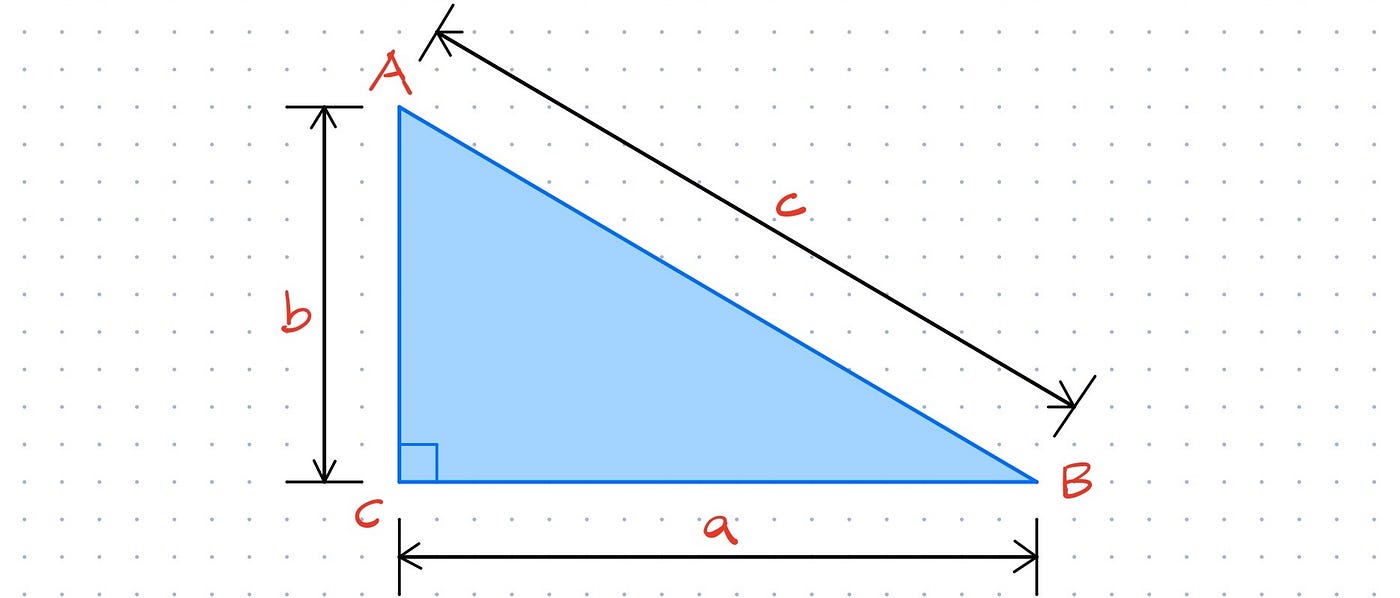
One of the most important and best-known theorems of Euclidean geometry, the Pythagorean theorem, expresses a fundamental property of right-angled triangles. It states that the square of the length of the hypotenuse of a right triangle equals the sum of the squares of the lengths of the other two sides. The equation c² = a²+b² expresses this relationship in mathematical symbols.
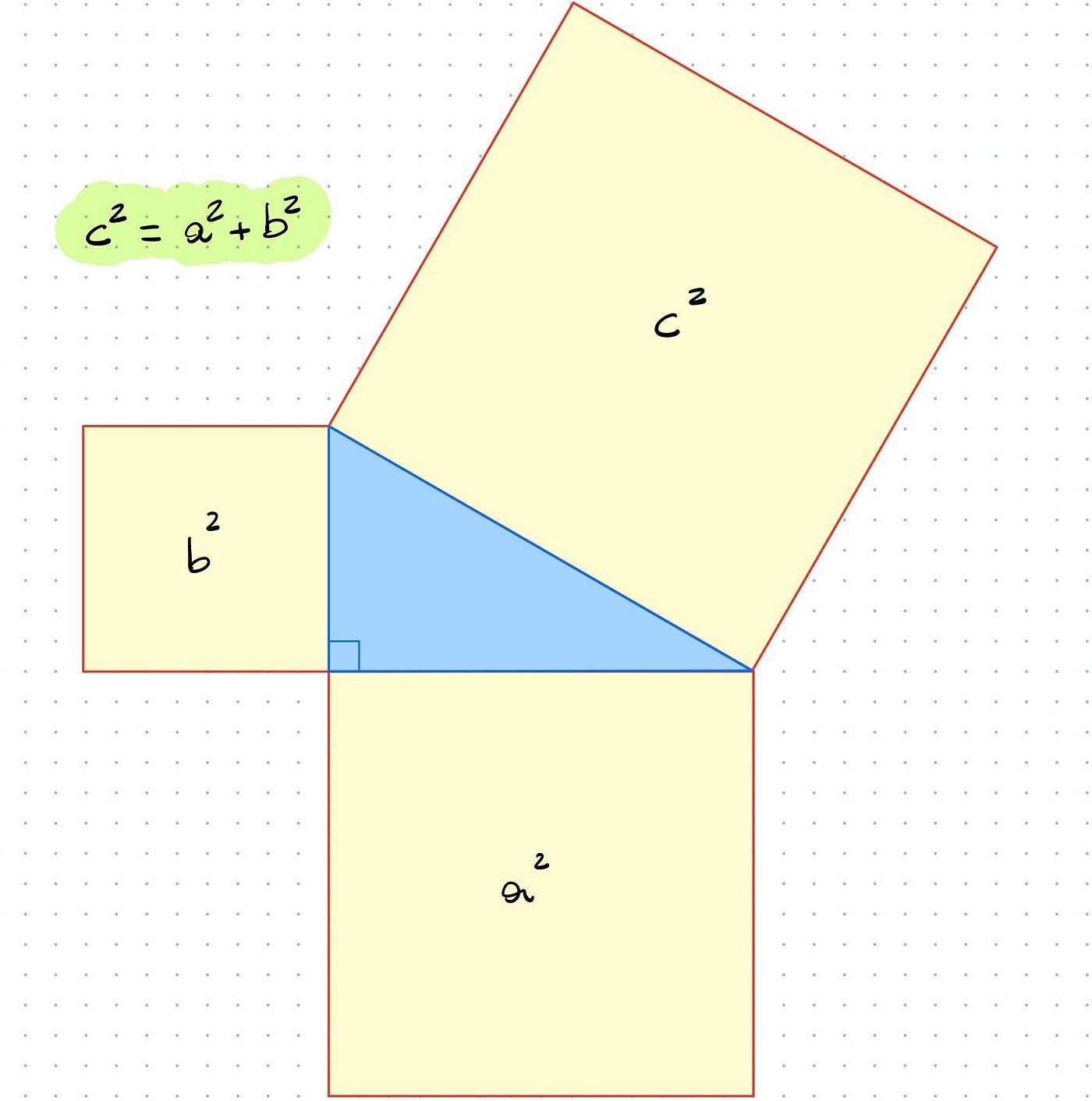
Throughout history, countless proofs of the Pythagorean theorem have been given. Below we will examine some of the best known.
The simplest and most convincing proof
The simplest and most immediately convincing proof is a geometric one based on rearranging the position of four triangles within a square, as shown in the following image.
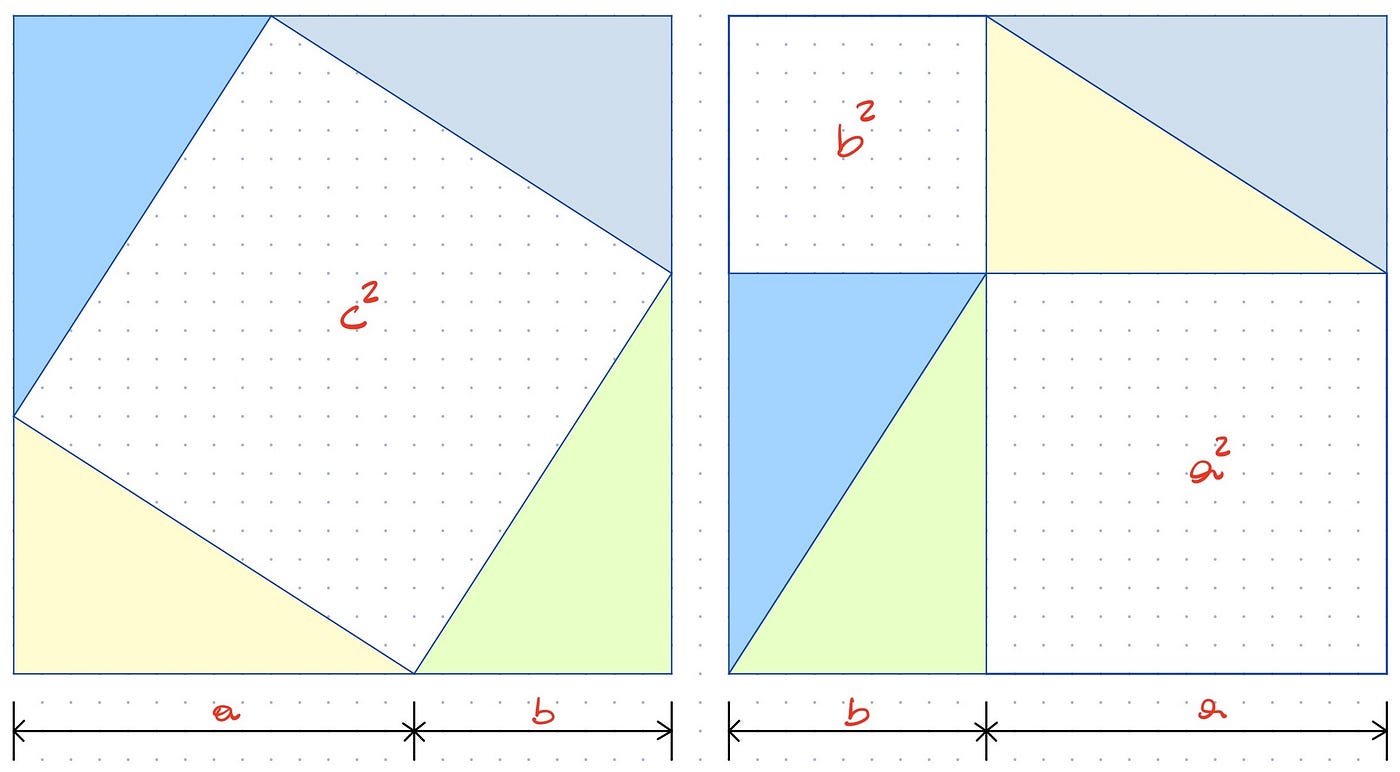
In the square on the left, four congruent right-angled triangles leave a central space of area c², corresponding to the square with the hypotenuse of each of the four triangles for its sides. The square on the right is the same as the other. The only difference is that the inner triangles have been moved so as to leave space for the formation of two internal squares, one of area a², which has sides equal to side a of each triangle, and the other of area b², whose sides are equal to side b of each triangle. The rearrangement of the triangles visually shows that the square c² is equal to the sum of the squares a² and b², as it was meant to prove.
Bhāskara’s proof
The same identity can also be proved algebraically. Let’s consider the square on the left in the image above. The length of each side is equal to the sum of sides a and b of the triangles inside it. Therefore, its area is equal to (a+b)². But we can also get the same area by adding the figures inside it, that is, the square of area c² and the four right-angled triangles. From this, it follows that the area c² of the inner square is equal to the area of the outer square (a+b)² minus the area of the four right triangles. Since the four triangles are congruent, we can write the equation:

Carrying out the calculations, we get:

Adding the like terms, it remains:

which is what we wanted to prove. This proof was given by the Indian mathematician and astronomer Bhāskara around 1150 CE.
Four triangles and a square
We can obtain another proof of the Pythagorean theorem by arranging the same four congruent right-angled triangles to form a square as in the following image.
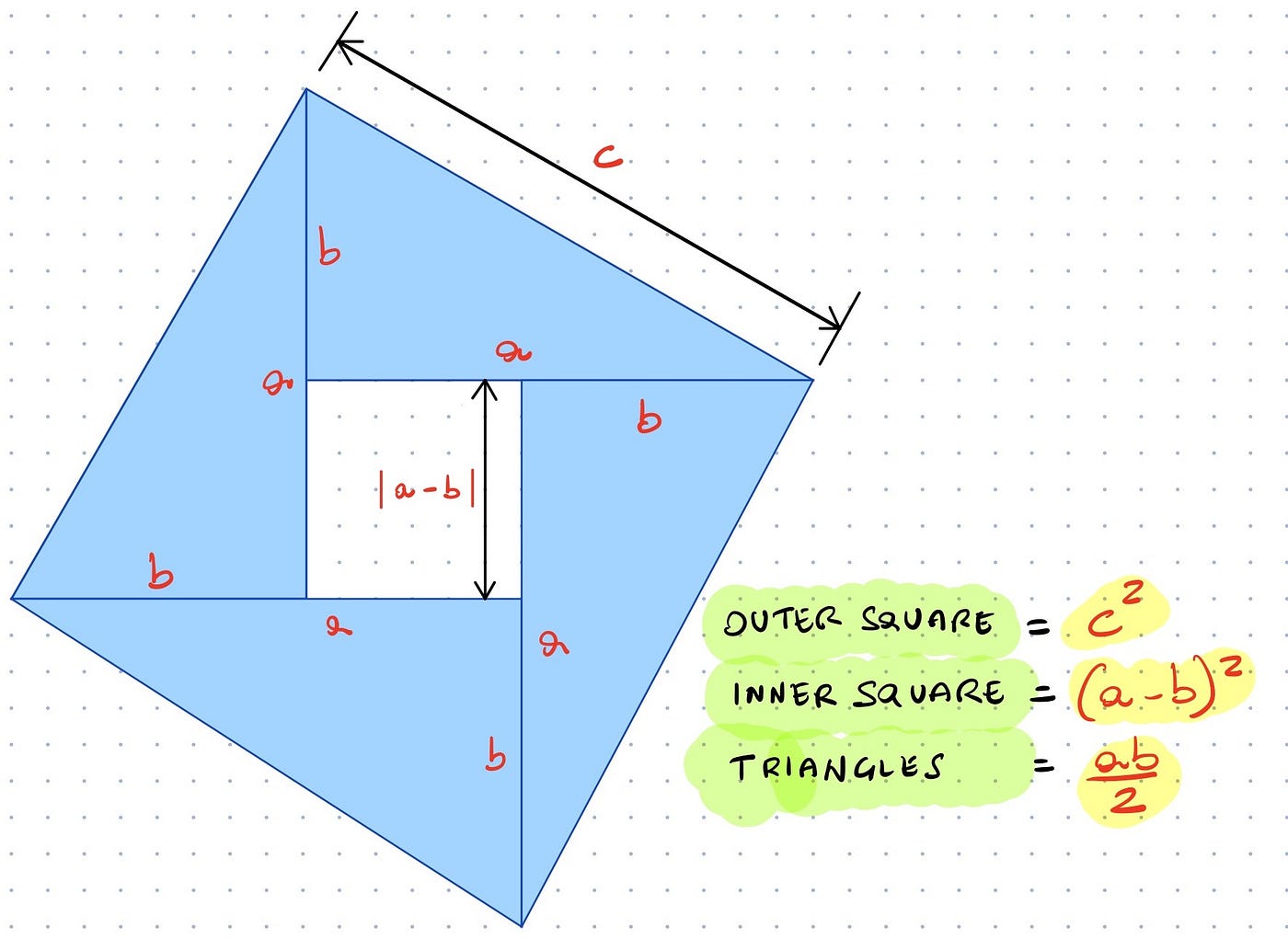
In this case, the four triangles form a square whose sides are their hypotenuses, i.e., their sides c. Thus, the area of this square is c². The space left free by the triangles in the center of the figure forms a small square, the sides of which have a length equal to the difference between side a and side b of each triangle. Therefore, the area of this inner square is (a−b)². So, we can write the following equation:

Carrying out the calculations, we get:

Again, adding the like terms we get:
which is what we wanted to prove.
Garfield’s proof
The following proof of the Pythagorean theorem was published in 1876 in the New-England Journal of Education by James Garfield, who would become the twentieth president of the United States in 1881.
Let’s consider the figure below. If we take into account only the outer edge, it is a trapezoid (or trapezium), the area of which is calculated by multiplying the half sum of the lengths of the parallel sides by the height. In this case, the sum of the parallel sides is a+b. The height is also given by a+b. Therefore, the formula for the area of this trapezoid is:

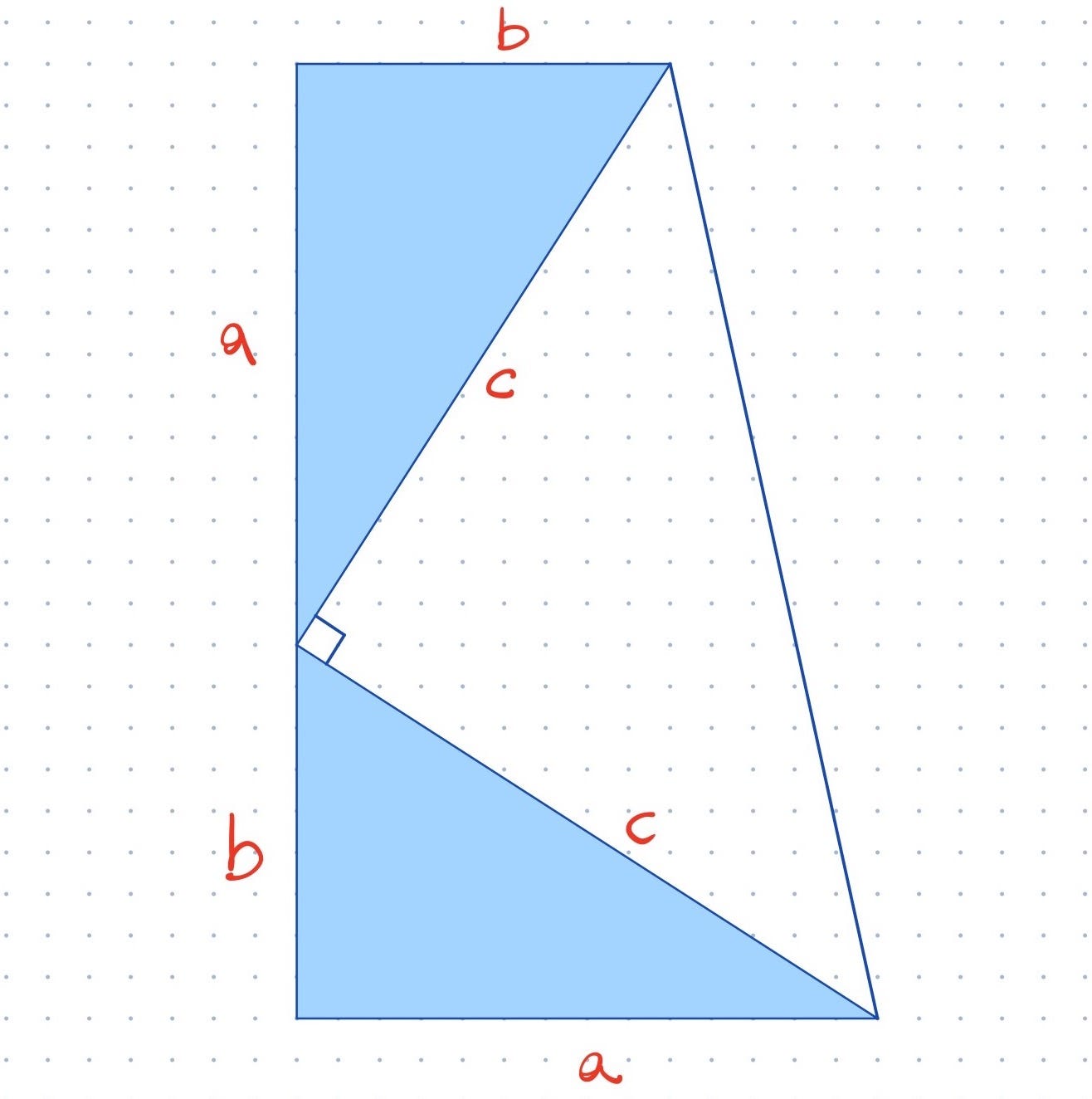
On the other hand, if we consider its internal subdivision, the area of the figure is given by the sum of the areas of three right-angled triangles, two of which are congruent. So, the total area is equal to:

Thus, equating the area of the trapezoid to that of the three triangles, we can write the equation:

Finally, carrying out the calculations, we get:

which, once again, proves the identity established by the Pythagorean theorem.
Einstein’s proof
Based on the properties of similar triangles, one of the most elegant proofs of the Pythagorean theorem is due to Einstein, who discovered it when he was just twelve years old, according to the account given by the German physicist in his autobiography.
For this proof, the only figure needed is a right triangle, like the one in the image below.
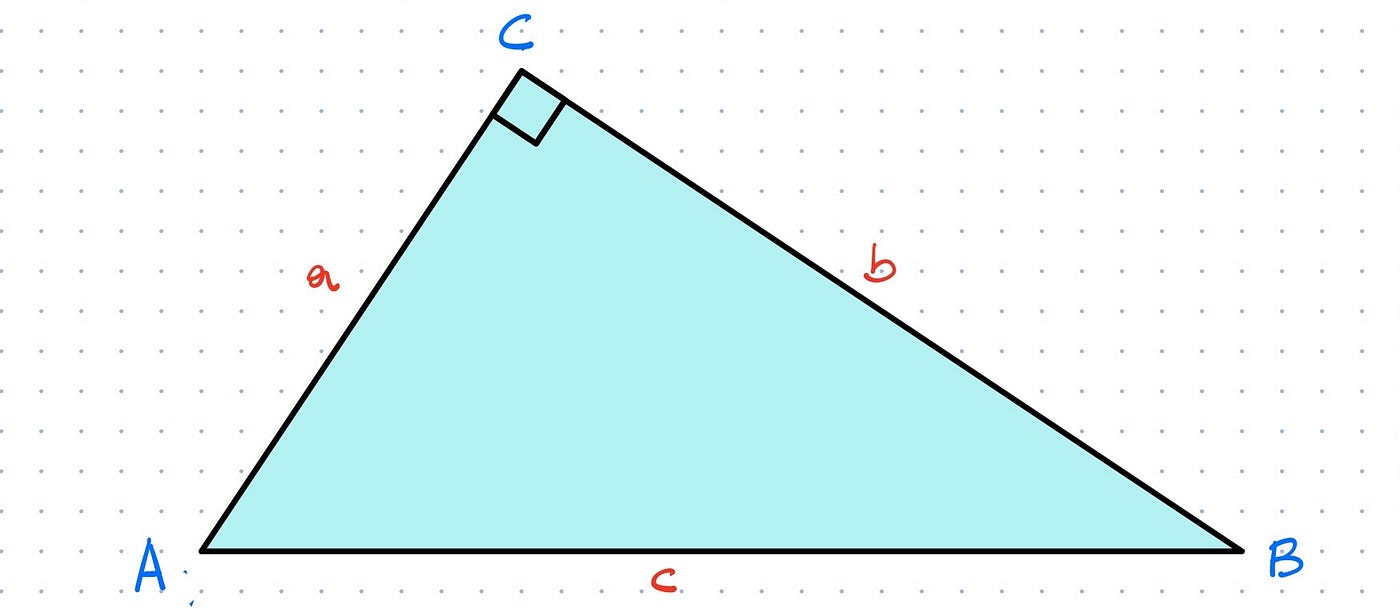
If we draw the perpendicular h from vertex C to the opposite side c, the right-angled triangle ABC is divided into two triangles ADC and DBC, both right-angled, as shown in the following image. As can easily be deduced from the figure, the sum of the areas of the inner triangles ADC and DBC is equal to the area of the outer triangle ABC.
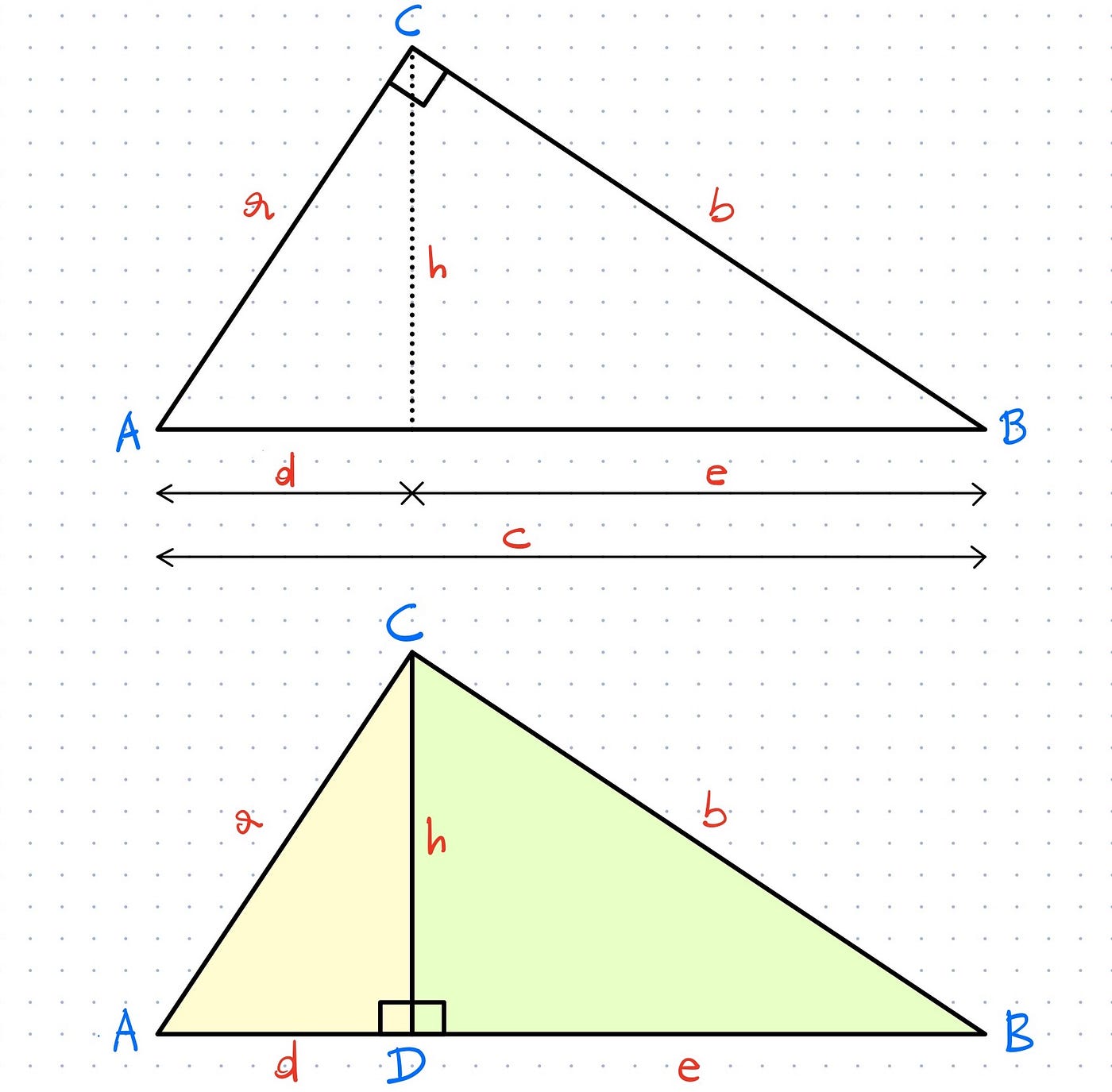
The key point in drawing the perpendicular h to side c of the triangle ABC is that the two internal triangles consequently obtained are similar to ABC. The hypotenuses of these two right triangles are the legs (side a and side b) of ABC. All this can be seen from the following image, in which the three triangles are drawn with the same spatial orientation and vertically aligned.
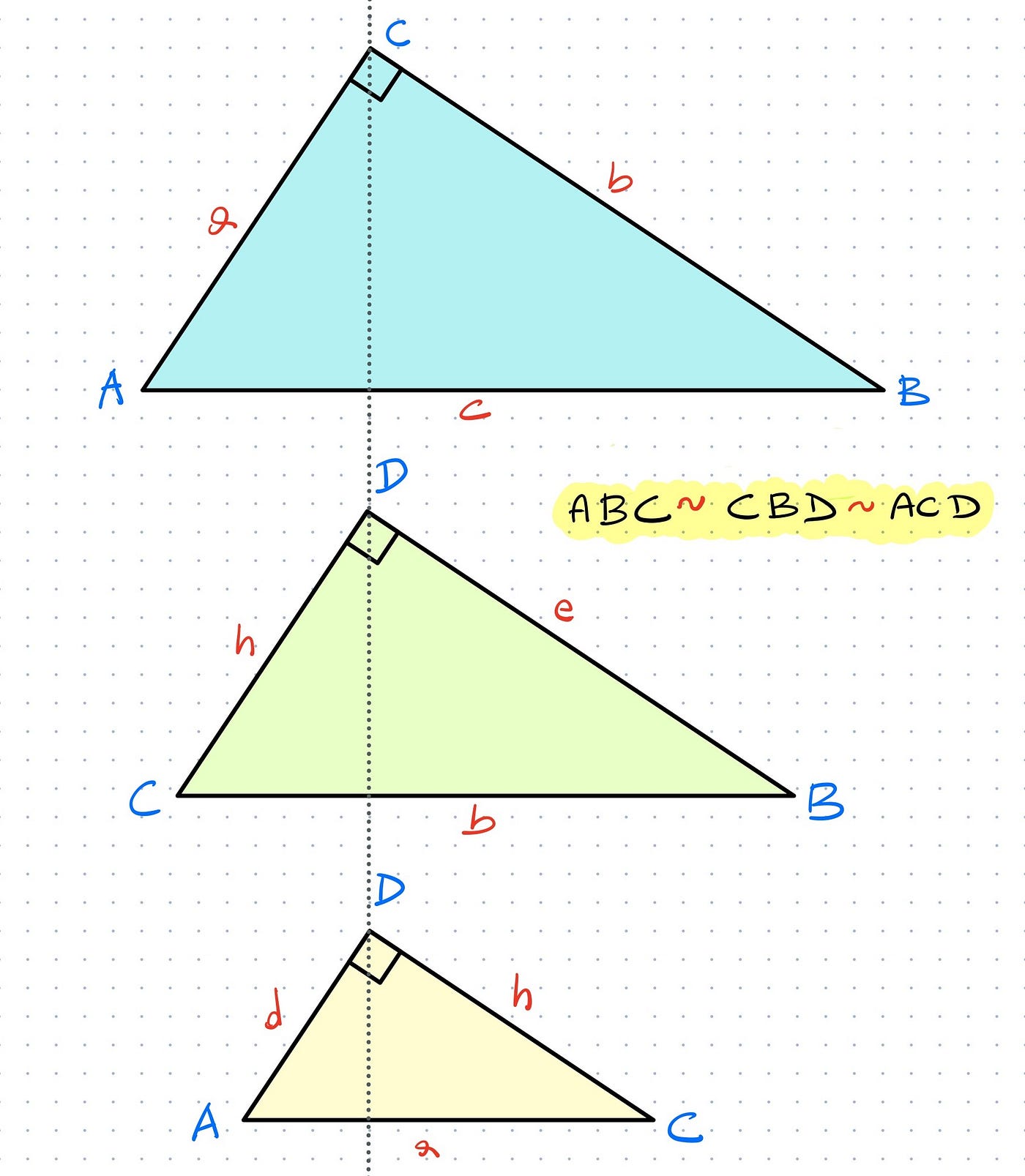
Similar triangles not only have their sides in proportion, but their areas are also in proportion, as well as the squares of each side. In particular, the ratio of the area of the triangle ABC to the square c² of its hypotenuse c is equal to the ratio of the area of the triangle ACD to the square a² of its hypotenuse a and the ratio of the area of the triangle CBD to the square b² of its hypotenuse b. If we call respectively X, Y, and Z the areas of the three triangles, the following equivalences hold:

Since Y+Z = X (i.e., the sum of the areas of the two inner triangles is equal to the area of the outer triangle), it follows that a²+b² = c².
We can algebraically derive this identity from the equation that relates the sum of the areas of the two inner triangles to the area of the outer triangle:

Since the three triangles are similar, we can replace in the equation the variables that designate the sides of the two inner triangles (d, h and e, h, respectively) with the variables a and b, which designate the sides of the outer triangle, multiplied by the constant of proportionality that expresses the ratio of side a to side c, and the ratio of side b to side c of the outer triangle:

Now, dividing both sides by ½ ab, we get:

Finally, multiplying both sides by c² to eliminate the denominators on the left, we get:

which is what we wanted to prove.
Euclid’s proof
This proof is given in Proposition 47 of Book 1 of Euclid’s Elements (about 300 CE).
Let ABC be a triangle with a right angle in vertex A. Let BDEC be the square, one of whose sides is the hypotenuse BC of the triangle, and let ACKH and BAGF be the squares one of whose sides are, respectively, the legs AC and BA of the right triangle. Now, let us draw from vertex A the perpendicular to the hypotenuse BC, which meets BC at point M, extending the perpendicular until it meets side DE of the square BDEC at point L. Finally, let us construct with suitable line segments the triangles FBC, ABD, AEC, and BCK, as shown in the following figure.

The final purpose of the proof is, as always, to show that the square that has the hypotenuse of the right triangle for its side (BDEC) is equal to the sum of the squares that have for their sides the two legs of the triangle (ACKH and BAGF). The way chosen by Euclid to prove this is to demonstrate that the two rectangles in which the square BDEC has been divided by the perpendicular conducted from the vertex A of the triangle, that is, LECM and DLMB, have area equal to the squares ACKH and BAGF respectively. Proving this also proves the Pythagorean theorem since the area of the square BDEC is equal to the sum of the areas of the two rectangles LECM and DLMB.
First, we note that the angle ⦣FBC is equal to the angle ⦣ABD. In fact, both angles are obtained by adding the same angle ⦣ABC to the right angles ⦣FBA and ⦣DBC. Also, sides FB and AB are the same because they are sides of the square BAGF. Similarly, sides BD and BC are the same because they belong to the square BDEC. Therefore, the triangles FBC and ABD are congruent since they have two equal sides and the angle between them is also equal.
We also note that FB is the base of the triangle FBC and FG (or BA) its height. Therefore, the area of the triangle FBC is equal to ½(BF×FG). Since the area of the square BAGF is equal to BF×FG, it follows that the area of the triangle FBC is half that of the square BAGF.
Similarly, we note that BD is the base of the triangle ABD and BM (or DL) its height. Therefore, the area of the triangle ABD is equal to ½(BD×BM). Since the area of the rectangle BDLM is equal to BD×BM, it follows that the area of the triangle ABD is half that of the rectangle BDLM.
But, as demonstrated above, the two triangles FBC and ABD are congruent. It follows that the area of the square BAGF is equal to that of the rectangle DLMB.
With entirely analogous reasoning to that carried out so far, we can demonstrate that:
- the triangles BCK and AEC are congruent because they have two sides and the angle between them equal;
- the area of the triangle BCK is half of the area of the square ACKH;
- the area of the triangle AEC is half of the area of the rectangle LECM;
- the area of the rectangle LECM is equal to that of the square ACKH.
Therefore, the area of the square BDEC, which is the sum of the areas of the rectangles BDLM and LECM, is equal to the sum of the areas of the squares BAGF and ACKH, which is what we wanted to prove.
메타데이터
- post_id
- fbf58d3811ce
- slug
- proving-the-pythagorean-theorem-fbf58d3811ce
- url
- https://medium.com/not-zero/proving-the-pythagorean-theorem-fbf58d3811ce
- canonical_url
- https://medium.com/not-zero/proving-the-pythagorean-theorem-fbf58d3811ce
- author_url
- https://medium.com/@md64
- status
- ok
- fetched_at
- 2026-06-09 18:16:15