It’s a Wonderful Life (1946) — A Wonderful Movie for Any Time
An essay on Frank Capra’s timeless classic, 80 years removed.
THE ESSENTIALS
It’s a Wonderful Life (1946): A Wonderful Movie for Any Time
An essay on Frank Capra’s timeless classic, 80 years removed.
Credit: Paramount Pictures
It must be Christmas in July because, yes indeed, I’m not waiting until December to watch and review It’s a Wonderful Life. There are several reasons for this, the least of which is that director Frank Capra never intended the film to be pigeonholed to one time of the year. The Christmas overtones occur primarily at the end, leaving the majority of the film to relish in a timeless aura. The main reason, however, is that this is exactly what I need right now. I’ve been open about my emotional struggles as of late, and it dawned on me that I’m not too different from good ol’ George Bailey (James Stewart).
Good is the key word right there. I must admit that as I’ve gotten older, and frankly more cynical in my film studies, I’ve forgotten just how powerful a showcase of goodwill can be in movies. Of course I love challenging content, conceptually and artistically. That said, there’s something to that old Frank Capra magic that’s endearing and irresistible, despite what Pauline Kael had to say. (Though her infamous trashing is entertaining to read!) What we watch as this story unfolds is George Bailey being a good human being despite all the obstacles he’s dealt with, and how increasingly unsatisfied he feels in comparison to others. Sometimes, the simplest lessons are the hardest to learn, and the easiest to take for granted.
The events of It’s a Wonderful Life are etched firmly into people’s minds at this point, partly because George forgets how great his life is despite how obvious it is to us. George saves his brother from drowning when they are kids, stops his boss from accidentally poisoning a child, and takes over the family business after his father passes away at his own personal expense, helping his community against the cold-hearted tycoon Mr. Potter (Lionel Barrymore). No matter how much George aspires to travel the world and be an explorer, one unfortunate event after another keeps him locked in Bedford Falls. We remember these moments so dearly because they’re relatable to many of us as times get rough.
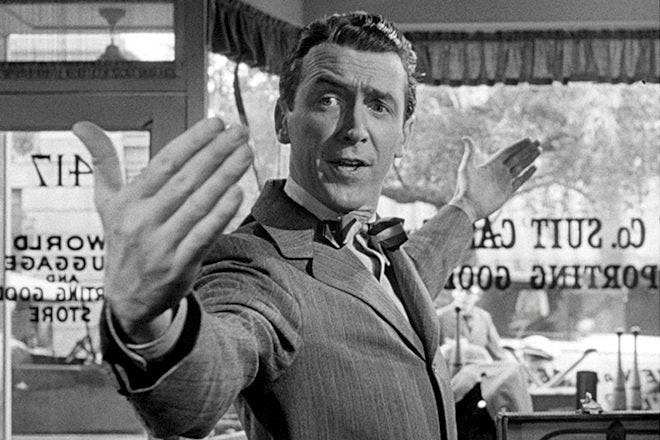
Credit: Paramount Pictures
In Capra and Stewart’s cases, It’s a Wonderful Life was their first film after both men enlisted in World War II. For Capra, specifically, having been a rags-to-riches story himself — born in Italy and immigrating to America when he was five — his vision was one to encapsulate the lives of hard-working people who represent “The American Dream.” No actor was better for the starring role than Stewart, who not only was Capra’s leading man in several films before, but was also struggling to find work post-WWII until this miracle of a movie found him. (Though Henry Fonda wouldn’t have been a bad choice in an alternate universe.) The unfortunate truth is that, in its day, this film was a combination of behind and ahead of its time.
Capra’s worldview fit more with the 1930s Depression Era, and funny enough, the film was under scrutiny by the FBI for openly displaying support for Communism in Hollywood during the early stages of the Red Scare. Much of this centered around the villainization of bankers through Barrymore’s performance as Mr. Potter. It sounds like a bunch of hogwash to call It’s a Wonderful Life communist propaganda, and it is. Sad to say, then, that if you listen to people like Ben Shapiro, you’ll come to realize that some stupidity is also ageless.

Credit: Paramount Pictures
Whatever political allegories are present in the film are best left for an academic discussion. The fundamental point is how It’s a Wonderful Life seamlessly weaves through dark times, depression, and then finds the right amount of magic to lift us up. All the Christmas joy we remember at the end tends to make us forget how dark the story gets. This is a special kind of movie where a man contemplating suicide is juxtaposed side by side with a guardian angel — sorry, AS2: Angel Second Class — joyfully sprinkling around his magic with chimes on the soundtrack of “twinkle, twinkle, little star.”
When you read a description like that on paper, it sounds ridiculous. Yet, nothing is out of place. Our angel, Clarence (Henry Travers), occupies an endearingly quirky quality through several elements. That becomes apparent from the beginning when we’re introduced to him through a primitive special effect of the angels talking. It’s a still photograph of Stephan’s Quintet, a group of galaxies in the constellation Pegasus. (My research finds that Pegasus embodies courage, inspiration, and nobility — the more you know!)
What struck me the most watching the film again is how the fantasy elements begin as parts of the filmmaking before evolving into the on-screen. Clarence begins as a speck moving across the screen, then transitions into a voice-over narrator (along with the angel, Joseph), adding lighthearted comedy with his bumbling comments. “Is that a king?” he says at the first sight of Mr. Potter in his carriage, and “It’s a good face; I like it, I like George Bailey” upon seeing George grown up. It’s a delightful blend of fantasy storytelling with the nondiegetic elements that comment on the filmmaking itself: Clarence needs to get his wings before getting used to the dissolve transitions, and Joseph pauses with a freeze frame so Clarence gets a good look at George.

Credit: Paramount Pictures
What makes the film special, however, is the earnestness in these scenes where George builds a family, a community, and does what’s right by sacrificing his ambitions. Many of these moments are, well, wonderful. George hits it off with Mary (Donna Reed), jitterbugging the night away, and falling in love after falling in the school pool. The following scene, in which George walks Mary home, accidentally steps on her robe, undressing her as she darts away, and then teases her as she hides in a bush, is the kind of gag that’s so forced, but God almighty, does it bring a smile. Stewart brings his swagger, strutting around a shaking bush and negotiating his leverage in this “very interesting situation.”

Credit: Paramount Pictures
Then, of course, there are the temptations George must resist, the most obvious of which is Mr. Potter’s offer. This is one of the great “deals with the devil” scenes in all of movie history, as Potter attempts to control George with a $20,000 salary. Lionel Barrymore had previously lent his sinister voice as Ebenezer Scrooge in radio dramas of A Christmas Carol, making him the perfect counter to Stewart’s heroic persona. Wouldn’t you know it, his physicality is something to behold, too. Barrymore has the perfect scowl in this role: a mean mug, pointed eyebrows, and a piercing glare that complement the cold blankness of his complexion. (Something you don’t get with that abhorrent colorized version where his skin is as peachy as a kind-hearted soul.) Watching George resist the temptations of this devil with his cigars, fancy office chair, and wormy tongue is a real pleasure — one of the film’s many “rah-rah” moments.
There are many other great moments to point out: The telephone scene where George and Mary’s bitter arguing turns into unshakable love, the run on the bank where George gives away his wedding money to help his community from being bought by Potter, and of course, the final stretch in which Clarence shows George how bad everyone would’ve been without him. All of it builds to that ending in which the Bedford Falls community, after years of depending on George to keep them intact, finally have the chance to give back to him. The best detail is how the man who was the most stubborn during the run on the bank, demanding his $242, is the first one to run up and throw his money to George. This ending is so powerful not just because it’s the ultimate showcase of goodwill, but because each person coming up one after another, telling George how grateful they are for him, cements how important life and love are after we’ve seen what could’ve been.
It all builds to Clarence’s final note for George: “No man is a failure who has friends.” However, the line that struck me the most is one George’s father (played excellently by Samuel S. Hinds) tells him the night he passes. It’s when George asks what Potter’s deal is, and his Pa responds, “He hates anybody that has anything he can’t have — hates us mostly, I guess.” The fact that George is mindlessly staring into his plate, almost oblivious to what his father just told him, is the ultimate lesson. George goes about his life drowning in his dreams, trying so hard to convince himself that he hates his town and everyone/everything in it, but forgets that he already has everything he will ever need. Times are tough, and in today’s age, it’s so much easier for us to compare ourselves to others, questioning our self-worth. It’s a Wonderful Life is a wonderful movie for any time and, in some ways, even more so now.

Credit: Paramount Pictures
메타데이터
- post_id
- fbf8f25186d3
- slug
- its-a-wonderful-life-1946-a-wonderful-movie-for-any-time-fbf8f25186d3
- url
- https://medium.com/its-only-a-movie/its-a-wonderful-life-1946-a-wonderful-movie-for-any-time-fbf8f25186d3
- canonical_url
- https://medium.com/its-only-a-movie/its-a-wonderful-life-1946-a-wonderful-movie-for-any-time-fbf8f25186d3
- author_url
- https://medium.com/@DialFforFilm
- status
- ok
- fetched_at
- 2026-08-22 13:39:07





