Why I’m writing a survival guide for the Big Island
The world is an increasingly precarious place; it makes sense on many levels to prep for disasters and even serious collapse scenarios
Why I’m writing a survival guide for the Big Island
The world is an increasingly precarious place; it makes sense on many levels to prep for disasters and even serious collapse scenarios
What happens to the Big Island and Hawaii if the boats stop coming?
Not “stop coming” for a week after a hurricane. Not “delayed” by a supply chain hiccup. I mean: stop coming for months. Or longer.
We import roughly 90% of the food consumed on this island. Ditto for the fuel for our cars and trucks. Our power grid runs in part on diesel shipped from the mainland. Our water systems depend on electric pumps. Our medical supply chains, our hardware, our fuel — almost all of it comes from somewhere else, on boats.
If that supply chain is interrupted — by a major hurricane, a tsunami, a grid-down event, an EMP attack, a geopolitical disruption, major war, or something we haven’t thought of yet — life on this island gets hard, fast. That’s not fear-mongering. It’s geography.
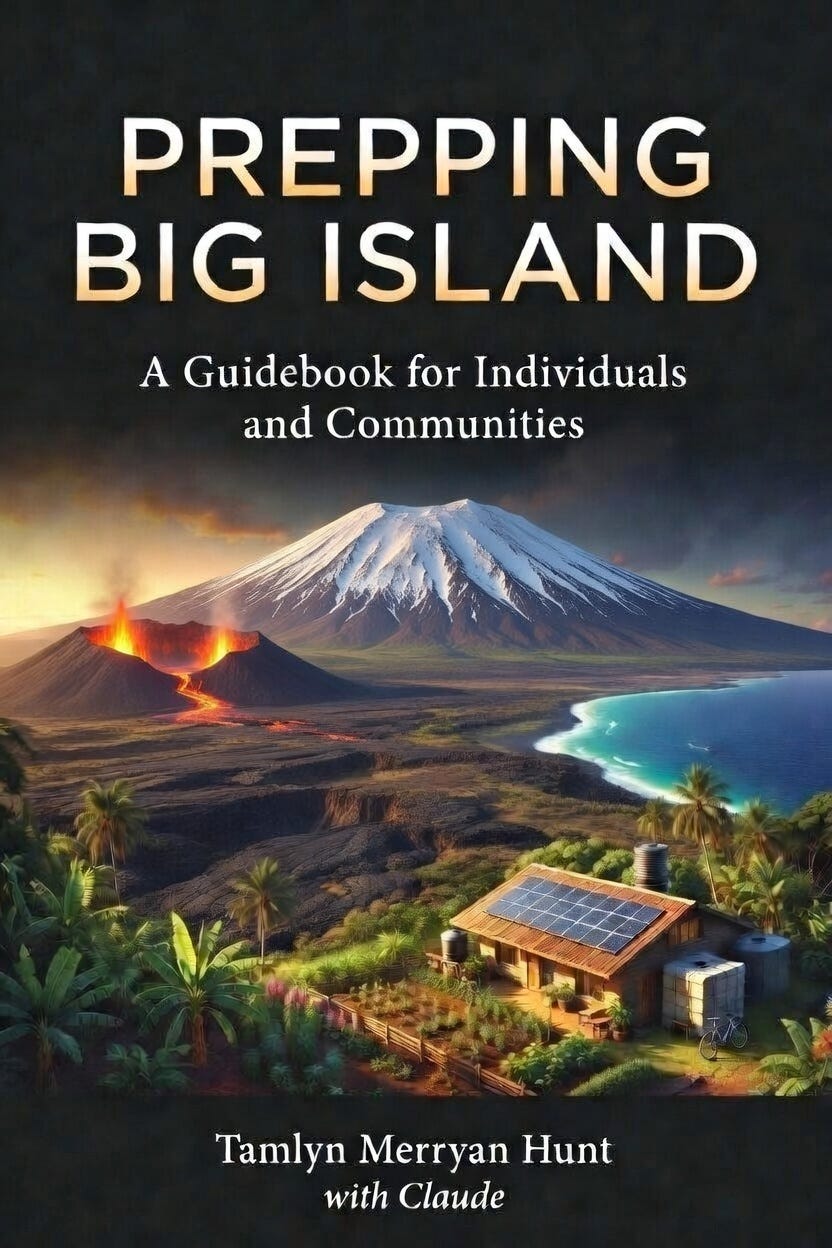
That’s why I’m writing Prepping Big Island: A Guidebook for Individuals and Communities, PBI for short, co-authored with Claude (Anthropic’s AI), and based on feedback from numerous community members plus my 12+ years living on the Big Island as a homeowner and a homesteader.
What the Book Is
PBI is a comprehensive, technically rigorous preparedness and self-sufficiency guide written specifically for people who live here (later editions will focus on Oahu, Maui and Kauai). Not generic prepper content pulled from mainland forums. Not a FEMA checklist. A real, detailed, Big Island-specific manual that takes seriously both the vulnerabilities of island life and the extraordinary resources this island provides.
I’ve been living south of Hilo for twelve years. I have solar power, batteries, rainwater catchment, gardens, and direct experience with what works — and what fails — when you’re not on the grid. That ground-level knowledge shapes every chapter.
The book is organized into five parts:
Part I: Know Your Island — Big Island vulnerabilities, geography, and hazards
Part II: Your Body and Health — water, food, sanitation, medical care, and tropical survival basics
Part III: Your Toolkit — practical technical skills: power systems, communications, tools, transportation, firearms
Part IV: Your Mind and Community — psychology of collapse, ethics, community resilience
Part V: Building Forward — recovery, trade, communications, and governance after societal collapse
The chapters cover things like how to maintain a solar power system in a salt-air environment, how to treat a tropical wound infection without a hospital, how HAM radio mesh networks and satellite wifi can keep communities connected when everything else fails, how to keep a bicycle running as primary transportation when fuel is unavailable, and how community governance might be rebuilt using the ahupua’a model — the watershed-based system Hawaiian communities used for centuries to manage shared resources. And many many more topics.
What It Isn’t
PBI isn’t a bunker-and-bullets survival fantasy. It isn’t a list of things to be afraid of. And it definitely isn’t written for people who want to retreat from their community and wait out the end of the world in isolation.
My personal rule for preparedness is simple: I’m only going to do things that make sense even if nothing bad ever happens. Buying food in bulk makes sense in any era. Growing your own food makes sense in any era. Building a closer relationship with your neighbors and wider community makes sense in any era. Getting a HAM radio license and learning how to use it makes sense in any era.
Resilience-building, done right, just makes your life better — more self-sufficient, more connected, more rooted in this place, eating better, more healthy, more happy. Whether the boats stop coming or not.
There’s also a strand running through every chapter that most mainland prepper guides completely miss: the deep wisdom embedded in historic Native Hawaiian practices. The ahupua’a isn’t a historical curiosity — it’s a functional model for watershed-based community resource management that sustained a thriving civilization on this island for centuries without and external supply chains.
The concept of laulima — many hands working together — is as good a framework for community resilience than anything I’ve seen in contemporary prepping literature. Ho’oponopono, the Hawaiian practice of restorative conflict resolution, becomes genuinely essential when you’re rebuilding community governance after a collapse.
These aren’t decorative cultural references. They’re structural to how the book thinks about resilience.
Why Write It With AI?
In writing this book I got a lot of help from Claude — Anthropic’s AI — and I think that’s worth explaining, because it raises legitimate questions.
The knowledge in this book comes from me and those I’ve interviewed and consulted — from twelve years living off-grid on this island, from the research I’ve done, from the specific context of Big Island life that I bring to every chapter. What Claude contributes is the ability to synthesize that knowledge into comprehensive, technically accurate prose at a speed that would take years to produce alone, and to help ensure that nothing important gets missed.
I review every chapter. I push back on generic advice. I insist on Big Island specificity — on accounting for vog, for salt-air corrosion, for the specific road vulnerabilities in Puna versus Hamakua versus Kohala. Claude is a powerful collaborator, but the judgment and the local knowledge are mine.
The result is a book that would have taken a team of writers years to produce. We’ve done it in months.
A Note on the Hard Stuff
I won’t pretend this book is all easy reading. There are chapters on firearms and ammunition, on improvised medical care, on the psychology of serious societal disruption, on what community governance looks like when formal institutions have failed. These aren’t topics most people want to think about.
But I believe that thinking clearly about hard things — in advance, with good information — is far better than encountering them unprepared. The research on how communities actually behave in disasters is, largely, hopeful: people cooperate more than they panic, help more than they hoard, organize more than they fragment. The book reflects that reality. It takes collapse seriously without surrendering to despair about it.
There’s even a chapter — structured as an interlude between the community psychology section and the rebuilding section — called “Finding Peace in a Time of Collapse.” Because any honest guide to living through serious disruption has to grapple with the emotional and psychological reality of what that actually means for human beings.
Who Should Read This
If you live on the Big Island, this book is for you. Not because catastrophe is in any way inevitable, but because living on an island 2,400 miles from the nearest continent makes a certain kind of self-sufficiency simply good sense.
It’s for the Puna family whose road gets cut off every few years when Kilauea decides to remind us who’s in charge, or the latest Kona low flooding. It’s for the retiree in Kona wondering whether their solar setup will actually carry them through a week-long outage. It’s for the young couple in Hamakua trying to figure out how to grow more of their own food. It’s for anyone who has ever looked at the container ships in Kawaihae and thought, quietly, about what happens if they stop coming.
We’re all in this together. That’s not just a nice thing to say — it’s the most practical survival strategy available to us. Laulima: many hands working together.
I’m hoping to have the book published by this summer. Here’s the current table of contents:
**Preface** — Preparing for Resilience in Paradise
**Introduction** — Why Hawaii Needs This Book
• Big Island’s geographic isolation and unique vulnerabilities
• Beyond ‘disaster prepping’ — a resilience lifestyle
• How to use this handbook
**Opening Scenario** — EMP Attack: The First 72 Hours
• Day Zero: the event and its cascade of failures
• Hours 1–72: communications, family safety, community response
PART I KNOW YOUR ISLAND
Context, Vulnerability, and Planning
Ch. 1 Understanding Big Island Vulnerabilities
• Geographic isolation: 2,400 miles from the continent
• Natural hazard spectrum: volcano, tsunami, hurricane, earthquake, vog
• Infrastructure fragility: power grid, water systems, supply chains
• Region-by-region risk profiles across the island
Ch. 2 Building Your Emergency Plan
• Family communication protocols and designated mainland/inter-island hubs
• Evacuation routes and meeting points by region
• 72-hour kit and extended supply planning
• When modern communications fail: alternative devices and protocols
PART II THE BODY
Keeping Yourself Alive
Everything the human organism needs to survive: water, food, sanitation, energy, medicine. The most urgent tier — start here if you haven’t.
Ch. 3 Water Security and Storage
• Rainfall catchment systems for East vs. West sides
• Filtration, purification, and testing
• Storage sizing and container selection
• Water pump mechanics: SeaFlo diaphragm pumps, troubleshooting, repair
Ch. 4 Food Security and Self-Sufficiency
• Hawaii’s 90% food import dependency
• Emergency food storage: calories, rotation, tropical storage conditions
• Garden planning for Big Island microclimates
• Traditional Hawaiian food systems and the ahupua’a
• Edible limu and coastal foraging
Ch. 5 Sanitation and Waste Management
• Flush toilet maintenance, cesspools, and septic systems
• Humanure bucket toilets and commercial composting systems
• Greywater reuse: banana circles and garden irrigation
• Soil building on volcanic terrain through closed-loop waste cycling
• Toilet paper alternatives: hau leaf and traditional options
Ch. 6 Energy Independence and Off-Grid Power
• Solar sizing for Big Island conditions
• Battery chemistry: lead acid vs. lithium for tropical environments
• Inverter/controller systems: setup, fault codes, troubleshooting
• Generator selection, fuel storage, and maintenance
• EMP protection considerations for off-grid power systems
• Non-electric alternatives: kukui nut oil lighting, rocket stoves, solar ovens
Ch. 7 Medical Preparedness
• Establishing a household medical capability
• Stocking and rotating pharmaceutical supplies
• Traditional Hawaiian medicine: la’au lapa’au overview
• Community medical response networks
Ch. 8 **Infection Control and Wound Care** — Tropical Disease and Survival Medicine
• Tropical infection threats: leptospirosis, staph, MRSA, dengue, fungal
• A neighbor’s leg: a case study in tropical infection underestimation
• Prevention strategies and immune function through nutrition
• Scientifically-validated natural antiseptics: honey, noni, turmeric, garlic
• Wound care protocols for high-humidity environments
• Community-level infection control and sanitation systems
Ch. 9 Pharmacologics, Sexual Health, and Intimacy After Collapse
• Medicinal plants affecting libido and sexual function: evidence and cultivation
• Contraception tiers: pre-collapse preparation to post-collapse alternatives
• Fertility awareness methods: effectiveness and practical application
• STI prevention and treatment with limited resources
• Emotional wellbeing and intimacy under sustained stress
PART III THE TOOLKIT
Skills, Equipment, and Technical Competence
The technical core — organized so readers can browse by skill gap. Everything from hand tools and metalwork to communications and firearms.
Ch. 10 Specialized Skills and Hand Tools
• Structural repairs, carpentry, and traditional Hawaiian building techniques
• Plumbing systems: pipe repair, pump maintenance, water catchment
• Electrical systems: solar troubleshooting and safe circuit repair
• Small engine repair: generators, pumps, chainsaws
• Improvised tools and field-expedient solutions
Ch. 11 **Mechanical Advantage** — Moving Heavy Objects with Limited Resources
• Physics of mechanical advantage: MA ratios and real-world efficiency
• Block and tackle configurations
• Come-alongs and hand winches: operation and care
• Rope systems, rigging, and essential knots
• Z-drags, redirects, and compound systems for extreme loads
• Practical applications: vehicle recovery, clearing debris, construction
Ch. 12 **Powered Tools for Homesteaders** — Use, Maintenance, and Repair
• Power tool categories and Hawaii-appropriate selections
• Battery systems: chemistry, care, and tropical climate degradation
• Detailed repair procedures: Ryobi, DeWalt, and Makita platforms
• Battery cell replacement and spot welding techniques
• Motor replacement: brushed and brushless systems
• Corrosion prevention for coastal and vog-exposed environments
Ch. 13 Metalworking and Welding for Resilience
• Blacksmithing basics: forge construction, heat treatment, edge tools
• Welding fundamentals: SMAW, MIG, TIG for repair applications
• Corrosion management in Hawaii’s salt-air environment
• Sourcing and salvaging metal on the Big Island
Ch. 14 **Vision Resilience** — Maintaining and Creating Optical Devices
• Why vision correction is a survival-critical resource
• Eyeglass maintenance, repair, and pre-collapse reserve strategies
• Improvised vision correction: pinhole glasses and lens stacking
• Telescope, binocular, and microscope maintenance
Ch. 15 Transportation and Mobility
• Big Island road network vulnerabilities by region
• Vehicle preparation: fuel storage and off-road capability
• Alternative routes: plantation roads, 4WD bypasses, cane road cycling
• Regional considerations: Puna isolation, Hamakua landslides, Kohala access
Ch. 16 Bicycle Maintenance, Troubleshooting, and Repair
• Bicycles as critical post-collapse transportation infrastructure
• Routine maintenance for salt air, volcanic grit, and UV degradation
• Common repairs: drivetrain, wheels, brakes, bearings
• Improvised solutions when commercial parts are unavailable
• Cargo configurations for Big Island terrain
Ch. 17 Communications Systems for Grid-Down Scenarios
• Cascade of communication failures: hours to years timeline
• Equipment tiers: FRS/GMRS, MURS, CB, HAM, satellite
• HAM radio licensing, equipment selection, and mesh network architecture
• Starlink: capabilities, power requirements, and collapse scenarios
• Community radio hub development and scheduled broadcasts
• Communication options comparison by Big Island district
Ch. 18 EMP Protection and Planning
• EMP threats: nuclear, solar, and localized sources
• Vulnerability assessment for household electronics
• Faraday cage construction and testing
• Protection for off-grid power systems
Ch. 19 Firearms and Ammunition After Collapse
• The .22 LR ecosystem: CB caps through hyper-velocity by application
• 12-gauge shotgun: roles, load selection, and Big Island use cases
• Air rifle and slingshot: quiet pest control and small game
• Force hierarchy: matching tools to threat levels
• Tropical storage and maintenance for humid, salt-air environments
• Ammunition reloading: 12-gauge as the practical platform
• Casting pellets and slugs from reclaimed lead; closed-loop recovery
Ch. 20 Everyday Carry Systems for the Big Island
• Car EDC: Tesla Model S frunk, sub-trunk, and main trunk configurations
• Day pack EDC with TSA-compliant quick-remove module
• Shoulder bag / festival pack configuration
• Tactical belt: serious bug-out from home base
PART IV THE MIND AND COMMUNITY
Psychology, Ethics, and Social Fabric
Everything about the inner life and the group — currently the most underserved dimension of preparedness literature. Includes the interlude essay.
Ch. 21 The Psychology of Collapse** — Resilience, Decision-Making, and Staying Cool Under Fire ★**
• How the brain responds to collapse: stress physiology and cognitive limits
• The OODA loop: why Orient is where most failures happen
• Freeze, fawn, fight, flight — knowing your own default response
• Cognitive biases that kill: normalcy bias, confirmation bias, authority bias
• Building resilience before collapse: stress inoculation, fitness, sleep
• Performing under pressure: acute crisis psychology and decision frameworks
• Group dynamics: scapegoating, groupthink, authority capture
• Hawaiian frameworks: lokahi, pono, ho’oponopono as resilience infrastructure
Ch. 22 Mental Health and Stress Management During Emergencies
• Common acute stress responses and longer-term psychological challenges
• Island-specific stressors: isolation, ‘trapped’ feelings, ‘ohana separation
• Preventive mental health: community connection, routine, psychological first aid
• Hawaiian wellness: ha breathing, ocean therapy, hula, ‘āina connection
Ch. 23 Ethical Considerations in Disaster
• What disaster research actually shows about human behavior
• The ‘therapeutic community’ effect: cooperation as the empirical norm
• Fear-based vs. cooperation-based community responses
• Information management and the ethics of honest communication
• Leadership emergence: facilitation vs. command and control
Ch. 24 Security and Community
• Physical security: property hardening without community isolation
• The research on looting and antisocial behavior — what actually happens
• Information security and rumor management
• Traditional Hawaiian conflict resolution: ho’oponopono in practice
❧ Interlude: Finding Peace in a Time of Collapse
• The case against manufactured cheerfulness
• Grief vs. despair — the distinction that changes everything
• Gratitude without anesthesia: honoring what is still good
• The discipline of determined action regardless of outcome
• Community as both means and end
• On complicity and self-forgiveness
PART V BUILDING FORWARD
Recovery, Governance, and What Comes Next
The future-oriented content — from the recovery phase through the long work of rebuilding functional society on the island.
Ch. 25 **The Recovery Phase** — Learning and Adapting for Future Resilience
• Understanding recovery psychology: disillusionment, grief, post-traumatic growth
• Physical reconstruction: build back better philosophy
• Infrastructure resilience improvements: water, energy, food, communications
• Economic adaptation: local production and cooperative models
• Community governance evolution and formalization
Ch. 26 **Rebuilding After Collapse** — Communication, Trade, and Governance
• COMMUNICATIONS — Phase 1: Human networks, bulletin boards, couriers
• COMMUNICATIONS — Phase 2: Radio hubs, Starlink integration, community broadcasts
• COMMUNICATIONS — Phase 3: Full information ecosystem restoration
• TRADE — Stage 1: Direct barter; high-value Big Island trade goods
• TRADE — Stage 2: Commodity money; salt, alcohol, preserved protein
• TRADE — Stage 3: Community token currency; time banking; labor-backed design
• TRADE — Inter-island and regional trade framework development
• GOVERNANCE — Stage 1: Emergency authority (days to weeks)
• GOVERNANCE — Stage 2: Council governance; the ahupua’a model
• GOVERNANCE — Stage 3: Formalized community government; written rules
• GOVERNANCE — Native Hawaiian sovereignty and legal complexity
• GOVERNANCE — Justice systems: ho’oponopono as restorative practice
• Recovery timeline framework: 30 days / 90 days / 1 year / long-term
APPENDICES & BACK MATTER
App. A Emergency Supply Checklists and Emergency Plan Template
App. B Local Resource Directory — Big Island-specific
App. C Communication Protocols and Frequency Lists
• HAM frequencies by Big Island district
• NOAA Weather Radio: 162.550 MHz
• Scheduled check-in times and call sign registry template
App. D Native Hawaiian Traditional Knowledge Resources
• La’au lapa’au plant guide
• Edible limu of Hawaii reference
• Ahupua’a land management principles
App. E Legal Considerations for Community Preparedness
• Hawaii water law and the public trust doctrine
• Native Hawaiian governance rights
• Emergency authority: county and state powers
App. F EDC Master Checklists
• Car EDC — Tesla Model S configuration
• Day Pack EDC with TSA quick-remove module
• Shoulder Bag / Festival Pack
• Tactical Belt — Home Bug-Out
App. G Ammunition and Reloading Quick Reference
• .22 LR selection guide by application and grain weight
• 12-gauge reloading components, press settings, and load data
• Lead sourcing, casting, and closed-loop recovery
Resilient Hawaii is currently in development. If you’re interested in being notified when the book is available, or if you have expertise, stories, or local knowledge you’d like to contribute, reach out.
E nihi ka helena i ka uka o Puna — Tread carefully in upland Puna. We’re doing our best.
메타데이터
- post_id
- fc03f8ca4dca
- slug
- why-im-writing-a-survival-guide-for-the-big-island-fc03f8ca4dca
- url
- https://medium.com/@tamhunt/why-im-writing-a-survival-guide-for-the-big-island-fc03f8ca4dca
- canonical_url
- https://medium.com/@tamhunt/why-im-writing-a-survival-guide-for-the-big-island-fc03f8ca4dca
- author_url
- https://medium.com/@tamhunt
- status
- ok
- fetched_at
- 2026-06-21 15:33:18