ROFL: Breaking Blockchain’s Limits with Offchain Logic and Confidential Computation
Imagine a world where decentralized apps (dApps) can think faster, compute heavier workloads, and still remain as trustless and private as…
ROFL: Breaking Blockchain’s Limits with Offchain Logic and Confidential Computation
Imagine a world where decentralized apps (dApps) can think faster, compute heavier workloads, and still remain as trustless and private as ever. A world where AI models can infer securely, where blockchains can fetch live data without losing integrity, and where your personal data is never exposed to the wild. This is not a scene from a cyberpunk novel, it’s what ROFL is making real today.
The Runtime Offchain Logic Framework, better known as ROFL, is Oasis’s powerful new computing framework that generalizes the core value proposition of crypto: decentralization, verifiability, and privacy, while extending its capabilities beyond what we thought possible.
Why Do We Need ROFL?
Blockchains are brilliant at what they were designed for: storing immutable, verifiable data in a decentralized manner. However, they were never built for heavy computation, non-deterministic operations, or interacting freely with the internet. Imagine training an AI model or fetching real-time weather data on Ethereum — impossible due to costs, constraints, and architectural design.
This is where ROFL enters. It enables arbitrary offchain logic to run securely and verifiably alongside the blockchain using Trusted Execution Environments (TEEs). Think of it as an invisible layer of computation, performing heavy or private tasks offchain, and then cryptographically proving the results to onchain smart contracts.
How Does ROFL Actually Work?
At the heart of ROFL lies the TEE (Trusted Execution Environment). TEEs, such as Intel SGX or the upcoming Intel TDX, are secure enclaves within processors that ensure the integrity and confidentiality of code execution. This means any logic running within a TEE is shielded from tampering or spying, even by the host machine itself.
Here’s the simplified flow of how ROFL operates:
- Provisioning Secure Enclaves: The Oasis Network provisions a TEE for each ROFL application. These enclaves enforce execution integrity, ensuring that no malicious actor can interfere with the code or data.
- Remote Attestation: Before interacting with the blockchain, the ROFL app generates cryptographic proofs (attestations) to verify that it is running genuine, unaltered code within a secure enclave.
- Offchain Computation: The heavy lifting, whether it’s AI inference, data aggregation, or API calls, happens offchain inside the TEE.
- Onchain Verification: Results are communicated to smart contracts, along with cryptographic proofs, allowing onchain logic to verify the authenticity of the offchain computation without revealing private data.
- Decentralized Validator Set: ROFL relies on Oasis’s validator set as the root of trust, ensuring that computation is not just secure, but also decentralized and censorship-resistant.
ROFL vs Traditional Onchain Computation
While traditional onchain computation is limited by gas fees, storage, and determinism, ROFL enables:
- Arbitrary computation: Anything software can do, ROFL can run offchain.
- Privacy preservation: Inputs, outputs, and even model parameters remain confidential.
- Verifiability: Unlike black-box third-party APIs, ROFL provides cryptographic proofs to smart contracts.
This effectively turns ROFL into a decentralized TEE cloud, merging the best of both worlds, offchain performance with onchain trust.
What Can Developers Build With ROFL?
The use cases are as vast as software itself. Here are just a few:
1. Autonomous AI Agents
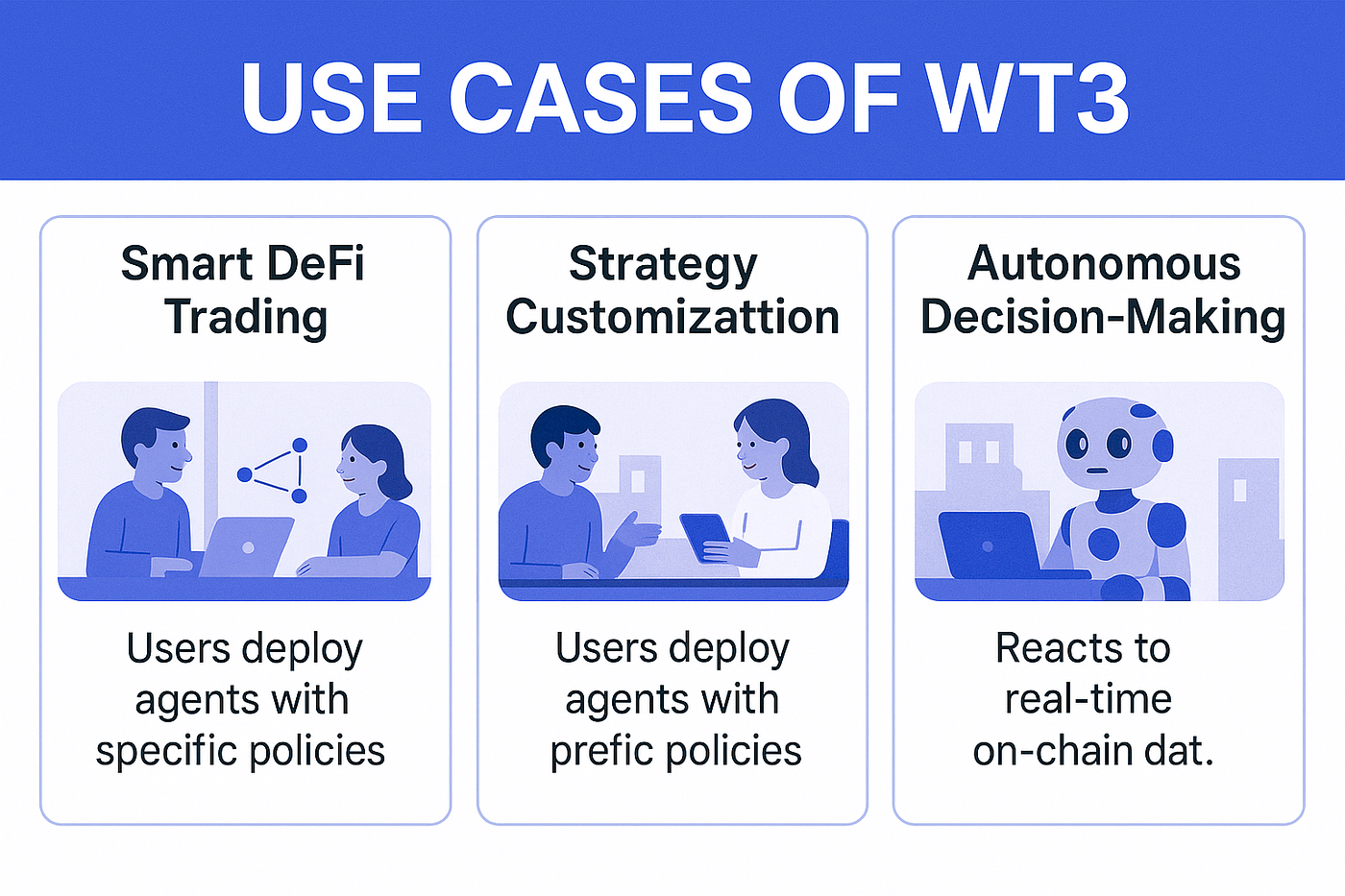
Imagine deploying AI-powered trading bots or digital assistants that operate privately and verifiably. For example, Oasis’s own WT3 is an autonomous trading agent leveraging ROFL’s trusted execution to manage funds securely. As Intel TDX support rolls out, developers can run AI inference while ensuring models remain private and unaltered.
2. Oracles and Light Clients
ROFL can run light clients for other blockchains like Bitcoin, enabling dApps to verify external chains’ states directly and securely. It can also act as an oracle, fetching data from remote APIs and proving its integrity onchain without relying on centralized intermediaries.
3. Intent Solvers and Chain Abstraction
User experience in Web3 has always been clunky. ROFL can upgrade this by allowing users to express high-level goals (intents) while ROFL apps find optimal solutions in real-time, manage keys, sign transactions, and submit them across chain, senabling seamless multichain operations without bridges.
4. ZK-Prover Enhancements and Sequencers
ROFL can complement Zero-Knowledge protocols by performing computations verified by ZK proofs, enhancing security with additional remote attestation proofs. Moreover, decentralized sequencers using ROFL can ensure fair block production while handling encrypted transactions efficiently.
5. Gaming and Interoperability
Offchain game logic can now run confidentially while still interacting with smart contracts verifiably. Imagine games that can handle complex physics or AI NPCs offchain, yet remain fully decentralized in outcomes and asset ownership.
Getting Started With ROFL
The Oasis team has integrated foundational ROFL support into Oasis Core v24.2, with v24.3 adding support for Intel TDX hardware, further expanding what developers can achieve.
To deploy your first ROFL app, you can use the rofl.app platform or Oasis CLI templates. Early projects already live on ROFL include:
- WT3 Autonomous Trading Agent: A high-trust AI trading bot running inference and execution within ROFL’s TEEs.
- Zeph AI Companion: A privacy-first AI friend that keeps conversations truly confidential.
These pioneers are only scratching the surface of what ROFL enables.
Why ROFL Matters for the Future of Web3
Web3’s mission has always been about trust minimization — removing the need for intermediaries and empowering users with self-sovereignty. However, privacy and performance have been perennial bottlenecks. ROFL addresses both by enabling:
→ Heavy, arbitrary computation → Tamper-proof and verifiable execution → Confidential data processing → Seamless integration with smart contracts
With ROFL, dApps are no longer limited by blockchain throughput or storage. Developers can build AI models, financial agents, or decentralized apps that think and act as fast as centralized apps while preserving crypto’s foundational guarantees of trustlessness and privacy.
What’s Next for ROFL
ROFL is more than just a framework; it’s a paradigm shift. As we continue to integrate AI with decentralized systems, frameworks like ROFL will be the bedrock enabling trustworthy machine intelligence, real-time interoperability, and privacy-first applications.
To get started, visit:
The next era of decentralized applications will not just live onchain but will thrive ROFLing offchain efficiently, privately, and verifiably.
References: → https://oasisprotocol.org → https://rofl.app → https://docs.oasis.io/build/rofl/ → Intel TDX Overview: https://www.intel.com/content/www/us/en/developer/tools/trust-domain-extensions/documentation.html
메타데이터
- post_id
- fc04b1a9fcb2
- slug
- rofl-breaking-blockchains-limits-with-offchain-logic-and-confidential-computation-fc04b1a9fcb2
- url
- https://medium.com/@savvysid/rofl-breaking-blockchains-limits-with-offchain-logic-and-confidential-computation-fc04b1a9fcb2
- canonical_url
- https://medium.com/@savvysid/rofl-breaking-blockchains-limits-with-offchain-logic-and-confidential-computation-fc04b1a9fcb2
- author_url
- https://medium.com/@savvysid
- status
- ok
- fetched_at
- 2026-07-18 16:58:14