The Disappearing Grid
The power grid is one of the most important systems humanity has ever built. It is also, frankly, a bit of a mess.
The Disappearing Grid
The power grid is one of the most important systems humanity has ever built. It is also, frankly, a bit of a mess.
Look up on almost any city street and you’ll see the same thing: cables sagging between poles, wires stacked on wires, the occasional mysterious loop that seems to exist only because nobody ever dared remove it. We’ve lived with the tangle so long it barely registers — like the junk drawer in the kitchen, the grid works well enough that no one wants to empty it out and start again.
We might finally be approaching the moment when someone does.
A few winters ago, footage circulated from Helsinki of a repair crew wrestling a fallen power line out of a snowstorm. Ice had dragged the cable across the road, and the blocks around it sat in a cold, very Finnish blackout. As the workers chipped away and hauled the line upright, the fragility of the whole arrangement was hard to miss: entire neighbourhoods depending on miles of exposed metal thread, strung out in the weather, waiting for gravity, a falling branch, or a bad storm to intervene.
Moments like that make wireless electricity feel less like science fiction and more like common sense.
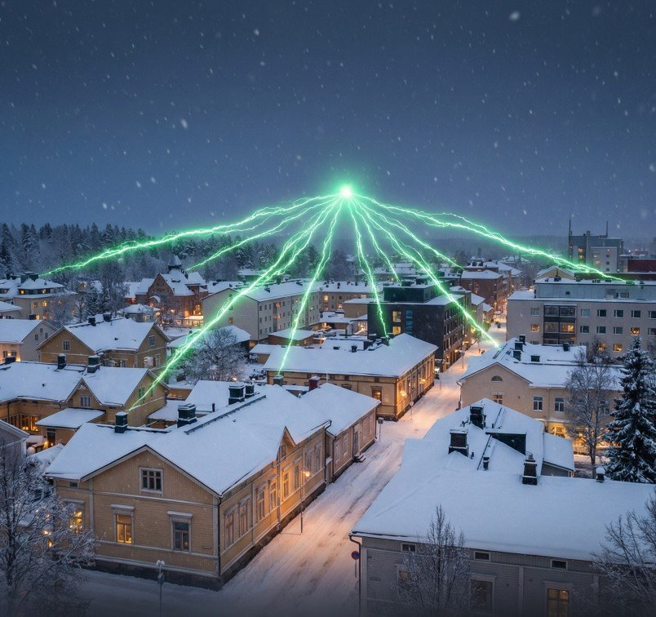
You may have seen the viral images from Finland — eerie green beams glowing above snowy streets, looking like something lifted straight out of Cyberpunk 2077. The physics behind them is far less exotic than the photos suggest. Strip away the glow and the idea is simple: turn electricity into a tightly directed beam of energy, send it through the air, and turn it back into electricity wherever you need it.
Power, in other words, without the wire.
Why the Wire Still Wins (for Now)
If wireless power sounds so obvious, why isn’t your kettle already running on it?
Because wires are annoyingly good at their job.
When electricity travels down a cable, almost all of it arrives at the far end. But convert that electricity into a beam — light or microwave — and then convert it back again, and you pay a toll at every step. Engineers sometimes call it the “double conversion tax.” Even the most advanced systems today rarely push much past the halfway mark in end-to-end efficiency. Set against a copper cable that delivers almost everything you put into it, that is a steep price.
But efficiency was never the only number that mattered.
In a country like Finland — 188,000 lakes, endless forest, towns separated by long, empty distances — the real cost is the line itself. Cables aren’t just expensive to string; they carve permanent corridors through ecosystems and demand constant maintenance against ice, wind, and falling trees. Past a certain point, the wasted energy of a beam starts to look cheaper than the wire it would replace.
The Hidden Payoff: Space
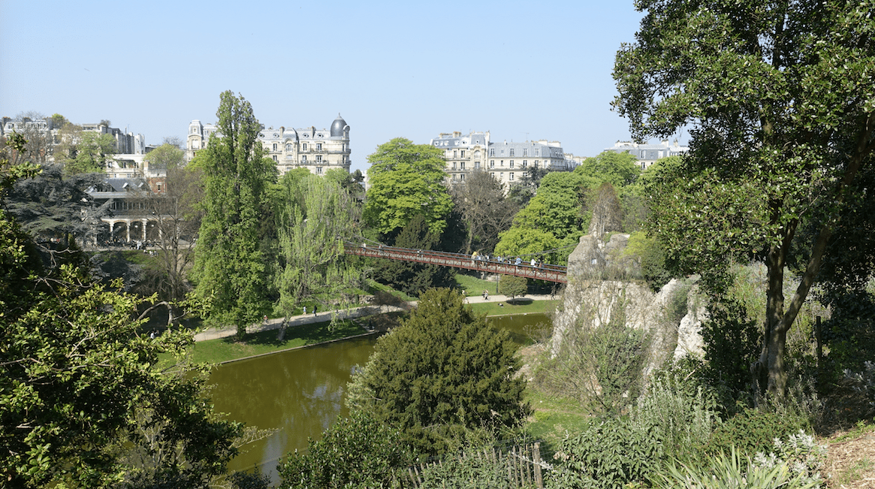
For civil engineers and urban planners, taking down the overhead lines isn’t an aesthetic flourish. It changes what a city is physically allowed to be.
So much of urban design quietly bends around power infrastructure. Buildings step back from high-voltage lines. Trees are pruned hard so they never brush a cable. Whole corridors exist for no reason other than to hold electricity safely above our heads.
Remove the wires and you get that space back.
Trees grow as they should. Streets feel less cluttered. Power becomes something you can deploy in an afternoon rather than something that demands trenches and months of digging. In a disaster zone, a field hospital could draw power from a transmission node overhead instead of waiting for cables to be laid through the rubble. You wouldn’t plug into the ground — you’d connect to the sky.
Making the Beam Smart
Sending power through open air raises one obvious question: what happens when someone walks through it?
The answer is that the beam can’t be dumb.
The Finnish optical experiments use high-powered lasers aimed at specialised receivers, and a laser carrying real power is not something you want crossing a pavement unsupervised. So the beam is wrapped in a watchful layer of sensors — cameras and detectors that track its path continuously, much the way an automatic door watches the space in front of it. The instant a person, a bird, or a drifting snowflake breaks the line of sight, the system cuts the power.
Think of it less as a fixed laser and more as a reflex: the grid noticing the world around it and flinching in milliseconds.
Why London Might Do It Differently

Finland’s cold, dry air is close to ideal for laser-based transmission. London, by contrast, specialises in fog that feels personally designed by Dickens.
Fog scatters light, which makes optical power transfer unreliable at exactly the moments you’d most want the lights on. For somewhere as damp as Britain, the more practical route is long-range microwave transmission — microwaves shrug off fog and rain in a way visible light simply can’t.
Different climates, different physics problems. Finland’s enemy is ice. Britain’s is weather that behaves like a wet sponge.
Cleaning Up the Skyline
If wireless power ever matures, the most striking change might be the one you can see.
Over the past century we’ve hung the skyline with cables, pylons, transformers, and substations. They were necessary, but they were built in an age whose only ambition was to get electricity from here to there somehow — not elegantly, just reliably.
Wireless transmission inverts that logic. Instead of miles of physical hardware, you end up with a scattering of small transmission points and receivers quietly trading energy through the air. The result isn’t dramatic. It’s the opposite — fewer things. Fewer poles. Fewer cables. Fewer crews chipping ice off a downed line at midnight.
Cities like London and Helsinki wouldn’t suddenly look futuristic. They’d just look a little calmer, a little cleaner — a little less like the back of an old television set. And one day we might look at photographs of streets webbed with power lines the way we now look at early telephone switchboards: ingenious for their moment, and impossibly tangled by the standards that followed.
The real triumph of the next grid won’t be that it’s more powerful. It will be that, for the first time in a century, it finally learns to disappear.
메타데이터
- post_id
- fc057dcff951
- slug
- the-disappearing-grid-fc057dcff951
- url
- https://medium.com/@jai.khowala/the-disappearing-grid-fc057dcff951
- canonical_url
- https://medium.com/@jai.khowala/the-disappearing-grid-fc057dcff951
- author_url
- https://medium.com/@jai.khowala
- status
- ok
- fetched_at
- 2026-06-17 08:20:12