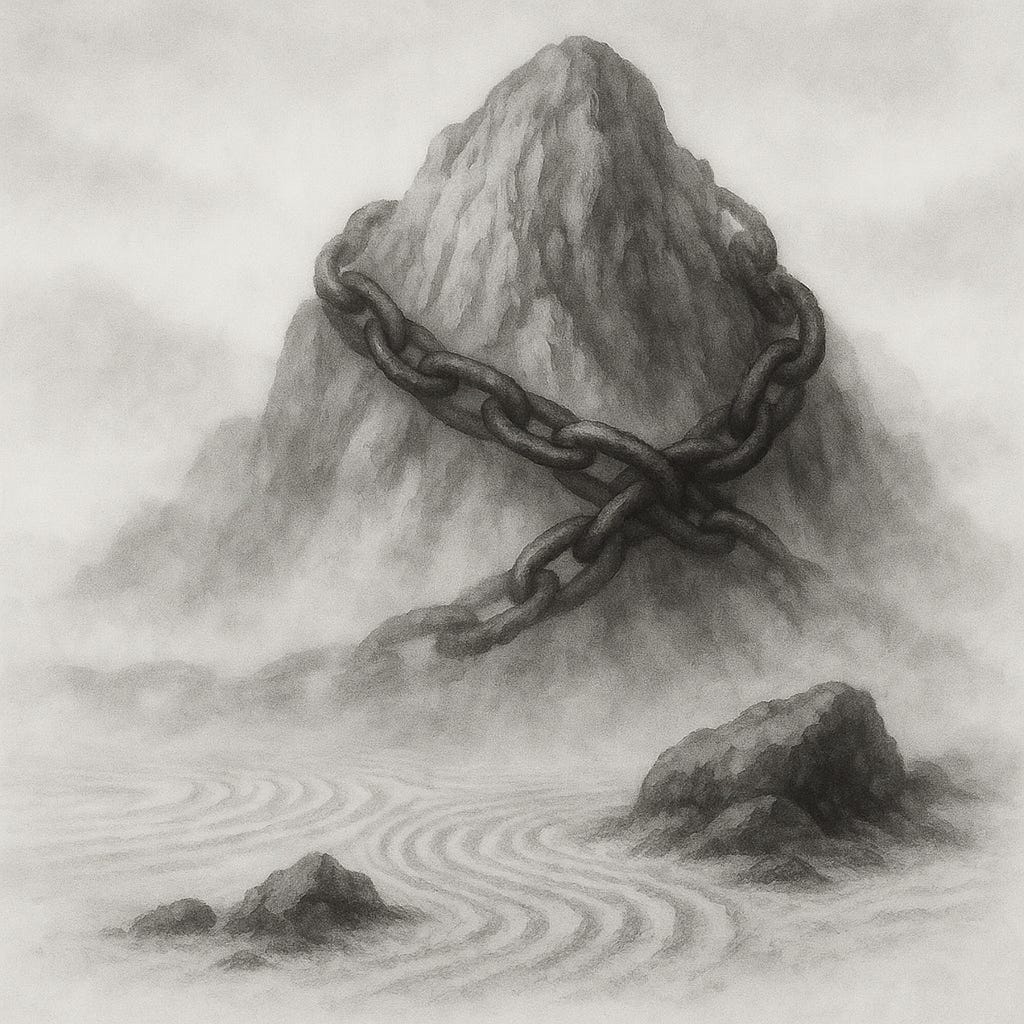
The West’s Moral Blindness — And What It Is Costing Us
On Hamas, Israel, and the slow suicide of Western values
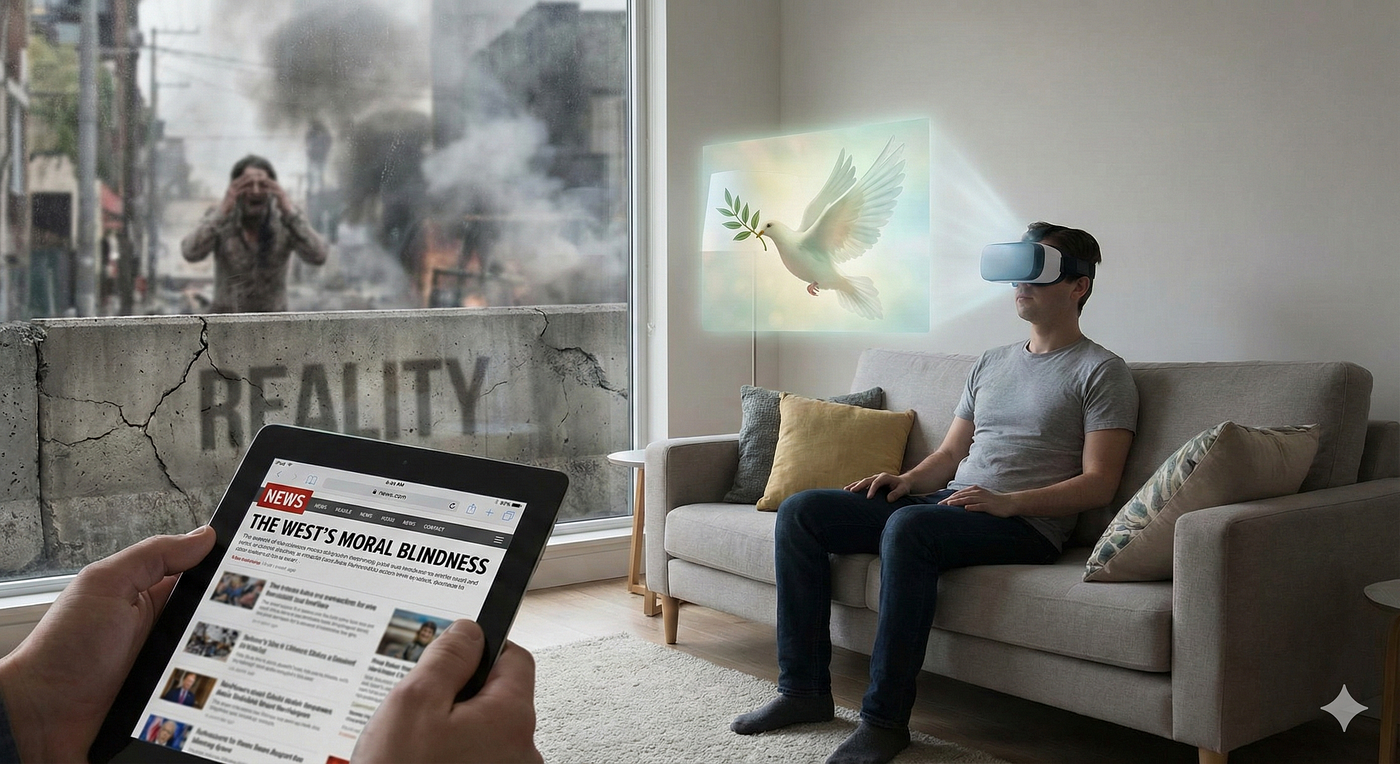
Image created with Google Gemini
The West’s Moral Blindness — And What It Is Costing Us
On Hamas, Israel, and the slow suicide of Western values
The massacres of October 7th confronted the West with a logic it is barely equipped to understand. Hamas operates by a principle with no equivalent in Western moral thought: “We love death the way you love life.” Martyrdom is not defeat — it is triumph.
Israel operates by the opposite logic: a state that cannot defend itself disappears from the map. This is not ideology. It is arithmetic.
The West, watching from a safe distance, has largely failed to understand either position — because it is wearing a third pair of glasses entirely.
Conviction Without Consequence
Max Weber drew a distinction that has never been more relevant: the difference between the ethics of conviction and the ethics of responsibility.
Conviction ethics judges actions by the moral purity of their intention. What matters is not what your action produces, but what it says about you. Responsibility ethics judges actions by their consequences — whether they actually protect the people you are accountable for, whether they make things better or worse.
Since 1945, the West has become overwhelmingly a civilization of conviction ethics. And in the Israeli-Palestinian conflict, this produces a moral catastrophe.
Images of Palestinian children in the rubble overwhelm every argument. That Hamas deliberately produces these images — by embedding military infrastructure in hospitals, schools, and residential buildings, using its own population as a shield — is acknowledged, if at all, as a footnote. The operative logic: whoever suffers is innocent; whoever causes suffering is guilty. The strategic choices that created the situation, the ideology of those who started it — these vanish in the face of the image.
The parallel to postwar German revisionism is uncomfortable but accurate. Neo-Nazis and historical revisionists shifted attention away from Hitler’s war of annihilation toward the bombing of Dresden and the expulsion of ethnic Germans — real suffering, instrumentalized to obscure responsibility. Today Palestinian civilian suffering functions in an almost identical way: a projection surface for Western empathy that systematically excludes examination of who created the conditions for that suffering. Weber knew this would happen. Those who practice only conviction ethics make themselves blind to consequences. The result is a grotesque inversion: the state that actually shares Western values is placed in the dock while its enemies are celebrated as the oppressed.
The Luxury of Distance
Western moral judgments about Israel are a product of geography, not ethical superiority.
Having lived in security for eighty years, Westerners treat existential threat as an abstraction. From inside this safety, “better naive than cruel” seems like a reasonable position — because one’s own survival is never genuinely at stake. For Israel, threat is daily reality: rockets, terrorist attacks, hostile militaries on every border, and October 7th as a massacre of previously unimaginable scale in peacetime.
This is why Israeli operations appear disproportionate to Western observers. But if parents in Berlin or Paris faced the same choices Israeli parents face, they would not choose differently. The difference is not moral. It is positional.
There is also a psychological dimension worth naming honestly. Many people in the West simply do not want to see the world as it is. They cannot bear its brutality and contradictions. “I don’t want to live in a world like that” a friend of mine once said — and spoke for millions. So a narrative shield is constructed: a dreamworld with clear victims and clear perpetrators, where one can stand on the side of the weak with a clean conscience. Images of Palestinian children sustain this story. Analysis of Hamas’s ideology would destroy it, so it is excluded. The West trades truth for purity: the world remains ugly, but one feels morally clean.
The implication is stark. Demanding that Israel make a deal leaving Hamas in power sounds humane from a safe distance. From Israel’s position it would demonstrate that terrorism works, guaranteeing the next escalation. It is roughly equivalent to the Allies in 1945 halting the war before defeating Nazi Germany to end immediate suffering. The problem would not have been solved. It would have been locked in.
The West chooses innocence because it can afford to. Israel must choose survival even at the cost of moral condemnation. The difference is geographic, not ethical. Only those not existentially threatened can afford a moral dreamworld.
The Hijacking of Truth
There is no free press in Hamas-controlled Gaza. Every journalist knows they may report only within Hamas-permitted boundaries — anything else risks imprisonment or death. Every piece of information leaving Gaza is pre-censored, filtered, staged. Yet Western media treat it as though it arrives from a neutral source.
The clearest example: the “Gaza Health Ministry.” It is a Hamas propaganda organ. Yet Western newsrooms cite its figures with the same authority they would grant a credible state institution. Hamas has learned to dress its narratives in the language of institutional legitimacy — the ministry, the official statement — and launder them into our information ecosystem.
International institutions amplify this. UNRWA, the UN agency for Palestinian refugees, has for decades taught hatred in its schools, allowed its buildings to be used as Hamas cover, and uncritically adopted Hamas narratives — yet carries credibility in the West because it bears the UN seal. Seventy-five percent of all UN General Assembly resolutions since 2000 have targeted Israel, while far bloodier conflicts elsewhere receive minimal attention. Iran — a regime that strips women of rights and crushes protest with lethal force — recently chaired a UN body on women’s rights. This is not coincidence. It is the systematic use of international institutions to convert propaganda into “international truth.”
Western media are not merely victims. They apply to Hamas the credulity they would never extend to Russia or Iran — because the narratives fit. The result is asymmetric truth: Israel fights according to international law and is constantly judged against it; Hamas violates those laws, controls the images, and produces the suffering the West wants to see. Israel is trapped fighting a physical war on the ground and a rigged narrative war globally — against an image of itself already shaped by its enemies.
The Values the West Has Forgotten
The West presents itself as a community of values: freedom, democracy, rule of law, protection of minorities, equality for women, freedom of the press, the dignity of every individual. These were not natural or inevitable. They were won over centuries of bloody struggle by people who understood what it meant to live without them.
Israel, for all its internal tensions, belongs to this community. It has free elections, independent courts, a raucous free press, genuine pluralism. Hamas explicitly rejects every item on that list. It preaches death rather than life, submission rather than freedom, religious law rather than democratic accountability.
Yet this opposition has disappeared from Western discourse. Why? Because since 1945 the West has elevated one value above all others: stop the war. This is historically understandable but intellectually ruinous. It means that whenever freedom, equality, and pluralism come into conflict with the demand for immediate ceasefire, they lose. Demanding that Israel stop fighting at all costs means demanding the surrender of the very values Israel actually embodies.
The deeper problem: the West has stopped articulating its own values. They are treated as self-evident — the natural default of humanity, requiring no defense. The existence of movements that openly and systematically reject them is not taken seriously. So the West ends up, almost without noticing, supporting forces that would destroy its own foundations. What is invisible cannot be defended.
The Global Picture
This conflict is embedded in something larger: a coordinated assault by Russia, China, and Iran on the Western-led international order. Russia wages a war of conquest in Ukraine while Iran supplies drones and finances terror across the Middle East. China supports both, and simultaneously presents itself as the voice of the Global South. The formula is simple: the West is guilty — of colonialism, inequality, oppression. For many governments in the Global South, this is a convenient distraction from domestic failures. Israel serves as the perfect symbol: small, Western, militarily capable, and therefore apparently the proof of “Western colonialism” — never mind that it is a tiny state surrounded by neighbors that have repeatedly tried to destroy it.
In Western universities, media, and NGOs, this narrative falls on prepared ground. The postcolonial framework is so deeply internalized that when Iran or Venezuela insist the problems originate in the West, it sounds plausible. Hamas presents itself as a liberation movement, and a significant portion of the Western intelligentsia nods along.
Putin has said openly that Western pluralism is a weakness to be exploited. He is right that it is a vulnerability. He is wrong that it is a weakness — but only if the West is willing to defend it.
The West’s greatest intellectual tradition — from Socrates through the Enlightenment — is the idea that honest self-examination is a civilizational strength. That tradition is right. Self-criticism is not weakness.
But there is a version that tips into self-destruction: the inability to name what you stand for, the reflexive suspicion of your own values, the willingness to extend unlimited moral generosity to movements that would extinguish those values entirely.
The West does not need to abandon self-criticism. It needs to apply that critical intelligence honestly — to itself and to everyone else. Equally. Without exception.
That would be a genuine return to Western values. Not the performance of moral purity. The difficult, consequential work of actually defending what matters.
This essay draws on Max Weber’s distinction between Gesinnungsethik and Verantwortungsethik, and engages with themes developed in the companion essay “Why Empires Fall — And What It Means for the West Today.”
메타데이터
- post_id
- fc0b7fed0538
- slug
- the-wests-moral-blindness-and-what-it-is-costing-us-fc0b7fed0538
- url
- https://medium.com/@michael.raz/the-wests-moral-blindness-and-what-it-is-costing-us-fc0b7fed0538
- canonical_url
- https://medium.com/@michael.raz/the-wests-moral-blindness-and-what-it-is-costing-us-fc0b7fed0538
- author_url
- https://medium.com/@michael.raz
- status
- ok
- fetched_at
- 2026-06-09 14:34:10