Orchestration Is a Systems Design Problem Disguised as a Tooling Choice
You didn’t pick the wrong scheduler. You skipped the design. Here’s what that cost you at 3 am — and the three decisions that actually fix…
Orchestration Is a Systems Design Problem Disguised as a Tooling Choice
You didn’t pick the wrong scheduler. You skipped the design. Here’s what that cost you at 3 am — and the three decisions that actually fix it.
Every year or two, a data team reaches the same conclusion: the orchestrator is the problem. They benchmark, they migrate. Six months later, the same pipelines fail at the same hours — they just look different way of doing it.
The tool was never the problem. The design was. Nobody sat down and asked what failure means for each pipeline — which consumers break, how recovery takes, whether a retry makes things better or quietly makes them worse. That conversation got skipped. The scheduler has been absorbing the consequences ever since.
“Switching orchestrators without fixing your design is repainting a house with a broken foundation. It looks better until it doesn’t “
3 am Failure Nobody Designs for
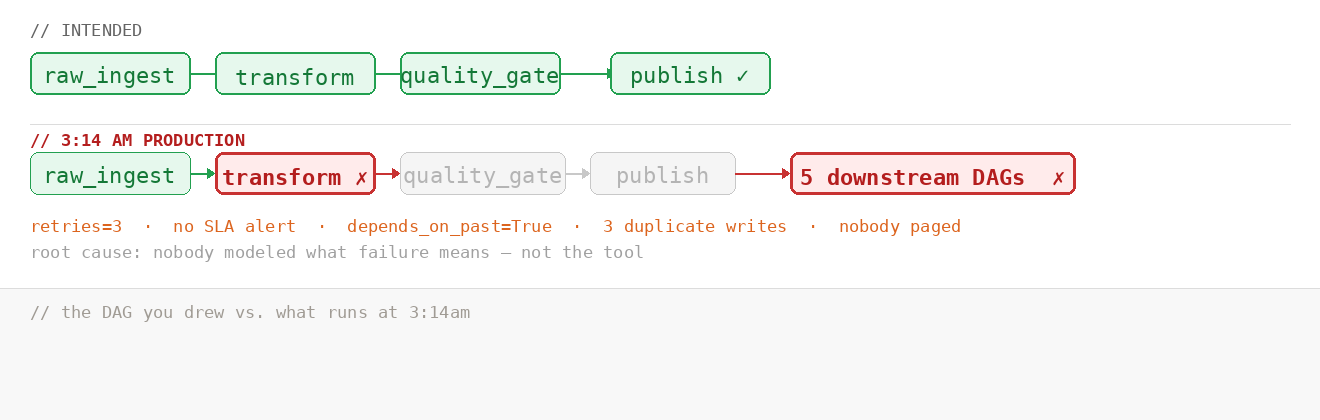
A transform task fails. Its downstream DAG has depends_on_past=True. There’s no SLA alert configured because someone meant to add it. By 8 am, five tables are stale, and a BI dashboard is confidently reporting wrong revenue numbers. An executive is about to make a budget call on data that hasn’t refreshed since Tuesday.
The engineer on call didn’t pick the wrong tool. They inherited a pipeline where “nobody had ever asked what failure means”.
Every bad retry count, every missing alert, every silent cascade — all symptoms of that one skipped conversation. The scheduler didn’t cause any of it. It executed exactly what it was told.
⚠ The uncomfortable truth
If you’ve ever opened Airflow at 3am and clicked “Clear” on a failed task without understanding why it failed, you’ve been treating symptoms. The diagnosis lives upstream of the tool, in decisions that were either made badly or never made at all.
Retries Are a Contract, Not a Config
Think about the last time a pipeline failed overnight and the on-call engineer cleared it by morning. The task was retried, it passed, and the DAG went green. Nobody asked why it failed the first time. Nobody asked whether the retry wrote the same data twice. The incident was closed.
That engineer didn’t fix anything. They rescheduled the problem. Here is the single most dangerous line of configuration in data engineering:
# copy-pasted after from Airflow tutorial on the internet

transform_task = PythonOperator(
   task_id='transform',
   retries=3,        # why 3? nobody knows. It was in the example
   retry_delay=timedelta(minutes=5)
)
Dangerous because it looks responsible. You set retries, you have a delay. This is fine, right? The answer is No.
retries = 3 is a silent bet that your task is idempotent — that running it multiple times produces the same results. If your task does a plain INSERT into a Delta table, every retry appends another copy of the same data. You don’t have three attempts at recovery. You have one failure followed by two acts of data corruption, all logged under a single incident, all signed off by a scheduler that had no idea what it was doing.
Ask why that number is 3 for retries. If nobody can answer, that pipeline has never been designed for failure. It’s been configured for optimism.
⚠ Check your own pipelines right now
Find a pipeline that writes data. Look at its retry config. Is every task idempotent? Have you verified that? If not, those retries aren’t protecting you. They’re a scheduled corruption job with a 5-minute delay and a green checkmark at the end.
Retry config is derived from two facts:
1. Is this task idempotent? If yes, retries are safe. If no, fix that first. 2. What’s the SLA budget? How many minutes does recovery have before a consumer is impacted? Divide by your retry delay. That’s your retry count. Everything else is guesswork.
# after actually thinking about it

transform_task = PythonOperator(
   task_id = 'transform_customer_events'.

   # Delta MERGE handles duplicates -> idempotent, safe to retry
   # SLA Window: 20 mins -> 2 retries x 7 mins = 14min used, 6 mins buffer
   retries = 2,
   retry_delay = timedelta(minutes=7),
   on_retry_callback = notify_oncall,
   sla = timedelta(minutes=20),
)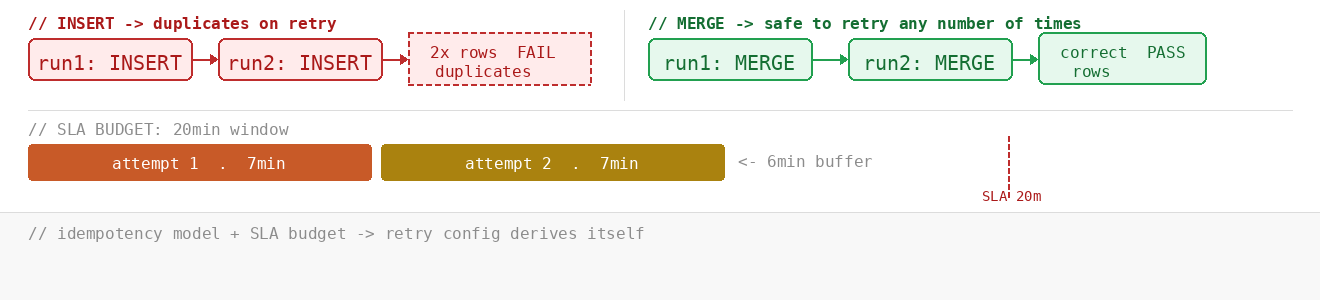
Visulalise how retries can impacts your SLA
Quality Gates Belong Inside the Graph
Ask a data team where their quality checks live, and you’ll usually hear: a monitoring dashboard, a nightly notebook, or a Slack alert that fires after consumers have already been burned. All three are observers. They watch the pipeline finish and then tell you it was wrong. That’s not quality assurance. That’s a post-mortem pipeline.
X% of pipeline incidents are silent quality failures. Pipelines that completed successfully but delivered corrupt or incomplete data, because there was no gate, only an observer that reported that problem after consumers were already hit.
Code below uses an Anomalo check as a quality gate, but you can choose your own:
# quality gate as first class node - not a sidecar, not a dashboard
ingest >> transform >> quality_check >> publish_to_customer

def quality_gate(**context):
    result = run_anomalo_check(
        table="prod.customer_events",
        run_date=context["ds"]
    )
    if not results.passed:
       # downsteam BLOCKED. Data protected
       raise AirflowException(f"Quality check failed: {result.summary")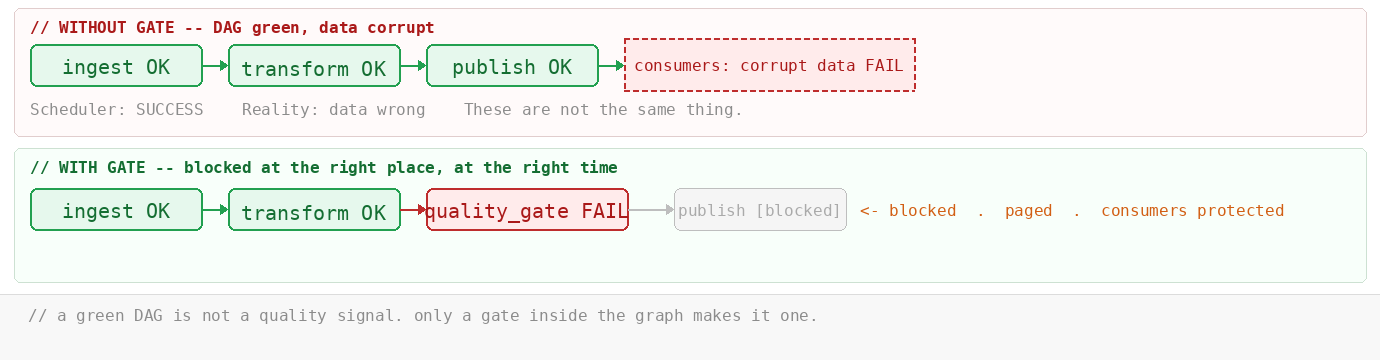
Green DAG is not a quality signal
Dependencies Are Data Contracts, Not Task Links
Pick any DAG in your codebase. The one where Task B reads the output of Task A.
Now answer this: if Task A wrote partial data — a schema drift, a truncated load, a row count 40% below normal — would Task B know?
In most pipelines, the answer is no and >> means “run this after that.” Pipeline schedules as instructed. Task B would start on schedule, read whatever was there, and produce output. Downstream consumers would get numbers. The dashboard would update. Nobody would know until a meeting two weeks later, when someone noticed the trend looked off.
⚠ The lie hiding in your >> operator
Every task dependency in your DAG that isn’t backed by an explicit data contract is an assumption you haven’t tested. It might hold for a year. It will break at the worst possible moment — in a way that won’t surface in the scheduler UI.
# task-level: scheduling order only - on data guarntee
transform >> downstream_report # did transform produced VALID Data? undefined.

# Airflow: enforce the contract explictiy with ExternalTaskSensor
wait_for_customer_events = ExternalTaskSensor(
  task_id="wait_for_customer_events",
  external_dag_id="customer_events_pipeleine",
  external_task_id="quality_gate", #only passes if quality gate passed
  allowed_tasks=["success"]
  mode="reschedule",
  timeout=3600,
  poke_interval=60
)

weekly_report = PythonOperator(
  task_id = "weekly_report",
  python_callbale=build_weekly_report,
)

#weekly report only starts when customer_evetns is confirmed quality-checked
wait_for_customer_events >> weekly_report
Where incidents might come from
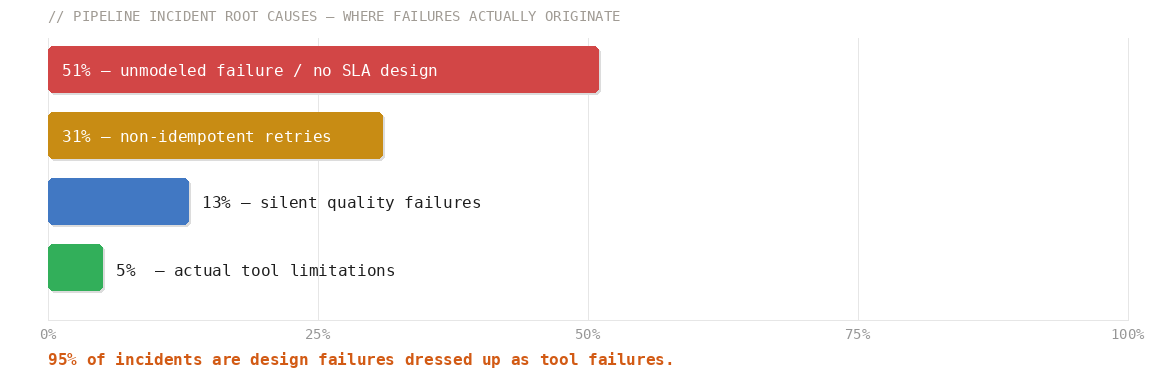
Percentages are estimated from author’s operational experience — not a formal study.”
95% of pipeline incidents traced back to design failures, not tool failures. The migration won’t help. The design conversation will.
So — Which tool fits your stack?
Once you know your failure semantics, idempotency guarantees, quality checks, and dependency contracts. The tool question gets dramatically simpler. Each one has a genuine home. The mistake isn’t picking the wrong tool. It’s picking any tool as a substitute for the work above.
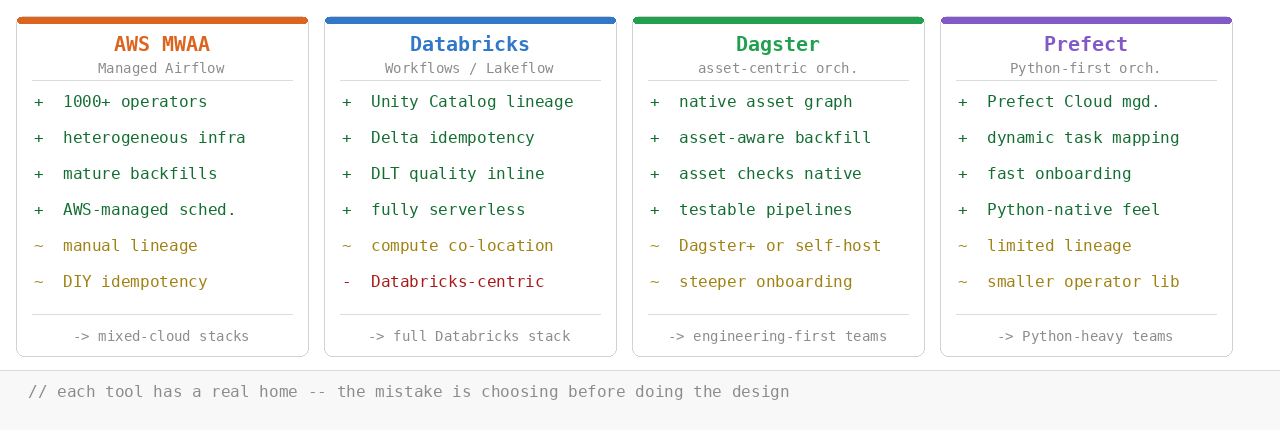
Assesments reflect common default configurations — your setup might differ
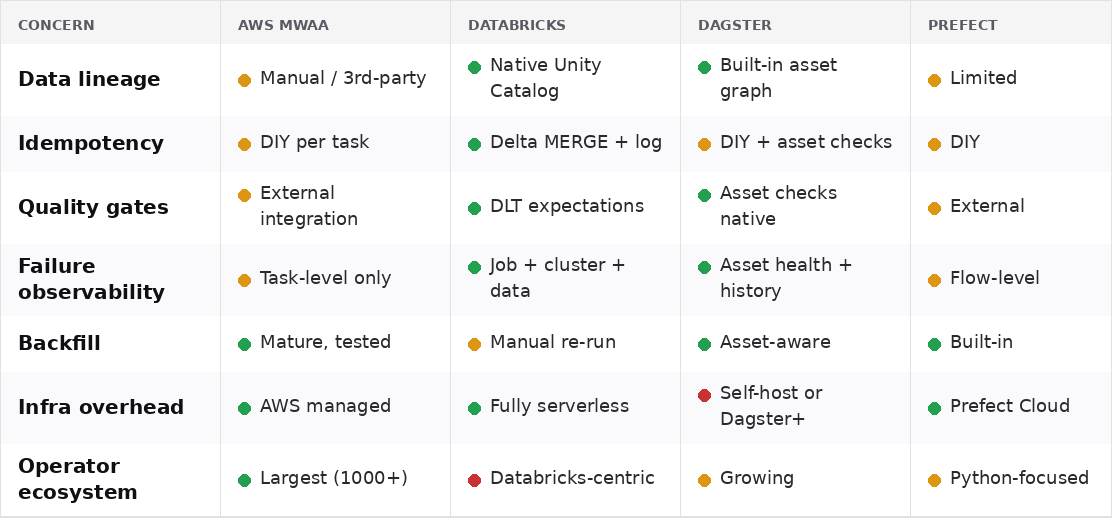
Assesments reflect common default configurations — your setup might differ
⚡ Honest pick guide
Full Databricks stack (Delta + Unity Catalog)? Workflows. Lineage flows automatically through Unity Catalog. Delta handles idempotency at the storage layer. DLT bakes quality expectations directly into the pipeline. Orchestration, governance, and compute collapse into one surface.
Mixed infra — Snowflake, Redshift, dbt, S3, APIs? MWAA. Operator ecosystem is unmatched. AWS manages the Airflow ecosystem. Tradeoff: lineage and quality are your problem — which is fine, because now you know how to solve them.
Engineering-first team that wants testable pipelines? Dagster. Asset checks, software-defined assets, type-safe IO managers. The onboarding cost is real. So is the 2 am difference between “the DAG failed” and “the customer_events asset is unhealthy, row count dropped 40%, here are the three downstream assets affected.”
The Real Reason Orchestration Keeps Breaking
The reason orchestration keeps breaking isn’t Airflow, It isn’t Dagster. It’s that data teams have learned to treat every production incident as a tooling problem — because tooling problems are concrete, scoped and fundable. Design problems are ambiguous, political and require everyone to admit they skipped something important.
So the migration gets approved. The new tool gets deployed. The same pipeline with the same unmasked questions baked into them, start running in a slightly shinier interface. Six months later, the same failure happened at the same hour.
Before you write a single operator, answer these three questions for every pipeline you own:
-
What breaks if the data is 2 hours late? Name the consumer. Name the business consequences. If you can’t, your SLA config is a number that was made up.
-
Is every task idempotent? Run it twice. Does the output change? If yes, your retry config is a scheduled data-corruption job with a polite delay and green status icon at the end.
-
Does a green DAG mean the data is correct? If not, you don't have a quality gate. You have a dashboard that lies with institutional confidence, and every downstream consumer is trusting that lie.
Every orchestrator can implement pipelines that pass all three checks. And every one of them will fail you if you skip this work. The tool choice follows the design. It has never worked the other way around.
“The team that designs for failure first, then picks a tool, will outperform the team that picks a tool and hopes for the best. Every single time.”
Next time someone pitches a migration, ask the real questions: What design problem are we avoiding by calling this a tooling problem? That conversation is harder. It’s also the only one that actually fixes anything.
메타데이터
- post_id
- fc0c6b44b85a
- slug
- orchestration-is-a-systems-design-problem-disguised-as-a-tooling-choice-fc0c6b44b85a
- url
- https://medium.com/@rbala17781/orchestration-is-a-systems-design-problem-disguised-as-a-tooling-choice-fc0c6b44b85a
- canonical_url
- https://medium.com/@rbala17781/orchestration-is-a-systems-design-problem-disguised-as-a-tooling-choice-fc0c6b44b85a
- author_url
- https://medium.com/@rbala17781
- status
- ok
- fetched_at
- 2026-06-13 09:11:36




