Golden Apples in Norse and Greek Mythology
Apples serve as a profound symbolic communication in various mythologic cultures. There have been numerous articles, essays, and books…
Golden Apples in Norse and Greek Mythology
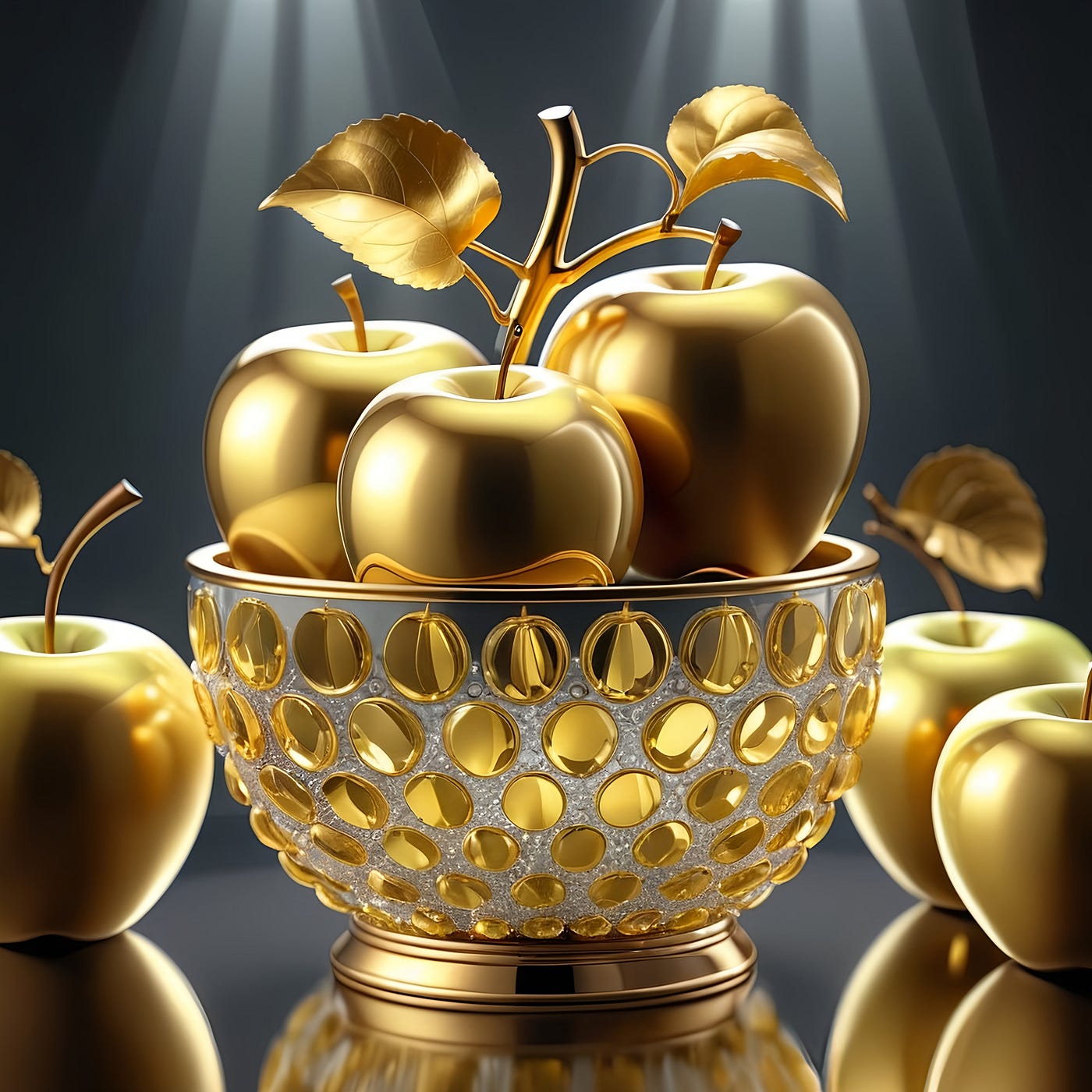
Apples serve as a profound symbolic communication in various mythologic cultures. There have been numerous articles, essays, and books written about their value and the role they play. However, even more fascinating and peculiar is the role of the golden apple. Just as it is elevated above the common red fruit, so its status in mythology overrides that of any other fruit (except perhaps, the pomegranate). The tree on which they grow is often heavily guarded, making them the perfect subject for an ancient heist story. In Norse Mythology, Idunn’s golden apples of youth keep the gods ageless and fruitful. Contrast this to Greek Mythology, with Hera’s golden apples from the Garden of Hesperides, which are supposedly equipped with the same powers of youth.
In Norse Mythology, Idunn holds the responsibility of retaining the gods’ youthful natures and vitality flows from her. Some suspect that Idunn herself holds these powers, while her apples are only a material representation of this (worldhistory.org). Because of her abilities, she is often characterised as the goddess of second chances, healing, and peace-keeping (worldhistory.org). In the story of Idunn’s Abduction, Loki tricks her into carrying her magic apples to where the shapeshifting giant, Thjazi, resides, who then captures her. It is only when the gods realise they are aging that they notice she is gone. They send Loki to fetch her home, which results in a chase between Thjazi the eagle and Loki the hawk. The Aesir were prepared for this flight, so when Loki passed through the gates of Asgard followed closely by Thjazi, they lit a fire underneath the eagle, killing him. Once Idunn is safely returned, the gods’ youth is restored (worldhistory.org).
In Greek Mythology, the golden apples from the Garden of Hesperides have many stories circulating around them. The Hesperides are maidens that guard the tree with golden apples, along with Ladon, the dragon; they were given to Hera as a wedding present from Gaia upon her marriage to Zeus. In one version of the labours of Heracles’, he takes over Atlas’ burden of holding up the sky while he goes to fetch the apples; in another version Heracles killed Ladon and took them for himself; and in a third he spent an entire evening with the Hesperides maidens who liked him so much they parted with the apples willingly.
In another story involving the golden apples, that is perhaps the most well-known, the “Apple of Discord” is the cause of the Trojan War. At the wedding of Peleus and Thetis, all of the gods, except for Eris (the goddess of discord), were invited. Eris, very bitter about her exclusion, crashed the party and threw a golden apple into the centre of the room saying “for the fairest!”. Naturally, Aphrodite, Hera, and Athena lunged for it. However, they couldn’t agree on who should get it — so Hermes took them to Paris to decide. Paris chose Aphrodite, being partial to her because of her promise to gift him Helene as a wife, which caused much strife between the goddesses and ultimately led to the Trojan War when Paris captured Helene as his “rightful” wife (theoi.com).
There are countless fairytales and narratives depicting the heroic adventures of someone trying to steal magic fruit; this comparison can even be drawn to Biblical retellings. The motif of the apple is an important one because in most cases it represents youth, vitality, and health, while forcing the seeker of its power to put himself in dangerous, exerting, and risky situations in order to steal it. Whether “the apple” in stories is a literal apple or another kind of fruit represented by a laymen’s one, is for the reader of that tale to decide himself.
The golden apple in these stories stands alone; it is a thing of beauty and captivity, it took no effort to make since the tree was just there, it takes care of itself so that it may take care of others. This common motif can even be seen in The Magician’s Nephew by C.S. Lewis, when Diggory steals the apple from the tree in order to save his mother — which reflects Eden’s theft of the magic fruit in the Bible — which is then again recycled in one tradition after another. Geoffrey of Monmouth in Vita Merlini describes the power of the apple simply but effectively (176. Blažek, Václav):
Atilis eterno producit uere uirentes
Flores et frondes per tempora cuncta
uirendo
Insula pomorum que fortunata uocatur
Ex re nomen habet quia per se singula
profert
Non opus est illi sulcantibus arua colonis
Omnis abest cultus nisi quem natura
ministrat
The island of apples which men call
“The Fortunate Isle” gets its name
from the fact that it produces all things of itself;
the fields there have no need of the ploughs
of the farmers and all cultivation is lacking
except what nature provides.
In Norse mythology Idunn stores her golden apples in her “chest of ash” and whenever the gods grow old they are given an apple to eat which then resets their age and makes them young again (178. Blažek, Václav). The Garden of Hesperides is also mentioned by Lugh in Irish mythology (169. Blažek, Václav), so one wonders if this garden could perhaps take the place of the Garden of Eden in stories and myths. Magic apples seem to come from a beautiful garden or from a tree that just appeared, so clearly there is more to this fruit than to any other. The theft of Idunn’s golden apples is reminiscent of Heracles’ theft of Hera’s golden apples because they are the object of challenges, they are desired and sought after, they are guarded, and they hold great importance. In the Prose Edda, the golden apples are not seen as frequently as in Greek myths, where countless stories and trials take place due to their value. While Idunn’s character seems more related to Hestia’s, her possessions are closer to that of Hera’s. Idunn is innocent and guiltless, while Hera is meddlesome and protective.
There is much that can be said on the subject of apples throughout various mythologic cultures, but for the sake of this essay, the main comparisons lie between Norse and Greek mythology, and Idunn and Hera. Many questions are raised in the pursuit of a simple similarity because while the motif is reused countless times, the tales are always unique, analogous, and fabled. Are golden apples valued higher than gold? Probably. Is the Garden of Hesperides symbolic of the Garden of Eden? Maybe. Are the apples tied to youth or desire? Who can say. This subject is endlessly fascinating and this essay merely serves as an overview of two mythologies and the role that golden apples serve in their cultures.
Works Cited
-
Atsma, Aaron J. “Judgement of Paris.” Theoi Project. Web. 2000. https://www.theoi.com/ Olympios/JudgementParis.html. Accessed 17 April 2025.
-
Blažek, Václav. “The Role of the ‘Apple’ in the Indo-European Mythologic Tradition and in Neighboring Traditions. https://muni.academia.edu/VáclavBlažek. Accessed 17 April 2025.
-
Mark, Joshua J. “Idunn.” World History Encyclopedia. 10 Sep 2021. https:// www.worldhistory.org/Idunn/#citation_info. Accessed 17 April 2025.
-
The Editors of Encyclopaedia Britannica. “Hesperides”. Encyclopedia Britannica, 18 Mar. 2024, https://www.britannica.com/topic/Hesperides-Greek-mythology. Accessed 17 April 2025.
메타데이터
- post_id
- fc18d8b684d5
- slug
- golden-apples-in-norse-and-greek-mythology-fc18d8b684d5
- url
- https://medium.com/@audreymscott/golden-apples-in-norse-and-greek-mythology-fc18d8b684d5
- canonical_url
- https://medium.com/@audreymscott/golden-apples-in-norse-and-greek-mythology-fc18d8b684d5
- author_url
- https://medium.com/@audreymscott
- status
- ok
- fetched_at
- 2026-07-24 15:22:40




