Türkiye’s Radar Industry: Building One of the World’s Fastest-Growing Defense Sensor Ecosystems
Radar has become one of the most critical technologies in modern defense. It is no longer simply a sensor that detects aircraft in the sky…
Türkiye’s Radar Industry: Building One of the World’s Fastest-Growing Defense Sensor Ecosystems
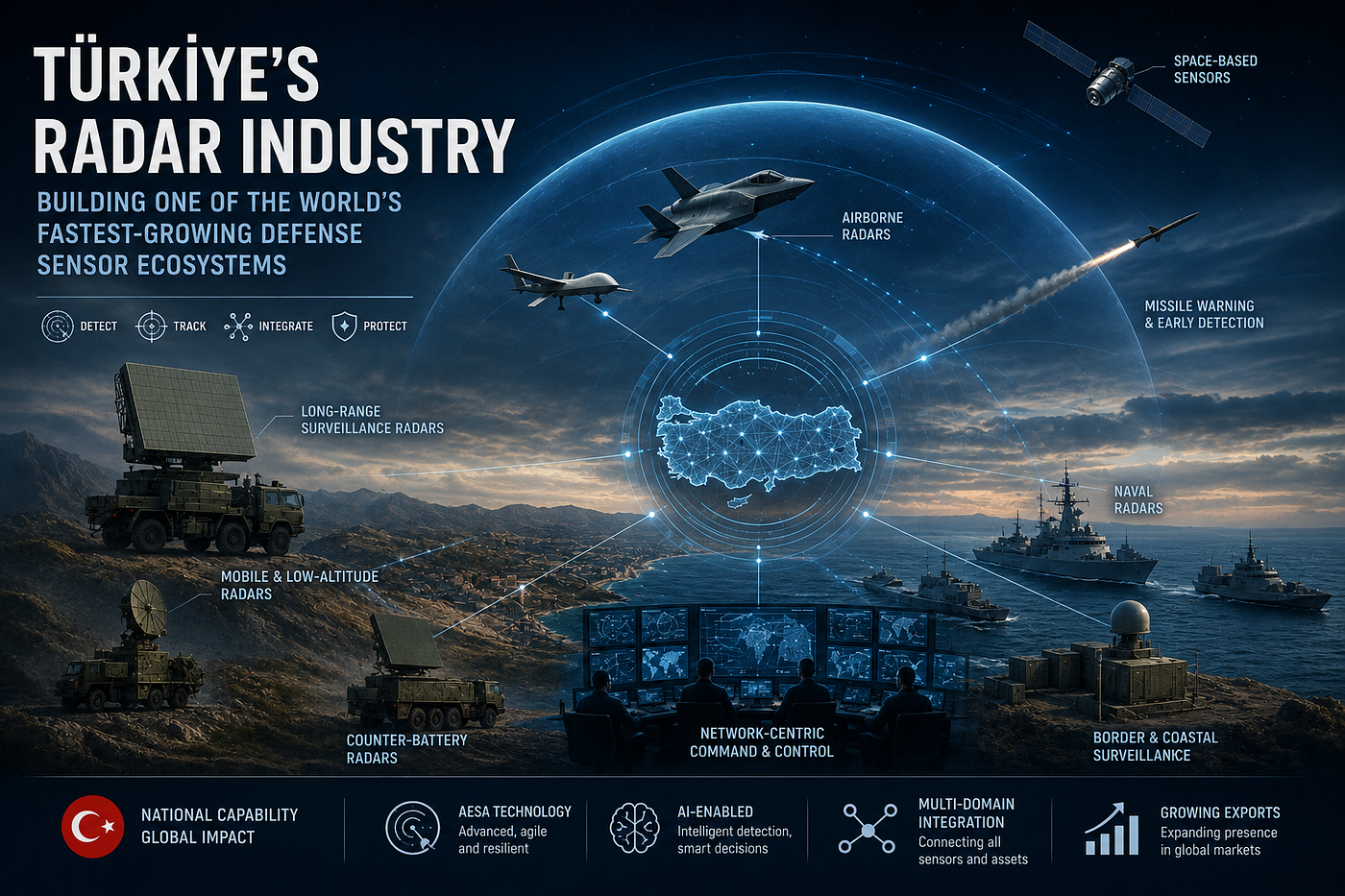
Radar has become one of the most critical technologies in modern defense. It is no longer simply a sensor that detects aircraft in the sky. Today, radar serves as the foundation of intelligence, surveillance, air defense, naval warfare, electronic warfare, missile defense, and network-centric operations.
For Türkiye, radar technology has evolved into one of the country’s most strategic defense priorities. Over the past two decades, the nation has transformed from relying heavily on foreign radar systems to developing a comprehensive domestic radar ecosystem capable of designing, manufacturing, integrating, and exporting advanced military sensors.
The Domestic Market
Within Türkiye, the military radar industry is overwhelmingly led by ASELSAN. The company develops nearly every major category of radar required by the Turkish Armed Forces, including:
- AESA fighter radars
- Long-range air defense radars
- Fire-control radars
- Naval surveillance radars
- Counter-battery radars
- Drone detection radars
- Border surveillance systems
- Ground surveillance radars
- Electronic warfare support sensors
Today, ASELSAN is estimated to account for approximately 80–90 percent of Türkiye’s military radar market.
This dominance is supported by decades of investment in radio-frequency engineering, phased-array antenna technology, signal processing, embedded software, and system integration.
Beyond ASELSAN: Türkiye’s Expanding Radar Ecosystem
Although ASELSAN is the flagship company, Türkiye’s radar capability is supported by a much broader industrial and research network.
TÜBİTAK BİLGEM
TÜBİTAK BİLGEM focuses on advanced radar research rather than mass production. Its contributions include:
- Digital signal processing
- Radar algorithms
- Artificial intelligence
- Electronic warfare technologies
- Advanced RF research
- Experimental radar concepts
Many of these technologies eventually transition into operational military systems.
METEKSAN Defence
METEKSAN Defence has established itself as a specialist in surveillance radar technologies.
Its portfolio includes radar systems for:
- Border security
- Coastal surveillance
- Critical infrastructure protection
- Counter-UAV missions
- Ground surveillance
Its radar products are particularly optimized for detecting small, slow-moving, and low-altitude targets.
HAVELSAN
HAVELSAN does not manufacture radar hardware directly, but it plays a critical role in connecting radar systems into a unified operational network.
Its expertise includes:
- Command and control systems
- Sensor fusion
- Air defense management software
- Decision support systems
- Network-centric warfare architecture
In modern combat, integrating radar information is often as important as detecting the target itself.
TÜBİTAK SAGE
While primarily recognized for missile technologies, TÜBİTAK SAGE contributes to radar development through:
- Radar seeker technologies
- RF electronics
- Guidance systems
- Target tracking algorithms
These technologies are essential for precision-guided munitions.
Turkish Aerospace (TUSAŞ)
Turkish Aerospace integrates radar systems into airborne platforms such as:
- KAAN
- HÜRJET
- ANKA
- AKSUNGUR
- ANKA III
Successful radar performance depends not only on the radar itself but also on aircraft integration, cooling, power management, and electromagnetic compatibility.
Universities and Research Institutions
Turkish universities continue to strengthen the radar ecosystem through research in:
- Microwave engineering
- Gallium Nitride (GaN) semiconductors
- Phased-array antennas
- Artificial intelligence
- Signal processing
- Electronic warfare
This academic infrastructure provides the skilled engineers required for long-term technological independence.
Türkiye’s Position in the Global Radar Market
Globally, the military radar market is estimated to generate between $15 and $20 billion annually, with continued growth expected as countries invest in integrated air defense systems, drone detection, and next-generation sensor technologies.
The global market is currently led by companies such as:
- RTX
- Lockheed Martin
- Northrop Grumman
- Leonardo
- Thales
- Saab
- HENSOLDT
- Israel Aerospace Industries
These companies benefit from decades of operational experience, large domestic procurement programs, and extensive export networks.
Türkiye is not yet among the largest radar exporters. However, it has become one of the fastest-growing competitors in this field.
ASELSAN’s estimated share of the global military radar market is believed to be approximately 2–4 percent, with significant growth potential over the next decade.
Why Türkiye Is Growing So Quickly
Several global trends are accelerating Türkiye’s radar industry.
The first is the rapid adoption of AESA (Active Electronically Scanned Array) technology. AESA radars provide higher reliability, faster target tracking, greater resistance to electronic warfare, and simultaneous multi-target engagement.
The second driver is the rise of drone warfare. Modern battlefields require radar systems capable of detecting very small drones, loitering munitions, cruise missiles, and other low-observable threats.
The third factor is the shift toward layered air defense systems. Projects such as Çelik Kubbe depend on multiple radar types working together, including:
- Long-range surveillance radars
- Low-altitude radars
- Fire-control radars
- Mobile radar units
- Passive sensors
- Naval radar systems
No single radar can provide complete situational awareness. Modern defense requires an integrated sensor network.
Finally, many countries are seeking alternatives to traditional defense suppliers. Türkiye has become increasingly attractive by offering advanced technology, competitive pricing, rapid delivery, and flexible industrial cooperation.
Export Opportunities
Türkiye’s radar exports continue to expand across multiple regions.
Growing markets include:
- Gulf countries
- Central Asia
- Southeast Asia
- Africa
- Eastern Europe
- NATO partner nations
The strongest export potential exists in:
- Mobile air defense radars
- Counter-drone radar systems
- Coastal surveillance radars
- Naval surveillance radars
- Border security systems
- Integrated C4ISR architectures
Unlike many defense products, radar exports often generate decades of additional business through maintenance, software updates, operator training, spare parts, and system modernization.
The Next Generation of Radar
Future radar development will extend far beyond traditional surveillance.
The next generation is expected to include:
- AI-supported cognitive radar
- Passive radar systems
- Multi-band radar architectures
- Distributed sensor networks
- Space-based radar systems
- Drone-mounted Synthetic Aperture Radar (SAR)
- Autonomous target classification
- Swarm detection algorithms
Artificial intelligence will increasingly transform radar from a detection device into a decision-support system capable of identifying threats, prioritizing targets, filtering false alarms, and assisting commanders in real time.
Looking Ahead
If Türkiye maintains its current pace of investment, industrial expansion, and export growth, it could realistically increase its share of the global military radar market to 5–7 percent over the next decade. While this projection is not an official forecast, it reflects current industrial trends, expanding product portfolios, and increasing international demand.
More importantly, Türkiye is no longer focused solely on building individual radar systems.
It is building an integrated defense sensor ecosystem.
The future battlefield will not be dominated by the country with the single most powerful radar. It will belong to the nation capable of connecting radars, artificial intelligence, electronic warfare, drones, missiles, satellites, naval platforms, and command centers into one synchronized network.
Türkiye’s radar industry is moving decisively toward that future, positioning itself not only as a regional leader but also as an increasingly important player in the global defense technology landscape.
메타데이터
- post_id
- fc1c176ba608
- slug
- türkiyes-radar-industry-building-one-of-the-world-s-fastest-growing-defense-sensor-ecosystems-fc1c176ba608
- url
- https://medium.com/@onurtatver/t%C3%BCrkiyes-radar-industry-building-one-of-the-world-s-fastest-growing-defense-sensor-ecosystems-fc1c176ba608
- canonical_url
- https://medium.com/@onurtatver/t%C3%BCrkiyes-radar-industry-building-one-of-the-world-s-fastest-growing-defense-sensor-ecosystems-fc1c176ba608
- author_url
- https://medium.com/@onurtatver
- status
- ok
- fetched_at
- 2026-07-09 06:11:55