The Better I Got At My Job, The Harder It Became To Ask For Help
Competence made me more useful—and far more private about the moments when I was lost.
The Better I Got At My Job, The Harder It Became To Ask For Help
Competence made me more useful—and far more private about the moments when I was lost.
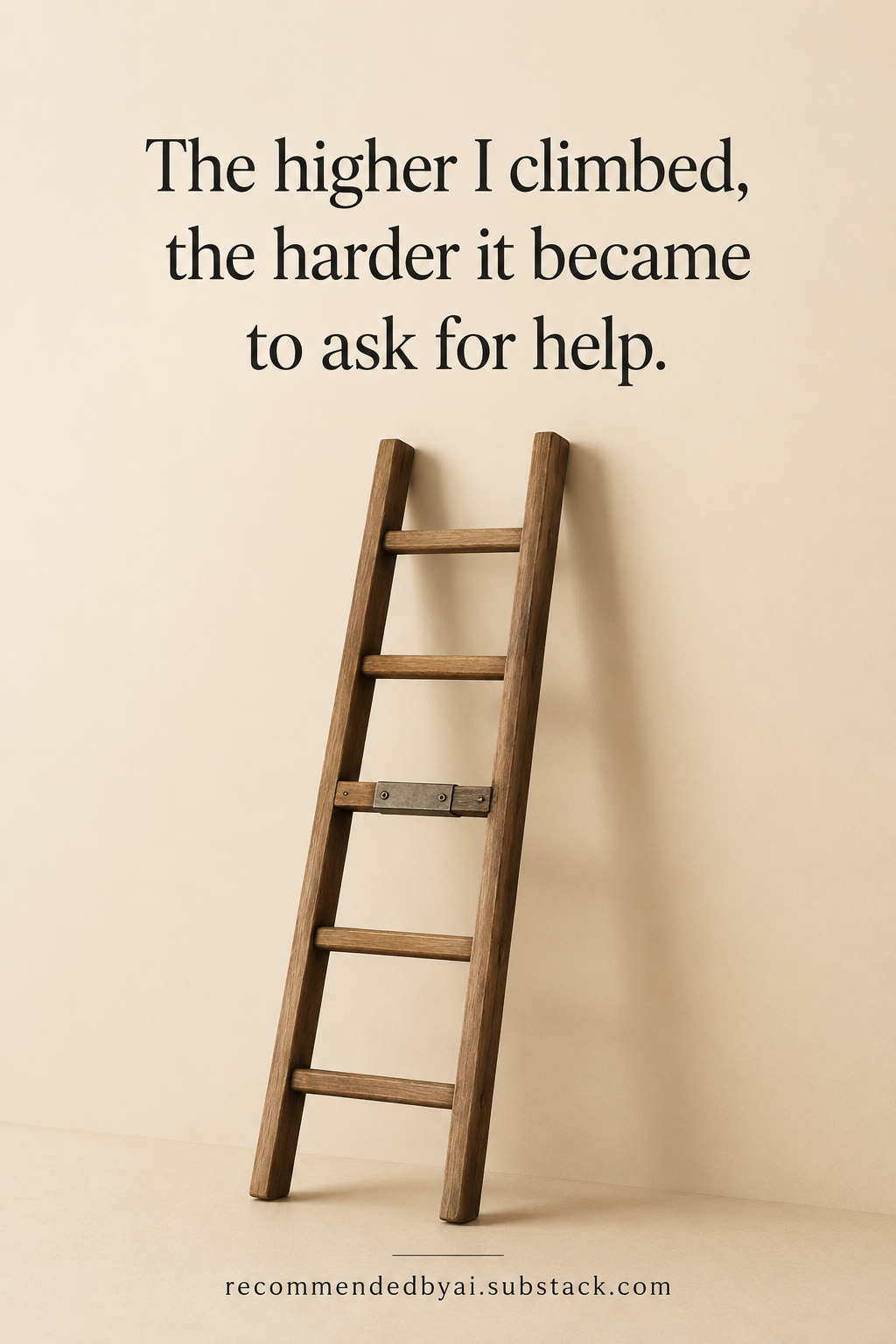
Ladder with quote about asking for help. Img src by the Author.
The first time I realized I had become afraid to ask for help, I was sitting in front of a problem I had already spent two days pretending I could solve alone.
Nothing about the problem was dramatic. It was the kind of issue that appears ordinary from the outside and becomes more embarrassing the longer it remains unresolved. I had logs open across two monitors, notes scattered beside my keyboard, and several half-formed theories that had already contradicted one another. Every hour or so, someone would ask how things were going, and I would say some version of, “I’m getting closer.”
I wasn’t getting closer.
I was getting more committed to the appearance that I should already know what to do.
Earlier in my career, asking for help had felt natural. I was new, which meant nobody expected me to understand every system or anticipate every failure mode. I could walk over to someone’s desk, explain where I was stuck, and learn something in ten minutes that might otherwise have taken me the rest of the afternoon. Questions were part of the job because learning was visibly part of the job.
Experience changed that in a way I hadn’t expected.
As my title grew, so did the number of people who came to me for answers. I became the person invited into difficult discussions, the person asked to review designs, and the person expected to notice risks before they became incidents. That trust felt good. It also created a version of me I became increasingly careful not to disappoint.
The better I became at my job, the less permission I gave myself to look uncertain while doing it.
By the second day, the problem had started to feel personal. I was no longer investigating a technical issue; I was defending an identity. Somewhere in the background, a quiet calculation had taken over my thinking. If I asked someone for help now, I would have to admit how long I had already been stuck. If the answer turned out to be obvious, the embarrassment would be worse. If a more junior engineer saw the thing I had missed, what would that say about me?
These thoughts were irrational, but they were persuasive.
Competence had once given me freedom. Now it was becoming a standard I felt compelled to perform.
Eventually, an engineer I trusted stopped by and asked what I was working on. I gave him the polished version first: the likely causes, the evidence I had gathered, the areas I had ruled out. He listened for a while, then asked a simple question.
“Where are you actually stuck?”
The question cut through two days of performance.
I told him.
We found the issue twenty minutes later.
The answer was not humiliating. It was not even particularly obvious. He noticed something in the logs because he came to the problem without the assumptions I had accumulated while staring at it alone. I had been trying to prove one theory; he had simply been trying to understand what was happening.
What embarrassed me afterward was not that I had needed help.
It was how much time I had wasted protecting myself from receiving it.
That distinction stayed with me.
I started noticing how often seniority creates this trap. The more capable people become, the more carefully they sometimes hide the limits of that capability. Junior employees ask questions because uncertainty is expected. Experienced people often spend far longer struggling privately because they believe uncertainty now requires an explanation.
The irony is that senior work contains more uncertainty, not less.
The problems become less defined. The decisions involve competing trade-offs. The information is incomplete, and the consequences reach further. Experience helps you recognize patterns, but it also teaches you how many variables you still cannot see. At exactly the point when collaboration becomes most necessary, pride can make it harder to reach for.
That is not confidence.
It is isolation wearing a professional title.
The best leaders I worked with behaved differently. They asked for help before a problem became a confession. They invited people into unfinished thinking. They could say, “I’m missing something,” without turning the sentence into an apology. Their authority did not seem to depend on appearing complete.
At first, I thought that openness came from having nothing left to prove.
Later, I realized it was one of the reasons people trusted them.
A person who can acknowledge the edge of their knowledge makes the room safer for everyone else to do the same. Questions arrive earlier. Risks surface faster. People stop wasting energy pretending. The team becomes more intelligent because no individual is required to perform intelligence alone.
Motherhood gave me a less flattering version of the same lesson.
There were evenings when I was exhausted, overwhelmed, and still insisting I could manage everything myself. I would reject help, then quietly resent how much I was carrying. Somewhere inside me was the same old belief: if I were truly competent, I would be able to handle it.
But parenthood has no respect for that kind of pride. Children get sick on difficult weeks. Work becomes busy when sleep disappears. The laundry does not care about your title, and a crying child does not become easier because you are usually good at solving problems.
Sometimes the healthiest sentence in the room is simply, “I need help.”
It took me longer than it should have to learn that.
Looking back, I think competence becomes dangerous when it stops being a skill and starts becoming an identity. Skills can grow, fail, and require support. Identities feel as though they must be defended.
Once I stopped treating every question as evidence against my ability, I became better at the work itself. I asked for another perspective sooner. I admitted uncertainty before it hardened into wasted effort. I became more useful because I was no longer spending so much energy trying to look useful.
The better I got at my job, the harder it became to ask for help.
The more mature I became, the more I understood that asking was part of the job.
Not a failure of competence.
One of its clearest signs.
P.S. I like using Substack Notes to test smaller ideas before turning them into full articles, but writing one Note at a time can quickly turn into another tab I have to live inside.
That is where Narrareach has been useful. It gives writers a way to batch schedule Substack Notes, import Substack Notes from CSV, and manage a Substack Notes content calendar without manually sitting inside the Substack composer every day.
Native Substack scheduling is useful for one-off Notes. Narrareach is built for the heavier workflow: bulk schedule Substack Notes, repurpose articles into multiple follow-up Notes, choose a best-time-to-post cadence, cross-post the strongest ideas, and track Substack Notes analytics so you can see which posts actually bring subscribers back to the publication.
메타데이터
- post_id
- fc24d2a8ea8c
- slug
- the-better-i-got-at-my-job-the-harder-it-became-to-ask-for-help-fc24d2a8ea8c
- url
- https://medium.com/illumination/the-better-i-got-at-my-job-the-harder-it-became-to-ask-for-help-fc24d2a8ea8c
- canonical_url
- https://medium.com/illumination/the-better-i-got-at-my-job-the-harder-it-became-to-ask-for-help-fc24d2a8ea8c
- author_url
- https://medium.com/@warstories
- status
- ok
- fetched_at
- 2026-07-15 15:40:31