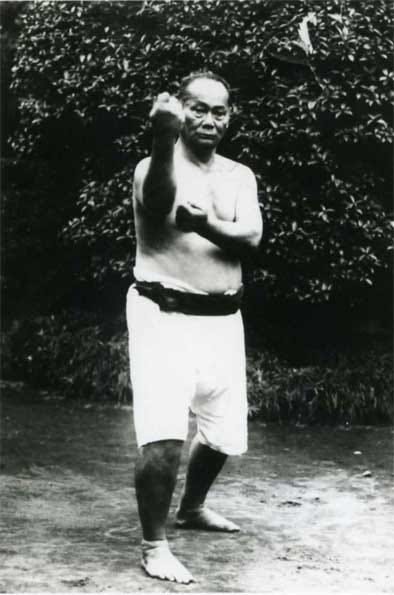
Yamada Tatsuo and Motobu Chōsei
Yamada Tatsuo was one of Motobu Chōki’s early students, and after the war, he corresponded with the Sōke (Motobu Chōsei). This…
Yamada Tatsuo and Motobu Chōsei
Yamada Tatsuo was one of Motobu Chōki’s early students, and after the war, he corresponded with the Sōke (Motobu Chōsei). This correspondence began when Yamada sent a letter dated July 29, 1958, addressed to the Sōke.
Yesterday, I heard about you from someone and wondered if you might be the late Motobu Chōki’s second son, Chōso. That’s why I wrote this letter to inquire. Or perhaps you are the son of Chōkei, Torajū Yacchī, or his brother. In any case, I believe you must be part of that family.

It is unclear who “someone” refers to, but I suspect it might have been Konishi Yasuhiro. Konishi mentioned the Sōke in his book Karate Mastery (1956), describing him as “continuing his father’s legacy” (p. 187), and had established contact with the Sōke before Yamada.
Motobu Chōki’s second son, Motobu Chōso (1915–1943), was legally recorded as the eldest son, while the Sōke was the second son. This was because the eldest son, Motobu Chōkō (1900–1945), was born out of wedlock. Consequently, while the letter was addressed to “Chōsei,” Yamada referred to him as Chōso, likely due to confusion between the two.
The Sōke likely wrote in his reply, “I am Chōsei, Chōso’s younger brother.” In his next letter (dated August 27), Yamada seemed to recall more, writing, “You must be around thirty years old, right? How old are you now?” At the time, the Sōke had just turned 33. According to a story I heard from Yamada’s student Konuma Tamotsu, Yamada often babysat the Sōke when he was an infant.
Yamada must have been delighted to learn that the baby he had cared for was now continuing Motobu Chōki’s legacy after the war. This marked the beginning of their correspondence.
In the earlier letter, Yamada mistakenly referred to Motobu Chōyū as “Chōkei” (朝桂). Interestingly, some karate books published after the war also mistakenly referred to Chōyū as “Chōkei,” and Yamada may have been the source of this error.
What is particularly intriguing is the mention of Chōyū’s second son, Torajū Yacchī (虎十ヤッチイ), or Motobu Chōmo. Torajū is likely his childhood name (虎寿), while Yacchī (ヤッチー)means “older brother” and is often used as an honorific for addressing older individuals.

Motobu Chōmo. He was Chōki’s nephew.
Why might Yamada have known about Chōmo? According to Marukawa Kenji, one of Motobu Chōki’s students, Yamada once said, “I actually didn’t learn much from Chōki Sensei. The person who taught me karate was Torajū Yacchī.”
Motobu Chōmo was closely associated with Motobu Chōki at the time and served as an assistant instructor at Chōki’s dōjō. This explains how Yamada learned karate from Chōmo.
In martial arts, it is common for students to learn from assistant instructors or senior students. Therefore, while Yamada is undoubtedly considered a student of Motobu Chōki, it was Motobu Chōmo who was his actual instructor.
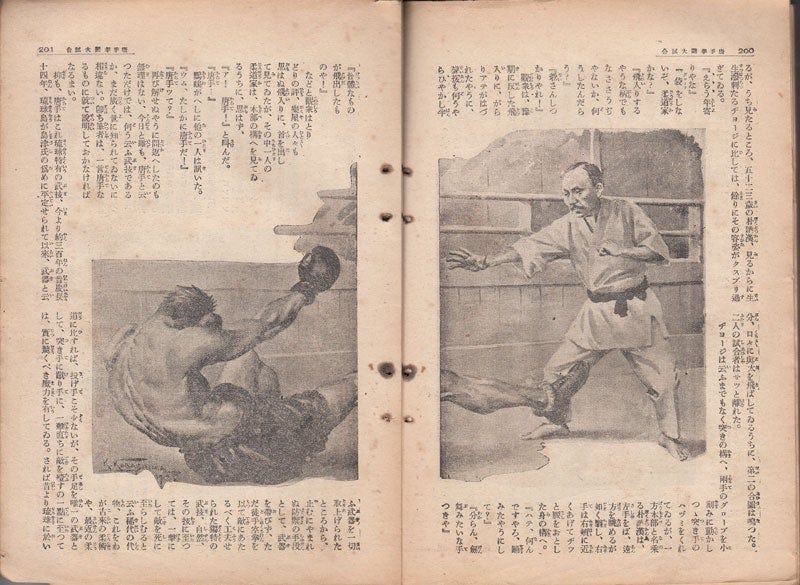
In his letter to the Sōke, Yamada did not refer to himself as part of the Motobu-ryū but instead mentioned his own creation, Nihon Kenpō Karatedō. Rather than preserving Okinawan karate in its original form, Yamada incorporated techniques from boxing and Muay Thai, creating a new martial art called “karate boxing.”
According to Konuma, Yamada did not teach Naihanchi in his dōjō after the war. Konuma himself had to make a special request for Yamada to teach it to him, which he later shared with me.
The Sōke still cherishes the manual of Nihon Kenpō Karatedō, gifted by Yamada. The content blends karate, boxing, and Muay Thai, resembling modern kickboxing. Indeed, Yamada was a pioneer of kickboxing, and his dōjō later produced kickboxing competitors.

This manual may be the only surviving copy in the world and is an invaluable resource for the history of postwar karate and kickboxing.
A video of Konuma uploaded to YouTube showcases a style closer to kickboxing than Okinawan karate.
[embed]
Yamada trained under Motobu Chōki until 1932 and temporarily left karate in 1933 to work as a bodyguard for Nakajima Chikuhei, the founder of Nakajima Aircraft and a former Minister of Commerce and Industry. According to the May 1994 issue of Monthly Full-Contact KARATE Magazine, bodyguarding high-profile individuals was a demanding job, and Yamada reportedly bore countless scars as a result.
Yamada returned to karate in 1947 and became an instructor for the karate club at Nihon University’s College of Science and Technology. Around 1951, Ōyama Masutatsu (founder of Kyokushin Karate) visited Yamada, and the two developed a relationship (as reported in the same issue).
In his letter to the Sōke dated August 27, 1958, Yamada lamented:
The current karate world has become like choreography for stage combat. It’s disappointing.
Before training under Motobu Chōki, Yamada had studied under Funakoshi Gichin in Tokyo, so he was familiar with both styles. Yamada likely felt that postwar karate had transformed into something different from both.
While Yamada himself pursued karate boxing, he lamented the changes that had transformed postwar karate. Learning that the Sōke was preserving Motobu Chōki’s karate likely brought him a sense of relief and joy. In his letter, Yamada invited the Sōke to visit him, writing, “Please come and see me sometime.” However, at that time, traveling from Osaka to Tokyo was not easy, as the Shinkansen had yet to open. Unfortunately, Yamada passed away suddenly at the age of 62 in 1967, before the two could meet.
This article was written to prevent future generations from misunderstanding the relationship between Yamada and the Sōke and forming incorrect impressions. In the karate world, it is not uncommon for false claims to circulate with the intent of disparaging someone. However, I wish to record here that their relationship was amicable and that Yamada supported the Sōke.
Motobu Chōki’s students were all unique individuals who were not the type to undermine others. Yamada’s vision for karate boxing did not achieve success, and kickboxing eventually overshadowed it. This may have been because Yamada was genuinely focused on his martial arts aspirations and lacked ambition for personal gain.
In modern karate history, there are many instances where individuals, even if not considered “successful,” deserve recognition for their pioneering contributions. Yamada is one such figure.
Thank you for reading my story. If you liked it, please applaud and follow me.
메타데이터
- post_id
- fc305219dfaf
- slug
- yamada-tatsuo-and-motobu-chōsei-fc305219dfaf
- url
- https://medium.com/@motobu715/yamada-tatsuo-and-motobu-ch%C5%8Dsei-fc305219dfaf
- canonical_url
- https://medium.com/@motobu715/yamada-tatsuo-and-motobu-ch%C5%8Dsei-fc305219dfaf
- author_url
- https://medium.com/@motobu715
- status
- ok
- fetched_at
- 2026-07-14 08:33:51