The Cost of Hesitation: Why a Strong Canada Needs the F-35
After decades of exhausting procurement delays, the Royal Canadian Air Force (RCAF) finally appeared to have its modernization path secured…
The Cost of Hesitation: Why a Strong Canada Needs the F-35
After decades of exhausting procurement delays, the Royal Canadian Air Force (RCAF) finally appeared to have its modernization path secured in January 2023. Ottawa signed a $19 billion CAD contract for 88 Lockheed Martin F-35A Lightning II stealth fighters — a decision that was meant to close a long chapter of political debate and usher in a new era of North American defense.
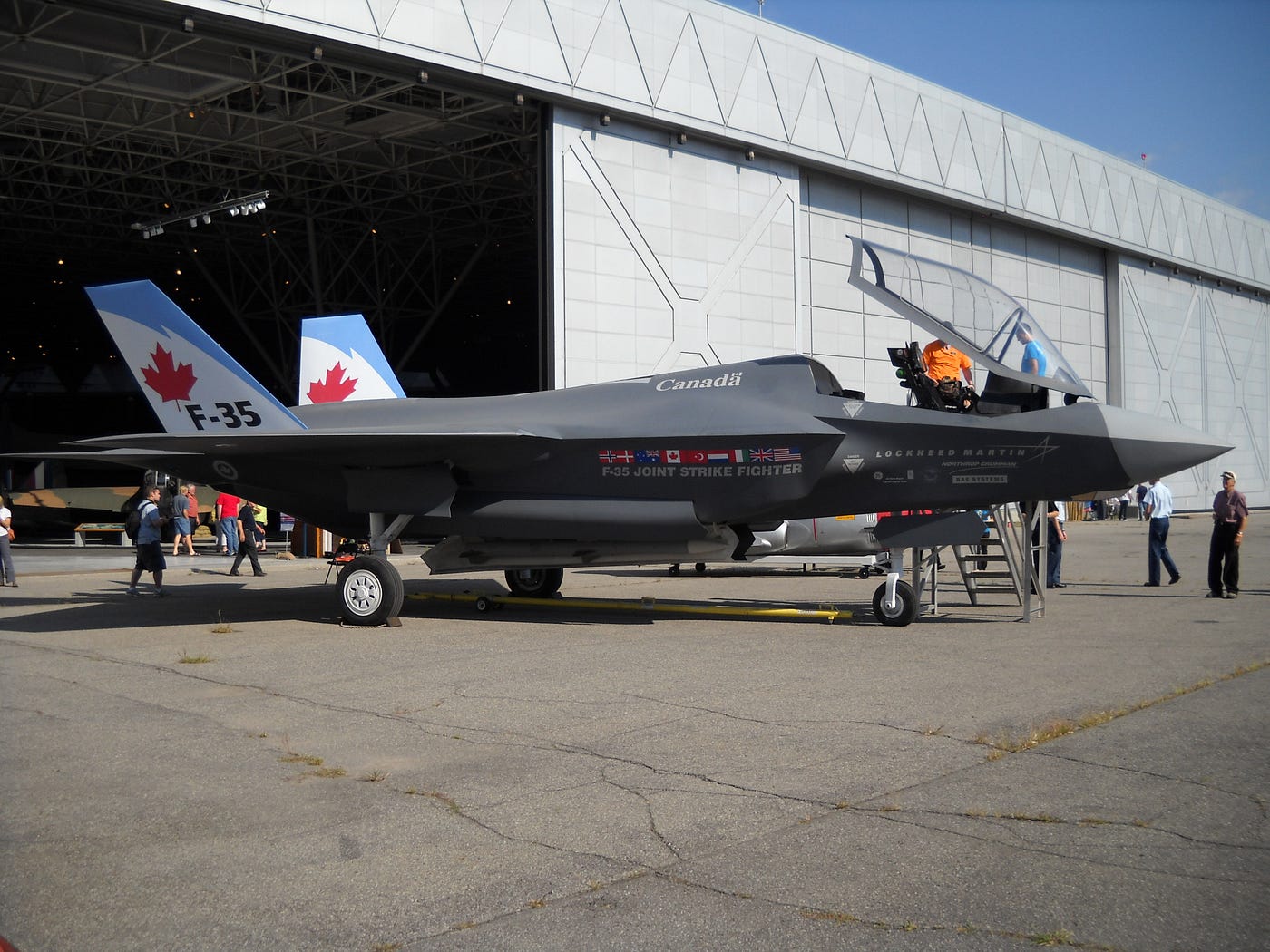
Yet, Canada’s fighter recapitalization has once again entered uncertain waters. Citing escalating costs — with lifecycle and infrastructure estimates rising toward $27.7 billion CAD ($20.3 billion USD) — alongside broader trade frictions with Washington, Prime Minister Mark Carney’s government has initiated a formal contract review. While an initial batch of 16 jets remains on track, Ottawa is actively evaluating whether to truncate the remaining order and pivot to a split fleet that includes Sweden’s Saab Gripen E.
While cost management is a vital responsibility for any government, domestic political friction must not override strategic reality. For Canada to remain a robust, sovereign nation capable of defending its vast territory, it requires a unified, modern fighter fleet.
A Legacy of Strategic Partnership
The idea that the F-35 is a hasty foreign imposition overlooks a quarter-century of Canadian industrial integration. Canada has been an active, Tier 3 partner in the Joint Strike Fighter (JSF) program since 1997. Long before the aircraft became a subject of political debate, Ottawa’s early investments secured lucrative bidding rights for the domestic aerospace sector.
As a result, Canadian aerospace firms are deeply embedded in the global supply chain, manufacturing essential components for every F-35 built. Truncating the order now does not shield Canadian interests; rather, it risks alienating key international partners and disrupting billions of dollars in long-term domestic aerospace contracts.
The Trial Data: A Clear Disparity
When assessing how to best safeguard Canadian sovereignty, the government’s own internal evaluations provide the clearest roadmap. During the rigorous technical and mission trials conducted under the Future Fighter Capability Project (FFCP), the competing airframes were pushed to their limits.
According to internal Department of National Defence documents leaked via Radio-Canada, the evaluation results were definitive. The F-35A scored a resounding 57.1 out of 60 points (95%), while the Saab Gripen E scored 19.8 points (33%).
Canada Fighter Jet Evaluation Scores (Out of 60)
===================================================
[████████████████████████████████████████] 57.1 (F-35A)
[███████████] 19.8 (Saab Gripen E)
===================================================
While the Gripen is an excellent, highly capable Generation 4.5 aircraft, it was fundamentally outmatched by the F-35’s Generation 5 stealth and sensor fusion capabilities. In an era where Arctic airspace is increasingly contested by highly sophisticated Russian and Chinese strategic threats, a strong Canada requires a front-line fighter that possesses maximum survivability.
The Interoperability Illusion
A primary driver behind exploring European alternatives like the Gripen is the desire to project a foreign policy independent of Washington. However, the technical realities of modern defense mean that true independence cannot be achieved simply by choosing a non-American airframe.
The Saab Gripen E is profoundly reliant on the United States military-industrial complex to function as a frontline fighter. It is powered by an American General Electric F414 turbofan engine (the same powerplant used in the U.S. Navy’s Super Hornet), utilizes U.S.-made munitions like the AIM-120 AMRAAM and AIM-9X Sidewinder, and relies entirely on U.S.-standard Link 16 tactical data networks to communicate with allies.
If Ottawa selects the Gripen to minimize its defense reliance on the U.S., it inherits a paradox: Canada would field a less survivable airframe while remaining entirely tied to Washington for the regulatory approval of its engines, spare parts, and weapons.
Learning from Middle Power Peers
Other democratic middle powers have navigated these identical strategic crossroads and chosen a different path. Australia, a fellow Commonwealth nation facing a volatile regional security environment in the Indo-Pacific, leaned heavily into U.S. technological integration. By decisively fielding a fleet of 72 F-35s and joining the AUKUS alliance, Canberra secured a seat at the inner sanctum of global intelligence and technology sharing.
Historically neutral nations like Switzerland and Finland conducted exhaustive, independent evaluations of both the Gripen and the F-35. Both ultimately rejected the European option, concluding that a Generation 5 stealth platform was the baseline requirement for modern defense. They realized that if an airforce must rely on American data networks and weapons anyway, it is an unnecessary compromise to place those assets on an older, non-stealth hull.
Furthermore, Canada’s past attempts to restructure military procurement to favor domestic political mandates have yielded cautionary tales:
- The Sea King Replacement: Decades of political cancellations and restructuring surrounding the CH-124 Sea King replacement resulted in the deeply delayed, over-budget CH-148 Cyclone program, which ultimately required heavy reliance on American manufacturer Sikorsky anyway.
- The Griffon Program: The acquisition of the CH-146 Griffon saw Ottawa select a modified civilian Bell design to meet domestic manufacturing quotas, leaving the military with an underpowered helicopter that struggled in demanding operational environments.
Conclusion: Securing Canada’s Future
The geopolitical consequences of Canada’s defense vacillation are already becoming evident. The Pentagon’s recent decision to pause its participation in the U.S.-Canada Permanent Joint Board on Defence highlights growing concern among allies regarding Ottawa’s long-term commitments to continental readiness.
To be a strong, respected, and truly sovereign country, Canada must possess a military capable of standing shoulder-to-shoulder with its allies. Splitting the fighter fleet creates an unnecessary logistical burden and leaves the RCAF with an mismatched force. If Canada wishes to project strength in the Arctic, honor its NATO obligations, and protect its own skies, it must look past short-term political friction and deliver the 88 F-35A fighters its military needs.
메타데이터
- post_id
- fc348bb4b1a5
- slug
- the-cost-of-hesitation-why-a-strong-canada-needs-the-f-35-fc348bb4b1a5
- url
- https://medium.com/@asiadefense/the-cost-of-hesitation-why-a-strong-canada-needs-the-f-35-fc348bb4b1a5
- canonical_url
- https://medium.com/@asiadefense/the-cost-of-hesitation-why-a-strong-canada-needs-the-f-35-fc348bb4b1a5
- author_url
- https://medium.com/@asiadefense
- status
- ok
- fetched_at
- 2026-06-16 19:09:56