🚀 OAuth2 vs JWT vs Session-Based Authentication: What Every Backend Developer Should Know
If you’ve worked on backend systems long enough, you’ve probably heard developers say things like:
🚀 OAuth2 vs JWT vs Session-Based Authentication: What Every Backend Developer Should Know
If you’ve worked on backend systems long enough, you’ve probably heard developers say things like:
“We use OAuth2 authentication.”
Or:
“JWT is more secure than Sessions.”
The problem?
Most of the time, these terms are being mixed together incorrectly.
I used to confuse them too.
At one point, I thought:
- JWT = OAuth2
- Session authentication was outdated
- JWT should be used everywhere
But after building production-grade Spring Boot applications, I realized something important:
OAuth2, JWT, and Session Authentication solve different problems.
And choosing the wrong one can lead to:
- unnecessary complexity
- scalability issues
- security risks
- painful debugging sessions
So let’s break this down in the simplest possible way.
🔐 1. What is Session-Based Authentication?
Session-based authentication is the traditional authentication mechanism used by many web applications.
Here’s how it works:
- User logs in with username/password
- Server validates credentials
- Server creates a session
- Browser receives a session ID cookie
- Every future request sends that session ID
The server stores authentication state internally.
🧠 Session Authentication Flow
✅ Advantages
- Easy to implement
- Strong server-side control
- Easy logout/invalidation
- Excellent for monolithic applications
❌ Drawbacks
- Harder to scale horizontally
- Requires session storage
- Sticky sessions may be needed in distributed systems
💡 Best Use Cases
Session authentication works great for:
- Traditional web applications
- Banking systems
- Admin dashboards
- Server-rendered apps
🎟️ 2. What is JWT Authentication?
JWT (JSON Web Token) is a stateless authentication mechanism.
Instead of storing session data on the server, the server generates a signed token that contains user information.
The client stores the token and sends it with every request.
🔑 JWT Authentication Flow
6
Example JWT Structure
HEADER.PAYLOAD.SIGNATUREExample payload:
{
  "sub": "rahul",
  "role": "ADMIN",
  "exp": 1712345678
}
✅ Advantages
- Stateless and scalable
- Perfect for microservices
- No server-side session storage
- Fast authentication validation
❌ Drawbacks
- Harder logout management
- Token revocation is tricky
- Stolen tokens remain valid until expiration
- Payload is readable (not encrypted)
💡 Best Use Cases
JWT is excellent for:
- REST APIs
- Mobile apps
- Microservices architecture
- Distributed systems
🌐 3. What is OAuth2?
This is where many developers get confused.
OAuth2 is NOT an authentication mechanism.
It is an authorization framework.
Its main purpose is:
Allowing applications to access resources on behalf of a user.
The most common example:
👉 “Login with Google”
When you use Google login:
- Google authenticates the user
- OAuth2 authorizes your application
🌍 OAuth2 Flow
Important Realization
This changed everything for me:
OAuth2 is not JWT.
But OAuth2 can use JWT tokens internally.
That distinction is incredibly important.
✅ Advantages
- Secure delegated access
- Industry standard
- Supports third-party login
- Centralized identity management
❌ Drawbacks
- More complex to implement
- Many confusing flows
- Misconfiguration risks
💡 Best Use Cases
OAuth2 is perfect for:
- “Login with Google/GitHub”
- Enterprise SSO
- Third-party integrations
- Identity providers like:
- GitHub
- Okta
- Auth0
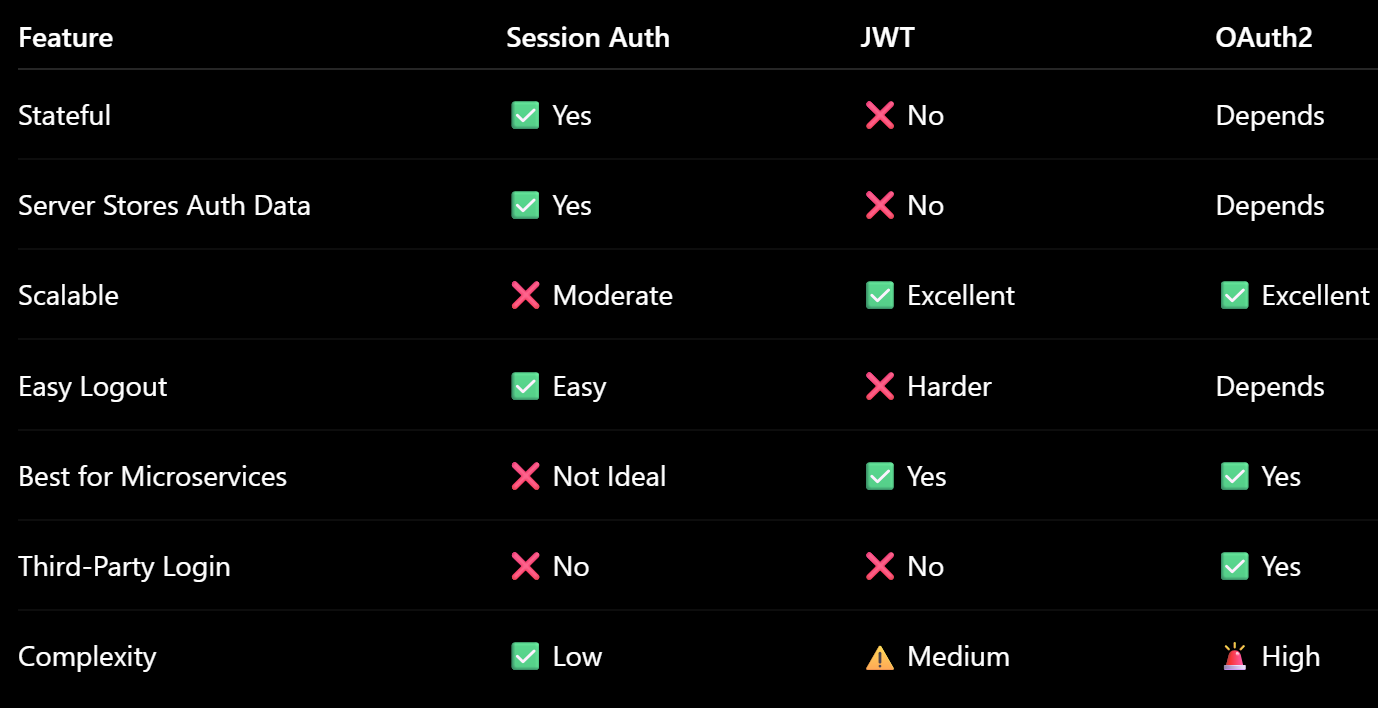
⚔️ OAuth2 vs JWT vs Session Authentication
🚨 The Biggest Misconception
One of the most common mistakes developers make is saying:
“We use OAuth2 tokens.”
Usually, what they actually mean is:
- OAuth2 for authorization
- JWT as the token format
These are not the same thing.
🏗️ What We Use in Production
In most modern Spring Boot production systems:
🔐 Monolith Application
→ Session Authentication
🌐 Microservices + APIs
→ JWT Authentication
👤 Social Login / Enterprise Login
→ OAuth2
And sometimes…
👉 all three together.
💡 Real-World Example
Think about a streaming platform like: Netflix
They might use:
- OAuth2 → Login with Google
- JWT → API communication
- Sessions → Internal admin tools
Different problems require different solutions.
🔒 Security Considerations
No authentication system is automatically secure.
The real security comes from:
- HTTPS enforcement
- Proper token expiration
- Secure cookie handling
- Strong secret keys
- Rate limiting
- Monitoring suspicious activity
Authentication alone is never enough.
🧠 The Best Choice Depends on Your Architecture
Here’s the truth most tutorials skip:
There is no universally “best” authentication mechanism.
The right choice depends on:
- architecture
- scalability needs
- frontend type
- security requirements
- user experience
🚀 Final Takeaways
Use Session Authentication when:
✅ Building traditional web apps ✅ You want simple server-side control
Use JWT when:
✅ Building REST APIs ✅ Working with microservices ✅ Scaling horizontally
Use OAuth2 when:
✅ Supporting third-party login ✅ Integrating with identity providers ✅ Building enterprise-grade systems
💬 Final Thoughts
Understanding authentication deeply changed how I design backend systems.
Before, I used JWT everywhere because it felt modern.
Now?
I choose authentication strategies based on the actual problem being solved.
And honestly, that mindset shift made my systems both simpler and more secure.
👇 Question for Developers
Which authentication mechanism are you currently using in production — Sessions, JWT, or OAuth2?
메타데이터
- post_id
- fc43b5e95db8
- slug
- oauth2-vs-jwt-vs-session-based-authentication-what-every-backend-developer-should-know-fc43b5e95db8
- url
- https://medium.com/javarevisited/oauth2-vs-jwt-vs-session-based-authentication-what-every-backend-developer-should-know-fc43b5e95db8
- canonical_url
- https://medium.com/javarevisited/oauth2-vs-jwt-vs-session-based-authentication-what-every-backend-developer-should-know-fc43b5e95db8
- author_url
- https://medium.com/@rsoni14378
- status
- ok
- fetched_at
- 2026-06-29 02:33:43