Neptune and Market Bubbles: Is the Nasdaq Rally Too Optimistic?
The Nasdaq often becomes the stage where the future gets priced before it fully arrives. Artificial intelligence, semiconductors, cloud…
Neptune and Market Bubbles: Is the Nasdaq Rally Too Optimistic?
The Nasdaq often becomes the stage where the future gets priced before it fully arrives. Artificial intelligence, semiconductors, cloud computing, data centers, cybersecurity, robotics, software, and digital platforms can all create powerful growth stories. These stories attract young traders, institutional investors, hedge funds, and long-term technology believers.
However, every major technology cycle carries one important risk: optimism can move faster than fundamentals.
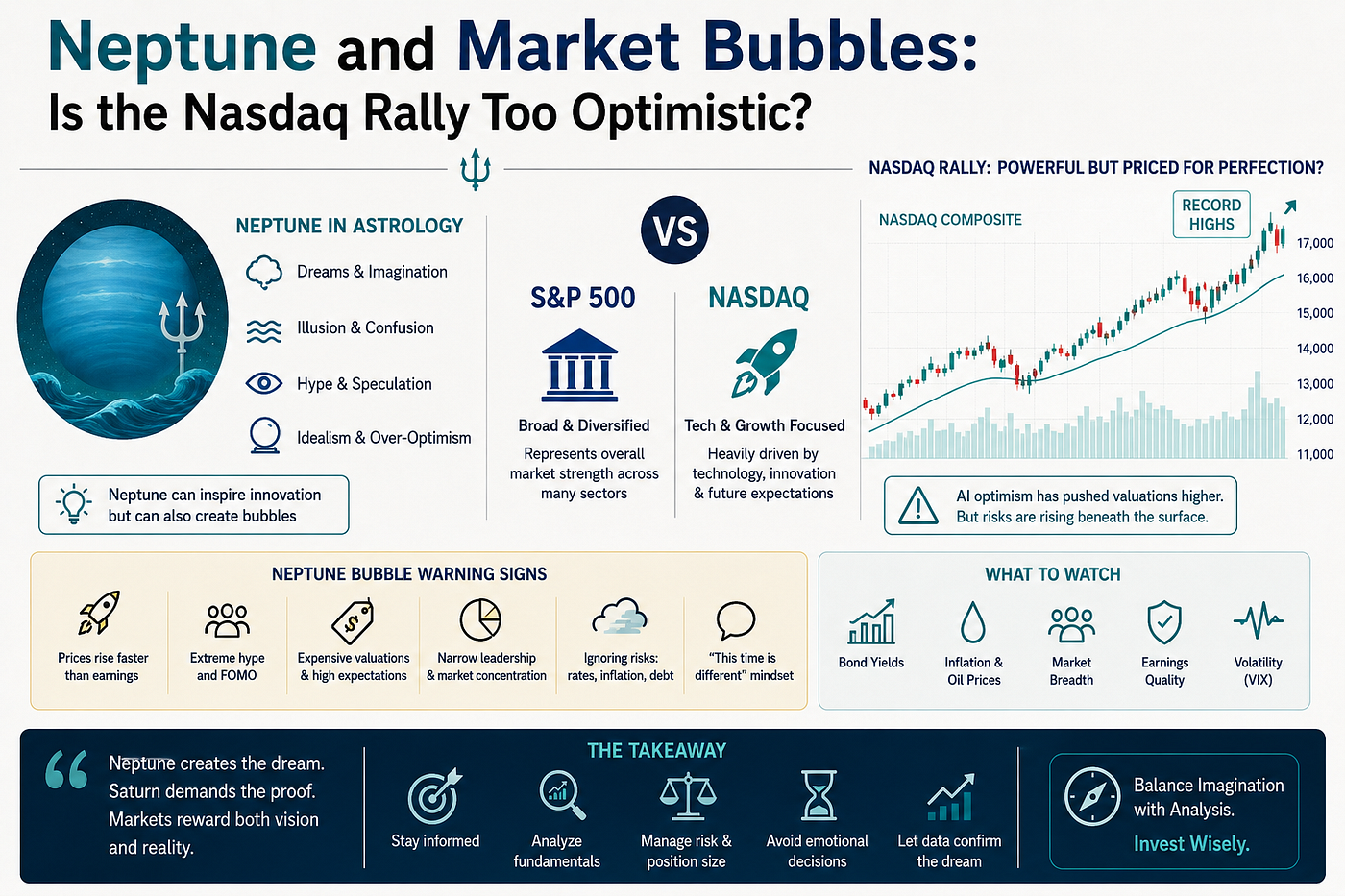
This is where Neptune becomes important in financial astrology. Neptune is linked with dreams, imagination, illusion, confusion, hype, speculation, and idealized expectations. In market psychology, Neptune does not simply mean fraud or weakness. It can also represent vision, innovation, and belief in a future that is not fully visible yet. That is why Neptune is especially relevant to Nasdaq rallies.
The current market has shown both sides of this theme. AI optimism has helped the S&P 500 and Nasdaq reach record highs, with chip and technology shares leading gains. Reuters reported that the S&P 500 and Nasdaq touched record closing highs on May 13, 2026, boosted by AI-related technology strength. At the same time, the rally has faced pressure from rising oil prices, inflation worries, and bond-yield stress, with Reuters noting that tech shares weakened as oil climbed and the S&P 500 and Nasdaq ended lower on May 18, 2026.
So, is the Nasdaq rally too optimistic? The answer is not simple. The AI cycle may be real, but the price investors are willing to pay for that future may already be stretched.
What Neptune Represents in Financial Astrology
Neptune represents imagination, dreams, fog, speculation, idealism, collective belief, and uncertainty. In financial markets, Neptune often appears when investors fall in love with a story. They may stop asking hard questions about valuation, margins, cash flow, debt, competition, or execution risk.
In a positive form, Neptune gives markets vision. It helps investors imagine a future shaped by new technology, productivity, automation, and digital transformation. Without imagination, markets would never fund innovation.
In a negative form, Neptune creates bubbles. It can make investors believe that a theme is unstoppable. It can blur the line between genuine growth and promotional storytelling. It can make people buy because of excitement rather than evidence.
This is why Neptune is useful when studying Nasdaq rallies. The Nasdaq is built around innovation, and innovation always requires belief. But belief must eventually meet earnings.
The Nasdaq Rally and AI Optimism
The Nasdaq has gained strength from the AI boom. Investors are buying semiconductor companies, cloud platforms, data-center suppliers, software names, and mega-cap technology stocks because they expect AI to create a new wave of productivity and profit growth.
There is logic behind that optimism. AI is already changing software development, enterprise automation, cloud infrastructure, chip demand, search, advertising, cybersecurity, healthcare research, and industrial systems. Long term, AI may become one of the most important economic forces of this decade.
However, strong themes can still become overvalued. The internet changed the world, but the dot-com bubble still collapsed. Electric vehicles changed the auto industry, but many EV stocks failed to justify peak valuations. Crypto created a new asset class, but speculative manias still ended painfully.
The question is not whether AI matters. The question is whether every AI-linked valuation is justified.
When a Rally Becomes a Bubble
A rally becomes a bubble when price rises mainly because investors believe someone else will pay more later. Fundamentals become secondary. Valuation discipline weakens. Market narratives become emotional. Investors start treating uncertainty as opportunity without properly measuring risk.
In a Nasdaq bubble environment, several warning signs may appear. Stocks rise after simply mentioning AI. Companies with limited AI revenue trade at premium valuations. Mega-cap leadership becomes extremely concentrated. Investors ignore rising bond yields. Bad news is dismissed. Good news produces smaller gains because expectations are already too high.
The Federal Reserve’s May 2026 Financial Stability Report noted that forward equity price-to-earnings ratios were in the upper ranges of their historical distribution and that market participants increasingly cited AI as a potential financial stability risk linked to equity valuations, debt-funded capital expenditure, and private credit exposure.
That does not prove the Nasdaq is in a bubble. But it does prove that valuation risk is no longer a fringe concern.
Bond Yields: The Reality Check for Neptune
Neptune can make investors dream, but bond yields often bring reality back. Technology stocks are sensitive to yields because many of their valuations depend on future earnings. When yields rise, those future earnings become less valuable today.
Reuters recently described how rising global bond yields, driven by oil prices, inflation concerns, and government debt, have been spoiling enthusiasm in AI-driven equity markets. This is exactly the kind of Saturn-style pressure that challenges Neptune-style optimism.
For Nasdaq investors, this means AI excitement must be tested against the cost of capital. If bond yields rise while valuations are already high, the Nasdaq becomes more vulnerable to correction. If yields stabilize or fall, the rally may regain support.
A Neptune rally can float on imagination for a while. But a yield shock can quickly expose whether the market was pricing realistic growth or fantasy.
Market Concentration and Fragile Leadership
One of the biggest risks in the Nasdaq rally is concentration. If a small group of AI-linked mega-cap stocks drives most of the gains, the rally may look stronger than it really is. A narrow rally can continue, but it becomes fragile if leadership weakens.
This is why investors should watch market breadth. Are many Nasdaq stocks participating, or only a few giants? Are software, semiconductors, cloud, cybersecurity, and smaller tech names all confirming strength? Or is the rally dependent on a handful of names?
A healthy technology cycle should broaden. A bubble often narrows. Neptune can make investors ignore that narrowing because the headline index still looks strong.
Veteran investors know that index strength can hide internal weakness. Young investors should learn the same lesson before chasing overextended Nasdaq names.
Neptune, AI, and the Power of Storytelling
AI is a powerful story because it touches almost every industry. It promises lower costs, faster research, smarter software, better automation, and higher productivity. That makes it easy for investors to imagine massive future profits.
But Neptune asks one hard question: what is real now?
Is the company generating meaningful AI revenue? Are margins improving? Is customer demand durable? Is capital expenditure producing returns? Are competitors catching up? Is the valuation already assuming perfection?
The danger is not AI itself. The danger is assuming every AI-labeled business deserves a premium multiple. In every technology cycle, a few companies become long-term winners, while many others become temporary beneficiaries of hype.
Mercury and Nasdaq News Flow
Mercury is also important for the Nasdaq because it rules data, communication, earnings calls, analyst commentary, trading systems, and news flow. Nasdaq stocks can move sharply after earnings guidance, chip-demand forecasts, cloud revenue updates, or AI capital expenditure announcements.
During Mercury-heavy periods, investors should avoid reacting too quickly. A stock may initially rally after earnings and then reverse if guidance disappoints. A company may announce AI plans, but the market may later ask whether those plans create profit.
For young traders, this matters because social media spreads Nasdaq narratives instantly. Mercury moves the headline. Neptune turns the headline into a dream. Saturn asks whether the numbers support it.
Uranus and Real Technology Innovation
Neptune represents dreams, but Uranus represents disruption and technology. A Nasdaq rally becomes healthier when Neptune’s imagination is supported by Uranian innovation and real earnings.
AI infrastructure, advanced chips, cloud computing, cybersecurity, robotics, and data centers are not imaginary. They are real parts of the economy. The market can legitimately reward companies that convert these technologies into cash flow.
The key is separating genuine Uranus from exaggerated Neptune. A company building essential AI infrastructure may deserve a premium. A company merely using AI language to attract attention may not.
Investors should not reject the Nasdaq rally just because it is exciting. They should separate real innovation from speculative fog.
How Young Investors Can Avoid Nasdaq Bubble Traps
Young investors often enter Nasdaq trades during exciting moments. They see a stock trending online, read bullish AI headlines, and fear missing out. This is exactly when Neptune can become dangerous.
A disciplined investor should slow down and ask basic questions. Is the stock near support or far above it? Is volume confirming the move? Are earnings growing? Are margins expanding? Are bond yields rising? Is the broader Nasdaq healthy? Is the rally broad or narrow? Is the company truly benefiting from AI?
Financial astrology can help by identifying periods when market psychology may become overly dreamy, emotional, or speculative. But astrology should not replace technical analysis, valuation, or risk management.
The goal is not to avoid every rally. The goal is to avoid buying the dream at the top.
How Traders Should Read a Neptune Nasdaq Window
A Neptune-style Nasdaq window should be treated as a period of heightened narrative risk. Traders should watch for emotional buying, vague optimism, unclear earnings quality, and exaggerated price moves.
During such periods, traders can still participate, but they should use discipline. They may reduce position size, avoid chasing parabolic moves, take partial profits, use stop-losses, and wait for pullbacks before entering.
A Neptune window becomes more dangerous when it overlaps with rising yields, weak breadth, oil-driven inflation pressure, or earnings disappointment. It becomes less dangerous when revenue growth, margin expansion, and broad market participation confirm the rally.
Is the Nasdaq Rally Too Optimistic?
The Nasdaq rally may be optimistic, but optimism is not automatically wrong. Major bull markets are built on optimism. The problem begins when optimism ignores risk.
AI can justify a long-term growth cycle. But high valuations, narrow leadership, rising yields, inflation pressure, and speculative enthusiasm can turn a healthy rally into a fragile one. The Federal Reserve’s financial stability concerns around AI-related valuation and debt-funded investment make this a risk investors should take seriously.
The best answer is this: the Nasdaq rally is not necessarily a bubble, but parts of it may be priced for perfection. That means investors should stay selective.
What to Watch Next
Investors should watch Nasdaq market breadth, semiconductor leadership, AI earnings guidance, capital expenditure trends, bond yields, inflation data, crude oil prices, the VIX, and the U.S. dollar. They should also watch whether AI winners continue to deliver real revenue growth.
If the Nasdaq continues rising with broad participation and strong earnings, the rally may remain healthy. If the index rises only because of a few mega-cap names while yields climb and breadth weakens, bubble risk increases.
In financial astrology terms, Neptune can inspire the dream, but Saturn and market data decide whether the dream survives.
Conclusion: Dream Big, But Confirm With Data
Neptune is the perfect symbol for Nasdaq bubble psychology. It represents the dream, the story, the imagination, and the belief that the future will be bigger than the present. That is exactly what drives many technology rallies.
But Neptune also warns investors about illusion. A powerful story can become dangerous when valuation, earnings, liquidity, and market breadth are ignored. The Nasdaq rally may continue if AI growth remains real and market data confirms strength. However, investors should avoid assuming that every AI stock, software company, or semiconductor trade will keep rising forever.
The smart approach is balanced. Use financial astrology to understand market psychology and timing windows. Use earnings, valuation, price action, bond yields, breadth, and risk management to confirm decisions.
To explore this subject further, read this detailed guide on financial astrology for S&P 500 and Nasdaq forecasting.
메타데이터
- post_id
- fc50cbc16fec
- slug
- neptune-and-market-bubbles-is-the-nasdaq-rally-too-optimistic-fc50cbc16fec
- url
- https://medium.com/@astrooduniaa/neptune-and-market-bubbles-is-the-nasdaq-rally-too-optimistic-fc50cbc16fec
- canonical_url
- https://medium.com/@astrooduniaa/neptune-and-market-bubbles-is-the-nasdaq-rally-too-optimistic-fc50cbc16fec
- author_url
- https://medium.com/@astrooduniaa
- status
- ok
- fetched_at
- 2026-06-09 15:37:30