Trump’s Nuclear Gambit: Shadows Over Russia’s Eastern Waters
When Submarines Stir the Sea and Storms Reveal the Weakness of Giants
Trump’s Nuclear Gambit: Shadows Over Russia’s Eastern Waters
When Submarines Stir the Sea and Storms Reveal the Weakness of Giants
Trump’s Nuclear Gambit: Shadows Over Russia’s Eastern Waters
Trump’s Echo in the Depths: A Thunder Under the Waves
When Donald Trump first assumed the mantle of President, many believed his eyes were fixed squarely on China — a strategic adversary, a trade rival, and an ideological foe. With that came the natural expectation that China’s iron ally, Pakistan, would also find itself in Trump’s crosshairs. And, true to style, Trump had once thundered that he cared little for what Russia or India did together — “let their sinking economies collapse,” he had tweeted, in a storm of offense and indifference.
But as history loves irony, Trump’s present fixation has veered toward Russia. A nation now grappling with pressure from the West, drone attacks brushing Moscow’s very breath, and — most recently — a quiet catastrophe beneath the waves: a tsunami has whispered into Russia’s far eastern coast, perhaps louder than any missile.
Two Submarines, One Message: “You Are Surrounded”
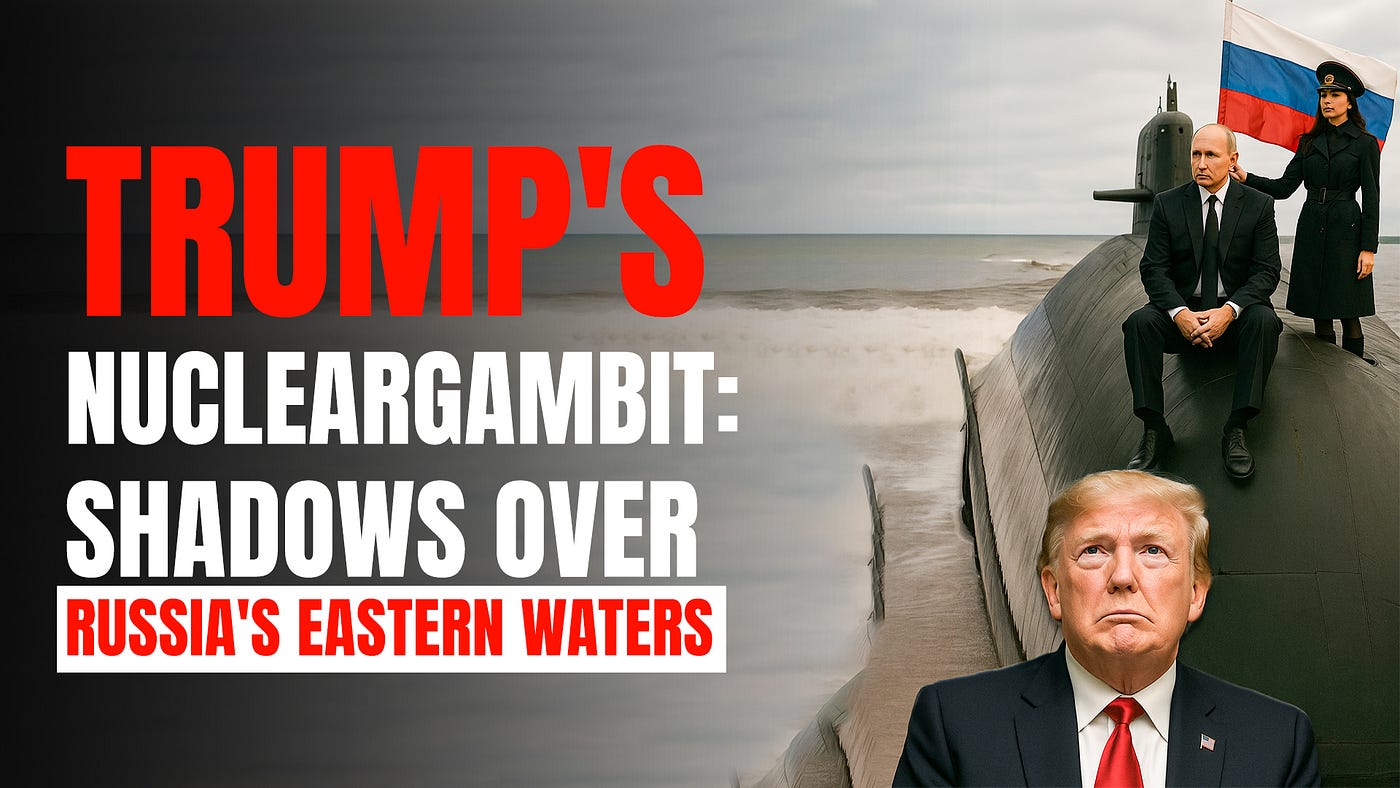
In the murky realm of geopolitics, nothing says “pressure” quite like the silent shadow of a nuclear submarine. In a bold gesture of strategic symbolism, Trump has dispatched two nuclear submarines to the Pacific — close, dangerously close — to Russian waters. These are not simply war machines. They are ghosts in the water, invisible reapers armed with firepower to silence continents.
This isn’t a new dance for Trump. His administration has always leaned toward intimidation over diplomacy. But this particular act — sending subs at a time when Russia’s own nuclear submarine base is reeling from natural disaster — carries an edge sharper than usual.
Just recently, an 8.8-magnitude earthquake struck the Far Eastern region of Russia. From that quake, a tsunami was born, rippling through the Pacific with whispered promises of destruction. Though no cities were claimed, reports suggest it struck the very infrastructure housing Russia’s prized nuclear submarines. Damages, though officially hushed, appear substantial.
In response, Trump’s submarines glide silently into the Pacific. Not to strike, but to remind.
Russia’s “Dead Hand” vs. The American Trigger
Russia has long held the world in awe — and terror — with its doomsday system: Dead Hand. A silent mechanism of nuclear revenge. If ever Russia’s leadership were wiped out in a surprise nuclear attack, this system would detect the carnage and launch a catastrophic counterstrike. No command. No survivors. Just pre-programmed vengeance.
So when Dmitry Medvedev recently mentioned Dead Hand, Trump’s response was immediate. He referenced the submarines — those two silent messengers now nearing Russian waters. It was a calculated chess move, not of pawns, but of underwater kings.
In return, Russia’s lawmakers claimed superiority in underwater warfare. “We have more submarines in the oceans than the U.S.,” they declared. But the world knows this is a bluff layered in cold water. The true danger of a nuclear submarine lies not in its number, but its silence. Their location is unknown, even to many high-ranking officials. That secrecy makes them the ultimate second-strike weapon — nuclear death with no warning.
The Tsunami and the Crippled Fangs of a Superpower
That earthquake was more than a tremor beneath Russia’s feet. It was a crack in the armor. Satellite imagery and intelligence whisper that several nuclear submarines suffered severe damage at the Far Eastern base. Repair crews scramble, but the damage is real. A base that once housed underwater kings is now a wounded fortress.
This vulnerability is what Trump now leans into. He senses an opening — an opportunity to tip the scales. The placement of American submarines isn’t mere posturing; it’s a signal to Moscow and the world. “We know. And we are watching.”
As if echoing this sentiment, Trump hinted at sending more. “Two today. More tomorrow, if necessary.” This is no hollow threat. This is a cold reminder that geopolitics has no pause button. That weakness, even from nature, invites pressure.
Putin’s Quiet and the Sound of Rising Tides
From Russia, silence. Not indifference, but endurance. The Kremlin has grown accustomed to war — drones above, sanctions below, isolation swirling like Arctic winds. The nation weathers this geopolitical storm with its usual stoicism.
But can they still toe-to-toe with the U.S. when their nuclear backbone is bruised?
Trump thinks not. He believes now is the time for pressure. For deals. For submission. “Accept our ceasefire terms,” they say. “Or face the storm we’ve already sent.”
Russia may still hold many submarines, but their wounded base speaks louder than their bravado. And in geopolitics, advantage isn’t just about firepower — it’s about timing.
The Final Note: A Whisper of War in a Time of Waves
So here we are — standing at the edge of an invisible battlefield, where submarines replace soldiers and waves whisper of destruction. Trump plays his hand with the bravado of a casino king, betting on weakness, gambling on pressure. His submarines are not merely warships. They are symbols, drifting silently through waters darker than night, carrying a message only Moscow understands.
And Russia? Time will tell. But for now, the Pacific stirs with unease. And the world watches with bated breath, wondering which shadow will strike first — or if diplomacy can still find its way through waters made murky by ambition and revenge.
메타데이터
- post_id
- fc5cf94f78ce
- slug
- trumps-nuclear-gambit-shadows-over-russia-s-eastern-waters-fc5cf94f78ce
- url
- https://medium.com/@bbcsportss/trumps-nuclear-gambit-shadows-over-russia-s-eastern-waters-fc5cf94f78ce
- canonical_url
- https://medium.com/@bbcsportss/trumps-nuclear-gambit-shadows-over-russia-s-eastern-waters-fc5cf94f78ce
- author_url
- https://medium.com/@bbcsportss
- status
- ok
- fetched_at
- 2026-07-18 14:07:40