Preserving quail eggs
This article is a translation of the original article Conservation des oeufs de cailles
Preserving quail eggs
This article is a translation of the original article Conservation des oeufs de cailles
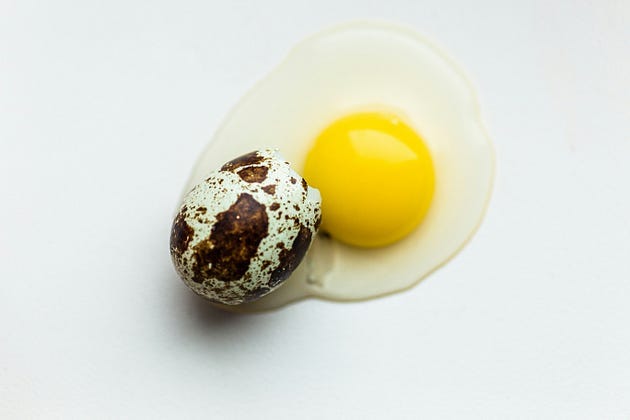
Photo de Klara Kulikova sur Unsplash
While my 15 quails are currently on their autumn laying pause, I’m glad I anticipated this seasonal slowdown by experimenting with various preservation methods. During the summer, each quail laid about one egg per day — 10 to 13 eggs daily, well beyond my needs. What to do with the surplus?
Room Temperature Storage
First, it’s worth knowing that quail eggs — like chicken eggs — keep remarkably well at room temperature for three weeks, provided you NEVER WASH THEM. Washing removes the natural cuticle that protects the egg from bacteria. This simple method allows you to build a buffer reserve for low-production days.
I keep my eggs in a wicker basket on the kitchen counter. No refrigeration needed — as is common practice in most parts of the world.
Pickled Eggs: Quick and Delicious
Like chicken eggs, quail eggs are perfectly suited for pickling. It’s my favourite method for using accumulated surpluses.
I select the oldest eggs (the shell comes off more easily after cooking). Two minutes of boiling is enough for quail eggs — their small size requires far less time than chicken eggs. After peeling, I place them in small 250ml Mason jars with my favourite marinade. Each jar holds about 12 eggs.
Vinegar and Beet Pickling Recipe
Ingredients 1/4 cup (60 ml) white vinegar 1/4 cup (60 ml) water 1/2 tsp (2.5 ml) sugar 1/2 tsp (2.5 ml) pickling spice 1/4 tsp (1 ml) salt
Instructions
- Combine vinegar, water, sugar, pickling spice, and salt in a small saucepan
- Bring to a boil, stirring until sugar dissolves
- Reduce heat, cover, and simmer for 10 minutes
- Strain the liquid if desired
- Place hard-boiled, peeled eggs in a 250ml jar
- Pour hot liquid over the eggs
- Let cool, cover, and refrigerate for at least 2 days before eating
Beet variation: Add small cubes of cooked, peeled beet to the brine for magenta-coloured eggs
Pickled eggs keep for several months in the pantry and make an excellent ready-to-eat protein source.
Limewater: A Fascinating Ancestral Method
This traditional technique never ceases to amaze me with its simplicity and effectiveness. No washing, no cooking, no peeling required. You simply submerge whole eggs in a mixture of water and food-grade calcium hydroxide (slaked lime).
How does it work? Calcium hydroxide slightly penetrates the porous shell, hardens it, and seals it hermetically. The eggs retain their full freshness and nutritional properties for 12 to 18 months. Yes, you read that right: over a year of storage for fresh eggs.
Limewater Preparation
Ingredients 1 litre of water 28g (1 oz) food-grade calcium hydroxide (available online or at specialty grocery stores)
Instructions
- Dissolve the calcium hydroxide in the water
- Pour into a glass or stoneware container (never metal)
- Gently place unwashed eggs into the solution
- Ensure all eggs are completely submerged
- Cover the container
- Store in a cool, dark place
Important: Always handle calcium hydroxide with care (gloves recommended) — it is a strong base
Rinse eggs thoroughly before eating
This ancestral method will carry me through winter and moulting periods with a reserve of fresh eggs. Pure food autonomy.
Why Preserve?
Quails, like hens, follow natural laying cycles influenced by light and seasons. My quail house is currently going through its first autumn moult — the 15 quails were born in late May and laid generously all summer. As days shorten significantly in October, production temporarily stops while they renew their plumage.
Without the reserves built up over the summer, I would depend on purchased eggs during these unproductive weeks. Thanks to my preservation experiments, I remain self-sufficient even when nature takes a break.
— — — Note: I am gradually adding artificial lighting to the quail house to supplement natural light. Quails need 14 to 16 hours of light daily to maintain regular laying. I’m hoping production will resume within one to two weeks.
메타데이터
- post_id
- fc609d058dd8
- slug
- preserving-quail-eggs-fc609d058dd8
- url
- https://medium.com/@france_lamontagne/preserving-quail-eggs-fc609d058dd8
- canonical_url
- https://medium.com/@france_lamontagne/preserving-quail-eggs-fc609d058dd8
- author_url
- https://medium.com/@france_lamontagne
- status
- ok
- fetched_at
- 2026-06-29 22:44:20