The Revolution Will Not Be Televised: My Top 10 Films of 2025
I tend to shudder whenever I hear someone describe the movies as an “escape.” The thrall of the big cinema screen can make the auditorium…
The Revolution Will Not Be Televised: My Top 10 Films of 2025
The Secret Agent
I tend to shudder whenever I hear someone describe the movies as an “escape.” The thrall of the big cinema screen can make the auditorium, for many, a place of solace and sanctity, a space to abandon the world outdoors for unifying audiovisual pleasures. However, its value as a destination for relief should not reduce one’s summation of the media form it presents to one of passivity. Thinking of the cinematic arts in such reductive terms, one would imagine people are approaching the movies as a means to forget. If anything, the movies invite us to sit together, think, absorb, and remember. (One of the films on my list below, at #6, even reinforces the idea that blockbuster-sized movies may be drawing audiences because they feed on the paranoias of the broader populace.)
Some people choose to go to the movies to escape. I go to the movies to exist.
Should cinema be a pedagogical tool to help one make sense of our social ills and contemporary plights? Well, no one film can save the world. However, it takes the integrity, wit, and intelligence of scores of artists to make something that helps one remember that, yes, the world out there may be filled with darkness, but there is still light when we can gather together. It is in the uninterrupted time of sitting among strangers in a darkened room experiencing great art that makes one want to protect the people out there. To bring up the Hemingway quote that concludes one of my favourite thrillers of the 1990s: “The world is a fine place and worth fighting for. I agree with the second part.”
The plethora of modern anxieties can seem so numerous that it would be strange if any new release failed to capture something of the angst, rage, melancholy, and/or velocity of our time. In that way, every film released in 2025 inevitably becomes a film about 2025. While it was not a banner year for joy or justice, the treat of going to the movies constantly opened up avenues for delight and pleasure. The titles I examine below were a wellspring of audacity and sanity in a destructive world.
Meanwhile, I’m sure many cinephiles would consider last year’s defining artistic moment to not be a film at all, but the sudden passing of American director David Lynch last January. His visions of portent and disarray, stark and unnerving in any year, felt even more sublime after the artist’s loss, in an era vibrating with surreality.
I have also decided to begin by listing my 10 favourite films, released before 2025 and in alphabetical order, that I saw for the first time last year. Thank you for reading, and I’ll see you at the movies.
10 Great Classic Films I Saw for the First Time in 2025:
Compensation (1999, dir. Zeinabu irene Davis)
The Death of Mr. Lazarescu (2005, dir. Cristi Puiu)
His Motorbike, Her Island (1986, dir. Nobuhiko Obayashi)
Hospital (1970, dir. Frederick Wiseman)
The Killer (1989, dir. John Woo)
Lady Vengeance (2005, dir. Park Chan-wook)
Morvern Callar (2002, dir. Lynne Ramsay)
Offside (2006, dir. Jafar Panahi)
The Vertical Ray of the Sun (2000, dir. Trần Anh Hùng)
When a Woman Ascends the Stairs (1960, dir. Mikio Naruse)
10. Resurrection

Resurrection
It often feels like a rhetorical flourish when a new film is promoted as arriving from a “visionary” director. But there is no mistaking the audacity, and elasticity, of the new opus from Chinese auteur Bi Gan. Split across five chapters, set across the 20th century (and slightly into the 21st), each section of Resurrection features a “Deliriant,” among a rarified group of phantoms possessing the ability to dream and shape-shift into characters from cinematic genres like detective noir, postwar drama, and romantic horror. (That shape-shifter is played by Jackson Yee, dexterously adopting various personas and archetypes.) In Resurrection, the transcendent floating long take that has become Bi’s signature is set against the turn of the Millennium: its employment is not just technically innovative, but feels emotionally hewn to the character beats and planes of intricately-staged action. Nevertheless, the more contemplative stories within this fantasia — one involving spiritual ritual and a “pig Buddha,” another about a bewitching con that threatens to go awry — are even more majestic. Bi’s omnibus creation is an overwhelming compendium of sound and fury: you cannot help but be knocked out by the stupendous, well, vision on display.
9. Sinners

Miles Caton in Sinners
One of the finest short films of 2025 was a savvy, 10-minute promotional video featuring writer/director Ryan Coogler, as he walks through the various ways one can see Sinners in the cinema. Coogler’s infectious energy, as he described the qualities of different film stocks and a plethora of aspect ratios, pulled off a hard sell in a streaming era. Soon, audiences would pack into specially-formatted auditoriums for an original, R-rated horror film, one that also managed to be a deliriously good time at the movies. At its most striking, Sinners blends the tropes of old-fashioned Hollywood horror (twins, voodoo, and vampires, to name a few) and contemporary commentary about the aura (and cost) of artistic integrity. It helps that the film is full of scene-stealers (Delroy Lindo, Wunmi Mosaku, Jack O’Connell), a glittering new face and honeyed voice (Miles Caton), and the movie-star magnetism of Michael B. Jordan. Coogler’s screenplay nimbly weaves through an ensemble of characters on one glorious day (and night) in 1930s Mississippi, where a community of African Americans christening the opening of a local “juke joint” end up finding an enemy in some cultural interlopers. The eventual carnage and splatter are not just horror delights: they carry weight because we give a damn about the characters. Sinners was a cultural phenomenon that lived up to the hype — especially on an IMAX screen 50 feet high.
8. If I Had Legs I’d Kick You

Rose Byrne in If I Had Legs I’d Kick You
The first of four films in this countdown with a title that could work as a complete sentence — although I am bothered by that lack of a comma — Mary Bronstein’s biting, occasionally nerve-shredding horror comedy about maternal exhaustions is an absolute howler. As Linda, Rose Byrne offers a protean, pitch-perfect performance of seething fury (imagine Julianne Moore’s leaps into profane outbursts in Magnolia, but expanded to a feature’s length). Linda is a therapist having a tumultuous week: her ceiling has collapsed, her daughter’s recovery from a long illness has stagnated, her client (a new mother played by Danielle Macdonald) is deeply unstable, and her husband is absent aside from hectoring phone calls. This is 2025’s most stressful feature — and I mean this as a compliment of the highest order — and one of its most formally dazzling: Bronstein deserves as much credit for sustaining its frenetic tone as her indefatigable leading lady. If I Had Legs… is an odyssey of the distraught, and somehow the purest ode to the late David Lynch I saw this year. Its eerie finale even pays spiritual tribute to the existential dread (albeit with a gendered twist) of that artist’s uncompromising feature début, Eraserhead.
7. Blue Sun Palace

Xu Haipeng and Lee Kang-sheng in Blue Sun Palace
In Constance Tsang’s quietly devastating first feature, the lives of three Asian migrants living in the U.S. collide. Sisters Didi and Amy (Xu Haipeng and Wu Ke-Xi) work at a New York massage parlor, grimacing their way through their patrons’ indignities to save up for opening a restaurant in Baltimore. Then, there is Cheung (Lee Kang-sheng), who fled Taiwan and feels increasingly remote from his wife and daughter thousands of miles away. Then, a random tragedy careens the lives of these characters off their axes. Nevertheless, with Blue Sun Palace, Tsang manages to accumulate many small moments of deep, bracing emotional power. Adopting the intimacy of Taiwanese slow cinema, this début is less tethered to plot, more attached to simmering, humane beats of lost people doing their best to check in on each other, as they provide a warm meal, a caress, or just company. Unfolding against several minute-long takes, one feels the blooming and wilting rhythms of people navigating the liminal spaces of urban life. Working with Canadian cinematographer Norm Li (The Body Remembers When the World Broke Open), Tsang’s 16mm images affix to intimacies of care, framed in close-up, lingering just outside the bustling city. Blue Sun Palace, in its aching evocations of diasporic life, is a melancholic wonder.
6. The Secret Agent

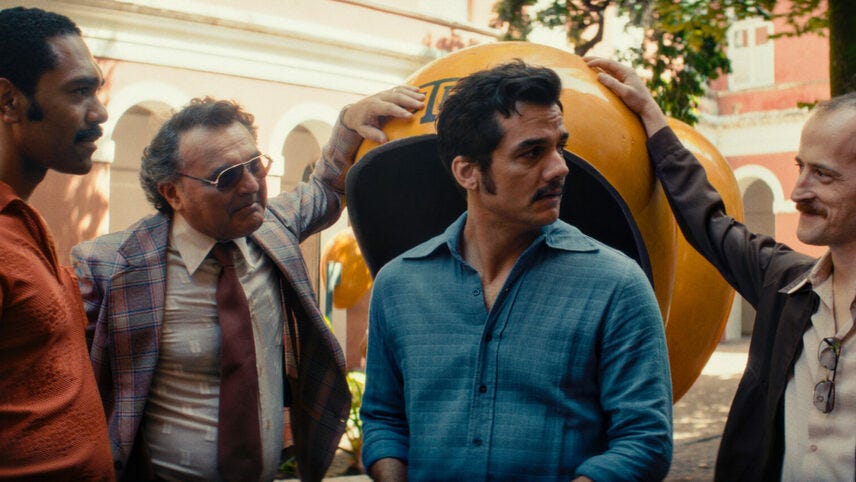
Wagner Moura in The Secret Agent
Keep your expectations in check: if you go into The Secret Agent expecting an explosive spy thriller, you may be disappointed. Nevertheless, the new film from Brazilian master Kleber Mendonça Filho is a gripping slow burn, a tale of intrigue set in 1977 — a time, as the opening titles state, of “great mischief.” Wagner Moura won a Best Actor prize at Cannes (and is considered a likely Oscar contender) for his role as “Marcelo,” whose motivations for taking up residence in a Recife home full of refugees and dissidents fill in across the 160-minute drama. The Secret Agent is a lush and absorbing period piece — the detail of its production and costume design deserve guild attention — and a haunting drama about the price of speaking truth to power within a brutal dictatorship. As with his previous dramas, Filho’s human epic is full of rich supporting turns and offbeat detours: its atmospheric bent and shaggy pacing prove to be a feature, not a bug. This is a thriller that rewards a viewer willing to resist the expected jolts of its genre.
5. Eephus

Keith Williams Richards and John R. Smith Jnr. in Eephus
There’s nine more innings to be played at Soldiers Field in Carson Lund’s hilarious, halcyon hangout movie. Yet Eephus does not merely capture the offbeat rhythms of a game of baseball, full of rowdy name-calling and bizarre rituals. The comedy is also a captivating and occasionally moving story of community, and a lovely showcase for more than two rosters full of character actors, some with paunch, others with punchy one-liners. Its title, a reference to an unexpectedly drawn-out pitch that aims to disorient the batter, seems to anticipate the narrative’s tonal swerves between electricity and dead air. (You know, like a regular game of baseball.) That pitch is also a fertile metaphor for the blink-and-you’ll-miss-it nature of life, surging toward you at a relative pace until, suddenly, it flits on by. Eephus is an admittedly minor-league (i.e., indie) delight, portraying the light-hearted camaraderie of its beer-bellied batters (and bunters). But it is also a major achievement: the poetry of baseball, in its wistful romanticism, resonates as deeply cinematic. Lund (working alongside scribes Nate Fisher and Michael Basta) is as keen to linger on the pithy player banter as he is to evoke the elegiac, sun-dappled environments of America’s pastime.
4. Sorry, Baby

Eva Victor in Sorry, Baby
Director Howard Hawks once described what comprises an excellent movie: three good scenes and no bad scenes. There are no bad scenes in writer/director Eva Victor’s grimly funny feature début, which chronicles five chapters in the life of a budding English professor (also played by Victor) whose life is tainted by a bad event. One of those good scenes is set in a courtroom, where protagonist Agnes, summoned for jury duty, wryly comments about how that aforementioned incident could spoil her objectivity. Another of those good scenes involves a friendly stranger who offers Agnes space to cry and then munch on a sandwich. Then, there is the scene involving a stray cat, adopted by a marooned Agnes and which becomes just the cutest of coping mechanisms. With Sorry, Baby, Victor demonstrates a miraculous tonal balance (and a fondness for titular commas). Alongside their taut, intricately-structured screenplay, Victor shows a natural tendency to cut scenes at just the right moment, to sustain a mood of dread or dry comedy. Nevertheless, it is their flinty performance as a Millennial processing the stain of a dismal experience, one which threatens to seep through everything, that gives the film a bruising emotional gravitas.
3. Put Your Soul on Your Hand and Walk

Fatma Hassouna in Put Your Soul on Your Hand and Walk
In April, the Cannes Film Festival selected Sepideh Farsi’s documentary about 24-year-old Palestinian photojournalist Fatma Hassouna to premiere at its festivities in May. The day after the announcement, an Israeli airstrike murdered Fatma and nine members of her family. Presenting the film at TIFF, Farsi described this event as a “loud death”: Put Your Soul on Your Hand and Walk has continued to reverberate since I first saw it there. The doc is conspicuously plain in its presentation, merely a collection of Facetime conversations between Fatma and the filmmaker, often depicted through a grainy medium close-up of the young journalist’s olive veil and radiant smile. The expression of joy feels strikingly at odds with the devastating circumstances: even the viewer can hear dim sounds of warfare ricocheting in the distance. The phone interactions, meanwhile, seem to rejuvenate Fatma, giving her another outlet to talk about and reflect upon life amidst the siege of war. We can momentarily access those bearing witness from Gaza, but Farsi’s impact is akin to our own: there is only so much we can do from the helplessness of our own homes to comprehend the unbearable. Despite the doc’s unadorned approach, allowing Fatma’s beaming face to envelop the cinema screen means Farsi’s doc feels even more urgent and unmissable.
2. It Was Just an Accident

It Was Just an Accident
Iranian director Jafar Panahi has long been one of the world’s most probing and stylistically flexible filmmakers. A dissident spirit informs the energy and substance of his dramas, many of which have been critiques of the repressive authoritarian regime in his native land. At 64, the director, who has been frequently detained by the Iranian government — and then subversively flouted their orders to stop making films — won a richly deserved Palme d’Or at the Cannes Film Festival. He won for It Was Just an Accident, an enthralling dark comedy. (The film itself is an act of subversion: Panahi did not receive filming permits from the Islamic Republic and relied on France and Luxembourg for a large portion of funding.) It follows car repairman Vahid (Vahid Mobasseri), who has kidnapped Eghbal (Ebrahim Azizi), a man whose voice and squeaking prosthetic leg flashes Vahid back to the sounds of his torturer from detainment years earlier. The working-class man is nearly certain Eghbal is a phantom awakened, but after kidnapping him, Vahid grapples with the morality of his actions. Retribution is not so simple, after all; neither, it seems, is mercy. It Was Just an Accident escalates into a riveting, dilemma-oriented drama, with Vahid reuniting with several ex-prisoners, hoping to confirm Eghbal is indeed the correct target. The film culminates with several large wails and piercing silences, showing the range of volume — the intensities of rage — that subsists within the rebel. A tale of furious, flawed, fumbling people made with ample formal control, Panahi’s latest is a triumph.
1. One Battle After Another

Leonardo DiCaprio in One Battle After Another
For the fourth time in a career spanning just 10 films, a new work from writer/director Paul Thomas Anderson is my pick for the year’s best film. Full of the breathless energy and oddball character beats that have made so much of Anderson’s oeuvre deeply invigorating, One Battle After Another is as purely exhilarating a piece of entertainment I’ve seen in years. It’s also a potent political thriller set against the backdrops of our cracked contemporary, of crises amidst sanctuary cities and fascist secret societies. Much of this film is told from the vantage points of a father and daughter: Bob Ferguson (Leonardo DiCaprio, never funnier) is a hazy, washed-up revolutionary desperate to find Willa (Chase Infiniti, astonishing), who has been targeted by a fascist regime as retribution for the actions of her mother, Perfidia (Teyana Taylor), a generation earlier. Anderson, gifted a nine-figure studio budget, finesses a mighty balance between swelling action set-pieces and satirical, minor-key character details, ensuring the story has both scope and a precise emotional texturing. One Battle After Another manages to be propulsive, rarely taking its foot off the accelerator, without abandoning the poignant journey of the family at its centre, filtered through DiCaprio’s anxious girl-dad. What else is there to say? Viva la revolución!
메타데이터
- post_id
- fc75d94cff0c
- slug
- the-revolution-will-not-be-televised-my-top-10-films-of-2025-fc75d94cff0c
- url
- https://medium.com/@jordanzadler/the-revolution-will-not-be-televised-my-top-10-films-of-2025-fc75d94cff0c
- canonical_url
- https://medium.com/@jordanzadler/the-revolution-will-not-be-televised-my-top-10-films-of-2025-fc75d94cff0c
- author_url
- https://medium.com/@jordanzadler
- status
- ok
- fetched_at
- 2026-07-13 06:23:13