Your Email Automation Is One Tool Update Away from Breaking. Here’s Who Should Be Watching It.
There’s a specific kind of dread every growing business eventually feels: you go to check your abandoned cart sequence, and it hasn’t fired…
Your Email Automation Is One Tool Update Away from Breaking. Here’s Who Should Be Watching It.
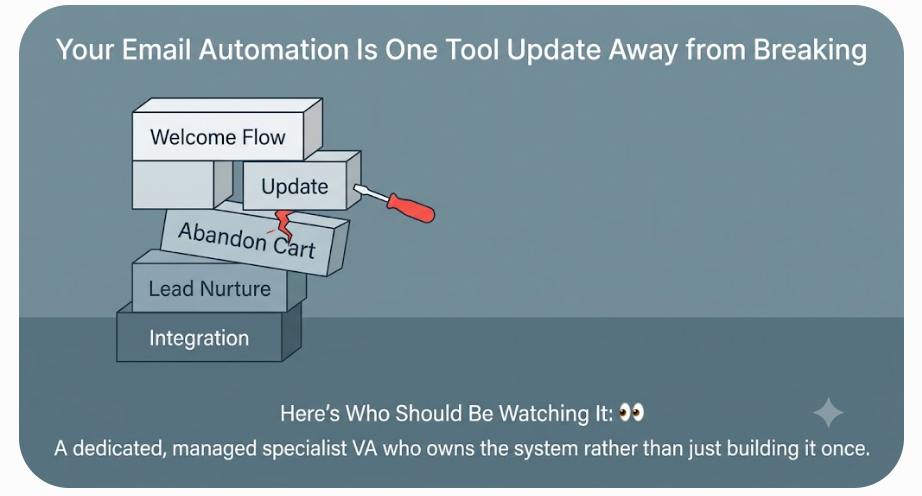
One update can collapse your email marketing. This image shows how a specialist VA keeps your automations stable and running.
There’s a specific kind of dread every growing business eventually feels: you go to check your abandoned cart sequence, and it hasn’t fired in three weeks. Nobody noticed. The automation didn’t crash loudly — it just quietly stopped working, and revenue leaked out the side door the whole time.
This is the problem nobody budgets for when they set up email automation. The setup gets attention. The upkeep doesn’t. And upkeep is where the real value — or the real risk — actually lives.
What an Email Automation Expert VA Is Actually For
Strip away the marketing language, and this role has a precise job: own the operational layer of your email system so it keeps running correctly, day after day, without you thinking about it.
That means building and maintaining automation sequences — welcome flows, nurture drips, abandoned cart recovery, post-purchase follow-ups, re-engagement campaigns. It means watching deliverability so your emails land in inboxes instead of spam folders. It means keeping your list clean, your integrations connected, and your reporting honest.
It deliberately does not mean email marketing strategy, campaign copywriting, brand voice, or owning revenue KPIs like CTR or conversion rate. That’s an important distinction, and one that gets blurred constantly in this market. A lot of businesses hire what they think is a “marketing person” and end up disappointed when sequences aren’t converting — when what they actually needed was someone to make sure the sequences run correctly in the first place, while a separate strategist decides what those sequences should say.
The Four Ways to Get This Done — And What Each One Actually Costs You
Most people only compare two options: hire someone full-time, or don’t. There are actually four real paths, and they trade off very differently.
In-house specialist. A full-time email/marketing automation hire in the US runs somewhere in the $55,000–$90,000 range annually before benefits. Strong ownership, but slow to recruit and expensive to carry through slow seasons.
Agency or certified consultant. Useful for an initial audit or complex platform migration, typically priced as a retainer or one-time engagement in the low-to-mid thousands per month. The honest limitation: they build a system, then move on to the next client. When something breaks at 11pm on a Tuesday, you’re back in a support queue with everyone else.
Freelance marketplace hire. Cheapest on paper, but the least accountable. No vetting standard beyond self-reported skills, no continuity guarantee, and the institutional knowledge of “why this automation was built this way” disappears the moment the contract ends.
A dedicated, managed specialist VA. This is the model built specifically to solve the upkeep problem — someone embedded in your operations long-term, who owns the system rather than just building it once and leaving.
The math on that fourth option is where it gets interesting. Market retainer pricing for ongoing email automation support typically runs $800–$6,000+ a month depending on volume and complexity. A dedicated specialist VA, properly vetted and trained, lands well inside that range while offering something agencies structurally can’t: full-time, exclusive attention to one account instead of split focus across a client roster.
The Vetting Problem Nobody Talks About
Here’s the part of this hiring decision that actually determines whether it works: almost anyone can claim “automation expert” on a resume. Few can actually walk through how they’d debug a broken Zapier scenario, or explain what they’d check first when open rates suddenly drop.
A real evaluation should include questions like these — whether you’re hiring through an agency or doing it yourself:
- Walk me through one automation you’ve built end-to-end, including a time it broke.
- How do you prevent duplicate entries and infinite automation loops?
- What’s your QA checklist before publishing a new automation live?
- How do you document a workflow so someone else could run it without you?
- What would you check first if our open rate dropped from 38% to 24% over two months?
Candidates who’ve only done surface-level campaign sends — scheduling broadcasts, picking templates — tend to answer these vaguely. Candidates who’ve actually managed full automation systems answer with specifics: trigger logic, fallback paths, authentication checks, sender reputation.
This is also where scope clarity matters enormously. The single most common cause of a bad hire in this category is an undefined job description — the business wants “marketing help,” the hire delivers technical automation upkeep, and both sides end up frustrated about a mismatch that a clear scope document would have prevented on day one.
The Technical Layer Most Buyers Don’t Know to Ask About
A genuinely capable email automation specialist isn’t just comfortable inside an ESP’s drag-and-drop builder. They understand the infrastructure underneath it:
- Deliverability fundamentals — SPF, DKIM, and DMARC authentication, sender reputation, warming new domains, and what to investigate when inbox placement quietly degrades.
- Integration logic — how to connect an ESP to a CRM, a checkout system, or a form tool without creating duplicate records or broken field mappings.
- List hygiene — identifying chronic non-openers, running re-engagement campaigns before suppression, and keeping bounce rates from damaging sender reputation.
- Platform-agnostic judgment — knowing when a native feature in your existing ESP solves a problem, versus when reaching for Zapier or Make actually adds unnecessary cost and fragility.
This is the layer that separates someone who can “use Mailchimp” from someone who can actually be trusted to own your email operations unsupervised.
Where Wishup Specifically Closes These Gaps
Each of the gaps above maps to something Wishup builds directly into how its Email Automation Expert VA service works.
On vetting: Wishup runs a six-step screening process — aptitude, cognitive ability, English fluency, and platform-specific checks — before a candidate ever reaches a client interview, with a reported 90%+ first-interview match success rate and a 36-month average retention rate among hires. That retention number matters specifically because it answers the institutional-knowledge problem: a VA who stays for years keeps the “why this automation works this way” context that a rotating freelancer never builds.
On scope clarity: Wishup defines role scope explicitly with every automation hire — what the role owns (setup, logic, integration, QA, documentation) and what it doesn’t (strategy, copywriting, brand voice, KPI ownership) — closing the most common cause of hiring mismatches before the engagement even starts. Clients also get unlimited same-day interviews at no extra cost, so there’s no pressure to settle on the first candidate out of sunk-cost fatigue.
On technical depth: Wishup’s VAs go through an eight-week training program covering 120+ tools, and the role is explicitly framed around deliverability (SPF/DKIM/DMARC), integration management, and data hygiene — not just campaign scheduling. The service works across 120+ ESPs and CRMs, including Mailchimp, Klaviyo, ActiveCampaign, HubSpot, GoHighLevel, and Salesforce, with the philosophy of working inside whatever stack a client already runs rather than forcing a switch.
On ongoing accountability: This is the piece that separates a managed VA model from both freelance marketplaces and certified-consultant engagements. Every Wishup automation hire comes with weekly manager reviews, fortnightly SOP adherence checks, and a monthly CSM cadence — plus a 24-hour replacement guarantee if a hire isn’t the right fit, and a 7-day money-back option for added downside protection. Onboarding itself runs around 60 minutes from finalized requirements to a matched candidate, against a market where freelance platforms can mean a multi-week wait.
On scaling without a rebuild: Wishup’s model explicitly supports starting with one workflow and one channel, then adding more channels, more sophisticated segmentation, and deeper CRM integration over time — without having to tear down and rebuild the system from scratch as the business grows. That continuity is exactly what a one-time agency engagement structurally can’t offer.
Where This Matters Most by Industry
Email automation isn’t equally high-stakes everywhere. A few contexts make the upkeep problem especially expensive to get wrong:
E-commerce. Abandoned cart, browse abandonment, post-purchase upsell, and win-back flows are direct revenue lines. A broken cart-recovery sequence isn’t a minor glitch — it’s silent, ongoing revenue loss until someone happens to notice.
B2B SaaS. Trial-to-paid nurture sequences and onboarding flows directly affect conversion. If a trial user never receives the activation nudge because an automation quietly failed, that’s a lost customer with no alarm bell attached.
Real estate and long-cycle sales. Lead nurture sequences here run for months or years. A broken automation doesn’t just cost a week of follow-up — it can mean a prospect goes cold permanently before anyone realizes the sequence stalled.
Healthcare and regulated industries. HIPAA-compliant email handling adds a compliance layer on top of the technical one — meaning the person managing automations needs both platform fluency and an understanding of what data can and can’t move through which channel.
In every one of these cases, the cost of a quiet failure compounds the longer it goes unnoticed — which is exactly why ongoing ownership matters more than clever initial setup.
Where This Leaves Most Businesses
Most hiring decisions in this space get made backwards: a business evaluates candidates on whether they can build an automation, then discovers months later that building was never the hard part — keeping it alive was.
The fix isn’t a smarter automation tool or a longer onboarding doc. It’s putting ownership in the hands of someone who’s vetted for this specific kind of accountability, scoped clearly from day one, and supported by a system that catches a broken workflow before it costs three weeks of silent revenue loss. That’s the gap a managed specialist VA is built to close — and it’s worth treating as a hiring priority, not an afterthought to whichever campaign launches next.
메타데이터
- post_id
- fc7ba2ed3237
- slug
- your-email-automation-is-one-tool-update-away-from-breaking-heres-who-should-be-watching-it-fc7ba2ed3237
- url
- https://medium.com/@williamdavis4309/your-email-automation-is-one-tool-update-away-from-breaking-heres-who-should-be-watching-it-fc7ba2ed3237
- canonical_url
- https://medium.com/@williamdavis4309/your-email-automation-is-one-tool-update-away-from-breaking-heres-who-should-be-watching-it-fc7ba2ed3237
- author_url
- https://medium.com/@williamdavis4309
- status
- ok
- fetched_at
- 2026-07-07 19:05:46