Zen and the Art of Metal Recycling
Could technological change have affected social change in ancient cultures?
Zen and the Art of Metal Recycling
Could technological change have affected social change in ancient cultures?

Image by author
In the ancient world axes were probably one of the most useful tools available and a part of almost every aspect of life. Certainly, they were used for chopping and carving wood, but they also could be used for cutting furrows for planting, as well as for warfare. The axe was associated with prestige, and its image was carved on standing stones and rock art (Bradley 1998: 48; Mohen and Eluère 2000:138). It seemed to be the ultimate in utilitarian devices and something that permeated all aspects of daily life.
A brief history of axes
There’s not that is much more basic than an axe. However, early in prehistory, axes had a symbolic significance that went beyond their mundane function. Finely polished jadeite axes, found hundreds of kilometers away from their source material, showed no signs of wear (Parker Pearson 1993: 34). They are interpreted as prestige items imported from distant locations. Early bronze axes were made in imitation of even earlier stone axes (Magnusson Staaf 2002 138; Parker Pearson 1993: 82).
One of the first innovations that were a result of using bronze instead of stone was the development of flanges (Childe 1930: 62). Like stone axes, bronze axes were fit onto a haft that was split so the ends of the wooden haft fit on either side of the butt of the axe. Flanges were metal protrusions on the top and bottom of the axe that could be folded over the wooden haft, making it more secure than it would be by just tying it in place. From there, axes followed an ever-widening variation of design.
Later axes were cast with sockets. These had a hollow core so the haft didn’t have to be split. The haft could fit snugly inside the haft, eliminating the stress on the split haft on flat axes that could cause it to split. Socketed axes needed no flange, yet flanges appeared to still have some significance. Early socketed bronze axes had decorations that resembled the three-dimensional flanges from the earlier type (Childe 1930: 66).
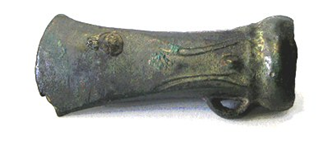
Socketed axe with flange design (image by author)
Like modern automobiles, axes were utilitarian objects in which the design and decorations changed repeatedly and were linked with individuality and social status. Axes went beyond their use for cutting wood and entered into the realm of a symbol of power and prestige (Parker Pearson 1993: 83). However, as mundane or as symbolic as they were, bronze axes were made of metal, and because of that, they had an attribute that was unknown before the development of metallurgy: they could be recycled.
After the technology of melting and casting metal was understood, the idea of re-melting previously cast metal objects followed. A broken tool of stone or bone could be repaired and reused, but it was never made totally new from its earlier form. The act of repairing it made the tool incrementally smaller until it was useless. Now a tool could be remade, new and whole.
Magnusson Staaf wrote that “The recycling of metal artifacts… [implied] a changing comprehension of metals” (Magnusson Staaf 2002: 142). How did this affect people’s outlook on life? Could the process of recycling have been instrumental in a change in society as well?
Technology and culture
Archaeologists usually divide artifacts into two groups: one defined as utilitarian objects and the other as ritual objects. The ancient world, as well as our own, is rarely so neatly delineated, and the meanings of artifacts are rarely so simple. Technology and culture are not easily separated (Dobres 2000: 133)
When these artifacts represent the only bridge between the ancient past and modern interpretation, how does one interpret their changing role? The axe was a highly useful tool that developed significance as a ritual object that was depicted in art and in ritual sites such as Stonehenge (Parker Pearson 1993). The significance of casting and re-melting metals could have had wide-ranging societal and ritual implications.
Archaeology and interpretation
Interpretation of the cultural meaning of artifacts is a modern concept, and it is a viewpoint applied by modern archaeologists who want very much to understand what was happening in the past. The invisible aspects of culture can only be inferred from the material remains (Thomas 1999: 28), which in turn are a product of the available technology and resources accessible to the archaeologist (Hodder 1986: 128). The interpretation of artifacts and the motivational decisions behind their manufacture is a product of what archaeologists consider significant. However, what archaeologists considered significant has changed greatly since the discipline began in the mid-1800s.
Early archaeology
Archaeological artifacts began their post-depositional lives as collection pieces in cabinets of curiosities. They were tumbled together with objects of natural history, fossils, and ethnographic works. Archaeological artifacts were one more item to be displayed as part of an elite, often private collection (Trigger 1989: 47). Little or no attention was paid to context, and interpretation was defined by the culture of the time. Early cultures (as well as contemporary non-Western cultures) were deemed to be primitive and barbaric, with the ultimate assumption that man had risen above his primordial roots by a succession of technological, social, and moral advances (Childe 1930).
With the publication of Lyells’ Principles of Geology in 1830 and Darwin’s On the Origin of Species (1859), archaeology moved from the age of antiquarian collecting to one of scientific method. Systems of relative dating were developed, and new interpretations were given to the curiosities of antiquity (Trigger 1989: 73, 92). While a linear concept of material progress was still espoused, the neatly organized system of interpretation was compromised by conflicting information provided by context, relative dating, and assumptions about the prehistoric past.
Context became increasingly important as a means of understanding artifacts and their role in past cultures. Archaeological artifacts moved from being individual items to components of a larger story. By placing value on the context, the artifact now had a connection to time and space, and interpretation of the greater context yielded information about the artifact’s place in the society. Items found in burials would have entirely different meanings than those found within a dwelling. Exotic items could be used as an indication of long-distance trade and represent the relative wealth of individuals in the society. The work of the archaeologist moved from one of a collector of objet d’art to one trying to tease a story of past lives from an assemblage. The archaeologist’s job was to try to understand aspects of life, such as social structure and belief systems that cannot be directly seen in the archaeological record (Trigger 1978: 9).
Through recognizing the significance of context, more interpretation became possible. The artifacts have not changed, but the changing needs of archaeology caused them to be viewed in a new way, creating new interpretations and expanded meanings for what were once just curiosities (Dobres 2000: 131, 133).
Reaching beyond the material
With the advent of material culture studies, archaeology became a metaphoric tool for the systematic excavation of the past in order to understand earlier life-ways (Thomas 1999: 12). Artifacts no longer had a history that was bounded by their creation, use, and disposal. Now it extended into biographies that included the components of its manufacture, the groups who provided the materials from which it was made, as well as its connection to the society that made it, used it, and ultimately to the events connected to its deposition (Holtorf 2002). Every artifact was a remnant of an extensive web connecting time, materials, and societies together (Thomas 1999: 19). Beyond the observation of the isolated artifact, new levels of meaning could be deduced from its archaeological context (Dobres 2000:136).
Kristiansen (2004) recognized that cultural tradition is affected by social, economic, and ritual conventions. When ecological and economic balances pass a critical point, conditions emerge conducive to far-reaching social change.
Technology, performance, and social change
Dobres describes performance as a means of “interacting and experiencing the world” (Dobres 2000: 138). In her use of the word performance, Dobres is emphasizing the importance of everyday gestures, skills, and knowledge. This is the fundamental process of creation of objects that produces both personal and social identity. However, performance is not a static process, and both individuals and societies “can challenge and contest cultural paradigms and tradition, and thus create the conditions that lead to change” (Dobres 2000: 148). The use of technology in this interaction creates a basis for cultural change.
Technology is an intrinsic part of society, and while human agents create the technology, their society in turn is also molded by it (Dobres 2000: 127). Metallurgy did have an enormous impact on the economics of Bronze Age society (Magnusson Staaf 2002: 138). Labor became specialized, and those who worked in the mines and refined metals depended on others to provide food, clothing, and possibly even the tools they used (Harding 2000: 235).
Copper, tin, and other metals are mined in specific areas, and long-distance trade was necessary for some smiths who were located far from mineral sources to obtain the metals they needed. This would necessitate interaction with other societies in order to obtain the necessary materials for their work (Pydyn 1998). Ideas come along with trade, and it could be the case that new cultural concepts traveled along the trade routes with metals (Kristiansen 2004: 93; Trigger 1978: 227). Rowlands also observed that trade, religion, and colonization were part of the same package (Rowlands 1994:46).
The ongoing development of metallurgy, with its basis in trade for raw materials and finished products, could have provided a catalyst for widespread change. However, the spread of metallurgy was not a smooth progression. In some regions during the Middle Bronze Age, metal was not manufactured and is seen as having been a consumer good, while other regions developed and advanced in using the technology (Magnusson Staaf 2002:142). Metal, either as a trade good or as a skill, could constitute a cultural meme, in which the recognition of the unique qualities of metal was spread from one cultural group to another. The success of the meme depends upon its ability for it to be perceived by others along with its compatibility with the established hierarchy, traditions, and beliefs (Dawkins 1982: 108–110).
In the case of bronze axes, the status of the axe had already been established during the Neolithic when it was still manufactured from stone. The addition of metallurgical attributes and its role in the possible change in economic balance could have given it an even greater status. This could have provided the critical impetus for social change.
Following this line of inquiry, the possibility of considering the concept of reincarnation as a form of recycling can be considered. The body is broken or no longer functional, but rather than it being interred whole, it could be cremated.
Changes in burial customs
In the Early Bronze Age in Britain, inhumations were the dominant form of burial; however, by the Middle Bronze Age, cremations became increasingly popular (Bradley 1998: 98). Harding recognized that this was a “…major shift in beliefs” and that “…the preservation of the body after death was no longer seen as important” (2000: 112). Could this shift in burial custom have been influenced by the development of recycling metal? In both cases, the object/body could be viewed as broken or destroyed. In both cases, the dead object would have been subjected to furnace-like conditions. In viewing the similarities of the acts of cremation and the recycling of metals, it could be that the idea of recycling might have had an influence on the changes in ritual practices during the Middle Bronze Age.
Recycling life and death, an act of reincarnation?
Could the act of recycling have changed people’s perceptions of life and death? An axe is put into the crucible, melted down, and is cast into a new life in a new form. The cycle repeats until the artifact is finally deposited in a context where it will no longer be used. This action not only affected the economic and production cycle of metallurgy but could have had a profound psychological effect as well. Ingold wrote that the manufacture of artifacts is a reflexive process where the process of creation of the artifact and the creation of culture arise from a common source. The creation of the cultural environment is reflected in the creation of crafts and vice versa (Ingold 2004: 68).
Transformative technologies such as metallurgy could have had enormous impacts on societies (Magnusson Staaf 2002: 142; Dobres 2000: 148). Previously, tools that were worn or broken might be repaired, but ultimately, they were discarded. Now a tool that was worn out or broken could be put into a crucible, melted, cast, and emerge from a mould as a new object, bright and whole. It was an amazing transformation that was impossible with any earlier technology. The object no longer had to undergo a cycle of creation, use, and disposal. It now had the ability to be reborn, perhaps in a different form, but still of the same substance. This model of recycling could have carried over into other aspects of society, including social and ritual contexts, with recycled metal being a potent symbol that affected the perceptions of the society (Dobres 2000: 128, 133).
Can change in technology change cultural traditions?
Understanding the processes involved in manufacturing stone axes and contrasting them with the changes in the way axes were manufactured after the arrival of metallurgy helps us to see how this could have changed the worldview of societies as they began to work with metals. While some groups could have resisted change, others adopted the medium and developed it. This tension could also have provided a critical point for social change described by Kristiansen.
As stated above, the impact of the new technology would have had far-reaching effects. Because the cultural environment includes all aspects of life, in both the performance of ritual and day-to-day acts, the special attributes of metal and its ability to be recycled would permeate the culture (Ingold 2004: 68; Thomas 1999: 19).
Metal was the first substance that could be recycled. Broken tools weren’t thrown away; they could be put back into a crucible and made new.
This could be a metaphor for reincarnation. Seeing tools come out of a mould brand new, especially if the mould was made from the original object.
During the Middle Bronze Age, there was a conspicuous change in burial customs. Instead of inhumations, there was a move to cremations. Could this represent a cultural shift that linked the broken state of a tool with recycling that engendered comparisons with death and rebirth?
Metal tools, with their ability to be recycled, now had a ritual significance that no longer required their permanence for continued use.
Can we know for sure?
All of this is, of course, speculative and theoretical. We cannot know the minds of people who lived thousands of years ago who left no written record.
But can we recognize the motivating factors behind the decisions made in creating rituals of life and death in antiquity? Limited use of ethnography can help, but ethnography also serves to indicate how much cultural information is missing. The sounds, words, gestures, and other ephemera are gone, as well as those artifacts that do not survive in the archaeological record. Recognizing the significance of variations such as design, color, material composition; evidence of use; and other factors beyond simple technical innovation for a more efficient tool (Keates 2002; Parker Pearson 1993: 117; Roberts and Ottaway 2003).
Human beings are part of the world, and humans cannot be separated from their culture, environment, and craft (Thomas 1999: 19; Ingold 2004: 68). Likewise, trying to separate craft from ritual practice from culture creates problems. Where is the line drawn between them? Each aspect is intertwined with the other, creating a tapestry in which trying to pull out one thread will unravel the rest.
But there is also a fine line between interpretation and illusion. In archaeology, there is always the temptation to tell ourselves stories about the artifacts we work with. Speculation requires vigilance, discussion, and adherence to established methods, lest it wander into the realm of fairy tales. It is only through careful consideration of an artifact and its context within time, space, and associated objects that we can begin to unravel some of the meaning behind its place in a culture.
Unfortunately, artifacts are only representative objects of a culture that survive in the archaeological record. They are a product of the culture, but the culture itself cannot be excavated. We can only hold the material remains without direct experience of what the artifact represented to that culture (Thomas 1999: 28). By trying to understand the different contextual situations, we can understand that these axes were part of a more complex set of symbols. Experienced from within, rituals have different meanings to different participants, depending on their roles and relationships (Hodder 1986: 159). In the archaeological record, it can also be seen that rituals also change over time (Bradley 1998: 202), compounding the difficulty in understanding what the artifacts and their deposition represented.
Like the rituals themselves, archaeological interpretation is an ongoing process (Hodder 1986 161), and in doing this we must recognize that we are a product of our own cultures, which also affects our interpretation of artifacts.
Bronze tools and weapons had the ability to change society in very real ways. The new technology transformed the way in which tools were made and used, and introduced the concept of recycling. This in turn could have had an effect on the ritual life of people during the Bronze Age. The concept of recycling could have given rise to ideas of reincarnation after immolation. This then could have heightened the significance of metal artifacts, resulting in them becoming something more than utilitarian objects. They moved beyond being tools to become ritual objects. Axes placed in significant locations (for example, those deposited in water, mountain crags, or under monoliths) could have served as undying sentinels guarding borders (Roberts and Ottaway 2003: 136), or as sacrifices that would remove a valued object out of the cycle, both physically and spiritually.

Image by author
References
Bradley, Richard 1998 The Passage of Arms: An archaeological analysis of prehistoric hoard and votive deposits. Oxford, Oxbow Books
Childe, V. Gordon 1930 The Bronze Age. Cambridge, Cambridge University Press.
Dawkins, Richard 1982 The Extended Phenotype. Oxford, W. H. Freeman and Company
Dobres, Marcia-Anne 2000 Technology and Social Agency. Oxford, Blackwell
Harding, A. F. 2000 European Societies in the Bronze Age. Cambridge, Cambridge University Press.
Hodder, Ian 1986 Reading the Past. Cambridge, Press Syndicate of the University of Cambridge
Holtorf, Cornelius 2002 “Notes on the Life History of a Pot Sherd” Journal of Material Culture. Vol. 7 (49) pp 49–71
Ingold, Tim 2004 “Making Culture and Weaving the World” in Material Culture: Critical Concepts in the Social Sciences. Victor Buchli, ed. London, Routledge
Keates, Stephen 2002 “The Flashing Blade: Copper, Colour and Luminosity in North Italian Copper Age Society” in Colouring the Past: The Significance of Colour in Archaeological Research. Andrew Jones and Gavin MacGregor, eds. Oxford, Berg
Kristiansen, Kristian 2004 “Genes versus agents: A discussion of the widening theoretical gap in archaeology” Archaeological Dialogues 11 (2) 77–99 Cambridge, Cambridge University Press
Magnusson Staaf, Björn 2002 “Changes of Use: Transformations of Comprehension” in Metals and Society. Barbara S. Ottaway and Emma C. Wager, ed. Oxford, BAR International
Mohen, Jean-Pierre and Eluère, Christiane 2000 The Bronze Age in Europe: Gods, Heroes and Treasures. London, Thames and Hudson
Parker Pearson, Michael 1993 The Bronze Age in Britain. London, B.T. Batsford Ltd.
Pydyn, Andrzej 1998 “Universal or relative? Social, economic and symbolic values in central Europe in the transition from the Bronze Age to the Iron Age” in Archaeology of Value: Essays on Prestige and the Processes of Valuation. Douglas Bailey, ed. Oxford, BAR International
Roberts, Ben and Ottaway, Barbara 2003 “The Use and Significance of Socketed Axes During the Late Bronze Age” European Journal of Archaeology Vol. 6(2) pp. 119–140
Rowlands, Michael 1994 “Childe and the archaeology of freedom” The Archaeology of V. Gordon Childe. Chicago, University of Chicago Press
Thomas, Julian 1999 Time, Culture and Identity. London, Routledge
Trigger, Bruce, 1978 Time and Traditions. Edinburgh, Edinburgh University Press
Trigger, Bruce 1989 A History of Archaeological Thought. Cambridge, Cambridge University Press
메타데이터
- post_id
- fc8b8ea208db
- slug
- zen-and-the-art-of-metal-recycling-fc8b8ea208db
- url
- https://thequantasticjournal.com/zen-and-the-art-of-metal-recycling-fc8b8ea208db
- canonical_url
- https://thequantasticjournal.com/zen-and-the-art-of-metal-recycling-fc8b8ea208db
- author_url
- https://medium.com/@gfregni
- status
- ok
- fetched_at
- 2026-07-10 03:02:36