Designing Safety for eVTOL Passengers: What Happens When Your Flying Taxi Tilts Mid-Air?
Flying taxis are moving from concept toward reality. But one of the hardest passenger-safety problems is still unsolved: how do you tell a…
Designing Safety for eVTOL Passengers: What Happens When Your Flying Taxi Tilts Mid-Air?
Flying taxis are moving from concept toward reality. But one of the hardest passenger-safety problems is still unsolved: how do you tell a first-time rider that the stomach-dropping motion they just felt is completely normal?
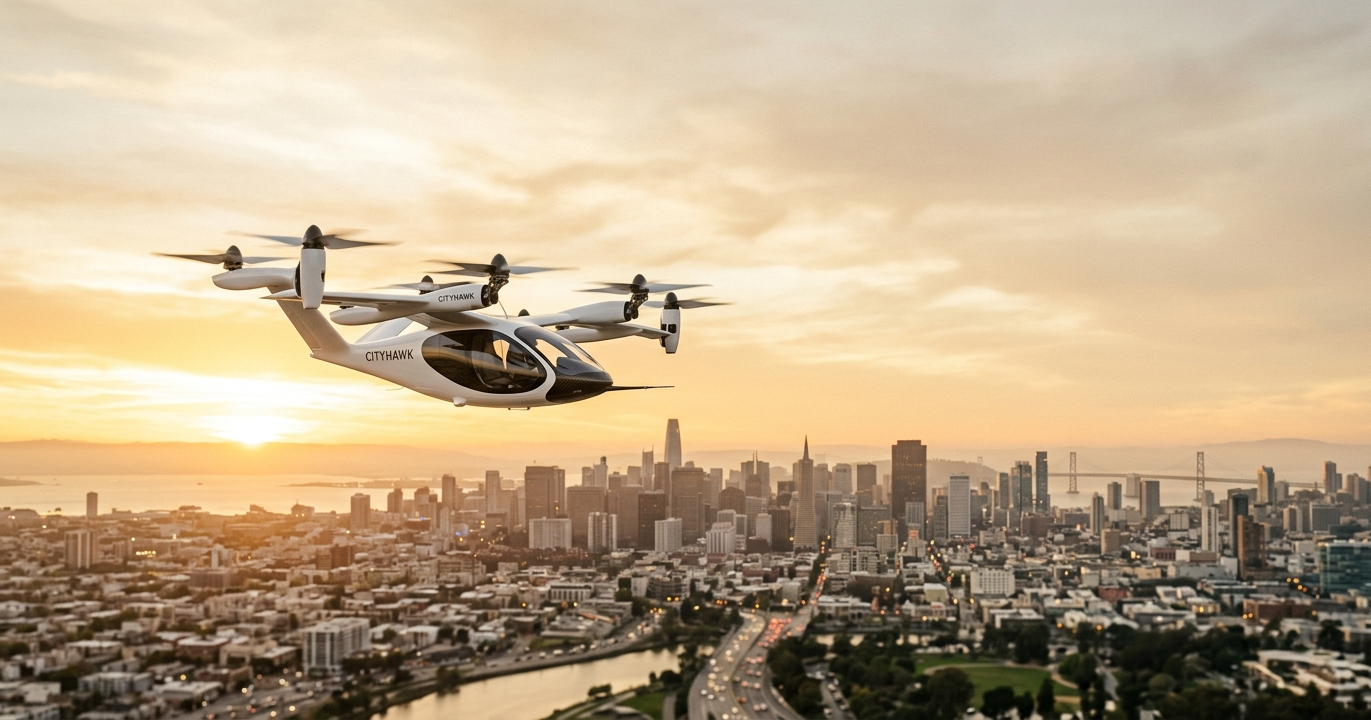
Electric air taxis are moving from concept toward reality (Image: AI-generated with Google Gemini)
Picture this. You’ve booked a flying taxi to skip the traffic across the city. You climb into a cabin smaller than your car, buckle a harness you have never seen before, and lift straight up off a rooftop. A minute in, the whole cabin pitches forward and your stomach drops as the aircraft swaps “going up” for “going forward.”
Is that supposed to happen? Or is something very wrong?
You have no idea. You’ve never felt anything like it, no one warned you it was coming, and the little safety card in the seat pocket said nothing about it. That flash of “should I be scared right now?” is the problem I spent a semester on. It turns out to be one of the most overlooked challenges in the entire flying-taxi revolution.

The tilt-to-cruise transition: a normal motion that a first-time passenger can easily misread as something going wrong (Image: AI-generated with Google Gemini)
The aircraft is almost ready. The passenger isn’t.
These vehicles have a name: eVTOLs, short for electric vertical takeoff and landing aircraft. Think of a quiet, electric cross between a helicopter and a small plane that lifts off straight up, then tilts to fly forward. They’re the centerpiece of what the industry calls Advanced Air Mobility, the plan to move people across cities through the air instead of clogged roads.
And they’re not science fiction anymore. Regulators have been putting certification frameworks in place, several manufacturers are deep into the approval process, and the first commercial passenger services are expected within the next few years. Enormous resources have gone into making the machine itself safe: redundant motors, fly-by-wire controls, and rigorous failure testing on every subsystem.
Here’s what almost no one is funding at the same intensity: the few seconds between a passenger feeling something strange and deciding what to do about it.
Because here’s the uncomfortable truth. You can build the safest aircraft in history, but if a first-time rider misreads a normal motion as a malfunction, panics, unbuckles, and stands up mid-flight, none of that engineering matters in that moment. Safety isn’t just whether the vehicle behaves. It’s whether the human inside understands what the vehicle is doing.
Why the old safety playbook breaks
We already have a system for talking to passengers about safety. It’s the pre-flight briefing on every commercial flight: the seatbelt demo, the laminated card, the cabin announcements. We’ve used it for decades.
It quietly relies on three things that eVTOLs don’t have.
- Time: A long-haul flight has minutes of taxiing for a briefing to land. An eVTOL hop might last a few minutes, total. There’s barely a runway, let alone a runway’s worth of time.
- A mental model: Most adults have a rough sense of how a normal plane behaves: it speeds up, it climbs, it hits bumps, it lands. eVTOLs introduce motions almost no one has felt before, like the forward “tilt-to-cruise” as it shifts into flight, or a sudden vertical “heave” as it stabilizes.
- Attention: Research on regular flights shows passengers tune out the safety briefing, especially frequent flyers who’ve heard it a hundred times. The information goes in one ear and out the other, then evaporates exactly when it’s needed.
So the standard approach asks a first-time passenger to remember, from a rushed briefing, what to do during a sensation they’ve never experienced. That’s a lot to ask of human memory under stress. And under stress, people don’t recall instructions they read earlier. They react to what they can see and hear right now.
The question I set out to answer
If memorized briefings won’t cut it, what will? That breaks down into three design choices for any safety message:
- Timing — when do you tell the passenger? Before they board, while they’re settling in, or in the exact moment the event happens (what researchers call “just-in-time”)?
- Modality — how do you deliver it? On a screen, through audio, or both at once?
- Format — what does it look like? Plain text, a simple icon, or a short animation?
That’s three questions, each with three answers. The catch is they don’t act in isolation. A perfectly worded message at the wrong moment fails. The right moment with the wrong format fails. So I couldn’t test them one at a time. I had to test how they work together.
Building a flight nobody has taken yet
You can’t ethically put nervous first-timers in a real flying taxi and trigger scary motions to see how they react. So I designed the study around virtual reality, structured as a 3 × 3 × 3 within-subjects factorial design — meaning every participant experiences every combination of the three variables, which keeps individual differences from muddying the comparison.
The plan: recruit 36–42 first-time flyers (no prior eVTOL or rotorcraft experience, so every reaction reflects a true novice), then put them in a Meta Quest 3 headset running a Unity-built simulation that drops them inside an eVTOL cabin and walks them through three kinds of moments.

The study runs in VR, where participants experience simulated eVTOL events alongside the safety messages being tested (Image: AI-generated with Google Gemini)
- A routine moment — a calm seatbelt instruction.
- A non-panic surprise — the cabin tilting forward as it transitions to cruise.
- A panic-like event — a sudden, turbulence-style drop.
In each moment, the passenger receives a safety message built from one combination of the three variables: a specific timing, a specific modality, a specific format. With three options each, that’s 27 unique conditions every participant experiences. Trial order is counterbalanced using a Latin-square method, so no one’s results are skewed by what came first.
Then I measure what actually happened, not just what people say. Comprehension, clarity, trust, and anxiety ratings are collected through Qualtrics after each event, alongside:
- A comprehension and end-of-session recall test — did they understand the message, and could they remember it later?
- Response time and accuracy — how fast and how correctly did they act?
- Perceived clarity and trust in the message
- A single-item anxiety rating, plus the NASA-TLX to measure mental workload
- An optional galvanic skin response (GSR) sensor that tracks the body’s physiological stress in real time
Main effects and interactions across timing, modality, and format are then assessed using a repeated-measures ANOVA. The result is a controlled way to see which messaging recipe keeps people both safe and calm across calm and frightening moments alike.
What I expect to find (and why that distinction matters)
I want to be precise here, because it’s where a lot of project write-ups quietly overclaim. This is a study I designed, not one I’ve run yet. I don’t have results. What I have are predictions, grounded in decades of human factors and instructional-design research:
- Messages delivered in the moment should beat messages delivered earlier, because they don’t lean on fragile memory.
- Messages that hit two senses at once (seeing and hearing) should beat single-channel ones, because the redundancy cuts through stress and confusion.
- Animations should beat icons, which should beat plain text, because showing an unfamiliar motion is clearer than describing it.
If those hold up, they point toward a concrete recommendation: stop relying on the safety card, and start delivering short, animated, in-the-moment cues that show passengers what’s happening as it happens.
Why this isn’t really about flying taxis
I’m an aviation nerd. I can name an aircraft by its silhouette, and I collect airline trading cards. So eVTOLs were always going to pull me in. But the more I worked on this, the more I realized the lesson underneath it has almost nothing to do with aircraft.
The core problem is this: How do you communicate critical information to someone who is stressed, unfamiliar with the situation, and has no time to study?
That’s not an aviation question. That’s a design question, and it’s everywhere.
- It’s the error message that pops up while a user is panicking about losing their work.
- It’s the onboarding flow that tries to teach everything up front, then watches users forget it all by the time they need it.
- It’s the medical instruction handed to a frightened patient who will not remember a word of it an hour later.
The same three levers apply. Tell people when it matters, not long before. Show the thing instead of describing it. And don’t make one channel carry the whole load. Good safety design and good product design turn out to be the same craft: meeting people where they are, in the moment they actually need you, in the form they can absorb under pressure.
The flying taxis are coming. The least we can do is make sure the person in the seat knows that the scary little tilt is just the aircraft doing exactly what it’s supposed to do.
This study was designed for ISE 212: Human Factors Experiments, part of my M.S. in Human Factors & Ergonomics at San José State University. It’s a study I built rather than one I have run yet and I would love to see it tested.
If you’d like to see more of what I do, my portfolio lives at khushi-designs.com. I am always happy to answer questions, talk through the research, or team up on something interesting, so if anything here sparked an idea, let’s collaborate!
메타데이터
- post_id
- fc8fa43a5d7b
- slug
- designing-safety-for-evtol-passengers-what-happens-when-your-flying-taxi-tilts-mid-air-fc8fa43a5d7b
- url
- https://medium.com/@khushi.g5/designing-safety-for-evtol-passengers-what-happens-when-your-flying-taxi-tilts-mid-air-fc8fa43a5d7b
- canonical_url
- https://medium.com/@khushi.g5/designing-safety-for-evtol-passengers-what-happens-when-your-flying-taxi-tilts-mid-air-fc8fa43a5d7b
- author_url
- https://medium.com/@khushi.g5
- status
- ok
- fetched_at
- 2026-06-13 07:35:29