Databases Explained — Relational DB, NoSQL, Vector Databases, Time Series, Graph, and NewSQL
Modern applications don’t just store data — they understand it, search it semantically, and process it in real time. As a result…
Databases Explained — Relational DB, NoSQL, Vector Databases, Time Series, Graph, and NewSQL
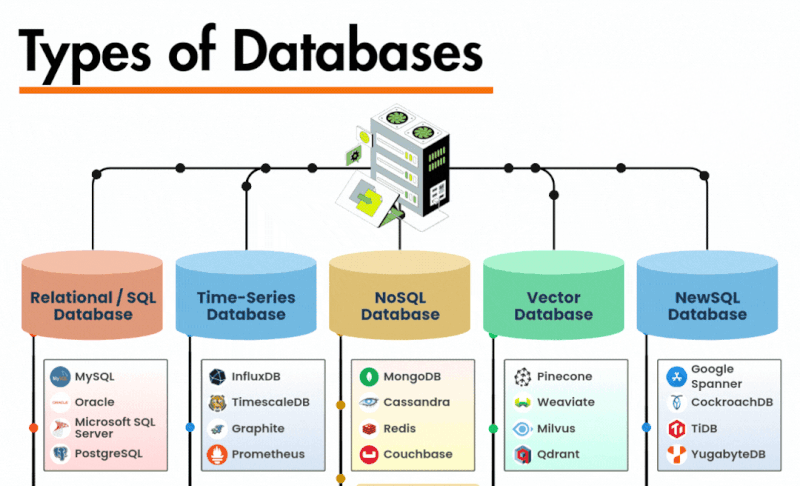
Modern applications don’t just store data — they understand it, search it semantically, and process it in real time. As a result, developers are no longer choosing a database. They are choosing a combination of databases, each solving a different problem.
In this article, we’ll break down the modern database landscape — from traditional SQL systems to vector databases powering AI — and everything in between.
🏛️ The Foundation: Relational Databases (SQL)


Relational databases are where it all began — and they’re still incredibly relevant.
These systems organize data into tables (rows and columns) with predefined schemas. They follow strict rules to ensure data integrity, often referred to as ACID properties (Atomicity, Consistency, Isolation, Durability).
Popular relational databases include:
- MySQL
- PostgreSQL
- Microsoft SQL Server
Why SQL Still Matters
Relational databases excel when:
- Data is structured and predictable
- Relationships between data are important
- Consistency is critical (e.g., banking, transactions)
Their biggest strength? Joins — the ability to connect data across multiple tables efficiently.
If your data has strong relationships and rules, SQL is still king.
Limitations
However, SQL databases can struggle when:
- Data structure changes frequently
- You need massive horizontal scaling
- You’re dealing with unstructured or semi-structured data
And that’s where the next category comes in.
🌐 The Shift: NoSQL Databases


As applications became more dynamic — think social media, real-time apps, and big data — rigid schemas became a bottleneck.
Enter NoSQL.
NoSQL databases are designed for flexibility and scalability. Instead of forcing data into fixed tables, they allow more natural formats like JSON.
Popular examples:
- MongoDB (document-based)
- Redis (key-value, ultra-fast)
- Cassandra (distributed, scalable)
Types of NoSQL
- Document databases → JSON-like storage
- Key-value stores → ultra-fast lookups
- Column-family stores → big data analytics
- Graph databases → relationships
When to Use NoSQL
- Rapidly evolving applications
- Large-scale distributed systems
- Real-time performance needs
NoSQL is not a replacement for SQL — it’s a different tool for a different job.
🧠 The Game Changer: Vector Databases (AI Era)


This is where things get really interesting.
Traditional databases store data. Vector databases store meaning.
Instead of storing text as plain strings, vector databases convert it into embeddings — numerical representations that capture semantic meaning.
Popular tools:
- Pinecone
- FAISS
- Weaviate
How It Works (Simple Version)
- Text → converted into vectors (embeddings)
- Query → also converted into a vector
- Database → finds the closest match using similarity
Say you have a large animal database and you want to query everything related to cats.
In a traditional SQL setup, you’d probably end up writing multiple conditions using LIKE, REGEX, or full-text search to cover terms like cat, kitten, ragdoll, siamese, maine coon, british shorthair, and so on.
It works—but only if you explicitly think of and include every possible variation.
Now imagine doing the same with a vector database.
Instead of matching exact words, the data is converted into embeddings — numerical representations of meaning. In this vector space, related concepts like cat, kitten, and different cat breeds are naturally placed close to each other.
So when you search for “cat,” you don’t need to list every variation. The system automatically retrieves semantically similar results.
That’s the key shift: you’re no longer searching for exact text — you’re searching for meaning.
Why This Matters
This enables:
- Semantic search (“find similar meaning,” not exact match)
- ChatGPT-style apps (RAG pipelines)
- Recommendation systems
- Image/audio similarity
SQL answers: What matches exactly? Vector databases answer: What feels similar?
This shift is fundamental — and it’s powering most modern AI applications.
🔌 Beyond the Basics: Specialized Databases
Modern systems often need highly specialized databases optimized for specific types of data.
⏱️ Time-Series Databases


Designed to handle time-based data efficiently.
Examples:
- InfluxDB
- TimescaleDB
Use cases:
- DevOps monitoring (CPU, logs, metrics)
- IoT sensor data
- Stock market analysis
🔗 Graph Databases


Graph databases focus on relationships between entities.
Example:
- Neo4j
Use cases:
- Social networks
- Fraud detection
- Recommendation engines
⚡ NewSQL Databases
You had to choose between Relational SQL and scalability of Noaql — what if you want best of both — comes NewSQL
Designed to combine the reliability of traditional SQL systems with the scalability of modern distributed databases.
Examples:
- Google Spanner
- CockroachDB
- TiDB
Use cases:
- Large-scale financial systems requiring strong consistency
- Globally distributed applications (multi-region data)
- High-traffic enterprise apps needing both ACID guarantees + horizontal scaling
So does that mean you’ve to use only one ?
No — many apps use a combination of above for different things
Modern application stack might look like this:
- PostgreSQL → core structured data
- Redis → caching & speed
- Pinecone → AI search
Each database solves a specific problem — and together, they create powerful systems.
🎯 Final Thoughts
Databases have evolved from simple storage systems into intelligent data engines.
- SQL gave us structure
- NoSQL gave us flexibility
- Vector databases are giving us understanding
And this is just the beginning.
As AI continues to grow, the way we store and query data will keep evolving. The developers who understand this landscape today will build the systems of tomorrow.
메타데이터
- post_id
- fc930815ef09
- slug
- databases-explained-relational-db-nosql-vector-databases-time-series-graph-and-newsql-fc930815ef09
- url
- https://pub.towardsai.net/databases-explained-relational-db-nosql-vector-databases-time-series-graph-and-newsql-fc930815ef09
- canonical_url
- https://pub.towardsai.net/databases-explained-relational-db-nosql-vector-databases-time-series-graph-and-newsql-fc930815ef09
- author_url
- https://medium.com/@vijeetdeliwala
- status
- ok
- fetched_at
- 2026-06-09 15:37:30