Doppler Drama: Is Your Signal on the Run?
Doppler Drama: Is Your Signal on the Run?
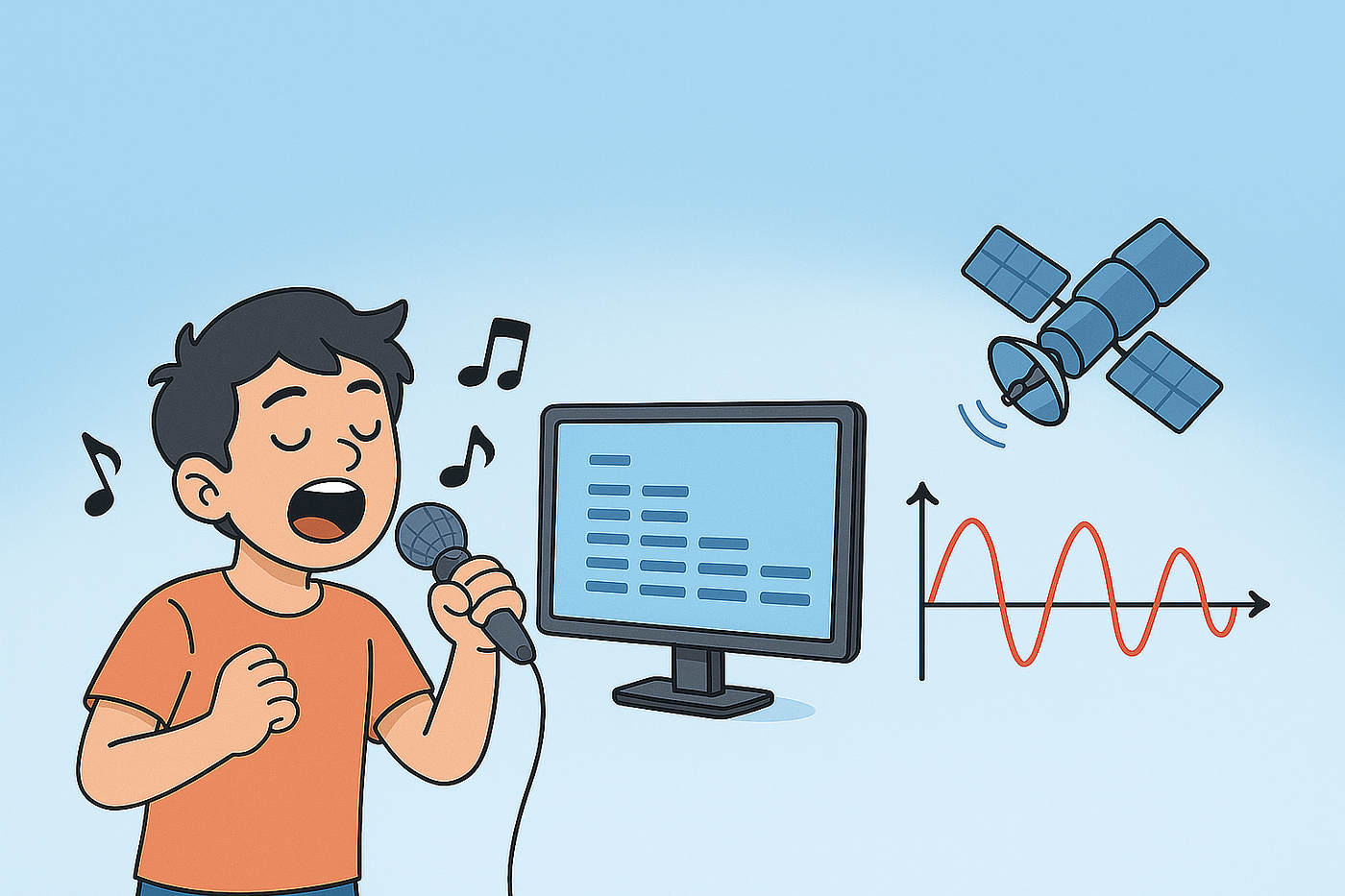
Imagine singing karaoke: you’re perfectly in tune, the lyrics are flowing, and suddenly the music starts speeding up, then slowing down. You’re still trying to sing the same song, but now you’re off-beat, off-key, and maybe even off-breath.
That’s precisely the challenge for wireless signals when the transmitter (like a LEO satellite) and the receiver (your phone or a ground station) are moving relative to each other. The rhythm between them breaks.
This is the **Doppler Effect. The same phenomenon that makes a passing ambulance sound higher-pitched as it approaches and lower-pitched as it drives away. In wireless communication, this is called [Doppler Shift,](https://imagine.gsfc.nasa.gov/features/yba/M31_velocity/spectrum/doppler_more.html) and it means one critical thing: the frequency and phase of your signal start drifting over time. When that happens, synchronization** — the invisible glue keeping your bits, beams, and symbols aligned — starts to fall apart.
The Chaos Behind the Melody
At low speeds (like walking with your phone), Doppler effects are mild. But scale it up to LEO satellites orbiting at 7.5 km/s or swarming drones communicating mid-flight, and the chaos is intense.
The relative motion stretches and squeezes the radio wavefront, altering the signal frequency thousands of times per second. If your receiver can’t keep up, you get:
- Symbol Misalignment: The receiver reads the data bit at the wrong moment.
- Beam Mispointing: Focused beams miss the target as the geometry changes.
- Frequency Drift: The entire signal channel moves, resulting in lost data and distorted communication.
The result is a communication link that sounds like “cosmic karaoke” in fast-forward, leading inevitably to buffering and dropped connections.
How We Keep the Beat: Classical Compensation
To handle these high-speed blues, engineers design Doppler compensation and adaptive synchronization algorithms that “predict and tune” the signal’s changing tempo.
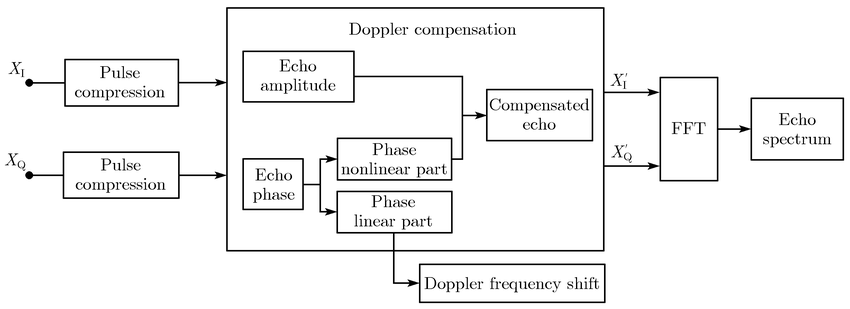
Example of a coventional Doppler compensation scheme.
Breaking Down the Image’s Concept:
First, we need to have a simple understanding of Doppler compensation. Shuzu et al. make a sophisticated breakdown of this concept as:
>> The Doppler compensation method is used to decompose the echo into amplitude and phase, and then compose the new compensated echo by the amplitude and the nonlinear component of the phase. Furthermore, the linear component of the phase can be used to estimate the Doppler frequency shift.
This block diagram illustrates a classical method designed to deal with the severe degradation caused by the Doppler shift in phase-coded pulse compression signals (often used in radar and specialized communications).
- Pulse Compression: The incoming signal (X_I and X_Q) first passes through pulse compression. A strong Doppler shift causes a mismatch here, resulting in a loss of the main signal and a rise in noisy sidelobes (the energy that should be focused, but is scattered).
2. Decomposition: The Doppler compensation block then separates the mangled echo into two components:
- Amplitude: How strong the echo is.
- Phase: The timing and shift of the wave — this is where the Doppler effect is primarily encoded.
3. Extraction: The key step is mathematically separating the phase into two parts:
- Phase Linear Part: This part is directly proportional to the constant rate of frequency drift caused by the target’s (or satellite’s) velocity. This linear component is extracted and used to calculate the Doppler frequency shift and, therefore, the velocity.
- Phase Nonlinear Part: This is the residual phase distortion, which contains the Doppler frequency spread (the chaotic part) and other random noise.
4. Recomposition: A Compensated Echo (X’_I and X’_Q) is then generated by combining the original Amplitude with only the Phase Nonlinear Part. By removing the linear Doppler component, the new echo is effectively “tuned” back to a state of zero Doppler frequency shift.
5. Final Analysis: This compensated signal is fed into a Fast Fourier Transform (FFT) to produce a clean Echo Spectrum that no longer suffers from the original Doppler mismatch.
In short, this scheme meticulously isolates the predictable linear phase shift (the tempo change) to calculate the speed, and then uses that knowledge to cancel the tempo change from the signal itself, restoring the clean melody.
Modern systems rely on sophisticated signal processing tricks:
- Pilot-Aided Estimation: Reference tones (pilot signals) are embedded into the data stream, acting as known tempo markers. The receiver measures how much these markers have shifted and adjusts all surrounding data accordingly.
- Adaptive Equalizers: These devices don’t just clear up echoes (as discussed in Level 3); they can also stretch or squeeze the incoming waveform to maintain rhythm, combating the Doppler-induced time variation.
- Phase-Locked Loops (PLLs): These are circuits that continuously generate a local signal and compare its phase (timing) to the incoming signal, instantly re-aligning the system like a DJ matching beats.
But as systems move faster (satellites, high-altitude platforms, even high-speed trains), these classical tricks start hitting their limits.
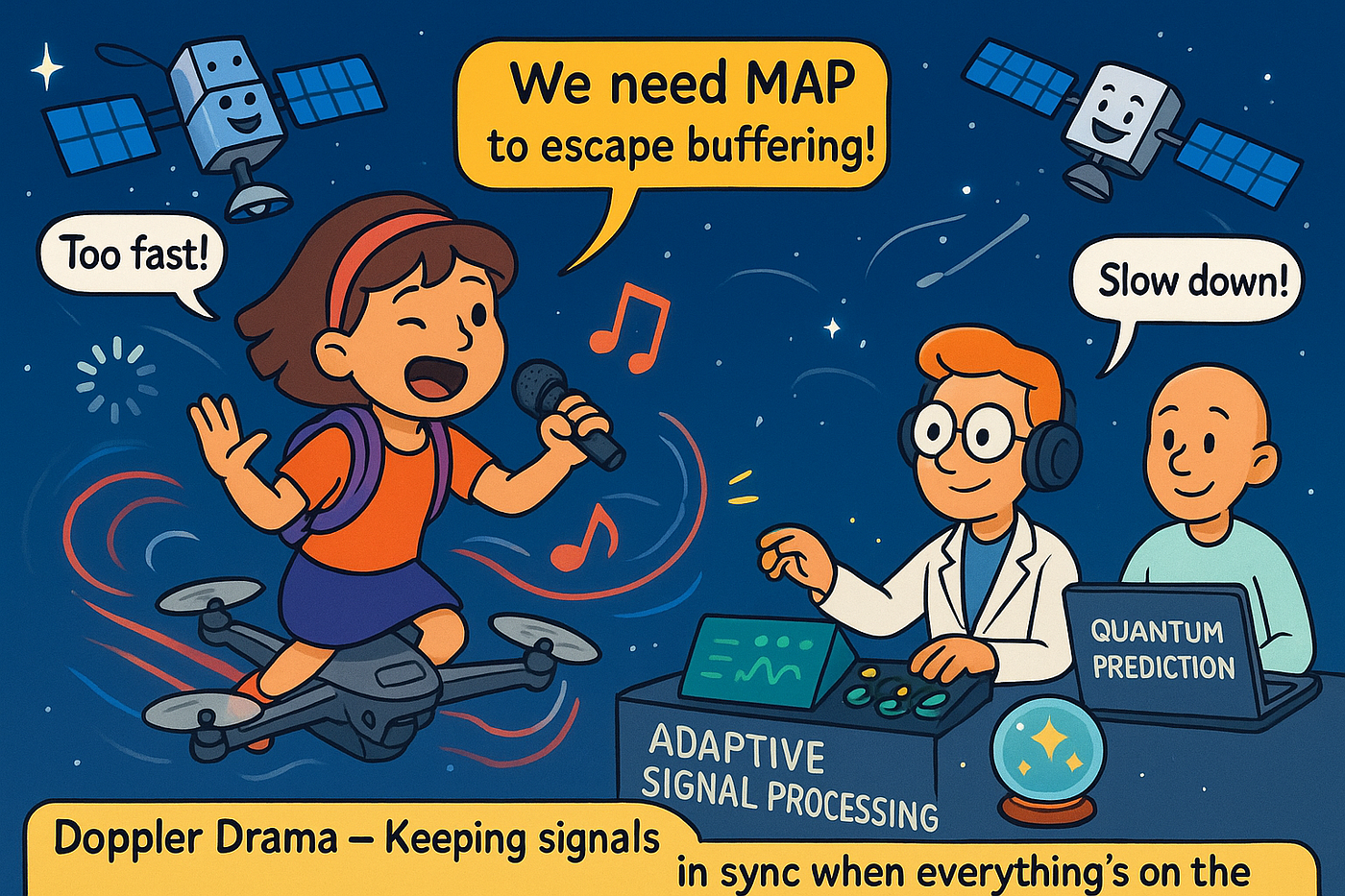
Keeping signals in sync when everything’s on the run. The image playfully combines the topics of The Wireless Game series: the need for MAP to share the channel (Level 1) and the necessity of Adaptive Signal Processing (Level 4) and Quantum Prediction (Future) to combat high-speed Doppler drift.
Enter Quantum Prediction
This is where the next leap in research, quantum-aided signal prediction, becomes necessary.
Traditional synchronization is a reactive or short-term predictive process. But by representing the wireless channel as a probability amplitude rather than a fixed state, quantum circuits can explore every possible Doppler shift and channel variation simultaneously — much like predicting every way your karaoke music could go off-beat, all at once.
This quantum computational advantage allows future receivers to “see ahead” in time, updating their synchronization and tuning parameters before the next channel drift even happens. It promises a proactive, adaptive solution to channel aging and high-mobility synchronization.
The Next Level
In our previous discussion (Level 3: The Signal-Shaping Crew), we learned how precoding and beamforming physically shape the signal before it leaves the antenna. But even the most perfectly shaped signal won’t land correctly if the “receiver’s rhythm” falls apart.
Level 4: Doppler Drama is about keeping that “rhythm” alive, no matter how fast the stage is moving. So next time you stream a video from a satellite, think of it as cosmic karaoke. The network’s job? Keep every note in sync, even when the stage itself is racing through space.
Disclaimer: All animated images in this article were created with GPTs Animation Creation
메타데이터
- post_id
- fcaf950d0f7d
- slug
- doppler-drama-is-your-signal-on-the-run-fcaf950d0f7d
- url
- https://medium.com/the-wireless-game/doppler-drama-is-your-signal-on-the-run-fcaf950d0f7d
- canonical_url
- https://medium.com/the-wireless-game/doppler-drama-is-your-signal-on-the-run-fcaf950d0f7d
- author_url
- https://medium.com/@elizac364
- status
- ok
- fetched_at
- 2026-06-14 11:28:49


