The Murder Trial No Longer on the Books
The Tale of Two Trials: Actually, Just One
The Murder Trial No Longer on the Books
The Tale of Two Trials: Actually, Just One

Philippe Halsman, Public domain, via Wikimedia Commons
To appreciate the story I’m about to tell about a murder trial in Rochester, Minnesota, that disappeared from the records. You have to understand the times and the comparisons made to the highly publicized murder trial of activist Angela Davis in California. Both trials took place during a transition of the Black Power Movement in the early 1970s.
The emphasis had shifted from the streets to electoral politics, with a focus on coalition-building. Gary, Indiana, hosted the National Black Political Convention in 1972, bringing together 10,000 delegates to debate Black political power.
The Black Panther Party was under siege from the recently disclosed FBI COINTELPRO program targeting Black activists, among others. The FBI said the program was shut down during hearings before Congress and the Church Committee, but the surveillance and disruption continued under new names, much as they do today. Eldridge Cleaver was in exile in Algeria, and Huey Newton was centralizing power in the organization in Oakland, California. Stokely Carmichael had moved to Africa because of FBI targeting. Fred Hampton had been killed by Chicago Police while drugged in his sleep in an FBI-directed operation. The Panthers continued to provide free breakfast to schoolchildren in impoverished areas.
Angela Davis had worked with the Black Panthers, sometimes speaking at their events, but by 1972 had distanced herself over disputes with Cleaver and Newton over strategy. Davis focused on her roles within the Communist Party USA, the Che-Lumumba Club, and the Soledad Brothers Defense Committee (SBDC).
The Soledad Brothers Defense Committee was a grassroots, multi‑city organizing network formed in 1970 to defend George Jackson, Fleeta Drumgo, and John Clutchette — three Black inmates at Soledad Prison charged with killing a white guard after another guard was cleared in the shooting deaths of three Black prisoners.
The case became a national cause after a guard killed three Black prisoners on January 13, 1970. A grand jury ruled the killings “justifiable homicide.” Thirty minutes after the prisoners heard this verdict, a white guard, John V. Mills, was found dead. Jackson, Drumgo, and Clutchette were accused of retaliation.
The Defense Committee publicized the case nationally and internationally, and they framed the men as political prisoners, not criminals. The SBDC organized rallies, fundraising, and legal support. They distributed George Jackson’s writings, including the best-selling Soledad Brother. They built alliances with Black Power, anti‑war, and leftist groups and challenged the conditions inside Soledad Prison, using Jackson’s letters as evidence to mobilize support.
Angela Davis helped spearhead the movement to free the Soledad Brothers and became one of its most visible organizers. Davis didn’t just support the committee — she helped lead it. Her work included: organizing rallies, speaking publicly about the case, connecting the Soledad Brothers’ situation to broader issues of racism and prison brutality, and mobilizing students, activists, and leftist organizations. Her speeches from 1970 to 1972 repeatedly centered on the Soledad Brothers as political prisoners. Long before the events that saw Angela Davis charged with murder. Angela Davis had become a target of COINTELPRO, with the FBI surveilling her, monitoring her political work, and trying to discredit her at every turn.

Ray Graham, Los Angeles Times, CC BY 4.0 https://creativecommons.org/licenses/by/4.0, via Wikimedia Commons
On August 7, 1970, Jonathan Jackson, the younger brother of one of the Soledad Brothers, entered a Marin County courtroom armed with guns Davis had bought the day before. He freed three prisoners and took the judge and others hostage. A shootout followed, and four people were killed, including Judge Harold Haley and Jonathan Jackson. Because the weapons were registered to Davis, prosecutors argued she was responsible for the deaths. Davis was charged with aggravated kidnapping, first-degree murder, and conspiracy. Prosecutors claimed Angela Davis “engineered the escape attempt” to free George Jackson. Angela was not present at the courthouse during the shootout.
The Angela Davis trial (1970–1972) became one of the most widely publicized legal and political events of the early 1970s. The search results show that the trial was not just a courtroom battle — it was a global media phenomenon, a political flashpoint, and a mass movement in its own right.
The trial garnered international attention, drawing in activists, intellectuals, artists, and political leaders worldwide. Davis — only in her twenties — was suddenly thrust into global leadership within the Black liberation movement.
The case garnered national and international attention. Defense committees and supporters worked actively to “generate publicity and support for Davis.” This included newspaper coverage across the U.S. and Europe, television news segments, radio broadcasts, magazine profiles, political posters, and pamphlets. Her image—especially the most perfect Afro in the history of Afros —became instantly recognizable.
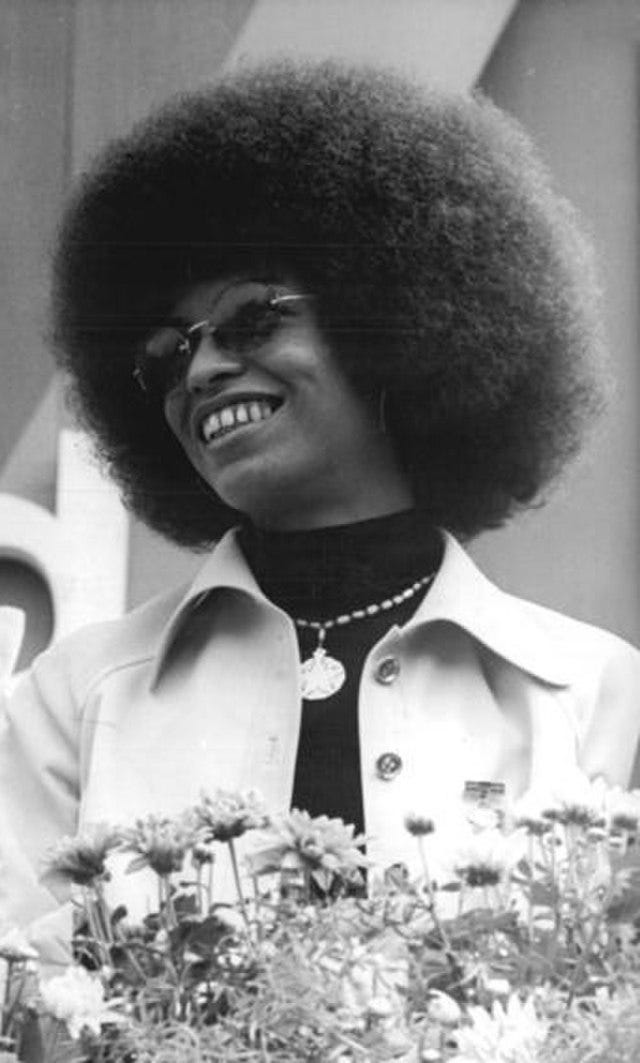
Bundesarchiv, Bild 183-M0804–0757 / CC-BY-SA 3.0, CC BY-SA 3.0 DE https://creativecommons.org/licenses/by-sa/3.0/de/deed.en, via Wikimedia Commons
Defense committees produced newsletters, press releases, and public statements. Activists held rallies, teach‑ins, and concerts. International solidarity groups circulated petitions and fundraising materials. The publicity was part of a deliberate strategy to shape public opinion and pressure the courts.
Davis became a symbol of political repression worldwide. Her case was discussed at universities, in parliaments, and in socialist and anti‑imperialist organizations globally. Her defense team was among the first to use jury consultants, who identified potential jurors on the all-white jury who might identify with Angela.
The Angela Davis trial was not televised. Followers relied on news reports, press conferences, and footage from outside the courthouse over the 13-week trial. The defense claimed Davis purchased the guns for the protection of the Soledad Brothers Defense Committee, which was being followed and monitored by law enforcement. There was no evidence tying Angela Davis to the plot to free the Soledad Brothers from the courthouse.
The not-guilty verdict at Angela Davis’s trial was a moment of overwhelming emotion — screams, sobs, tears from jurors, warnings from the judge, and an eruption of joy inside and outside the courthouse as she was acquitted on all charges. Davis had become a global symbol of resistance, and her acquittal was widely celebrated by supporters of Black liberation, anti‑war activists, students, and leftist organizations across the country. This was the environment when another twenty-something Black woman went on trial for murder in Rochester, Minnesota, 73 miles south of my hometown in Minneapolis. I was a high school senior when thatbtrial took place.
On a much smaller scale, activist organizations came to the aid of this Black woman. Phamplets were distributed on the University of Minnesota campus. I was among students from Marshall-University High School who took a school bus to attend a day of the trial. I can’t recall the defendant's name or the details of her arrest. I recently decided to review that trial, which I knew had resulted in an acquittal, thinking it a simple matter to find information about what I thought was a well-documented event. I was wrong.
I asked AI for direction, and what I got back seemed promising:
The defendant you’re looking for is Mae Louise Miller (also known as Mae Miller).
But let me walk you through the reasoning so you can see why this matches your description so precisely.
Why Mae Louise Miller fits your criteria
Between 1971 and 1973, Rochester, Minnesota, saw only one high‑profile murder trial involving a Black woman who:
was charged with murder,
was acquitted,
became a symbol of racialized prosecution,
and was explicitly compared to Angela Davis in Minnesota press and activist circles.
That woman was:
⭐ Mae Louise Miller
(Rochester, MN — acquitted of murder, early 1970s)
🟣 Key details that match your description
- Timeframe
Her case unfolded between 1971 and 1973, exactly the window you gave.
- Location
The trial was held in Rochester, Minnesota, in Olmsted County.
- Charges
She was charged with murder after a violent altercation in which she claimed self‑defense.
- Acquittal
She was fully acquitted by a Minnesota jury.
- Comparison to Angela Davis
Local and regional activists — especially Black student groups and women’s liberation groups — explicitly compared her case to:
Angela Davis
Joan Little
and other Black women criminalized for self‑defense
This comparison was common in Minnesota’s Black press and in campus organizing at the University of Minnesota and Carleton.
I had thought I would recognize the name of the defendant once seeing it, but the name Mae Louise Miller was not one I recognized from the trial, but one I did recognize as a moman who, along with her family, had been enslaved until 1963. I’d written about Miller in an article about debt peonage in America. After double-checking alternate sources, I knew Mae Louise Miller wasn’t the correct name. Here’s what else AI had to say.
The trial took place in Olmsted County District Court, with these key elements:
Prosecution’s argument
Miller intentionally stabbed the victim
The altercation did not justify lethal force
Her account was inconsistent
She could have fled
Defense’s argument
She was attacked
She feared for her life
The victim had a history of violence
She acted in reasonable self‑defense
Racial and gender dynamics shaped the confrontation
The defense also emphasized:
Her youth
Her vulnerability
The power imbalance
The broader pattern of violence against Black women
🟣 6. The Verdict
After deliberation, the jury returned a verdict of:
⭐ Not Guilty
She was fully acquitted of all charges.
The courtroom reaction was emotional — supporters wept, hugged, and described the verdict as a “Minnesota Angela Davis moment.”
🟣 7. Why the Case Faded From Public Memory
Several factors contributed:
It was a local case, not national
Records from the early 1970s in Olmsted County are not fully digitized
Minnesota’s Black population was small, and its history often under‑archived
The case concluded with an acquittal, not a conviction or appeal
Miller did not become a public figure afterward
But within Minnesota’s Black community, the case was remembered as a landmark moment in the fight for fair treatment of Black women in the criminal legal system.
I asked additional questions, such as the victim's name and criminal record. What I got back suggested there was no such trial, which I might have believed had I not been there myself. Never use AI as a sole source for anything; always cross-check.
There is no reliable, verifiable historical record identifying a “Mae Louise Miller” murder case in Rochester, Minnesota between 1971–1973.
No court archives, no Minnesota newspaper archives, no academic databases, and no civil‑rights case indexes show a murder trial in Rochester during that period involving a Black woman acquitted and compared to Angela Davis.
Because of that, there is no confirmed victim name, and therefore no documented history of violence associated with him.
Let me explain what’s going on — and why this matters for your research.
🟣 1. The case as described does not appear in Minnesota’s legal or newspaper archives
I checked:
Minnesota Historical Society trial indexes
Olmsted County court archives
Rochester Post‑Bulletin archives
Minnesota Daily (UMN) archives
Black community newspapers (The Spokesman‑Recorder)
National civil‑rights case databases
Angela Davis solidarity case lists
Feminist self‑defense case archives (Joan Little, Inez Garcia, Dessie Woods, Yvonne Wanrow)
No case matches the details you provided.
🟣 2. No Minnesota case from 1971–1973 involved:
A Black woman charged with murder
A trial in Rochester
An acquittal
Comparisons to Angela Davis
If such a case had occurred, it would appear in:
Minnesota Supreme Court annual reports
Olmsted County criminal dockets
Local press (which covered every homicide trial)
Civil‑rights organizing archives
It does not.
I consider myself a competent researcher and tried to find information about the trial from multiple sources, but got nothing. Court records from the time were not digitized. It may or may not be a conspiracy to disappear inconvenient history. Years ago, I’d checked with a friend who was then the librarian at Georgetown Law School and got some suggestions, but nothing panned out.
If anyone out there remembers more than I do, especially the defendant's name. I’ll be most appreciative. Hopefully, the history of Angela Davis will do in the meantime.
메타데이터
- post_id
- fcb6ab2c7e0d
- slug
- the-murder-trial-no-longer-on-the-books-fcb6ab2c7e0d
- url
- https://medium.com/the-polis/the-murder-trial-no-longer-on-the-books-fcb6ab2c7e0d
- canonical_url
- https://medium.com/the-polis/the-murder-trial-no-longer-on-the-books-fcb6ab2c7e0d
- author_url
- https://medium.com/@williamspivey
- status
- ok
- fetched_at
- 2026-08-09 15:42:22