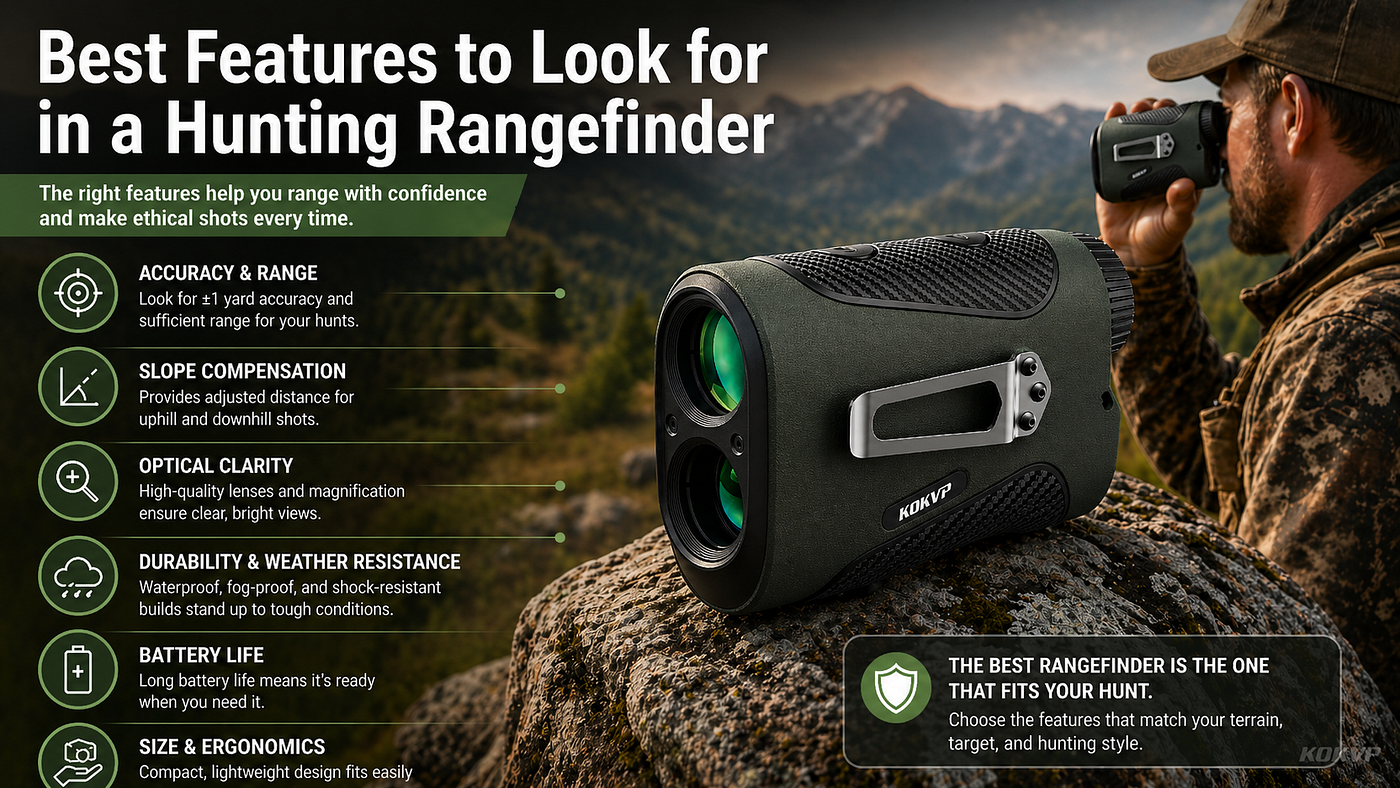
Best Features to Look for in a Hunting Rangefinder
A hunting rangefinder is easy to underestimate until you actually need one.
Best Features to Look for in a Hunting Rangefinder
A hunting rangefinder is easy to underestimate until you actually need one.
On paper, it’s just a small optic that gives you distance. In the field, it can be the difference between guessing, second-guessing, and making a calmer decision with a real number in front of you.
But not every rangefinder is built for the same kind of hunting.
Some are fine for open fields. Some are better in timber. Some work well for bowhunting from a tree stand. Others are made with longer rifle shots in mind. The trick is not finding the most expensive model or the one with the biggest number on the box.
The trick is knowing which features actually matter once you’re outside.
Reliable ranging on real targets
The first thing most people look at is maximum range.
That makes sense, but it’s also where a lot of confusion starts.
A rangefinder may advertise 1,000 yards, 1,500 yards, or even more. But those numbers are often based on highly reflective targets under clean conditions. A deer standing in shadow, a dark tree trunk, or a target partly blocked by grass is a very different situation.
For hunting, reliable ranging on real-world targets matters more than the longest possible reading.
You want a rangefinder that can give steady numbers on animals, trees, rocks, and uneven ground. If it only performs well on bright reflective objects, it may look good in a spec sheet but feel frustrating in the woods.
A good hunting rangefinder should not make you range the same object five times just to trust the number.
Angle compensation
If you hunt from a tree stand, hillside, ridge, canyon, or mountain slope, angle compensation is worth having.
When you range a target uphill or downhill, the straight-line distance is not always the distance your shot behaves like. The angle changes the practical distance, especially for bowhunters.
That’s why many hunting rangefinders offer angle-compensated distance. Instead of only giving line-of-sight range, they also provide a more useful number for the shot.
You don’t need to be doing math in your head while an animal is moving.
The rangefinder should handle that part quietly.
For flat ground hunting, this feature may not feel critical. But if your hunting setup includes elevation changes, it becomes one of those features you miss the second you don’t have it.
A display you can read in low light
This one sounds boring, but it matters a lot.
Many hunting moments happen early in the morning or near last light. That’s exactly when some rangefinder displays become hard to read.
Black LCD numbers can disappear against dark timber. A display that looks clear in a store may be tough to see against a shaded background. On the other hand, a display that is too bright can be distracting in low light.
The best setup is a display that is easy to read quickly without pulling your attention away from the situation.
You should be able to range, see the number, and move on.
If you have to stare through the optic and squint at the display, it’s not helping as much as it should.
Fast response time
Speed matters, but not because hunting should feel rushed.
It matters because animals don’t always stand still while you sort out your gear.
A rangefinder that takes too long to lock onto a target can be annoying. One that gives inconsistent readings can be worse. You end up ranging again, shifting your position, checking the number, then wondering if you ranged the animal, the grass, or the tree behind it.
A good rangefinder gives you a clean reading quickly.
That doesn’t mean you should take careless shots. It just means the tool should not slow down your decision-making when the moment is already moving fast.
Target priority modes
Brush, grass, rain, snow, and branches can all confuse a rangefinder.
Sometimes the laser picks up the closest branch. Sometimes it hits the background behind the animal. Sometimes it gives a number that makes no sense at all.
Target priority modes help with this.
Some rangefinders have modes that prioritize the closest target. Others can help range through light cover or pick up distant targets behind foreground clutter. Scan mode can also be useful when you’re following movement or checking several points in one area.
Not every hunter needs every mode.
But it helps to understand how your rangefinder decides what it is measuring. If you hunt in clean open ground, this may be less important. If you hunt in timber, brush, or broken terrain, it can matter a lot.
Good optical clarity
A rangefinder is not a binocular, but you still have to look through it.
Clear glass makes the whole process easier. You can find the target faster, hold on it better, and read the scene with less eye strain.
Cheap, cloudy optics can make ranging feel slower, especially in low light. Poor clarity also makes it harder to place the reticle exactly where you want it.
You don’t need luxury glass for every hunting situation. But the image should be sharp enough that you’re not fighting the optic.
If you can’t clearly see what you’re ranging, the number becomes less trustworthy.
Practical magnification
More magnification sounds better until you try to hold it steady.
Higher magnification can help in open country where targets are farther away. But it also makes hand movement more obvious. If you’re standing, breathing hard, wearing gloves, or ranging quickly, too much magnification can feel shaky.
For many hunters, moderate magnification is easier to use.
It gives enough detail without making the image jump around. That matters especially in timber, from tree stands, or in closer hunting situations.
A rangefinder should be quick and steady in the hand. It doesn’t need to replace your spotting scope.
Weather resistance
Hunting gear gets wet. It gets cold. It gets dusty. It gets bumped around in packs and rubbed against other gear.
A hunting rangefinder should be built for that.
Water resistance is important if you hunt in rain, snow, or damp woods. A solid housing matters if your gear gets used hard. Buttons should still work when your hands are cold or gloved. The battery compartment should feel secure, not flimsy.
This is one of those features people don’t think about enough before buying.
Then the weather turns bad, and suddenly it matters more than the max range number.
Easy one-hand operation
A rangefinder that works well at home can feel clumsy in the field.
You may need to pull it from a harness quietly. You may be holding a bow. You may be seated in a stand. You may be wearing gloves. You may not have time to adjust your grip three times before pressing the button.
That’s why handling matters.
The button layout should be simple. The body should be easy to grip. The size should work with your hand and gear setup. You should be able to range without making a lot of unnecessary movement.
Small details matter more when you’re trying to stay quiet.
Battery life and battery type
Nobody wants to think about batteries until the rangefinder dies at the worst time.
Before buying, check what battery the unit uses. Is it easy to find? Is it simple to replace? Does the rangefinder handle cold weather well? Can you carry a spare without thinking about it?
A spare battery weighs almost nothing, but it can save a hunt.
Also, learn how to change it before the season. Trying to figure it out with cold fingers in the dark is the kind of mistake you only want to make once.
Size and weight
A compact rangefinder is easier to carry, but smaller is not always better.
Very small units can be harder to hold steady. Larger units may feel better in the hand but take up more room in a pack or bino harness.
The right size depends on how you hunt.
If you hike long distances, weight matters. If you hunt from a stand, stability and ease of handling may matter more. If you already carry binoculars, calls, wind checker, range cards, and other gear, you’ll want something that fits cleanly into your system.
A rangefinder should be easy to bring along every time. If it’s annoying to carry, it may get left behind.
A simple menu system
Some rangefinders have a lot of modes, settings, and options.
That can be useful. It can also be annoying.
In hunting situations, simple usually wins. You should know how to switch modes, adjust brightness, activate scan mode, and read the display without digging through a confusing menu.
A feature only helps if you can use it quickly.
Before relying on a rangefinder in the field, spend time with it. Learn what the icons mean. Learn how it behaves in different modes. Learn how to reset it if you accidentally change something.
That little bit of practice can prevent a lot of frustration later.
Value, not just price
There’s nothing wrong with buying a budget rangefinder.
A basic model may be enough if you hunt shorter distances in simple terrain. But the cheapest option is not always the best value.
If the display is hard to read, the readings are slow, the body feels fragile, or the unit struggles in low light, you may end up replacing it sooner than expected.
On the other side, not everyone needs a top-dollar rangefinder with features they’ll never touch.
The better question is: what do you actually need for your hunting style?
That’s where looking at practical outdoor optics brands, including kokvp, can make sense. Not because a brand name alone should decide the purchase, but because hunters are usually better served by comparing real field usability instead of chasing the biggest spec sheet.
The features that matter most depend on your hunt
A bowhunter in thick woods may care most about angle compensation, close-range accuracy, and a readable display.
A rifle hunter in open country may care more about longer-range consistency, scan mode, and steady magnification.
A hunter in wet, cold conditions may care more about build quality and battery reliability.
A hunter who moves a lot may care more about size, weight, and one-hand use.
There is no single perfect rangefinder for every person.
The right one is the one that matches your terrain, your distances, your weather, and the way you actually hunt.
메타데이터
- post_id
- fcba923767fb
- slug
- best-features-to-look-for-in-a-hunting-rangefinder-fcba923767fb
- url
- https://medium.com/@poxiaoxi2/best-features-to-look-for-in-a-hunting-rangefinder-fcba923767fb
- canonical_url
- https://medium.com/@poxiaoxi2/best-features-to-look-for-in-a-hunting-rangefinder-fcba923767fb
- author_url
- https://medium.com/@poxiaoxi2
- status
- ok
- fetched_at
- 2026-06-09 15:37:30