The Simple Tangible Truth About Your Emotions
A Ground-Level Introduction to the Core Emotion Framework
The Simple Tangible Truth About Your Emotions
A Ground-Level Introduction to the Core Emotion Framework
I’ve spent years researching how emotions actually work — not how we think they work, but how they operate. What Jamel discoveres is both simple and profound: your emotions aren’t mysterious forces that happen to you. They’re a system. A structured, predictable, and trainable system.
Let me explain.
The Problem: We’re Lost Inside Ourselves
Most people experience their emotions like weather — something that happens to them, something they’re at the mercy of. You wake up “feeling off” and spend the whole day trying to figure out why. You get stuck in loops of anxiety, re-playing conversations, second-guessing decisions.
Traditional therapy often tries to help by exploring the story behind your feelings. “Why do you think you feel this way?” “What happened in your childhood?” “What does this remind you of?”
This approach — what I call “going around the bush” — can be helpful. But it’s also slow, and it often misses the point. Because your emotional suffering isn’t just a story. It’s a structural failure in how your internal operating system is configured.
The Insight: Emotions Are Operators, Not Feelings
Here’s the key insight that changed everything for me:
Emotions are not things you have. They’re things you do.
Every emotion is actually a functional operation — a specific transformation your system performs on incoming information. These operations are:
- Discrete (they’re distinct from each other)
- Irreducible (you can’t break them down into simpler components)
- Universal (every human has access to all of them)
I’ve identified exactly ten of these operations — no more, no less. Think of them like CPU instructions for your emotional processor.
The 10 Operations (And Where They Live)
Your emotional system is organized around three centers, each containing specific operations:
Head Center (Cognitive Focus)
Sensing — Raw perception. The intake of information before you judge or interpret it. This is the “aha, there’s something here” moment. It lives in the eyes and forehead, a subtle widening of attention.
Calculating — Analysis and evaluation. You compare, assess, and think through possibilities. This is your internal spreadsheet, felt as a narrowing behind the eyes and forward forehead tension.
Deciding — Commitment. The moment you choose a path. When this is offline, you’re trapped in analysis paralysis. It feels like a settling in the center of your forehead.
Heart Center (Relational Flow)
Expanding — Openness and connection. This is warmth, empathy, and receptivity. You feel it as a widening in your chest, a softening around your heart.
Constricting — Boundaries and protection. This is the “power of No,” the ability to filter and focus. It shows up as chest tightening, a protective posture.
Achieving — Quality and completion. This is aligning effort with an inner standard — not external success, but internal fulfillment. Feel it as a lift in your sternum, coordinated readiness.
Gut Center (Action & Meaning)
Arranging — Organization and structure. Sequencing, ordering, preparing. You feel it as engagement in your lower abdomen, grounded hips.
Appreciating — Recognizing value. Receiving goodness, feeling satisfaction. It settles as warmth in your lower belly.
Boosting — Energy and momentum. The drive to keep going when things get hard. It feels like heat rising from your core, forward energy.
Accepting — The system’s reset button. Yielding, releasing, allowing things to be as they are. This isn’t resignation — it’s completion. You feel it as a full-body release, settling downward.
The Simple Tangible Truth
Here’s what makes this framework different from everything else I’ve studied:
You can learn to identify exactly which operation you’re running.
Not just “I’m anxious,” but “I’m caught in a loop where Sensing is feeding Calculating, and Deciding is offline.”
You can learn to modulate these operations.
Just like you can turn up or down the volume on a speaker, you can intensify or quiet each of these operations on a scale of 0 to 10.
You can learn to “detangle” them.
When two operations get stuck together — like Sensing and Constricting fusing into hypervigilance — you can separate them. Restore their independence. Regain your freedom.
A Concrete Example: The Overthinking Loop
Let me show you how this works in practice.
You know that feeling when your mind just won’t shut up? When you’ve been “thinking about something” for hours and you’re no closer to a resolution than when you started?
Here’s what’s happening:
- Sensing is active — you’re noticing everything. Every variable, every potential threat, every possible outcome.
- Calculating is also active — you’re running scenarios, comparing options, assessing risks.
- Sensing and Calculating have fused. You can’t activate one without triggering the other. Every time you notice something, you immediately start calculating. Every time you calculate, you notice more things to worry about.
- Deciding is offline. You can’t commit to a path because that would mean stopping the analysis.
- The Heart and Gut are bypassed. Your chest is tight, your stomach is in knots, and you can’t organize your way out of the loop.
The solution isn’t to “think less.” It’s to interrupt the loop:
- Activate Constricting — Set a boundary on how many possibilities you’ll consider. “I’m not running 19 scenarios today. I’m choosing between two.”
- Activate Arranging — Shift from abstract thought to concrete action. “What are the next two physical steps I can take?”
- Activate Accepting — Surrender the need for perfect information. “I’m doing the best I can with what I have.”
- Activate Deciding — Commit. “This is sufficient. I’m choosing.”
The Somatic Anchor: Where It Lives In Your Body
This isn’t abstract philosophy. Each operation has a specific physical signature you can learn to recognize.
Sensing shows up as a widening behind your eyes, lightness in your forehead. Calculating feels like a narrowing behind the eyes, forward tension in your forehead. Deciding settles in the center of your forehead with a release in your jaw.
Expanding opens your chest with warmth and relaxed breathing. Constricting tightens your chest, draws your shoulders into a protective posture. Achieving lifts your sternum with coordinated, poised readiness.
Arranging engages your lower abdomen and grounds your hips. Appreciating warms your lower belly with a deep, settling breath. Boosting sends heat through your core with forward-driving energy. Accepting releases through your whole body, settling you downward.
You can use these physical cues as a dashboard. When you feel chest tightness, you know Constricting is active. When you feel forehead tension, Calculating is running. The body tells you what the system is doing, if you know how to read it.
Why This Changes Everything
Most approaches to emotional health are stuck in the narrative layer. They try to change the story without addressing the mechanics.
This is like trying to fix a malfunctioning engine by debating the driver’s motivations.
The Core Emotion Framework treats emotions as what they actually are: a functional architecture. A system that can be understood, tuned, and optimized.
You don’t need to “fix” yourself. You need to learn how your system works.
Where To Start
Step 1: Notice the physical signatures. Pay attention to where you feel things. Is it in your forehead? Your chest? Your belly?
Step 2: Name the operation. Instead of “I’m anxious,” try “I’m caught in a loop of Sensing and Constricting.”
Step 3: Modulate. If an operation is too loud (8 out of 10), try quieting it. If it’s too quiet (2 out of 10), try amplifying it.
Step 4: Detangle. If two operations are stuck together, try isolating them. Activate one without the other.
The Bottom Line
Your emotions aren’t mysterious. They’re not arbitrary. They’re not signs of brokenness.
They’re a functional system — the most sophisticated operating system ever created.
And like any system, they can be learned, navigated, and optimized.
This article introduces the Core Emotion Framework (CEF), a structural-constructivist model of human affective architecture. For the full technical specifications, research validation, and practitioner protocols, visit cefmethod.com. The CEF is an open-science project; all materials are available for independent research and replication.
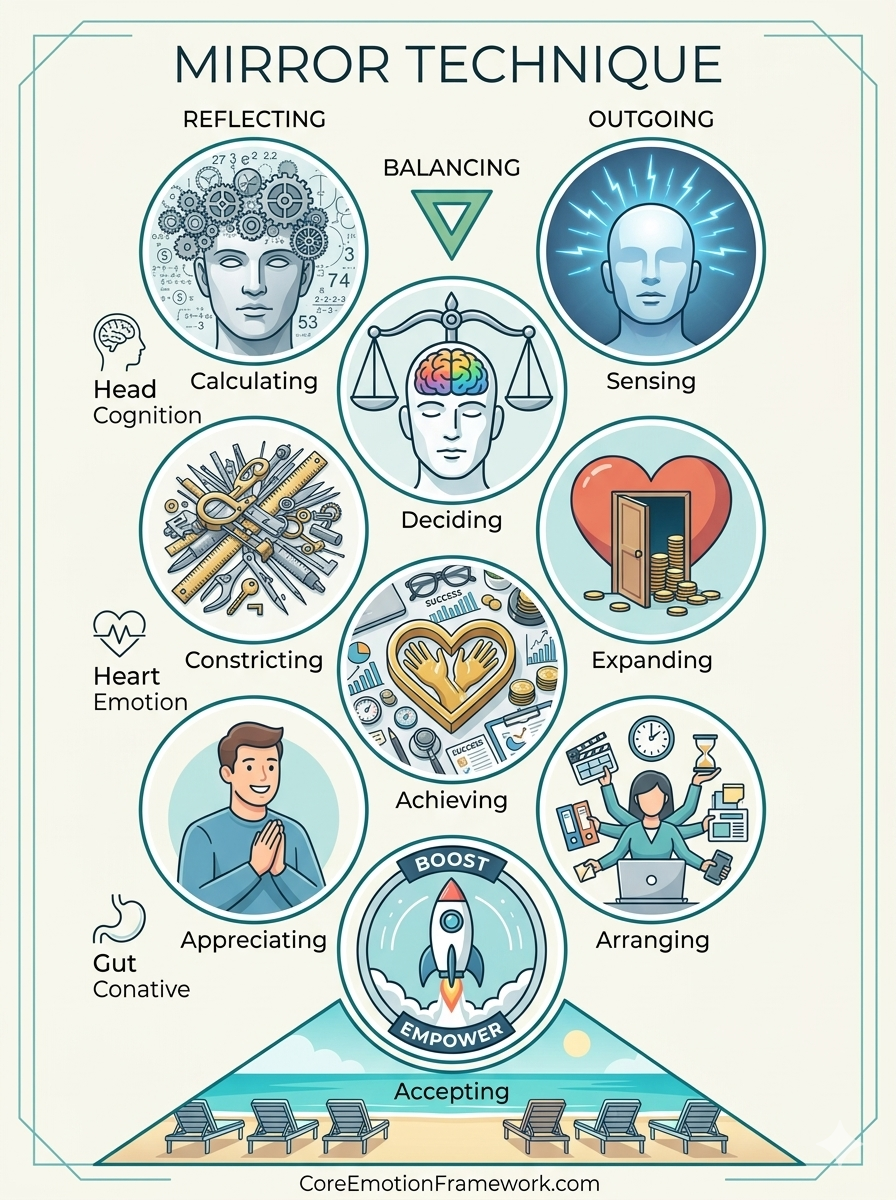
3 x 3 +1
메타데이터
- post_id
- fcc40bdee28a
- slug
- the-simple-tangible-truth-about-your-emotions-fcc40bdee28a
- url
- https://medium.com/@chelkeihanefesh/the-simple-tangible-truth-about-your-emotions-fcc40bdee28a
- canonical_url
- https://medium.com/@chelkeihanefesh/the-simple-tangible-truth-about-your-emotions-fcc40bdee28a
- author_url
- https://medium.com/@chelkeihanefesh
- status
- ok
- fetched_at
- 2026-07-13 17:48:35