Beyond Low-Cost Sourcing: Building Integrated Global Manufacturing & Supply Chain Strategies That…
Global manufacturing has become more accessible than ever, but it has also become significantly more complex. Finding a supplier is no…
Beyond Low-Cost Sourcing: Building Integrated Global Manufacturing & Supply Chain Strategies That Scale

Global manufacturing has become more accessible than ever, but it has also become significantly more complex. Finding a supplier is no longer the defining challenge. Maintaining consistent quality across multiple production runs, managing volatile input costs, coordinating international logistics, protecting intellectual property, and aligning procurement decisions with long-term commercial objectives now determine whether a sourcing strategy creates sustainable competitive advantage.
Many organizations initially approach procurement as a purchasing function focused on negotiating lower prices. Mature businesses, however, increasingly recognize procurement as an operational capability that influences profitability, cash flow, inventory performance, product quality, customer experience, and business resilience simultaneously.
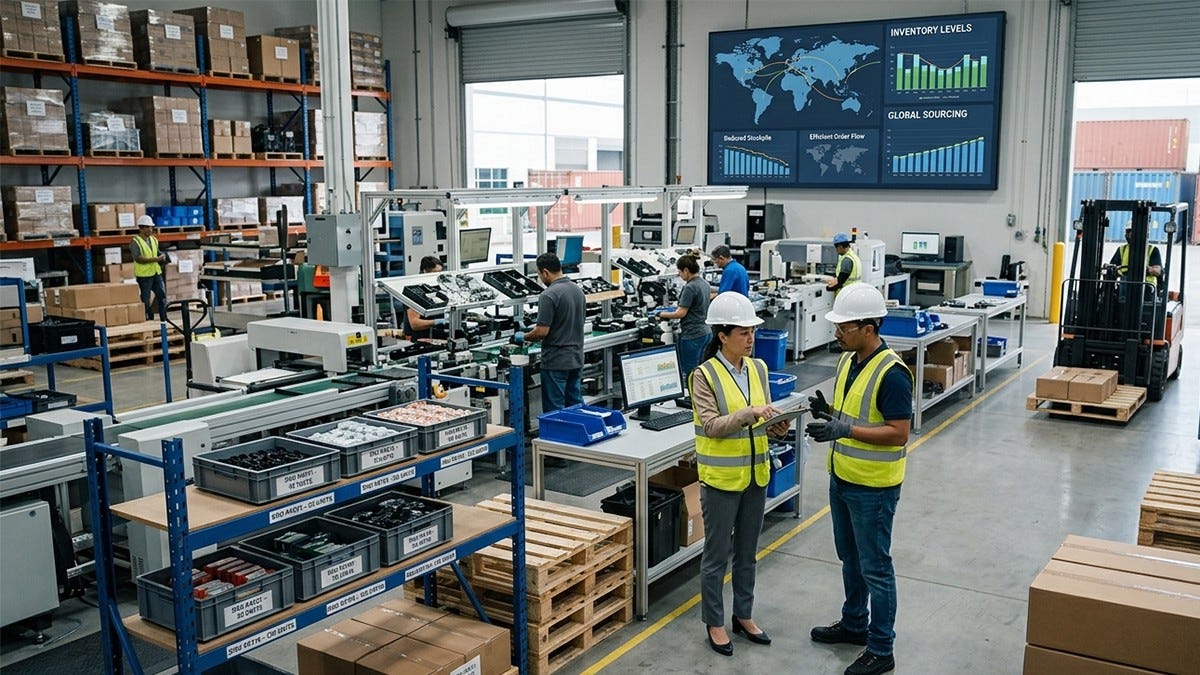
As international supply networks continue to diversify, companies are shifting away from transactional purchasing toward integrated manufacturing ecosystems where engineering, supplier management, production planning, quality assurance, logistics, and commercial forecasting operate as interconnected functions rather than isolated activities.
Why Modern Procurement Has Become a Cross-Functional Business Discipline
Manufacturing decisions rarely exist in isolation. A material substitution proposed by engineering may affect tooling costs. A procurement decision based solely on unit price can increase warranty claims if quality consistency deteriorates. Choosing a factory with shorter lead times may reduce inventory carrying costs enough to outweigh a slightly higher purchase price.
These interactions explain why leading procurement organizations increasingly evaluate sourcing decisions using total operational impact rather than individual cost components.
Several structural trends are driving this evolution:
- Greater supply chain fragmentation across regions
- Rising regulatory and compliance requirements
- Increased customization through OEM and ODM manufacturing
- Shorter product life cycles
- Growth of cross-border e-commerce
- Higher expectations for production flexibility
The consequence is straightforward: sourcing decisions increasingly resemble systems engineering rather than traditional purchasing.
The Hidden Cost Structure Behind Manufacturing Decisions
Product cost is often discussed as factory price, but this represents only one component of total landed cost.
A lower quotation may conceal additional expenses arising from production inefficiencies, delayed shipments, inconsistent quality, or fragmented supplier coordination.
The table below illustrates how procurement professionals typically expand cost evaluation beyond purchase price.
Looking Beyond Factory Price
Procurement professionals increasingly evaluate multiple cost dimensions rather than focusing solely on the quoted factory price. Each element contributes differently to the overall economics and operational performance of a product.
Unit Manufacturing Cost Primary consideration: Factory quotation Business impact: Directly influences gross margin but should be evaluated alongside other cost factors.
Tooling & Development Primary consideration: Mold investment and engineering revisions Business impact: Determines product lifecycle economics and affects long-term production efficiency.
Quality Management Primary consideration: Inspection processes, rework, and defect rates Business impact: Impacts customer satisfaction, warranty costs, and brand reputation.
Logistics Primary consideration: Freight, customs, and warehousing Business impact: Affects working capital requirements and delivery performance.
Inventory Primary consideration: Safety stock requirements and inventory planning Business impact: Influences cash flow, storage costs, and supply flexibility.
Supplier Reliability Primary consideration: Production stability and delivery consistency Business impact: Reduces supply disruptions and strengthens business continuity.
Compliance Primary consideration: Certifications, testing, and documentation Business impact: Supports market access, regulatory compliance, and risk mitigation.
Organizations that optimize these cost categories collectively often outperform competitors that negotiate only for lower unit prices.
This explains why comprehensive procurement solutions increasingly integrate engineering analysis, supplier qualification, logistics planning, and production management into one coordinated operating model.
OEM and ODM Manufacturing Are Strategic Choices, Not Simply Production Models
The distinction between OEM and ODM manufacturing is frequently simplified, yet the commercial implications extend well beyond product ownership.
OEM projects generally provide greater design control while requiring higher engineering investment and longer development timelines.
ODM approaches typically accelerate market entry by leveraging existing manufacturing capabilities but may reduce product differentiation.
The appropriate model depends less on company size than on strategic objectives.
OEM vs. ODM at a Glance
OEM is generally the better choice when your priorities include:
- Maximum product differentiation
- Proprietary engineering
- Long-term brand exclusivity
ODM is generally the better choice when your priorities include:
- Faster market entry
- Lower development investment
- Rapid product portfolio expansion
Procurement leaders therefore evaluate manufacturing models according to product strategy, expected sales volume, engineering resources, and lifecycle planning rather than treating one option as universally superior.
Supplier Selection Has Become Risk Management
Supplier evaluation has evolved far beyond price comparison.
A qualified supplier today represents a combination of manufacturing capability, financial stability, process discipline, communication effectiveness, compliance readiness, and production scalability.
In global sourcing environments, supplier performance influences operational resilience as much as production capacity.
Consider a common sourcing scenario.
Scenario: Two Factories, Different Business Outcomes
A consumer electronics importer receives quotations from two manufacturers.
Factory A
- 8% lower unit cost
- Limited engineering support
- Minimal production documentation
- Longer quality resolution cycles
Factory B
- Slightly higher pricing
- Dedicated engineering team
- Documented quality management
- Capacity expansion capability
- Established export experience
Although Factory A appears financially attractive during quotation analysis, Factory B often delivers lower total operational cost after considering:
- Reduced production delays
- Fewer quality incidents
- Faster engineering changes
- Lower logistics disruption
- Improved production forecasting
- Better inventory planning
This illustrates an important procurement principle: supplier capability frequently produces greater long-term financial value than initial purchase price.
Integrated Manufacturing Networks Reduce Operational Friction
Many businesses manage sourcing through multiple independent vendors responsible for engineering, tooling, production, packaging, inspection, freight forwarding, and customs coordination.
While specialization has advantages, fragmented management frequently creates communication gaps.
Engineering modifications may not reach packaging suppliers.
Production schedules may become disconnected from shipping reservations.
Quality documentation may be incomplete during customs clearance.
Integrated manufacturing ecosystems attempt to reduce these coordination costs by aligning operational workflows across the product lifecycle.
Rather than viewing manufacturing as sequential activities, integrated systems treat product development as a continuous process where information flows between technical, commercial, and logistical stakeholders.
This operational alignment becomes increasingly valuable for businesses managing multiple SKUs across international markets.
Digital Supply Chain Visibility Is Becoming a Competitive Requirement
Supply chain digitization is often associated with automation, but its greater value lies in decision quality.
Accurate operational data enables organizations to forecast procurement demand, monitor supplier performance, evaluate production efficiency, and identify emerging risks before disruptions occur.
Typical digital capabilities include:
- Supplier performance monitoring
- Purchase order tracking
- Production milestone visibility
- Inventory synchronization
- Logistics status integration
- ERP connectivity
- Demand forecasting
- Quality reporting
Collectively, these functions transform manufacturing from reactive execution into measurable operational management.
As production networks expand internationally, digital visibility increasingly determines how effectively organizations balance cost, responsiveness, and inventory investment.
Procurement Strategy Depends on Business Model
Not every company should pursue identical sourcing strategies.
Business objectives determine which procurement priorities create the greatest commercial value.
Enterprise Procurement
Large organizations generally prioritize:
- Production continuity
- Compliance consistency
- Supplier redundancy
- Contract stability
- Long-term capacity planning
Predictability often outweighs incremental cost savings.
Retailers and Distributors
Margin management typically becomes the dominant objective.
Key priorities include:
- Factory-direct purchasing
- Stable replenishment
- Packaging consistency
- Inventory optimization
- Volume-based purchasing strategies
E-Commerce Businesses
Marketplace sellers frequently emphasize operational flexibility.
Critical requirements include:
- Lower minimum order quantities
- Faster replenishment
- Packaging readiness
- Fulfillment coordination
- Multi-channel inventory management
Because demand fluctuates more rapidly in online commerce, procurement strategies often prioritize responsiveness over production scale.
Scaling Production Requires More Than Manufacturing Capacity
Businesses commonly associate production scaling with larger factories.
In reality, scalable manufacturing depends on synchronized capability across multiple operational functions:
- Engineering documentation
- Tool maintenance
- Raw material procurement
- Capacity planning
- Workforce management
- Quality assurance
- Supplier coordination
- International logistics
Weakness in any single component can become the primary constraint.
For example, doubling production volume without expanding quality inspection capacity frequently increases defect rates, even if manufacturing output technically rises.
Scalability therefore reflects system coordination rather than factory size alone.
Market Intelligence Has Become a Procurement Asset
Procurement increasingly relies on external market information instead of historical purchasing data alone.
Commodity prices, freight rates, labor availability, currency fluctuations, geopolitical developments, and regional manufacturing policies all influence sourcing economics.
Organizations that continuously monitor these variables can:
- Diversify sourcing before disruptions occur
- Renegotiate contracts using market evidence
- Improve inventory timing
- Protect gross margins
- Reduce supply uncertainty
This shift explains why sourcing solutions increasingly combine operational execution with analytical capabilities rather than functioning solely as purchasing services.
Within broader discussions of integrated supply chain solutions, market intelligence serves as the bridge between operational execution and strategic procurement planning rather than as a standalone forecasting exercise.
The Future of Global Manufacturing Is Integration Rather Than Intermediation
Global manufacturing continues to expand, but competitive advantage increasingly depends on coordination rather than access.
Factories remain essential, yet engineering collaboration, supplier governance, digital visibility, logistics integration, compliance management, and procurement analytics now contribute equally to commercial performance.
Businesses that approach sourcing as an interconnected operating system are generally better positioned to manage uncertainty while protecting margins and maintaining production continuity.
As manufacturing ecosystems become more distributed across regions and suppliers, procurement will continue evolving from a transactional purchasing function into a strategic capability that aligns product development, operational execution, and long-term business growth.
메타데이터
- post_id
- fcf780d7bd29
- slug
- beyond-low-cost-sourcing-building-integrated-global-manufacturing-supply-chain-strategies-that-fcf780d7bd29
- url
- https://medium.com/@widq/beyond-low-cost-sourcing-building-integrated-global-manufacturing-supply-chain-strategies-that-fcf780d7bd29
- canonical_url
- https://medium.com/@widq/beyond-low-cost-sourcing-building-integrated-global-manufacturing-supply-chain-strategies-that-fcf780d7bd29
- author_url
- https://medium.com/@widq
- status
- ok
- fetched_at
- 2026-08-06 06:10:54