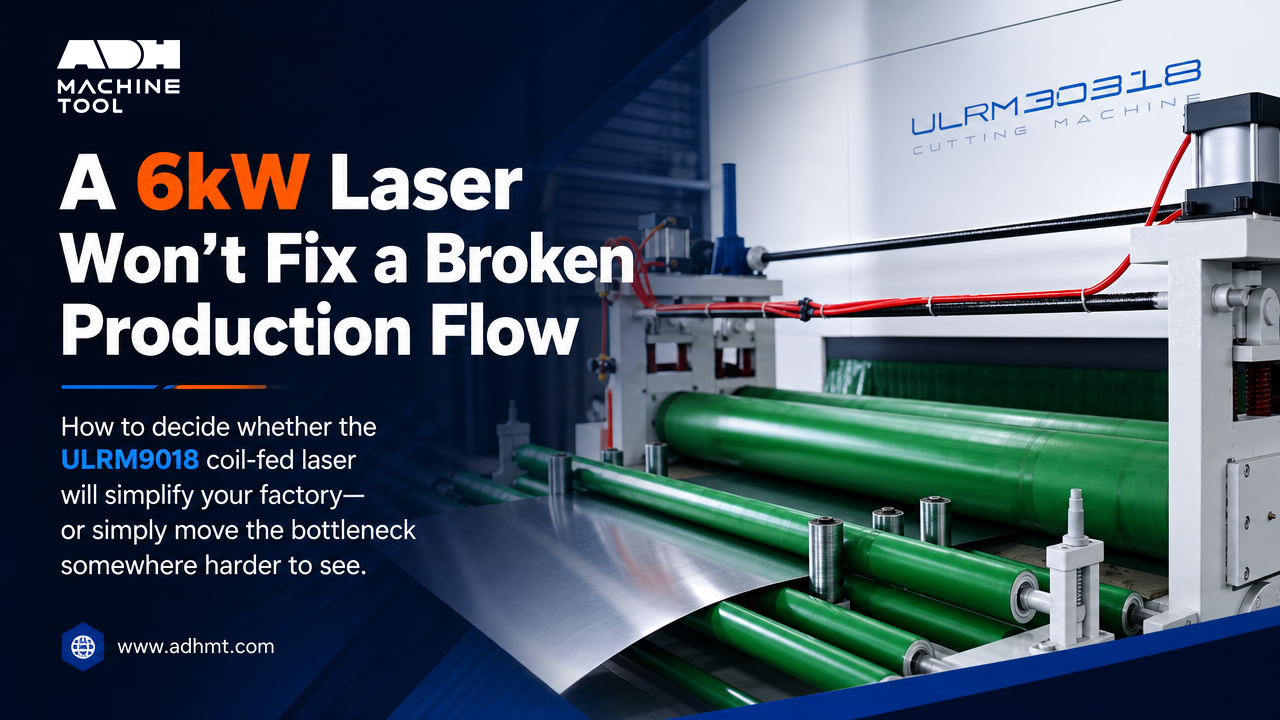
ULG14532 20kW Laser Cutting Machine: Why Rail Stability Beats Raw Wattage in Heavy Plate Production
A 20 kW fiber laser attached to a gantry suggests power and speed. Yet across a fourteen‑meter bed, the numbers fail to describe production…
ULG14532 20kW Laser Cutting Machine: Why Rail Stability Beats Raw Wattage in Heavy Plate Production
A 20 kW fiber laser attached to a gantry suggests power and speed. Yet across a fourteen‑meter bed, the numbers fail to describe production reality. The ULG14532, built for extreme heavy‑plate work, proves that mechanical stability — not wattage — governs yield and precision. Its performance redefines expectations around beam quality and mechanical reliability, showing that raw power alone cannot substitute for structural integrity across industrial scale lengths.
When Power Stops Describing Performance
Buyers assume beam wattage dictates throughput. At short scale that holds true: rigid platforms cut cleanly. At fourteen meters, accumulated structural error degrades focus and erases added watts. Power density only matters if the beam lands where programming expects; flex or shake dilutes intensity and produces dross.
On compact beds, offsets stay within auto‑correction; once length triples, deflection magnifies. The same 20 kW, through a longer bridge, loses stability. Industrially this means slower cutting, not from lack of power but collapsing motion precision. Minute instability echoes through the kerf — producing visible texture that no optical upgrade can cure.
Laser class defines optical ability; stiffness determines whether that ability reaches the workpiece at full density. Maintaining geometric constancy ensures real precision instead of nominal wattage.
Overhead Gantries Beyond Ten Meters: Physics Taking Over

Overhead Gantries
Suspended bridges carrying heavy heads act like beams under moving loads. Deflection grows with the cube of span length. Tenths of a millimeter at ten meters become millimeters at fourteen, exceeding accuracy limits. Servo algorithms model sag but struggle under live motion.
Dynamic harmonics align with carriage frequencies, amplifying vibration. The result: chronic striation. Manufacturers throttle acceleration; the “slow” spec is a stability ceiling.
Hence identical laser output can deliver half traverse rate. The beam stays constant; stiffness limits motion energy. Manufacturers who chase speed without redesign enter a plateau where precision loss outpaces wattage gain, confirming that physics — not specification — sets maximum feasible velocity.
The Ground Rail Idea: Decoupling Force and Accuracy
Railway engineering isolates geometry from load. ULG14532 applies that logic. Motion loads pass into earth through dual hardened rails anchored in concrete, ensuring heavy plates stay precisely aligned even under dynamic acceleration. For operations seeking this level of structural stability, the Ground Rail Laser Cutting Machine from ADH Machine Tool extends the same decoupled‑force design into production scale, giving manufacturers predictable precision and endurance on high‑power CNC platforms.
Carriages ride directly on rails; the cross‑beam guides only width, free of long‑span stress. Vertical anchoring preserves precision lost in overhead bridges.
Plate‑support and motion base separate. Vibrations from material or piercing fail to reach servos. Sensors read commanded movement alone. Feedback confusion disappears before correction starts, ensuring authentic signal fidelity inside the control loop rather than continuous self‑compensation.
Independent structures drift with time or temperature; periodic calibration resets geometry. Neglect causes growing positional drift and scrap. Ground rail mitigates some of this naturally, extending maintenance intervals and preserving repeatability even after years of continuous service.
Sustained Acceleration and Micrometric Tolerance
The 1.2 g acceleration looks low yet shows structural honesty. Hundreds of kilograms moving at that rate challenge any frame. On ground rails energy flows into foundation, holding ±0.03 mm repeat‑accuracy. Overloads degrade quietly; small losses accumulate into measurable deviation.
True productivity is not linear with acceleration. Staying within design bandwidth keeps consistency; chasing speed beyond stiffness yields faster cycles but more scrap.
The 30‑meter 30032D illustrates this: twice the mass yet same accuracy because inertia disperses into foundation. Rail stability rises with anchoring, not with laser power. Additional damping hardware extends usable acceleration range slightly and prevents resonant buildup during long contour paths.
Beam Focus Across Length: Managing Thermal Effects

Beam Focus
Optical quality stays constant, yet mechanical height shifts with temperature. Steel rails expand roughly 0.16 mm per °C per 15 m. Differential heating between rails causes yaw: the head moves in a curve instead of a line.
Preventing this requires integrated climate control, ventilation balance, and expansion joints at anchors. Vendors note accuracy but omit environment dependence. Thermal gradients alter straightness more than servo error.
Ground rail removes sag yet demands environmental discipline. Active conditioning systems monitor humidity and room temperature, compensating via real‑time offsets that keep precision reliable for multishift operation.
Stress Testing on Thick Carbon Steel
Cutting sixty‑millimeter carbon steel exposes mechanical truth. Any drift appears in striation and dross.
During piercing, spatter clouds optics — tiny shifts exceed tolerance. Water‑cooled heads stay symmetric; air‑cooled distort. Active cooling governs pattern as much as servo logic. Repeat testing shows the cooling circuit influences finish consistency almost as strongly as mechanical alignment.
Beyond sixty‑five millimeters, melt viscosity rises and vibration scars the surface. Rail temperature yaw converts minor error into finish decay. At eighty millimeters, deviations trigger incomplete cuts and rough faces. Stability turns from luxury to necessity, as each incremental imperfection amplifies during deep penetration and post‑cut grinding.
Production Heat and Correction Bandwidth
Multi‑hour runs bring ambient warming, plate bow, and external vibration. Each uses separate correction budgets yet interacts beyond sensor scope. When both loops work near limits, stray vibration adds invisible error.
Operators observe finish degrading along the bed: clean near anchors, rough at far end. Drives read “in spec” because each axis holds its own tolerance; composite distortion escapes monitoring.
These are integration failures. Facility harmony must match mechanical design; otherwise precision remains theory. In many audits, minor ventilation imbalance or ground resonance explained large discrepancy, confirming that full‑system calibration under real workload is essential before production guarantees apply.
Infrastructure Realities Hidden Behind Specifications

ADH ground rail laser cutting machine
Foundations and Vibration
Standard 150 mm slabs resonate at 8–18 Hz, inside servo bandwidth. Controllers detect vibration as error and over‑correct.
The remedy copies rail beds: isolated 300 mm slab with thick sub‑base. Achieving under 25 µm displacement costs six‑figure construction. Skipping it adds invisible drift when nearby presses run. A clean encoder cannot fix moving concrete. Durable foundation integrity becomes part of machine accuracy, not optional civil work.
Extraction Requirements
Open‑rail machines lack full enclosure. Oxygen‑assist cutting forms fine oxide dust settling over encoders, causing random jitter.
Proper mitigation uses zoned downdraft and traveling overhead extraction. Eight controlled zones keep fume within 300 mm. Without it, lens cleaning quadruples and weekly downtime grows. Reliable extraction preserves uptime and optics. Extra airflow also regulates temperature balance across rails, indirectly supporting geometric stability.
Handling and Material Flow
A fourteen‑meter, fifty‑millimeter plate weighs eight tonnes. Lifting, aligning, and squaring take half an hour; cutting fifteen minutes. Without automation, utilization sits near 25 %.
Efficiency relies on synchronized cranes or conveyors feeding plates continuously. Capital for these equals foundation expense. Throughput based on speed alone misleads; logistical delay erases wattage gain. Ancillary automation often determines overall profitability far more than laser upgrade pathways.
Financial Translation: Where ROI Lives or Dies
Returns from power alone ignore integration cost. Profits stem from reduced grinding and scrap, not speed. Heavy‑plate operations save hundreds of labor hours yearly, which offset infrastructure only under high volume.
Site readiness adds $300–$500 k beyond price. Labor savings alone take years to recover. Scrap reduction, however, pays instantly: dropping rejection from 5 % to 0.5 % rescues weeks of material and delivery time. Continuous production unlocks benefit; occasional jobs do not.
Economics depend on repetitive, high‑tonnage work, not variable projects. Break‑even analysis favoring 14‑meter spans assumes workflow saturation above 80 %. Below that, depreciation overshadows operational relief, reaffirming that machine choice ties directly to sustained utilization.
Who Should — and Shouldn’t — Buy One
Small shops with short runs face drawbacks: long setup, low use, and thermal‑sensitive drift. Recovery means re‑leveling and recalibration across fourteen meters — days offline.
Factories upgrading from ten‑meter gantries hit a design threshold demanding new infrastructure. The shift is architectural, not dimensional. Without it, extra power turns liability. Understanding this avoids expensive misallocation by distinguishing process capacity from optical strength.
Ground rail fits large carbon‑steel batches and punishes general‑purpose users. Production must meet weekly tonnage and length standards before payoff appears.
Where Enclosed Gantries Still Win
Not all benefit from rail design. Enclosed gantries stay rigid under ten meters, reach multi‑g acceleration, and need little environmental control. For thin or mixed materials, they cut faster. Stainless below twenty‑millimeters favors enclosed setups; ground‑rail isolation adds nothing.
If parts stay under ten meters, conventional frames excel. Rail architecture matters only once deflection passes correction limits. Compact gantries continue to dominate small fabrication markets due to minimal infrastructure cost and flexible job switching — making context the ultimate deciding factor.
The 50‑10‑30 Rule: A Practical Decision Framework
ULG14532 pays back under a clear matrix — processing > 50 tons of carbon steel weekly, plate length > 10 m, batches ≥ 30 identical pieces. Below those numbers, overhead consumes advantage.
Meet them, and results transform: minimal scrap, reliable precision, predictable yield. Miss any, and invested stability sits idle. Quantifiable rules simplify planning and align investment with throughput expectations, bridging engineering data to financial outcome.
Across every equation — deflection physics, rail expansion, and handling logic — the core message holds. Heavy‑plate laser output depends on rail‑based stability, not beam rating. ULG14532 proves optical power is commodity; positional fidelity built on ground anchoring decides yield, quality, and financial survival.
메타데이터
- post_id
- fcfb5edc070c
- slug
- ulg14532-20kw-laser-cutting-machine-why-rail-stability-beats-raw-wattage-in-heavy-plate-production-fcfb5edc070c
- url
- https://medium.com/@adhmachinetools/ulg14532-20kw-laser-cutting-machine-why-rail-stability-beats-raw-wattage-in-heavy-plate-production-fcfb5edc070c
- canonical_url
- https://medium.com/@adhmachinetools/ulg14532-20kw-laser-cutting-machine-why-rail-stability-beats-raw-wattage-in-heavy-plate-production-fcfb5edc070c
- author_url
- https://medium.com/@adhmachinetools
- status
- ok
- fetched_at
- 2026-06-09 15:37:30