Web3 Returning Control to Users
A quiet shift from “using the internet” to “owning a part of it”
Web3 Returning Control to Users
A quiet shift from “using the internet” to “owning a part of it”
That night, as my eyes moved across the screen, everything slowed down briefly. A thought slipped in between posts
What truly holds the reins of every move I make at this moment?
Pictures I took. Messages sitting in my inbox. Information stored under my name.
Mine? Not quite. They sit close, though like memories worn thin.
It starts there, where that idea takes root, quietly growing into what people now call Web3.
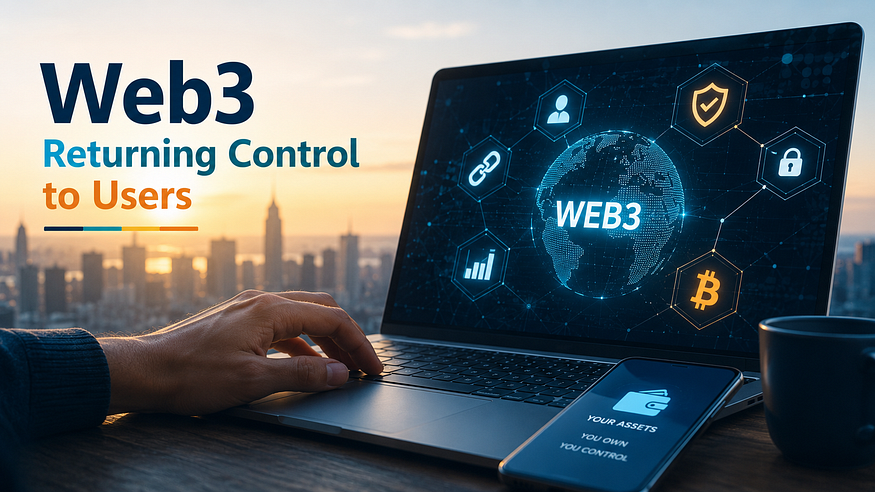
Image is Generated by AI
The Internet We Know and Its Limits
Most people see the web as straightforward. Open an app here, share something there. Tap a button to pay, then walk away. Life moves without thinking twice.
Hidden away, the current web, known as Web2, is run by big central systems. Your information lives on their servers because they hold every key. What appears in front of you comes through filters they set without asking. Control flows where they allow it to go.
Web3 challenges this structure.
A fresh thought shows up here instead
What if users, not companies, controlled the internet?
Ownership shifts toward people when the web runs on blockchains. Control returns where it belongs through decentralised design. Privacy becomes built-in, not an afterthought. This version of the internet puts users first by default.
How Web3 Stands Apart?
What lies underneath Web3 isn’t a single tool. Instead, think of it as pieces fitting each part connecting through shared rules
- Blockchain networks
- Cryptocurrencies
- Smart contracts
- Decentralised applications (dApps)
Without these setups, someone else would usually step in. Instead, they cut out extra players by themselves.
Peer-to-peer exchanges sit at the core of Web3, cutting out corporate middlemen. Direct swaps happen openly, sometimes running themselves without oversight. Automation blends into clear interactions between users. Trust shifts from institutions to coded rules visible to everyone involved.
It’s not just about technology.
Power moves when people start deciding differently.
From “Read & Write” to “Read, Write & Own”
The internet has evolved in phases:
- Back then, just reading stuff online was possible, no changes allowed. Pages stayed put, like digital paper pinned to a wall
- On Web2, reading plus sharing became possible through platforms people actually used. Interacting online shifted how information moved around back then. Pages allowed comments while apps opened up new ways to engage daily. That era let users add content instead of just viewing it silently
- Ownership comes with using the web now. Access lets you explore pages. Writing appears when you add content. Control shifts your way through digital property
What sets it apart is who holds control.
Your stuff, identity, possessions, and what you do online stick with you in Web3, not some company’s server. That shift feels like taking back control, so people name it digital sovereignty
Money moves without banks using open digital networks
Money matters show up clearly in Web3. What you see often ties back to how value moves through this space.
Decentralised Finance (DeFi) allows people to lend, borrow, trade, and earn without traditional banks.
There’s no paperwork.
No approval delays.
No central authority.
Just code.
When conditions are met, smart contracts process deals without people stepping in. These rules run themselves once set up correctly. Less involvement means fewer mistakes creep in along the way.
Across the world, many lack basic bank services. This change means entry, not just progress.
The Promise of Freedom, Privacy, and Transparency
For web3 fans, a shift could fix what’s broken online now
- Your data belongs to you because control stays in your hands once it’s yours
- Privacy → Less dependence on centralised storage
- What stops censorship? Nobody holds the keys. Control spreads out, so no one boss decides what stays or goes. Power shifts quietly. Rules bend when no central hand pulls strings
- Across the planet, internet users gain entry without barriers. Participation opens up through connected devices anywhere. Location matters less when networks bridge gaps. Digital pathways welcome involvement from all corners. Online presence becomes a gateway by itself
The idea is simple:
An internet that works for users, not just platforms.
The Reality Check: Not Everything Is Perfect
Yet things look different from another angle.
Change keeps shaping Web3; it’s growing, yet bumping into real hurdles along the way
- Transactions crawl when demand spikes. Costs climb alongside usage. Performance dips as networks swell. Speed falters under pressure. Expenses rise with growth. Systems strain at higher loads
- Regulatory uncertainty
- Security risks in poorly built systems
- Complexity for everyday users
Some specialists note how much of Web3 remains unfinished, more trial than finish. Not everything works smoothly yet, parts still feel like testing grounds.
People are starting to argue more about it
Could Web3 really be free from central power, or does it quietly move authority around? Still puts trust in different hands.
A Human Perspective That Matters
Most folks find Web3 hard to grasp right away. Still, it puzzles many who come across it.
Yet deep down, it’s really about one thing people keep wondering:
Someone has to wonder whose hands really hold the online spaces we walk through each morning? Not companies, maybe. Perhaps it belongs more to the people who shape it hour by hour.
Some people won’t touch crypto wallets at all.
Some folks might not get blockchain right away.
Most people get what it means to own something, keep things private, or act fairly.
And that’s why Web3 matters.
Future Not Yet Finished
Still, Web3 isn’t complete yet.
Scientists still aren’t sure about it.
For sure, it falls short of being flawless.
Yet it points somewhere that opens up an option.
An internet where you are not just a user,
but a participant…
Perhaps a proprietor too.
One way or another, that dream might take shape. Or it could stay nothing more than a thought
relies less on tools than you might think
yet shaped by the decisions each person makes.
메타데이터
- post_id
- fcfc591b8402
- slug
- web3-returning-control-to-users-fcfc591b8402
- url
- https://medium.com/@fynlytics59/web3-returning-control-to-users-fcfc591b8402
- canonical_url
- https://medium.com/@fynlytics59/web3-returning-control-to-users-fcfc591b8402
- author_url
- https://medium.com/@fynlytics59
- status
- ok
- fetched_at
- 2026-07-09 20:10:33