Two Container Ships Can Fix a Country
Two container ships and a few solid crews — and the island stops living in permanent workaround mode.
Two Container Ships Can Fix a Country
Two container ships and a few solid crews — and the island stops living in permanent workaround mode.
I like small countries because everything there carries weight. In large states, a problem can be pushed into language: discussed, described, turned into procedures, spread across committees. And then you step outside and feel that it was all just sound. On a small island, sound ends quickly, because life is held together by things. Electricity. Roads. Water. A roof. You can’t talk your way around that.
I have a reflex I can’t switch off. When I see a microstate, I arrange it in my head like a model. I look for one node on which everything else depends. The thing that keeps daily life in line. And the thing whose failure unravels the entire day.
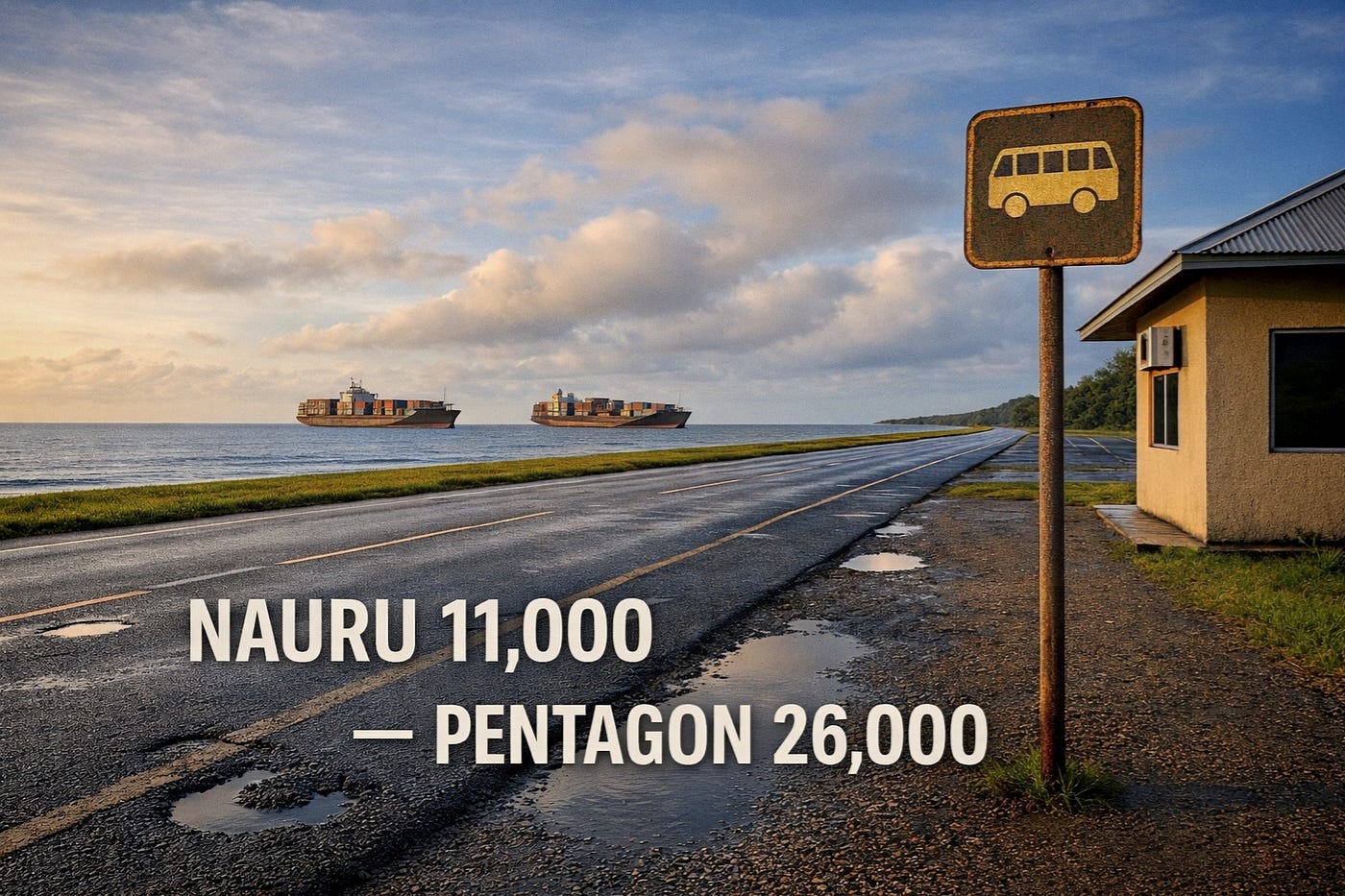
About eleven thousand people live on Nauru. In a single Pentagon building, more than twice that number work. That’s it. That’s the measure of scale.
Nauru has no comfortable buffers. There is no “for now,” no “somewhere else.” Everything is central, because the entire place is central. A malfunction immediately becomes a national issue. Temporary fixes quickly stop being temporary. The worst moment comes when people stop being surprised. When they start living in workaround mode. And over time, those workarounds become the norm.
The island is the way it is for a simple reason: for decades it lived off phosphate. It was easy money while it lasted. And when it ended, the costs remained, along with the land left behind by extraction. The exploitation was so intense that most of the interior was degraded and taken out of normal use. The center of the island ceased to be a space on which the country’s life could comfortably rest. The state is squeezed into a narrow coastal belt, where everything has to fit: homes, roads, networks, the airport, people.
On top of that comes dependence on external streams of money. This helps close the budget and keep day-to-day operations going, but it does not change the structure of the problem. Infrastructure remains fragile, and fixed costs stay exactly where they are.
Nauru rests on a few things that from a distance look insignificant. The runway, the ring road, basic networks. For the world, that’s little. For the island, it’s the spine. A weak runway makes everything more expensive. A damaged road consumes time in a way that never fades into the background. Power outages tear the rhythm out of the day and turn normal life into a series of interruptions.
Then a thought appears that calms me because it is concrete: this has the size of a task. It can be closed. It can be done in sequence. It can be delivered. Two container ships stop being an image and start being a unit of measure.
The first ship lays the foundation: the airport and the road. This is not about prestige, but about getting time back. And time on an island has real value: when it disappears, it disappears for everyone at once; when it returns, it returns for everyone at once. Rehabilitating an airport at this scale means tens of millions of dollars. Roads, drainage, connections, and basic networks also cost “island prices,” meaning more than on the mainland, because every component has to arrive by sea, and equipment and service have to make sense locally.
On top of that come housing built quickly and consistently, to a standard that does not require constant improvisation. Tightness, durability, simple operation. A home should provide stability, not add problems. Prefabricated solutions, including CLT, make sense here as a method: repeatability, quality control, shorter assembly. At real island costs, this means several thousand dollars per square meter, ready to live in. If this is meant to change the scale, you have to think in terms of several thousand units. Then the housing budget becomes measurable: tens of millions of dollars, not symbolic sums.
The second ship closes the whole process so that modernization does not end at the starting line. Networks, drainage, lighting, connections. Stable power with energy storage. Electricity cannot depend on generators or on whether fuel arrives. A package like this at this scale is also counted in tens of millions. And the thing that decides everything: maintenance. On-site service. Workshops, warehouses, parts, people. Without this, even the best investments drift back over time into a state of “it somehow works.”
Large states today have a problem that has almost become the norm: everything drags on. Endless stages, endless programs, endless excuses for why results still aren’t visible. A small island offers a rare luxury: the work can be finished. The spine can be built, the rest closed, maintenance left in place that actually works. The subject can be closed.
If you count it honestly, without pretending that logistics and maintenance are free, modernizing Nauru’s “spine” comes in at several hundred million dollars. In a restrained version, around two hundred million. In a more ambitious one, closer to three to four hundred. That’s a lot for an island. It’s not a number from outer space.
Two container ships. A few good teams. Efficient logistics. And then a daily life that stops falling apart. A small-scale state does not have to impress. It only has to work.
메타데이터
- post_id
- fcff0804f62a
- slug
- two-container-ships-can-fix-a-country-fcff0804f62a
- url
- https://medium.com/@jaceksumislawski/two-container-ships-can-fix-a-country-fcff0804f62a
- canonical_url
- https://medium.com/@jaceksumislawski/two-container-ships-can-fix-a-country-fcff0804f62a
- author_url
- https://medium.com/@jaceksumislawski
- status
- ok
- fetched_at
- 2026-06-26 12:24:55