Why Science Suddenly Feels Faster Than Ever
AI, Humanoid Labs, and the Rise of Exploration Systems
Why Science Suddenly Feels Faster Than Ever
AI, Humanoid Labs, and the Rise of Exploration Systems
For centuries, science was a history of discovery.
Observe what no one had seen before. Name it. Explain it. Record it for the next generation.
Scientific progress moved at the speed of human life. One generation asked the question. The next one finished the answer.
That structure is now breaking.
According to the original manuscript, the change is not incremental — it is structural. Science is no longer accumulating slowly. It is reorganizing itself around exploration.
Automation Is Not About Speed — It’s About Time Architecture
Most discussions about automated laboratories focus on surface-level gains:
- Faster experiments
- Lower labor costs
- Higher efficiency
But these are symptoms, not causes.
The real shift is this: the time structure of science has changed.
Traditional science was linear.
- One hypothesis
- One experiment
- One result
Knowledge grew step by step. Progress was inevitably slow.
AI and Humanoid Robots Turn Science Parallel
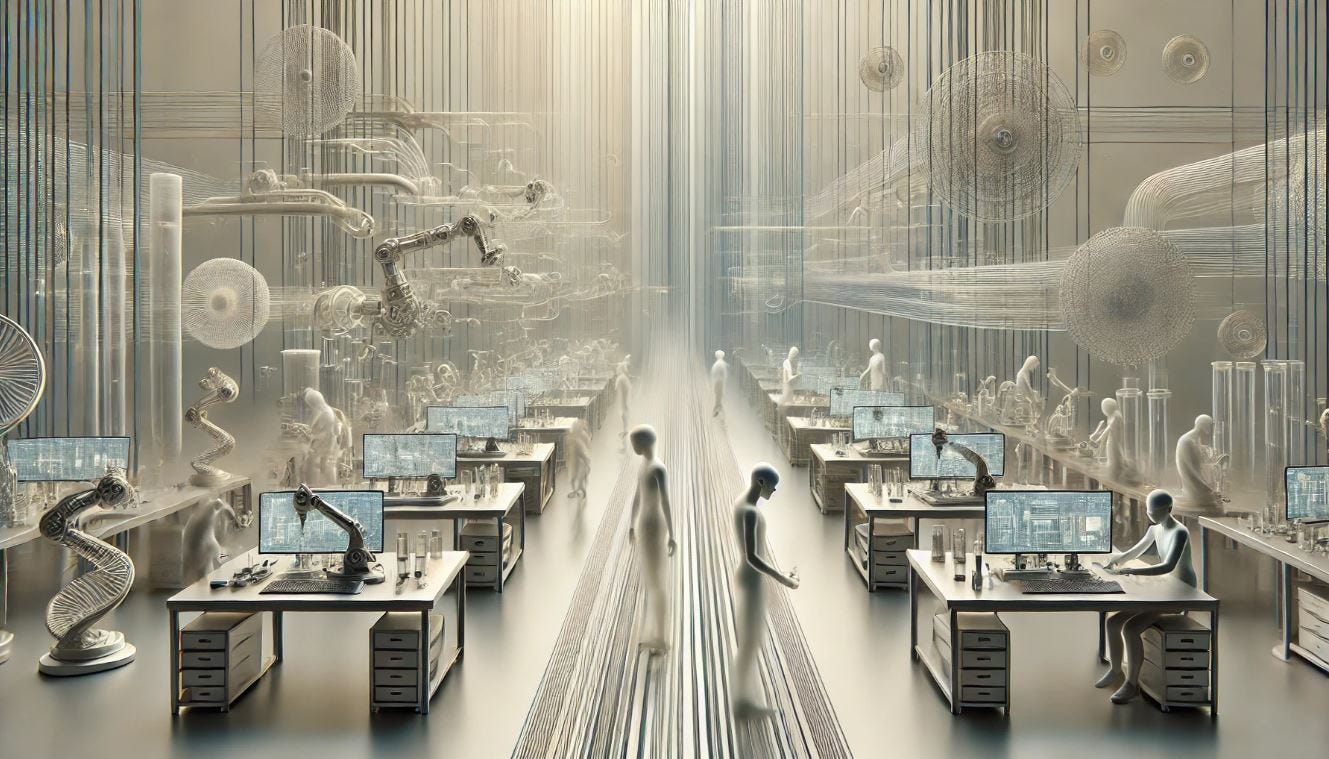
When AI systems and humanoid robots enter the laboratory, linear science collapses.
- Hundreds of hypotheses are generated simultaneously
- Thousands of experiments run in parallel
- Failed paths are discarded instantly
- Promising routes expand automatically
Science no longer “moves forward.” It fans out.
At this point, science stops being a result-producing machine. It becomes a system for exploring possible worlds.
From “What Is True?” to “What Is Possible?”
This transformation rewrites the definition of science itself.
Old science asked:
What is correct?
Exploration-based science asks:
How far can this go?
The value is no longer a single answer, but a map of possibilities:
- Which paths are open
- Where risks emerge
- What choices exist
Science shifts from a record of discoveries to a history of exploration systems.
The Future Is Not Faster — It Arrives All at Once
People often say: “Technology makes the future come faster.”
That framing is wrong.
Exploration-driven science does not accelerate the future. It reveals multiple futures simultaneously.
- Technologies expected in ten years appear today in provisional form
- Several unfinished futures emerge as candidates at the same time
The future no longer arrives in a straight line. It arrives layered and parallel.
What This Means for Scientists
The definition of scientific excellence changes.
What matters less:
- Manual speed
- Repetitive experimental skill
What matters more:
- Structuring questions
- Designing exploration space
- Classifying risk and possibility
Scientists become less like answer-finders and more like architects of future landscapes.
The Real Problem Is Not Technology — It’s Institutions
Science has already gone parallel.
Law, ethics, responsibility, and governance have not.
This creates the real tension ahead: not technological danger, but asymmetry of speed.
Science sees many futures at once. Society is still organized around one present.
The FrameLAB Perspective
This is not a story about AI or robots.
It is a story about how humans handle time.
Science is no longer a tool for creating the future. It is a system for selecting among futures.
And the burden of that choice is returning — inevitably — to humans.
FrameLAB Thought
Science is no longer a slow archive of accumulated knowledge.
Science is now not a machine that brings the future closer, but a system that unfolds multiple futures at once.
The technology is ready.
The remaining question is not scientific, but human:
Which future are we prepared to choose?
The world looks complex — until you see the frame. — FrameLAB by BeomView
메타데이터
- post_id
- fd014987303a
- slug
- why-science-suddenly-feels-faster-than-ever-fd014987303a
- url
- https://medium.com/@beomview/why-science-suddenly-feels-faster-than-ever-fd014987303a
- canonical_url
- https://medium.com/@beomview/why-science-suddenly-feels-faster-than-ever-fd014987303a
- author_url
- https://medium.com/@beomview
- status
- ok
- fetched_at
- 2026-06-09 15:37:30