Flipping the Asset Architecture: How Swish Rewrote the Playbook on 10-Minute Food Delivery
For years, the consensus among traditional quick-commerce aggregators was absolute: ultra-fast food delivery is structurally unviable.
Flipping the Asset Architecture: How Swish Rewrote the Playbook on 10-Minute Food Delivery
For years, the consensus among traditional quick-commerce aggregators was absolute: ultra-fast food delivery is structurally unviable.
The industry watchword was consolidation and retreat. We watched market leaders shelf or heavily downscale their sub-15-minute experiments:
- Swiggy benched Snacc.
- Zomato paused Quick.
- Zepto scaled down Café.
To the corporate observer, the diagnosis seemed simple: consumer demand could not overcome the severe margin leakage inherent in the traditional aggregator ecosystem. Every minute a delivery partner spends idling at a chaotic, unmanaged third-party restaurant kitchen represents unrecoverable capital. The math simply didn’t work.
Then came Swish.
By securing a $54M capital injection, Swish challenged the industry’s baseline hypothesis. They bet that the incumbents weren’t wrong about consumer demand — they were wrong about the operational architecture.
Here is a strategic breakdown of how Swish broke the structural gridlock.
The Strategic Pivot: Full-Stack Vertical Integration
Traditional aggregators operate as asset-light matching platforms. They attempt to connect fragmented supply (local restaurants) with fragmented logistics providers (gig workers).
Swish discarded this playbook entirely, opting for a model of Full-Stack Vertical Integration. Instead of intermediating the value chain, they chose to own it.
By taking end-to-end ownership of the ecosystem, Swish engineered control across four critical operational pillars:
- Proprietary Micro-Hubs (Cloud Kitchens): Deployed specifically to minimize the physical delivery radius and centralize production.
- Aggressive SKU Rationalization: By offering a highly curated, limited menu, they eliminated preparation complexity and maximized kitchen throughput.
- Dedicated Hyperlocal Logistics: A private fleet eliminates the bidding and allocation friction common in open marketplace networks.
- Monolithic Tech Stack: Proprietary infrastructure maps demand forecasting directly to kitchen prep times in real-time.
By owning the entire value chain, Swish successfully compressed the preparation-to-dispatch lag down to near-zero.
Changing the Paradigm: From Logistics to JIT Manufacturing
The fundamental strategic mistake made by incumbents was viewing the problem through a logistics lens. They asked: “How do we route drivers faster to pick up restaurant food?”
Swish reframed the problem entirely as a Just-In-Time (JIT) Manufacturing challenge. Their core thesis was: “How do we redesign the physical production floor to optimize velocity?”
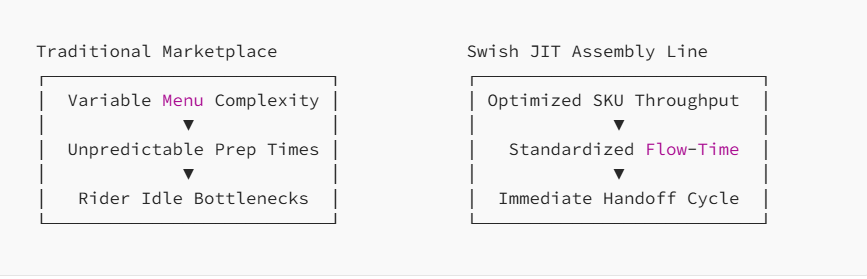
When you look at a Swish facility, you aren’t looking at a kitchen; you are looking at a micro-factory. The physical floor layout is modeled after manufacturing assembly lines. Because the menu options (SKUs) are strictly controlled, the flow-time of every dish is fully standardized. Food is not “cooked to order” in a traditional sense; it is manufactured for immediate handoff.
The metrics suggest the market validation is real. Within 18 months, the company scaled to 20,000+ daily orders, earning the backing of tier-one institutional investors including Accel, Bain Capital Ventures, and Hara Global Capital Management.
The Core Strategic Takeaway
Many early-stage companies fail because they attempt to compete against massive incumbents using the exact same playbook, hoping to simply “execute better.”
Swish provides a textbook case study in asymmetric market entry:
- Isolate the Structural Limitation: Identify the one foundational flaw that the giant’s massive scale prevents them from fixing (e.g., the aggregator’s inability to control independent kitchen workflows).
- Flip the Asset Architecture: Redesign the physical and digital infrastructure from the ground up to exploit that specific vulnerability.
- Optimize for Velocity over Variety: Sacrifice menu breadth to achieve unbeatable unit economics and speed.
In heavily defended markets, the winning strategy is rarely to build a slightly better copy of the incumbent’s machine. The winner is the player who looks at the industry’s core assumptions, finds the single vulnerability everyone else accepted as a fact, and rewrites the rules of efficiency entirely.
메타데이터
- post_id
- fd02c35efcac
- slug
- flipping-the-asset-architecture-how-swish-rewrote-the-playbook-on-10-minute-food-delivery-fd02c35efcac
- url
- https://medium.com/@thangella.shreyaa/flipping-the-asset-architecture-how-swish-rewrote-the-playbook-on-10-minute-food-delivery-fd02c35efcac
- canonical_url
- https://medium.com/@thangella.shreyaa/flipping-the-asset-architecture-how-swish-rewrote-the-playbook-on-10-minute-food-delivery-fd02c35efcac
- author_url
- https://medium.com/@thangella.shreyaa
- status
- ok
- fetched_at
- 2026-07-10 19:34:48