Niger Halts GoviEx Case While Squeezing Orano — A Crucial Test for Global Atomic at Dasa
GoviEx waits, Orano exits — what Niger’s reset really means for Global Atomic and uranium supply.
Niger Halts GoviEx Case While Squeezing Orano — A Crucial Test for Global Atomic at Dasa
GoviEx waits, Orano exits — what Niger’s reset really means for Global Atomic and uranium supply.
The Atmosphere of Crisis
Night in Niger’s north arrives like a dropped curtain: sudden, heavy, and full of whispers. In Arlit, the road signs point to mines that once seemed eternal, to pits and mills that fed distant reactors and old alliances. Now that certainty is gone. A junta rules in Niamey. A French nuclear champion has been shown the door. A smaller Canadian miner has not — its legal fight frozen mid-stride, its future held in a silence that says more than any speech.
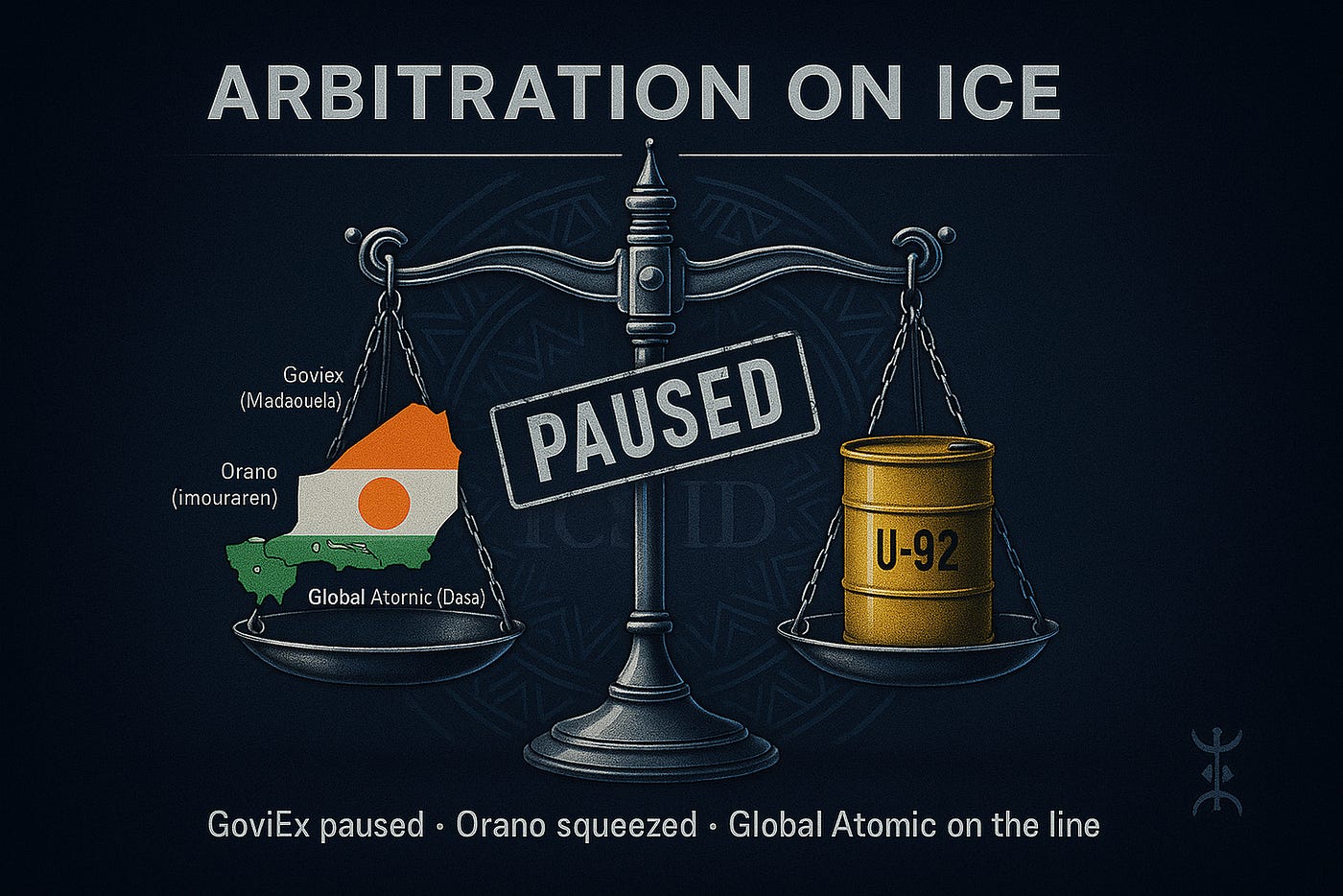
On the surface it’s procedural: officials agree to pause an international arbitration with GoviEx Uranium over Madaouela. But paperwork doesn’t explain why trucks idle longer at checkpoints, why ministry phones ring a little later each day, or why investors have begun to read the wind like pilots. Pauses like this are never about courtesy. They are about leverage. They are about time.
Why does a government that moved so decisively against France’s Orano want to bargain with a junior? Why is a legal war put on ice just as uranium demand is warming? And what, exactly, does this limbo mean for the next player in line — Global Atomic — whose Dasa project sits squarely inside the same political weather system?
Rising Tensions: The Players and the Stakes
To grasp the moment, begin with the map. Uranium turned Niger from a borderland into a power line that runs beneath Europe’s cities and Asia’s factory lights. For half a century the French state’s mining arm — renamed Orano — anchored that connection. Then a coup rearranged the furniture. Foreign troops left. Licenses were yanked. A message was sent.
But the message was not uniform. Orano faced a closed gate and an unblinking stare. GoviEx, by contrast, met a protracted pause — neither welcome nor expulsion, but a thin, deliberate sliver of possibility. And just beyond them stands Global Atomic, a different kind of test: newer relationships, a different balance of capital and dependence, and a flagship project that can make or break the country’s claim that it wants partners, not patrons.
What is Niger building here — a clean break from a colonial past, or a new patronage network draped in sovereignty? In a market this thin, even the hint of an answer can move prices, reorder alliances, and decide which mines become headlines and which become case law.
The Conflict Unfolds
The pause with GoviEx is not a detour; it is the road. Arbitration is a private court for public quarrels — binding, expensive, slow. To freeze it mid-stride is to admit that a courtroom victory might be worse than an imperfect deal. From Niamey’s view, a hard award invites years of asset-chasing in foreign jurisdictions and a reputation that costs more than any royalty. From GoviEx’s view, a triumphant judgment that leaves it locked out of the ore is a pyrrhic win. Talk is cheaper, faster, and more reversible.
Orano’s treatment explains the rest. Ejecting France’s champion was a sovereign performance meant to echo in Paris. It did. But sovereignty is a beginning, not a business plan. Mines need money, engineering, buyers. A state can seize a site; it cannot, by decree, conjure solvent partners on bankable timelines. Hence the two-track strategy: a clenched fist for the symbol, a measured handshake for the future. A legal freeze here, a quiet term sheet there, and a signal to non-French players that, yes, the rules are changing — but not into chaos.
This is where Global Atomic enters the frame. Dasa, its Niger project, is more than a pit and a mill; it is a test of whether the government can translate political theater into durable policy. If the GoviEx pause matures into a negotiated reset — tougher fiscal terms, clearer local content, a visible role for the state miner — then Dasa’s path looks navigable. If not, every camp light on the desert horizon becomes a risk indicator. The company’s bankers won’t say it aloud, but they are watching the same tea leaves: export protocols, customs clearances, paperwork velocity, phone calls returned.
Meanwhile the market is doing its own arithmetic. Uranium is a thin, nervous commodity; a handful of missing pounds can turn a tight year into a fretful one. Each quarter of delay pushes first production to the right and capex up and to the north. Investors who once treated “country risk” as a footnote now price it line-by-line. And outside the sector, a cast of new suitors — state-backed firms from Moscow, Beijing, Astana, and the Gulf — hover at the edge of the frame, offering money on terms that blur the border between commercial and strategic.
Behind the scenes, leverage is a living thing. The state’s finances harden or soften by the month — aid flows, customs receipts, oil revenues. Companies stack their chips — offtake interest, contractor readiness, treasury runway. The longer the pause holds, the more both sides learn what they can and cannot live without, and the closer politics slides toward economics, where most disputes eventually end.
The Implications
For Niger, the risk is reputational arithmetic. Push too hard and you win the symbol but lose the cycle: capital dries up, schedules slip, and the promise of local jobs and roads becomes an unkept campaign. Strike a balance and you can claim a sovereign reset that still lets shovels turn. That balance looks like a slightly higher state take, enforceable commitments to hire and buy locally, and transparency that reassures lenders who do not care for desert drama.
For GoviEx, the pause is a second chance. A re-papered deal — more state visibility, predictable export rules, shared upside — can be marketed to investors as certainty in an uncertain place. It won’t be yesterday’s economics, but it might be tomorrow’s financing.
For Global Atomic, the moment is narrower and sharper. If GoviEx’s détente becomes blueprint rather than exception, Dasa’s risk premium declines even as its fiscal burden rises. The company can live with tougher terms; it cannot live with shifting ground. The measure will be procedural: are permits re-affirmed on time, are shipments cleared without theatrics, does the state answer the phone? If the answer is yes, Dasa becomes proof of concept. If not, Dasa becomes a footnote in a legal brief.
For Orano, the calculus is colder. Even a courtroom victory likely yields damages, not a return to the pit. The French company’s half-century in Niger has dwindled to paperwork and principle. In Paris the lesson will be political; in Niamey, practical.
And for the uranium market, the effect is a slow tightening rather than a sudden snap. These are future pounds, not today’s supply. But every deferred shaft and contested road makes the curve a little steeper just as utilities pencil in restarts and new builds. Thin markets remember small insults.
There is one final lever that keeps both sides at the table: enforcement. Arbitration awards must be recognized around the world, but collecting is another art. Sovereign immunity shields embassies and central bank vaults; only commercial assets bleed. Niger does not hold many. That scarcity turns legal triumphs into diplomatic negotiations, and it turns today’s pause into tomorrow’s payment plan. Better to promise a share of tomorrow than to fight over a trickle of today.
The Conclusion
We prefer tidy narratives: the empire retreats, the nation stands tall, the mines hum on a new cadence. Niger’s reality is less tidy and more human. A government wants dignity and dollars. Companies want certainty and access. The market wants pounds in a year that refuses to be simple. Between them, a pause — the quiet recognition that the verdict is better drafted at a table than delivered from a bench.
The desert teaches patience. So do commodity cycles. Somewhere between Arlit’s winds and Washington’s statutes, Niger is deciding what kind of uranium country it will be: a stage for gestures, or a workshop for deals. The answer won’t come in a press release. It will arrive, as these answers always do, as trucks move or don’t, as permits are stamped or set aside, as a junior’s pause becomes a template — or a warning — for the project waiting just down the road.
메타데이터
- post_id
- fd0c4f372ecc
- slug
- niger-halts-goviex-case-while-squeezing-orano-a-crucial-test-for-global-atomic-at-dasa-fd0c4f372ecc
- url
- https://medium.com/@johngalt88/niger-halts-goviex-case-while-squeezing-orano-a-crucial-test-for-global-atomic-at-dasa-fd0c4f372ecc
- canonical_url
- https://medium.com/@johngalt88/niger-halts-goviex-case-while-squeezing-orano-a-crucial-test-for-global-atomic-at-dasa-fd0c4f372ecc
- author_url
- https://medium.com/@johngalt88
- status
- ok
- fetched_at
- 2026-06-27 07:40:21