Truth, Archaeology, Reflection, Solidarity and Comradeship
Melike Bayık spoke with Ahmet Rüstem Ekici and Hakan Sorar about the exhibition “Rest in Pieces”, which spans the two-storey space of…
Truth, Archaeology, Reflection, Solidarity and Comradeship
Melike Bayık spoke with Ahmet Rüstem Ekici and Hakan Sorar about the exhibition “Rest in Pieces”, which spans the two-storey space of Bilsart and Monoco.io.
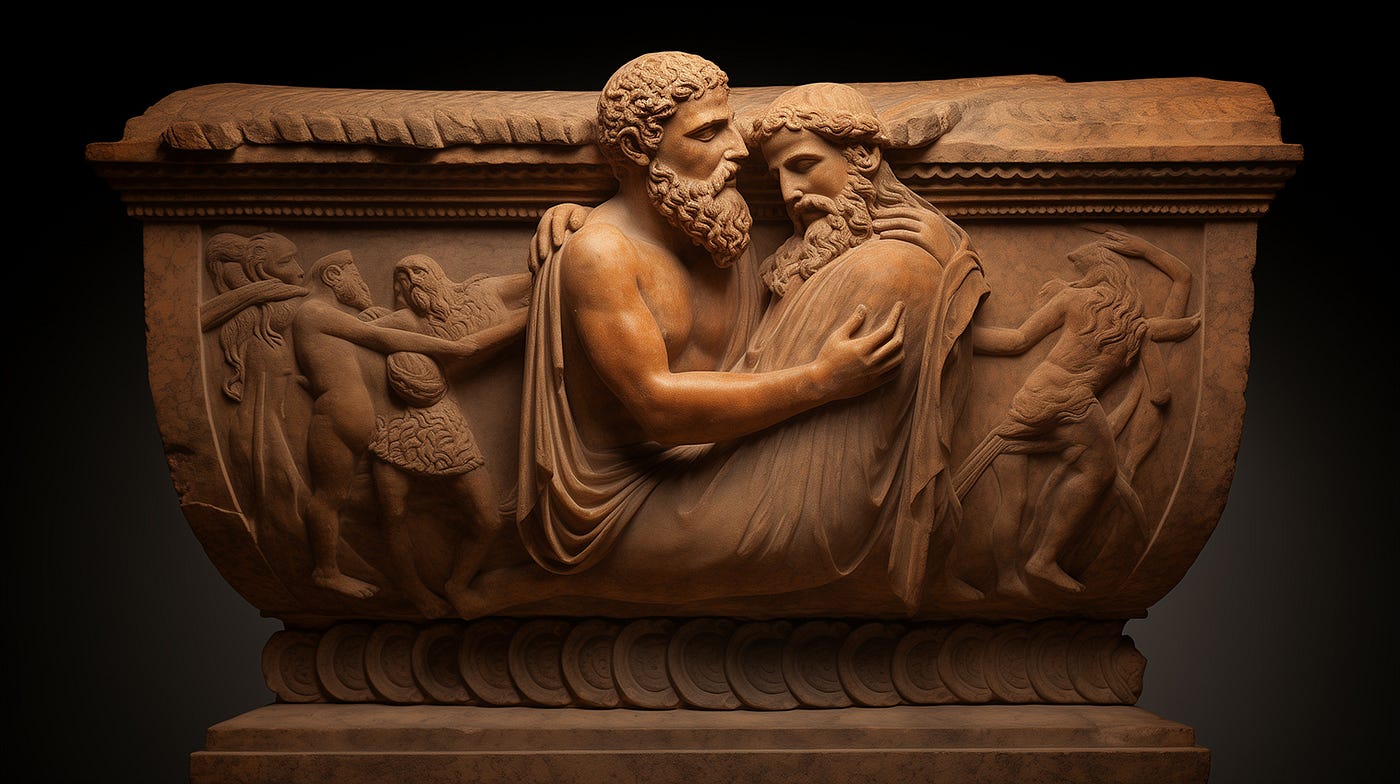
Ahmet Rüstem Ekici and Hakan Sorar’s “Rest in Pieces” exhibition, which was prepared in a long-term process with a dual work by Ahmet Rüstem Ekici and Hakan Sorar, opened to the audience’s experience by settling in the two-storey space of Bilsart and Monoco.io. The exhibition, which takes its soul from archaeology, reality, social issues and solidarity, has emerged by synthesising with inspiration from the absolute journey of Domaniç Frogs through the ages. Beyond pure unity and walking on invisible paths by carrying each other on their backs, it epitomised a shoulder-to-shoulder solidarity among today’s distorted realities. The “Rest in Pieces” exhibition, an exhibition realised by Ahmet Rüstem Ekici and Hakan Sorar in December 2023 with the cooperation of many people and institutions, has settled in the historical record with this aspect.
Melike Bayık: Ahmet Rüstem and Hakan, this is your most comprehensive exhibition together. Firstly, how did the research journey for this exhibition begin?
Ahmet Rüstem Ekici & Hakan Sorar: We have been living and producing together for a long time. Our first collaboration was realised with the Aşıklı Höyük Excavation Traces exhibition curated by Fırat Arapoğlu and Gary Sangster. Here, we had the chance to meet archaeologists who impressed us a lot with their original works. One of the works in our excavation traces exhibition was inspired by Prof. Dr. Mihriban Özbaşaran’s article “The Big Questions of Figurine”. Then we continued our conversations, readings and field studies on archaeology, which nourished us a lot. Rest in Pieces exhibition emerged at the end of this whole process. Every article, book, and source we read brought us together with new possibilities, and we had the chance to look at archaeology from the perspective of art/design. The cover of the 147th issue of Archeology and Art Magazine, published in 20 opened a brand new door for us. This issue analysed the Seyitömer Mound Excavation and featured photographs of frog-shaped Britons found in the mound, which are thought to have been produced 5000 years ago. By examining this object in depth, we focused on skeomorphism and humanity’s ability to interpret and imitate nature and previous culture/knowledge. The journey of frogs in the Domaniç region of Kütahya, which they continue today by carrying each other, obviously inspired the region's people 5000 years ago. This way of relating continued our journey with the following question. How do we carry each other? Who accompanied us on this journey, and what kind of a journey was this? Then, to avoid getting lost in the sea of archaeology, art and technology, we continued our work by focusing on death, leaving traces, permanence, transformation, layers, being in pieces, and the storytelling impulses of archaeological surfaces.
M.B.: We are talking about a multi-layered research exhibition. I want to start with the title. “Rest in Pieces”. You have entered this conceptual narrative with a playful and satirical exhibition title. Could you tell us about the exhibition title and the conceptual and formal narrative?
A&H..: Death is as much a political issue as it is a natural one. The word Rest in Peace is associated with sleeping in peace, and especially when we look at archaeology, the literary resting places that bring together the body and architecture designed to rest in peace are the most looted, dismantled and broken places. Today, attacks on grave structures continue. On the one hand, archaeology is connected with the coming together of fragments and information. In this exhibition, we, as artists working in the digital field, wanted to explore the digital to convey information to the future on the potentials of artificial intelligence and 3D tools today. In doing so, we wanted to pretend through a museum just like the frogs’ emphasis on skeomorphism. Museums are also structures that build society's identity by bringing the pieces together. Which artefacts do museums exhibit, and how do they filter them? Questions such as: Is the museum a space open to all identities, or is it a space where we often experience the remains of noble, influential people? Turned into the idea of scattering our pieces in a fictional museum. In this context, the exhibition “Rest In Pieces” is more than just an artistic expression; it is a critical look at how historical and cultural heritage is constructed, which voices are heard and silenced. It also explores how funerary structures and the stories contained within them have become a political tool throughout history and how the information extracted from them has been used. In this way, the exhibition brings past, present and future together, creating a new dialogue between history and technology. On the one hand, the exhibition is in constant transformation like this pun. In the exhibition, we focus on the transformation of words into texts, 3D objects, images, sound, and video with ort, the deconstruction of the word and its transformation potential.
M.B.: In your “Rest in Pieces” exhibition, we were able to see your works from many different disciplines. There was both a pluralistic practice of using materials and a production approach that would support the conceptual narrative as artists. How did you construct the interdisciplinarity here?
A&H..: During our excavations at both Aşıklı Höyük and Tavşanlı Höyük, we were inspired by the multidisciplinary perspectives of valuable archaeologists. Archaeology is already closely connected with analytical and social sciences, as well as archaeometry, archaeobotany, zooarchaeology, palaeoecology, experimental archaeology, art, architecture and many other disciplines. While constructing our own archaeology, we took care to develop a multi-voiced, multi-instrumental production language. The exhibition emerged with the labour of more than 60 people. First of all, we thought about the question of which artefacts we should focus on while constructing the museum and with which forms of production we should reveal these artefacts. For example, while producing the dead/death masks, we used the outputs of our digital bodies instead of traditional methods. From the Neolithic period to the present day, death masks were one of the forms of transmitting form and existence. In this object, which we pursued to transfer the image to the future without physical body contact, we created the virtual data by printing the virtual data as clay from a 3D printer, experiencing the machine print instead of fingerprints, and then baking it. We took care that most of the things in the exhibition did not remain fixed. For this reason, unlike the feeling of stone, weight, and constancy in museums, we pursued ambiguous aesthetics by editing videos of objects constantly flowing and transforming. We had the opportunity to work in the field and workshops in cities such as Istanbul, Iznik, Kütahya, Adana and Mersin.

M.B.: How do you evaluate the relations between the true story of these frogs you discovered in Kütahya, which you have just mentioned, and today’s world of life and culture, the notions of survival and continuation?
A&H..: The starting point of the exhibition was the frog-shaped ritons produced 5000 years ago, which are exhibited in the Kütahya Museum, and the journeys of frogs carrying each other on their backs, which are observed today in the Domaniç region of Kütahya.
Ritons, libation vessels, or most objects that were once everyday objects can now be defined as archaeological objects, and can turn into an object whose identity, but not its form, has changed. We were very impressed by the fact that this object was inspired by nature. Our storytelling impulses and skills met with various materials and sometimes appeared on mosaic surfaces, sometimes on frescoes, sarcophagus covers, vases and plates. Today, this urge of ours still continues. We not only keep the culture alive with patterns and traces on new products, but we are constantly trying different methods of transmission with new materials. Mimicking nature is at the centre of hundreds of thousands of years of humanity’s tool production. In addition to antler-shaped drinking vessels, tools and ornaments made of deer teeth, seashells and many other materials offered by nature, we have made incredible progress in building surfaces and objects with new mixtures and experiments. Perhaps the frog migration observed every March and June in the Domaniç region of Kütahya inspired the people 5000 years ago, and with this inspiration, these vessels exhibited in the Kütahya museum today emerged. On the one hand, imitation object, skeomorphism is also frequently encountered in digital tools. For example, the trash can on the desktop of our computers is shaped like a trash can, when we buy an electronic book, we still turn the page as if we were turning a page, and even make a page turning sound, could it be related to this urge of familiarity? Another inspiration point of these frogs was that they somehow represent the other. In the area we visited several times during the exhibition preparation process, we saw signs for cows and deer, but there were no signs for frogs. Because if you hit a large animal, you can damage your property, someone else’s property, your life, but a frog has the right to die, you can run over it. We could not find the answer to these questions whether an ecological bridge was built for these creatures, which are thought to have inspired the people of the region for 5000 years. The breeding migration continues with the frogs being hit by the vehicles. At the same time, the transformation of the everyday object of 5000 years ago into an archaeological object today is quite inspiring when we think about identity. We can observe this transformation in all works of the exhibition. In the exhibition, we experienced the transformation of our ideas into words and words into texts, sounds, 3D files, video and images with artificial intelligence tools, as well as experiments on the transformation of an image into an object.
M.B.: As the artists who had the longest exhibition in Bilsart history with a duration of 1 month, you were able to use both monoco.io and Bilsart spaces extensively for the project. How did you plan the spatial placement, setup and flow?
A&H..: Our project was shaped 2 years ago and we started to create the artefacts last year. At this point, we had shaped the whole layout according to the circulation route of Bilsart, both for our Theatrum Mundi interactive Video experience and for the space that we would organise like a museum. The exhibition started with a traffic sign and then continued like a museum, and at each stop we were experiencing the outputs of artificial intelligence image and sound generation tools. It invited the audience to circulate with exhibition areas that sometimes behaved linearly and sometimes like a hill. On the upper floor was the Theatrum Mundi experience area. Our exhibition was opened with great interest and we can say that we reached at least 1000 people after the opening, based on the number of catalogues. One of our greatest desires was to draw attention to the visibility of Domaniç frogs through interviews and press reflections.

M.B.: In the exhibition, you received support from many people in an individual context and developed co-operation. Could you tell us about this process?
A&H.: As independent artists, we got our greatest strength from solidarity. The exhibition has evolved into a very layered structure thanks to our collectors, curators who have guided us in a duo sense so far, professionals working in the field of art and archaeologists with whom we crossed paths. The booklet prepared for the exhibition contains 16 texts. These texts are about archaeology, architecture, media art and camaraderie, which are also fed by the exhibition process. At this point, we could not have printed this booklet without the support of LG Oled. At the same time, the music video we prepared for Kalben’s song Hatıraların Gölgesi, which will be released in March, using artificial intelligence visualisation tools, built a valuable bridge between popular culture and artificial intelligence video creation. Thanks to the valuable contributions of Asena Kumsal Şen Bayram, we were able to prepare our Sarcophagus and Frieze work as 3D printing. This kline-type sarcophagus, which gives its name to the Rest in Pieces exhibition, emerged at the intersection of archaeology, art and design with an impressive combination of artificial intelligence, 3D modelling and 3D printing technology. The sarcophagus, printed in 161 separate pieces from PLA material, bears detailed depictions of the artists and their dogs. On the front surfaces, there are abstract patterns resembling frog eggs created with the help of artificial intelligence. This project, which started modelling in May and started production on 28 September 2023, took 96,603 minutes on dozens of printers. Using 17.85 kg of filament, the sarcophagus was produced as a lower base (32 parts), walls (65 parts) and upper lid (64 parts). It was realised with the devoted cooperation of more than 40 participants for 48 days and with the support of Istanbul Technical University and ITU Faculty of Architecture. We would like to thank Asena Kumsal Şen Bayram for her valuable contribution to the project by mentioning everyone’s name in the exhibition catalogue and keeping a record of all production processes. We are grateful to everyone who contributed to the creation of this innovative and impressive work

M.B.: As you have just mentioned, you have also prepared a very comprehensive publication with the contributions of many people. This is a comprehensive publication that can be read like a book and also includes the exhibition. How important is this publication in terms of texts, narrative and content? How were textual contributions and collaborations planned?
A&H..: We did not want this exhibition to have a curator. Instead, we asked art professionals with whom we have crossed paths as a duo to write texts, like frogs carrying each other. Sera Yelözer, Arda Bülbül, Fırat Arapoğlu, Esra Özkan, Sinan Eren Erk, Nergis Abıyeva, Uras Kızıl, Aylin Alpüstün, Cansu Sönmez, Ayşegül Sönmez, Inana Abdelli, Kesra Mansuri, Feride İkiz, Asena Kumsal Şen Bayram, Onur Baştürk, Pascal Debodard and Christian Poelzler accompanied the exhibition with their texts. In this way, we have gained a multifaceted resource in which each author has dealt with the exhibition or this journey in a different way. There have also been quite experimental approaches here. For example, Sinan Eren Erk’s text established a relationship with QR code in the context of text and sound. In the second phase, an English/Turkish resource will be prepared with impression essays and texts by different archaeologists. In the exhibition texts, not only the perspective of the author but also his/her impressions of the process can be a part of the exhibition if the author was there during the process. At this point, the writings of Aylin Alpüstün and Cansu Sönmez, who took us to different cities and accompanied us on our journey, are like memories. Uras Kızıl & Nergis Abıyeva’s academic text titled “What Do Domaniç Frogs Tell Us?” begins with a quote from one of our favourite artists. “The difference between a story and a real memory is that the real experience has a scent and is not wrapped in a single ending.” Nan Goldin

M.B.: This exhibition is also an indicator of a holistic co-operation, a shoulder-to-shoulder will. We can see this both conceptually and concretely. Who are the supporters, collaborators in production, people and brands in the exhibition that you have progressed with such comprehensive support, and what kind of connections and support did you establish to realise this exhibition?
A&H..: Organising an exhibition with digital tools involves polyphony in terms of technology and infrastructure. As we mentioned, our exhibition file was ready a year ago and we gradually started to meet with brands and individuals for support meetings. For example, thanks to Asena Kumsal Şen Bayram, we were able to realise our 3D mud clay prints in Adana in the workshop of Inana Abdelli and Kesra Mansuri, where we crossed paths. The works that we pay attention to using completely Anatolian clays came to life and baked through this workshop. We are always able to realise our Theatrum Mundi work with Engin Arer’s superior knowledge. This time, Artun İmamoğlu, who is highly skilled in tools such as Unreal Engine and Blender, joined the team for this work. Thanks to BD Vertical Garden company, Kaan Sümer, Theatrum Mundi The Pond Interactive video installation established a different bond with the audience with the smell of moss in a very impressive atmosphere. Our sarcophagus and frieze work came to life with the support of Marshall Logistics and Porima Filament thanks to Asena Kumsal Şen Bayram. We were able to experience the videos we created with artificial intelligence through LG Turkey. Our favourite Brothers 1801 team was with us at our opening. All these connections were thanks to people who care about the exhibition and the journey of frogs. We would also like to thank Bilsart and Monoco for hosting us. The work in which the exhibition was created with artificial intelligence visualisation tools and shaped by hand was created with our favourite Cem Güven in Iznik Adil Can Nursan workshop. With the valuable contributions of Sinem Erşan in textile production, we have created a placement with a high variety of materials. Just like the journey of frogs together, this exhibition was realised with the support of two artists and the support of other people to these artists.

M.B.: Were there any productions or artefacts in the exhibition that you planned and could not realise, or were there any subjects that you could not realise in various collaborations?
A&H.: Yes, unfortunately we could not realise some of our works due to both time and budgetary reasons, but we included them in the exhibition in model size. One of them was the terracotta sarcophagi called Torpedo Type Sarcophagus. This sarcophagus type and its naming, which we encounter in dozens of city and district museums in Anatolia, underlines how much we often look at archaeology from today. The elegy written by Kalben, which we had the chance to listen to live in our workshop, will perhaps transform into different forms in the next exhibition. Besides, there are many works that we have eliminated and not exhibited.
M.B.: “Rest in Pieces” met with the audience as a multidimensional exhibition that perhaps describes your view of life in such a comprehensive way. How were the contributions and comments of the audience in this exhibition that we saw in Bilsart’s space? If we want to give a summary as artists who were present in the exhibition from the beginning to the end, how were your views shaped, what kind of stories and subjects did you encounter?
A&H..: We often spent time at Bilsart and Monoco, as we like to spend time in the exhibition space and develop dialogue. The exhibition was visited with great interest by schools, student communities, art excursion groups, and our sweetest moment was the presence of a viewer who came to experience the exhibition by cutting a newspaper clipping. The Theatrum Mundi experience was the work that the audience spent the longest time. This work, which transforms the viewer from a consumer to a producer, received feedbacks as an experience where most of the experiencers freely navigated in the video with a game console for the first time. The most important outcome of the exhibition, which was also widely reported in the press, will hopefully be the ecological bridge for the Domaniç Frogs and the protection of this species, which is thought to be established.
MELIKE BAYIK
This article was first published in Turkish on NFTIFY.com.tr and translated into English by NFTIFY.uk . Images are the artist’s own and may have been slightly altered in their original dimensions due to technical conditions. You can follow NFTYFY on Instagram.com/nftify
메타데이터
- post_id
- fd1550cfd2cb
- slug
- truth-archaeology-reflection-solidarity-and-comradeship-fd1550cfd2cb
- url
- https://medium.com/nftify-uk/truth-archaeology-reflection-solidarity-and-comradeship-fd1550cfd2cb
- canonical_url
- https://medium.com/nftify-uk/truth-archaeology-reflection-solidarity-and-comradeship-fd1550cfd2cb
- author_url
- https://medium.com/@NFTIFY_UK
- status
- ok
- fetched_at
- 2026-07-24 11:38:48