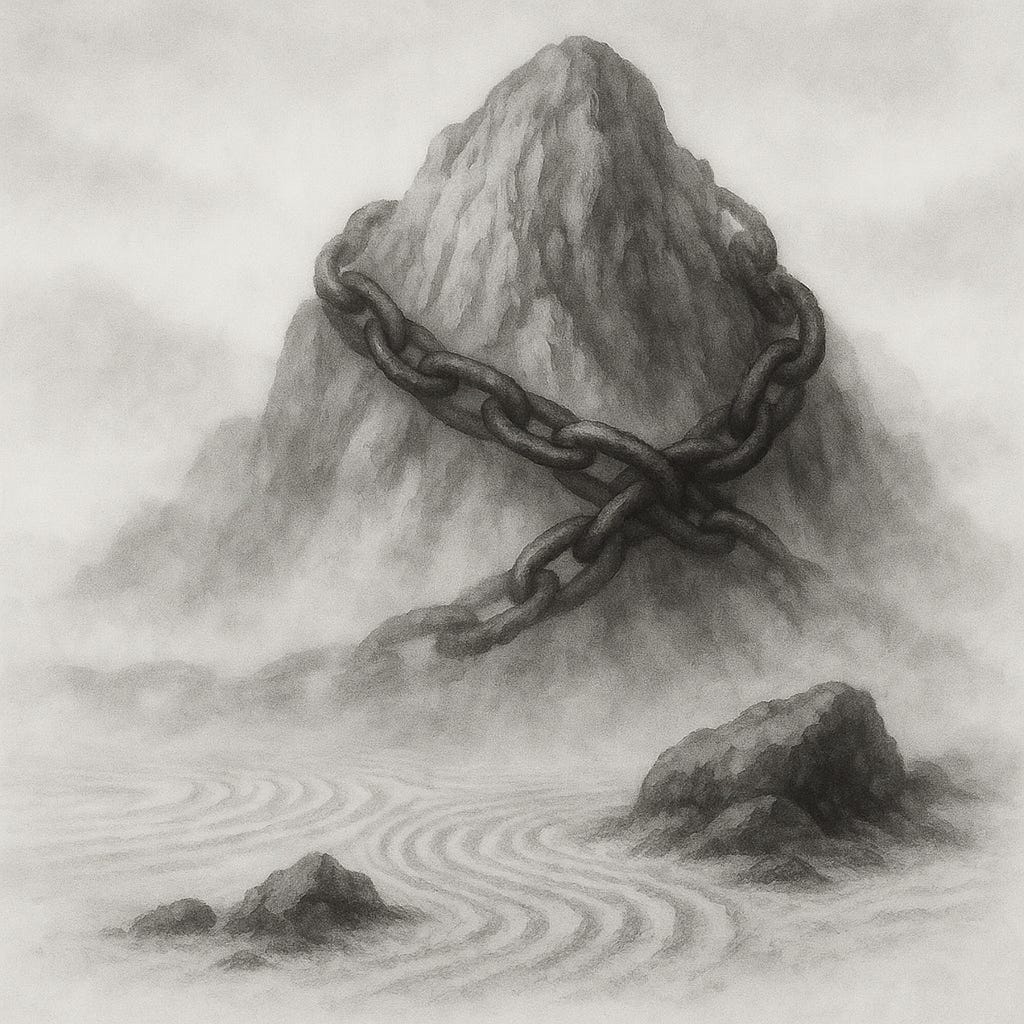
The Profundity of Bullshit
Maybe U. G. Krishnamurti Was Right?
The Profundity of Bullshit
Maybe U. G. Krishnamurti Was Right?
Sometimes moments of fundamental insight into Buddhist truths are disappointingly mundane, obvious, and anticlimactic. You’re just left thinking “wait, what? Surely there’s more to it than THAT.” Smh.
“There is no ignorance, no end of ignorance…. No path, no wisdom, no attainment and nothing to attain to.”(Heart Sutra)
I’ve been dabbling in mysticism, meditation, and occult stuff my whole life. Been fascinated with Gaudiya Vaishnavism, Kashmiri Shaivism, Orthodox hesychasm, sufism, etc. I had found patterns and matching experiences across traditions, almost organically arrived at a sort of “quasi-perennialist philosophy.” I recently created a map of higher-dimensional mystical states, blending ancient cosmology with theoretical physics. I felt like I was on to something deep. I created a framework and a map that makes sense of all the altered states of consciousness encountered across traditions. I concluded that these dimensions don’t have to be real higher dimensions of space-time but could just be conceptual, an innate part of human psychology. It wasn’t an ontology but a phenomenology. I was so close to figuring it all out. I was at the verge of a fundamental breakthrough…
Then I went on about my day, did my sutra studies as usual, which led to a profoundly obvious and disappointing realization. My whole phenomenological map is just describing the jhanas and abhijnas! Buddhism 101 just totally went over my head! And here’s the thing…the jnanas are just “empty” (sunyata) “mental projections”(samskara). They aren’t a glimpse into the nature of reality. They’re fundamentally unreal.
“You’re capable of realizing it (i.e. the mystical states and supernormal powers), since each and every one of them is within reach.”(Anguttara Nikaya 5.28)
The jhanas don’t make you special. Literally anyone can attain them. They’re just one Dharma gate, and they’re fundamentally mundane and unimportant.
“[Shakyamuni:] ‘Now, regarding these seven planes of consciousness and two dimensions, is it appropriate for someone who understands them — and their origin, disappearance, gratification, drawback, and escape — to take pleasure in them?’ [Ananda:] ‘No, sir.’”(Digha Nikaya 15)
Well, hmm…now I realize that I’ve been meditating wrong the whole time. I get caught up in the experience, clinging to and tangled up in the “meditative absorptions” (jhanas). That’s not even what I’m supposed to be doing! You’re not supposed to get caught up and cling to the pleasure of the jhanas. You’re supposed to be recognizing that they are all empty, fundamentally unreal, “mere representations” and “mental projections.” I was clinging — but the “I” and the “clinging” is what you’re really supposed to transcend. It’s all just more conditioned phenomena.
So I guess next time I sit down to meditate, I should start by trying to do the meditation correctly and see where that goes. But I’m also not terribly convinced that it does go anywhere. Maybe there is no “there” there? But I’m super disappointed that some of the most basic shit that I’ve heard a million times just totally eluded me. Talk about missing the forest for the trees!
I thought I was on the verge of Anuttara-Samyak-Sambodhi, full enlightenment! But no… It turns out that the major “truths” I was discovering are just stuff that people have been knowing for thousands of years. I might just be scratching the surface, discovering the basic prerequisites for stream-entry. We’re back to shoshin!
For a while now, I’ve been working with a kind of “seven-dimensional” framework for understanding mystical experience. When I first started thinking in these terms, I was tempted to treat it as something like a literal map of reality, as if I were uncovering hidden layers of the universe itself. Over time, though, I’ve come to see it differently. What I was really building wasn’t a physics model or a metaphysical claim about space-time. It was a phenomenological map — a way of organizing how experience changes as the mind moves through different modes of perception and interpretation.
The first four “dimensions” in my framework correspond to what we normally take for granted: the conventional world of space and time. Objects appear separate, the self feels localized in a body, and events unfold in a linear sequence. This is the domain of ordinary experience, where everything seems discrete, stable, and external. There’s nothing mystical about this level at all. It’s just the default structure of how our brains model reality.
What becomes interesting is what happens when that structure begins to loosen. As attention stabilizes, as perception becomes less cluttered, and as the usual boundaries between self and world begin to soften, experience starts to reorganize itself. At this point, the framework I’ve been using starts to diverge from ordinary space-time thinking. What I called “higher dimensions” were never meant to be literal spatial axes. They were a way of pointing to the fact that experience gains additional degrees of freedom. It becomes less constrained by the assumptions built into everyday perception.
At first, I thought this was a unique insight. But the more I looked into it, the more I realized that something very similar had already been mapped out in Buddhist thought, particularly in the system of the jhānas. These are traditionally described as a sequence of meditative absorptions (or mystical states), moving from more coarse to more refined states of awareness. The early stages still operate within the realm of “form,” meaning they retain some connection to structured, embodied experience, even if it is highly refined. But beyond those, there are the formless states (arupa jhanas): infinite space, infinite consciousness, nothingness, and finally a state that is so subtle it is described as neither perception nor non-perception.
This is where the overlap with my framework becomes hard to ignore. The transition from ordinary perception into these formless states feels very much like what I was trying to describe with the move into higher “dimensions.” Experience is no longer bounded in the same way. The sense of location dissolves. The distinction between subject and object becomes unstable. Awareness seems to expand beyond its usual limits, or even fold in on itself. It is very tempting, at this point, to interpret these states as glimpses into a deeper structure of reality, something that lies beyond the ordinary constraints of space and time.
And for a while, that’s exactly how I understood it. I thought I was mapping out something real in a strong sense. Not just experientially real, but indicative of the underlying architecture of the universe. The language of dimensions made that interpretation feel natural. It suggested that what we were encountering in these states might correspond to something “out there,” something ontological.
But there’s a problem with that move, and it’s a problem that Buddhist philosophy identifies very clearly. These states, as compelling as they are, are still constructed. They are still conditioned. They arise dependent on causes and conditions, and they pass away when those conditions change. In Buddhist terms, they are empty. Not empty in the sense of being nonexistent or meaningless, but empty of inherent, independent reality.
This is where the insight takes a sharp turn. The jhānas, including the most refined and formless ones, are not direct perceptions of ultimate reality. They are mental formations. Patterns of experience generated by the mind under specific conditions. They can feel more real than ordinary perception, more profound, more expansive, more true. But that feeling of profundity is itself part of the construction. It doesn’t grant them any special ontological status.
At first, realizing this felt almost disappointing. There’s a kind of narrative we build around spiritual practice, where we imagine climbing higher and higher toward some ultimate revelation. The idea that all of these states are, in a sense, just mental projections can feel like the rug being pulled out from under that narrative. It’s as if you spend all this time refining perception, expanding awareness, exploring deeper layers of experience, only to discover that none of it was pointing to a final, solid truth.
But the more I sat with that realization, the more I started to see that the disappointment itself was based on a misunderstanding. The problem wasn’t that the experiences were “just” mental projections. The problem was the expectation that there would be something beyond projection that could be directly accessed as a final answer. We imagine that if we go far enough, we’ll eventually break through to the thing-in-itself, the underlying reality independent of the mind. But all experience, by definition, is mediated. It is always structured, always interpreted, always shaped by the conditions that give rise to it.
In that sense, the realization that the jhānas are empty is not a dismissal of them. It’s a correction in how we relate to them. They are not ultimate truths, but they are not meaningless either. They are precise, lawful, reproducible transformations of experience. They reveal something important, not about the structure of the external world, but about the structure of experience itself. They show how flexible perception is, how the sense of self can dissolve, how the boundaries we take for granted can fall away.
My seven-dimensional framework still feels useful to me, but I no longer see it as a map of reality in any strong ontological sense. It’s more like a coordinate system for describing how experience can unfold when the usual constraints are loosened. In that sense, it runs parallel to the jhāna system. It’s another way of pointing to the same general terrain, even if it uses a different conceptual language.
What I missed at first, and what now seems almost obvious, is that the terrain itself is not something you ever step outside of to observe directly. There is no final vantage point from which the whole structure of reality is revealed as it truly is. There are only different ways experience can organize itself, some more coarse, some more refined, some more expansive, some more minimal. And all of them, without exception, are empty in the same fundamental way.
That realization can feel trivial, almost embarrassingly simple. Of course all experience is constructed. Of course we never encounter reality independent of the mind. It sounds like something you could have said from the beginning without all the effort. But there’s a difference between saying it as an abstract idea and seeing it as something that applies even to the most profound and convincing states of consciousness.
In that sense, the path doesn’t culminate in discovering some hidden layer of reality. It culminates in the recognition that there was never a final layer to discover in the way we imagined. The search itself was structured by an assumption that doesn’t hold up. And when that assumption drops away, what’s left is not a grand revelation, but a kind of quiet clarity. Not the sense that you’ve found the ultimate truth, but the absence of the need to find one.

메타데이터
- post_id
- fd175fccf8d2
- slug
- the-profundity-of-bullshit-fd175fccf8d2
- url
- https://medium.com/@waywardbodhisattva/the-profundity-of-bullshit-fd175fccf8d2
- canonical_url
- https://medium.com/@waywardbodhisattva/the-profundity-of-bullshit-fd175fccf8d2
- author_url
- https://medium.com/@waywardbodhisattva
- status
- ok
- fetched_at
- 2026-06-24 13:29:15