How to Build a Digital Growth Strategy Without Wasting Money on Tools You Do Not Need
Some businesses spend thousands every month on tools they barely understand, for problems they haven’t clearly defined. A CRM managing a…
How to Build a Digital Growth Strategy Without Wasting Money on Tools You Do Not Need
Some businesses spend thousands every month on tools they barely understand, for problems they haven’t clearly defined. A CRM managing a client list small enough to fit in a spreadsheet. An email platform with automation features that nobody has switched on. A social scheduling tool buying back twenty minutes a week at a monthly cost that doesn’t justify the saving.
None of that is a strategy. That is expensive confusion dressed up as progress.
The digital tool industry is built on a compelling idea: the right software will solve your growth problem. And because most founders feel their growth problem acutely, the temptation to buy the solution is almost irresistible. A convincing demo, a free trial, a competitor who appears to be using it successfully, and the credit card comes out.
Months later, the tool is underused, the growth problem is unchanged, and the budget is thinner. And the cycle begins again with the next promising product.
The reason this keeps happening is not that the tools are bad. It’s that the strategy that would tell you which tools you actually need was never built first.

Image: Luna Lovegood (Pexels)
The Three Questions Every Digital Growth Strategy Must Answer
Before a single tool is selected, a real digital growth strategy requires honest, specific answers to three questions. Most businesses skip them entirely. The ones that answer them first move faster and spend less.
Who specifically do you want to reach?
Not a general description of your target market. A genuinely specific picture of the individual who, when they find your business online, is the ideal person to be having a conversation with right now. What do they do? What problem are they actively trying to solve? What have they already tried? What language do they use when they describe their challenge? The more specific your answer, the more every subsequent decision simplifies.
What do you want them to do?
Not a vague conversion goal. A specific action: book a call, download a guide, reply to an email, visit a page, start a trial. When you know the exact action you’re moving people toward, you can design your digital presence around creating that movement rather than just producing content and hoping something happens.
What is the simplest path to making that happen?
This is the question that saves the most money. The simplest path between your ideal client and your intended action is almost always shorter, cheaper, and less tool-dependent than the path most businesses build. Complexity is often a substitute for clarity. When you don’t know exactly what you want to happen and why, you add layers: more tools, more touchpoints, more content, more automation. When you do know, you cut everything that doesn’t serve the path.
The 11 approaches that generate immediate digital growth results all share a common quality: they’re strategically positioned before they’re tactically executed. The execution is simple. The thinking behind it is clear.
Strategy Before Tools: What This Looks Like in Practice
A business that answers the three questions first builds something that looks very different from the businesses that jump straight to tools.
They know their positioning, so their website, their social media, and their content all express the same message in the same direction. There’s no inconsistency between what the Instagram profile says and what the sales page promises, because both came from the same strategic clarity.
They know their conversion action, so every piece of content they produce is connected to a next step. Not a hard sell. A natural progression. An article that ends with a relevant guide. A social post that references a specific offer. An email sequence that moves someone from interested to ready at a pace that respects their decision-making process.
They know the simplest path, so they’re not maintaining six platforms, three email sequences, two CRMs, and a project management tool that nobody updates. They’re focused on the two or three channels where their ideal client is actually looking and the one or two tools that serve those channels effectively.
The Digital Growth Philosophy calls this Operational Agility: the capacity to build lean, effective systems that produce commercial outcomes without unnecessary complexity. Quick wins in conversion rate optimisation often come not from adding new tools but from removing friction from the path that already exists, so the ideal client can reach the intended action without obstacles.
The Audit Most Businesses Have Never Done
If you already have a collection of digital tools, one of the most valuable things you can do before buying anything new is audit what you have against what it’s actually producing.
For each tool you’re currently paying for, ask three things. First: what specific outcome is this tool enabling that I could not produce without it? Second: am I using at least 60% of the features I’m paying for? Third: what would I lose, commercially, if I cancelled this subscription tomorrow?
If the answer to the first question is vague, the answer to the second is no, and the answer to the third is “honestly, not much,” you have a tool you’re paying for out of habit rather than strategy.
The money freed by this audit is not the main benefit. The clarity it creates is. When you remove the tools that aren’t earning their place, you see your actual digital infrastructure more clearly, and the gaps that genuinely need filling become obvious.
Building the Right Stack: Where to Start
A minimal, effective digital growth stack for a founder-led business rarely needs more than four or five tools. A website or landing page builder. An email marketing platform. A content scheduling tool for one or two platforms. A CRM, when the volume of conversations genuinely requires it. And possibly an analytics tool, when the volume of traffic justifies the insight it provides.
Everything else is optional until the evidence says otherwise. The evidence is commercial: does this tool help me reach more of the right people, move them more efficiently toward conversion, or retain them more effectively after they become clients? If the honest answer is no, the tool is not serving the strategy. It’s serving the anxiety about whether the strategy is working.
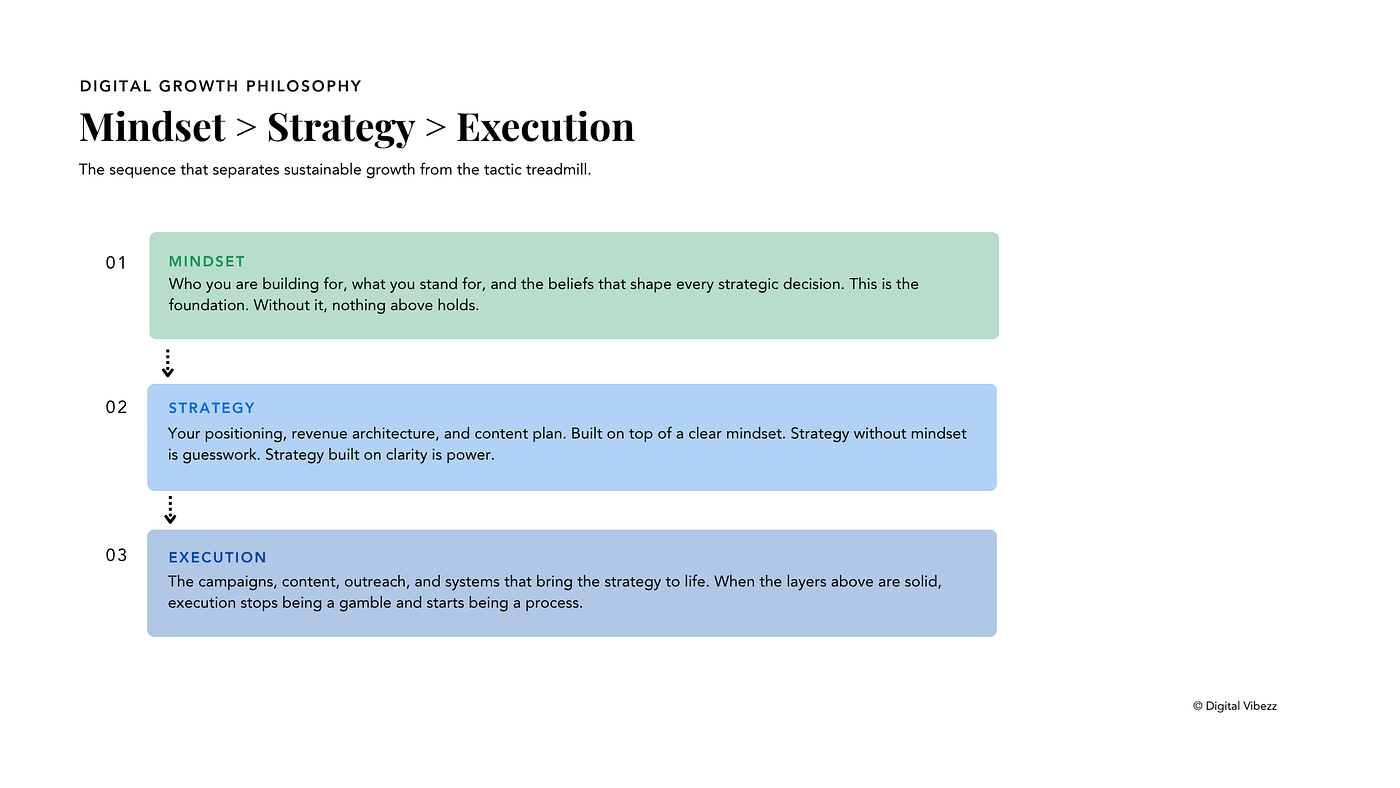
Growth Mindset Strategy to Execution Framework
The Order of Operations That Changes Everything
Strategy first. Tools second. Always.
This sounds obvious. Almost no business does it. The pressure to act, the visibility of what competitors are doing, the compelling demo, the free trial, all of it pulls founders toward tools before strategy is clear. And every time they follow that pull, they end up with a more expensive version of the same problem.
The businesses that grow sustainably are the ones that resisted that pull long enough to build the strategic foundation first. Who we’re for. What we want them to do. The simplest path to making it happen. Only then: which tools serve that path.
It’s not a slower approach. It’s a faster one. Because every tool you add to a clear strategy produces leverage. Every tool you add to an unclear one produces complexity.
If you want to audit your current digital strategy and build the foundation that makes your tools actually work, the Digital Growth Evolution session is where that work begins. Book your session today.
메타데이터
- post_id
- fd25e653d2ee
- slug
- how-to-build-a-digital-growth-strategy-without-wasting-money-on-tools-you-do-not-need-fd25e653d2ee
- url
- https://medium.com/@sabri-naouri/how-to-build-a-digital-growth-strategy-without-wasting-money-on-tools-you-do-not-need-fd25e653d2ee
- canonical_url
- https://medium.com/@sabri-naouri/how-to-build-a-digital-growth-strategy-without-wasting-money-on-tools-you-do-not-need-fd25e653d2ee
- author_url
- https://medium.com/@sabri-naouri
- status
- ok
- fetched_at
- 2026-06-14 11:28:49